


This article was automatically translated from the original Turkish version.
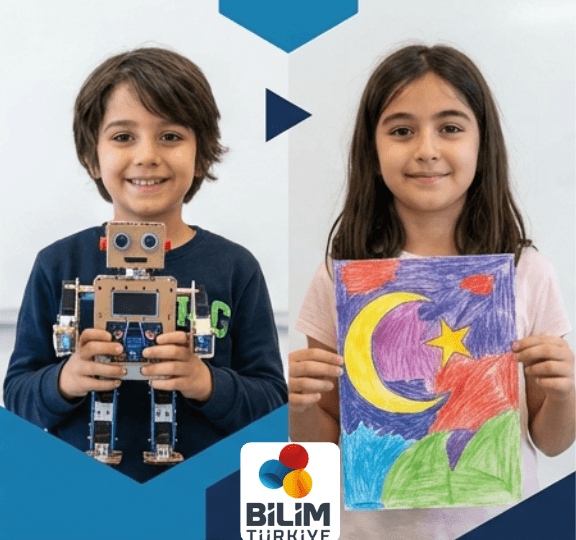
(Generated by Artificial Intelligence)
Guided Inquiry and Product-Based Science Education Model (GiPSci)
Teaching Cycle | 5E Model | ||||||||
|---|---|---|---|---|---|---|---|---|---|
Developer | T3 Foundation Türkiye Technology Team Foundation | ||||||||
Main Program | Science Türkiye Project Education and R&D Coordination | ||||||||
Pedagogical Basis | Experiential Learning Theory Constructivist Learning | ||||||||
Methodology | Product-based Learning Technology-supported Interaction Guided Inquiry | ||||||||
Application Area(s) | Science Centers Workshops Planetariums Exhibition Areas | ||||||||
Abbreviation | (Guided Inquiry and Product-based Science) GiPSci | ||||||||
Full Name | Guided Inquiry and Product-based Science Education Model in Science Centers | ||||||||
Guided Inquiry and Product-based Science in Science Centers (GiPSci) Model is an educational model designed for science centers and similar informal learning environments under the Science Türkiye project of the Türkiye Technology Team Foundation (T3 Foundation), structured according to pedagogical principles. The model aims to create systematic learning environments by integrating guided inquiry, product-based learning, and technology-enhanced interaction components.【1】
Science Türkiye Project: Corporate Logo (Science Türkiye Archive, 2026)
Science Türkiye is a science education initiative launched in 2020 by the T3 Foundation, aligned with Türkiye’s National Technology Initiative vision. The project’s primary objective is to increase public awareness of science and technology and to promote a culture of scientific curiosity and production-oriented learning, especially among children and youth. To this end, the project provides an educational ecosystem that supports science communication, enhances accessibility, encourages interest in STEM fields, and fosters the development of individuals with collaborative skills.【2】
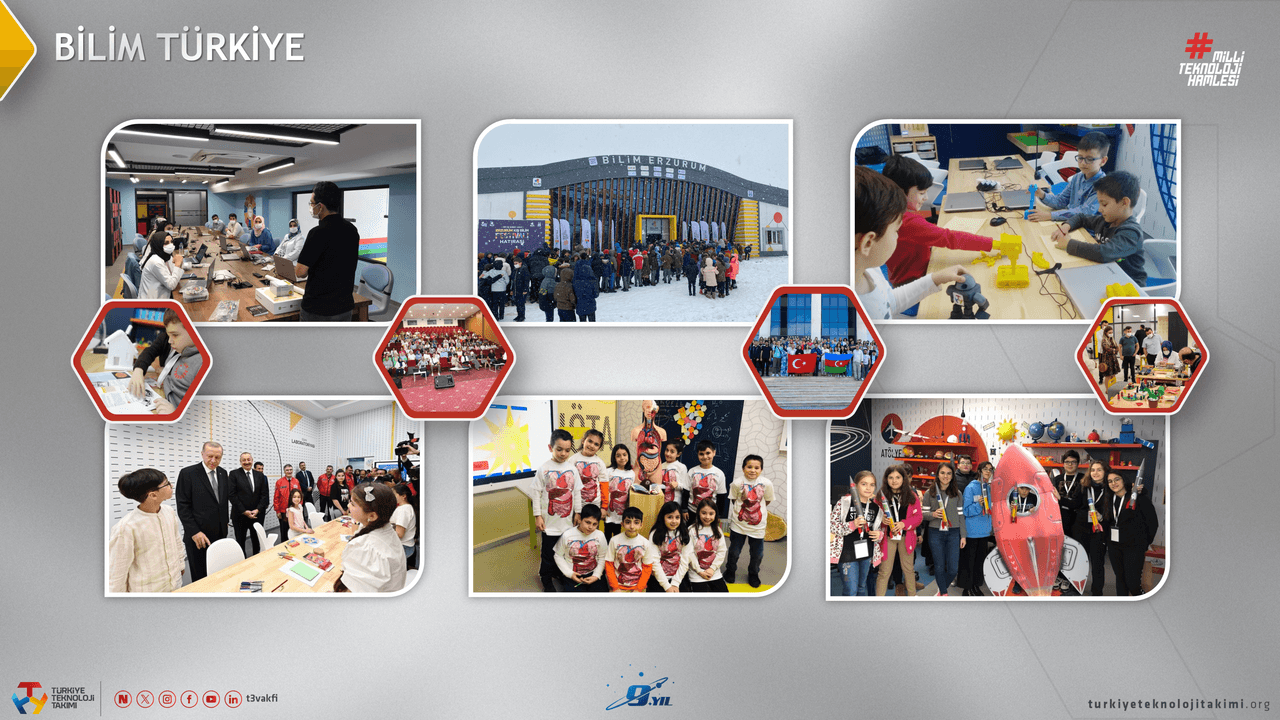
T3 Foundation Science Türkiye Project: Science Centers(T3 Foundation Archive, 2026)
The project is grounded in contemporary educational approaches that do not confine learning to the classroom and positions science centers as complementary learning environments.
Activities conducted in science centers aim to enable participants to directly experience scientific processes through technology-enhanced workshops, interactive exhibitions, and hands-on experiments. This structure represents a learning design that seeks not only to impart knowledge but also to develop scientific thinking skills through practical application.
As of 2026, the project’s activity network has reached seven Eurasian countries, 12 cities, and 28 centers. Over 4 million young people have participated in project activities, including repeat participants. The target audience is primarily children aged 6 to 14.
Educational activities under Science Türkiye consist of various program types with differing durations and content structures. These include:
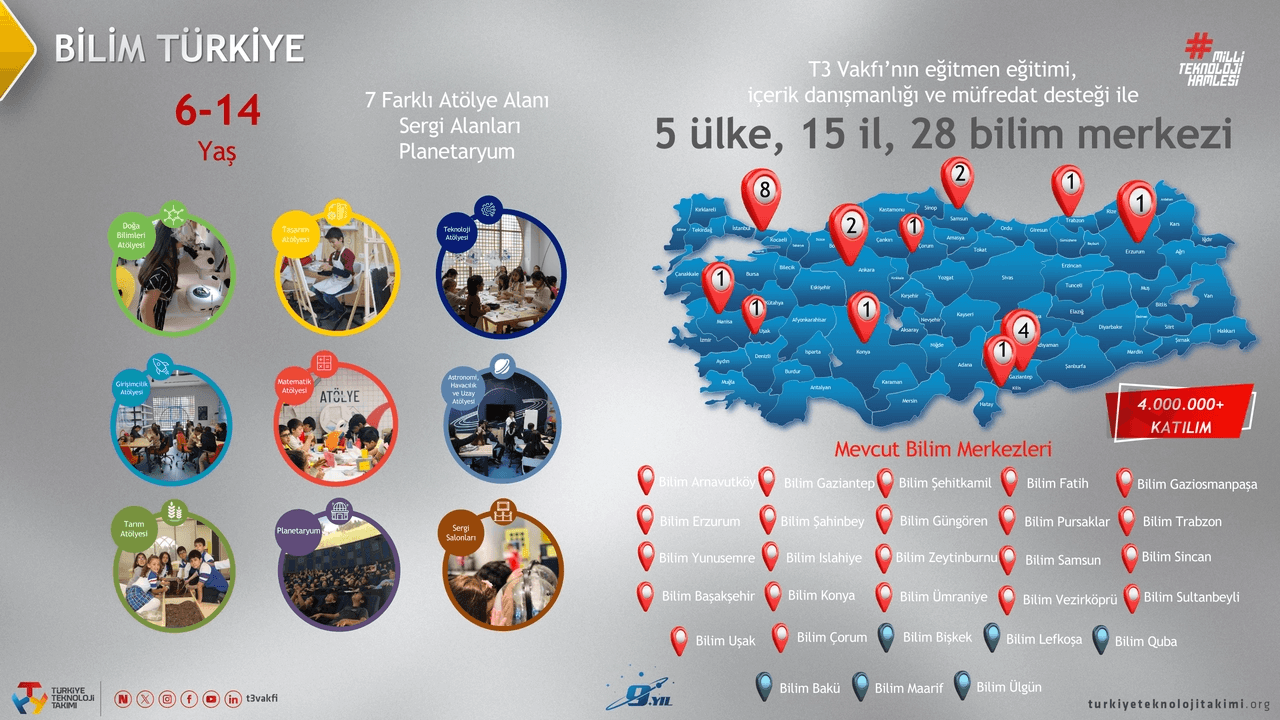
T3 Foundation Science Türkiye Project: Scope of Implementation and Thematic Workshops (T3 Foundation Archive, 2026))
More than 600 unique workshop contents are implemented in the centers; these are supported by learning technologies to encourage active learning.
The pedagogical structure of the project is based on the planned integration of interactions between workshop activities and exhibition spaces. This integration transforms the learning experience into a multi-stage process that extends beyond a single activity, enabling participants to engage in a holistic learning cycle encompassing observation, experimentation, discussion, and production.
The Science Türkiye project presents a model that views science centers not merely as exhibition spaces but as structured learning environments. In this regard, the project is regarded as a representative framework for implementing systematic pedagogical design in informal learning settings.【3】
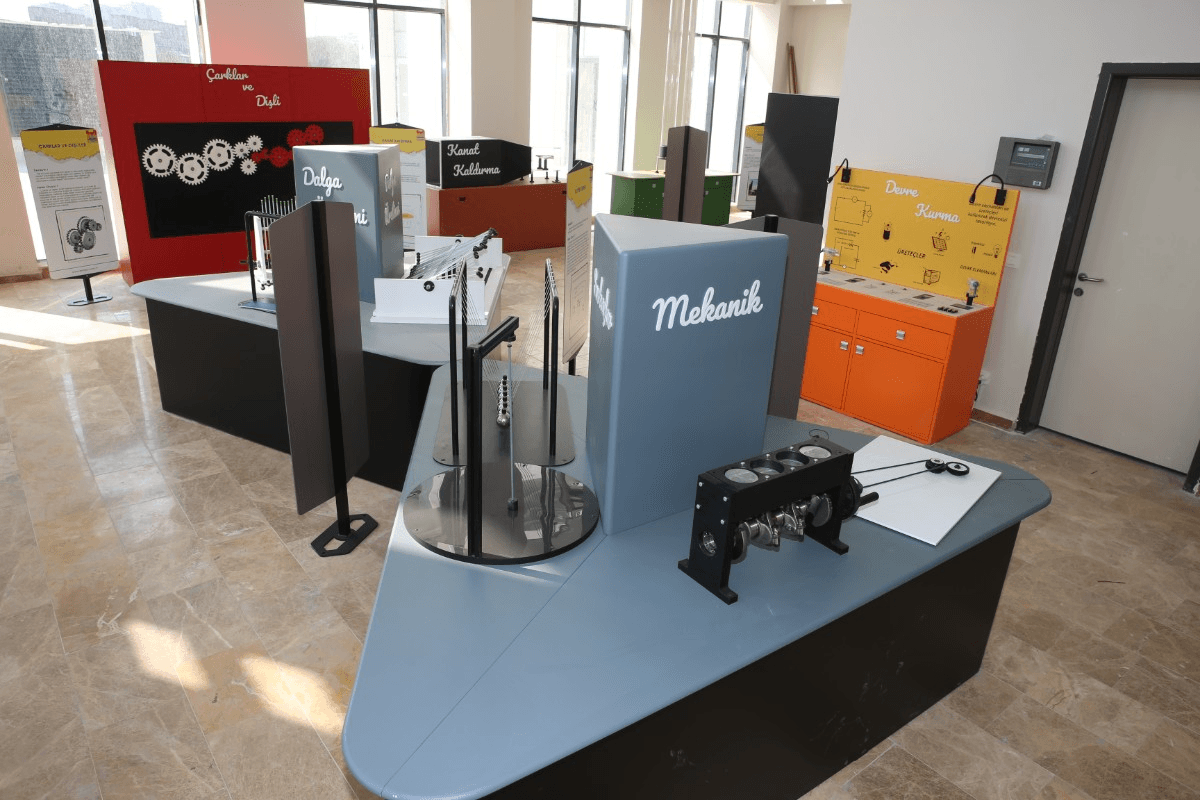
Operational View of Science Zeytinburnu Exhibition Installations Implemented Through Collaboration Between T3 Foundation and Zeytinburnu Municipality(Science Türkiye Archive, 2026)
The GiPSci model was developed in 2020 by the T3 Foundation Education and R&D Coordination Unit, and the related research was introduced to the academic literature in 2025 through a peer-reviewed article and report.【4】 The model provides a comprehensive framework for planning, implementing, and evaluating activities in science centers by situating them within a theoretically grounded instructional design context.
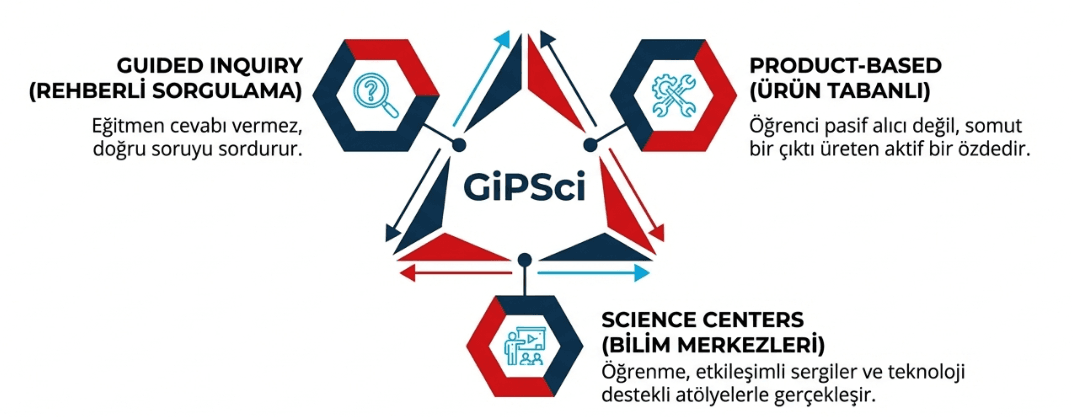
GiPSci Model: Structural Components and Process Cycle Diagram (Generated by Artificial Intelligence)
The model defines a systematic instructional approach in which learning is not viewed as a mere content delivery activity but as a process centered on active participant engagement, knowledge production through experience, and the concrete manifestation of learning through tangible outputs. Within this framework, guided inquiry, product-based learning, and technology-enhanced interaction components are integrated as mutually reinforcing pedagogical elements.
The GiPSci model aims to unify workshop activities, experimental applications, and exhibition-based learning experiences within a single instructional design. In this way, the model is built on the premise that participants should not merely observe scientific concepts but also ask questions, formulate hypotheses, generate solutions through trial and error, and express their outcomes in the form of a product or project. The use of technological tools in the learning process is deliberately planned to support experimental procedures and to develop participants’ digital literacy skills.
The model also adopts a pedagogical approach that transforms the role of the educator from a traditional instructor to a guide and facilitator. In this approach, the educator functions as the organizer, director, and evaluator of the learning process, while knowledge acquisition occurs through active student participation. Thus, GiPSci constitutes an educational model that systematizes activities in science centers, enables monitoring of learning outcomes, and is adaptable to different age groups.
The foundational basis of the GiPSci model is constructivist learning theory. According to this theory, learning is a process in which individuals mentally construct new knowledge by connecting it to prior knowledge and experiences. Knowledge is not a pre-packaged external input but a cognitive product formed through interaction, experience, and interpretation. This understanding necessitates active participant roles and experiential learning activities within the model.
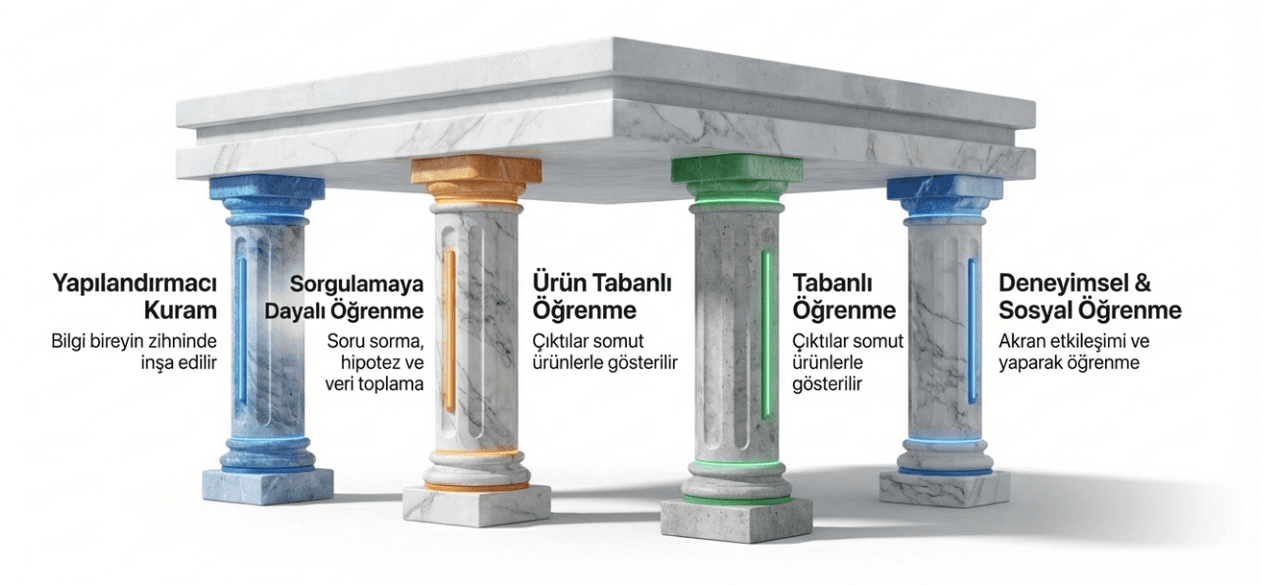
Conceptual Framework of the GiPSci Educational Model (Generated by Artificial Intelligence)
The model draws on the inquiry-based learning approach, which integrates core scientific thinking processes into learning design. In this approach, learning progresses through stages of questioning, hypothesis formation, data collection, analysis, and conclusion drawing. GiPSci activities are designed to enable participants to experience these processes and thereby develop scientific reasoning skills.
In the GiPSci model, learning outcomes are not limited to conceptual gains; tangible outputs produced at the end of the process are also recognized as indicators of learning. The product-based learning approach requires students to transform acquired knowledge into tangible outputs such as designs, models, prototypes, or projects. This approach is a key theoretical component of the model, as it promotes the application of learning and enhances its durability.
The model is also aligned with principles of experiential learning. Experiential learning posits that individuals construct knowledge through direct experience and that learning occurs within an action-reflection cycle. Hands-on activities in science centers provide learning environments that facilitate this cycle.
The GiPSci approach also draws on theoretical perspectives that recognize learning as a social process. Group work, collaborative problem-solving activities, and discussion processes support participants in learning from each other’s thinking patterns. In this way, the model offers a holistic pedagogical framework that encompasses both individual and collaborative learning processes.
In the GiPSci model, the instructional process is linked to the 5E instructional cycle, which facilitates the sequential and structured progression of learning. The cycle consists of five stages: Engage, Explore, Explain/Create, Elaborate, and Evaluate, providing a systematic framework for planning learning activities.
Each stage is designed to allow participants to experience scientific thinking processes step by step.
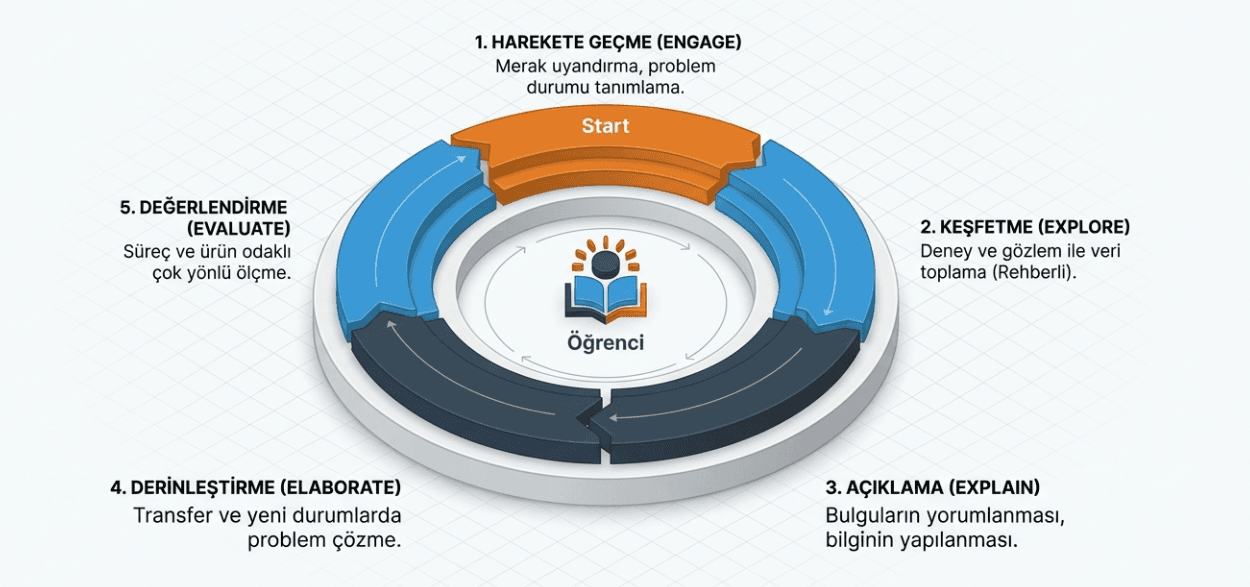
5E Instructional Cycle Diagram (Generated by Artificial Intelligence)
1. Engage: Stimuli, problem situations, or questions connected to everyday life are used to direct students’ attention to the topic. This stage aims to uncover students’ prior knowledge and prepare them mentally for the learning process.
2. Explore: Participants engage directly with concepts through experiments, observations, modeling, or hands-on activities. During this phase, the educator assumes a guiding role without providing direct solutions; students’ data collection and inference processes are supported.
3. Explain/Create: Participants interpret their findings, structure concepts, and express emerging knowledge. In this stage, students are expected to articulate their ideas verbally, in writing, or through product-based outputs.
4. Elaborate: This stage involves applying learned concepts to new situations. Participants work on different scenarios to transfer knowledge and develop problem-solving and connection-making skills, aiming to enhance learning durability.
5. Evaluate: Learning outcomes are examined through multi-dimensional assessment methods. Evaluation is both outcome-oriented and process-oriented; participants’ thinking pathways, problem-solving strategies, and products are assessed collectively.
Through the instructional structure implemented in the Science Türkiye project, the GiPSci model ensures that activities in science centers are conducted as pedagogically planned learning processes rather than random experiences, and systematically operationalizes the inquiry-based learning approach.【5】
The GiPSci model has been structured for implementation in technology-enhanced science centers operating under the Science Türkiye program. Its application context encompasses multi-layered learning environments where workshop spaces, interactive exhibition areas, planetarium experiences, and thematic components are pedagogically integrated. In these centers, the learning process is conducted within a planned structure based on educator guidance and active student participation, with the interaction between exhibition experiences and workshop activities forming one of the core elements of the learning design.
Üsküdar Science Center (Ministry of National Education)
GiPSci is not merely a model based on isolated activities; it offers a broad-scale application framework encompassing diverse educational formats with varying durations and content types. The program structure ranges from one-hour workshops to long-term education packages and thematic programs, complemented by exhibition tours and specialized learning experiences.
The primary characteristic of the application environments is the progression of learning through pedagogical connections established across different spatial contexts. Research indicates that curiosity and questions generated in exhibition areas are transformed into research and product development activities during workshops, revealing the model’s contextual learning structure.
Unlike traditional classroom settings, science centers provide interactive environments based on observation, experience, and inquiry, thereby offering an appropriate pedagogical foundation for implementing the GiPSci model. For this reason, the model is regarded as a structured application framework that comprehensively supports scientific thinking, problem-solving, and production processes in informal learning environments.
The GiPSci model assumes a pedagogical function aimed at structuring learners’ access to scientific knowledge through planned activities and simultaneously supporting the concurrent development of cognitive, practical, and higher-order thinking skills. Activities under the model are based on a systematic learning cycle that includes problem identification, hypothesis formulation, data collection, interpretation, and outcome generation—not merely on conceptual knowledge transfer. Educational research emphasizes that experimental activities play a critical role in supporting these processes and in developing scientific literacy and critical thinking skills.
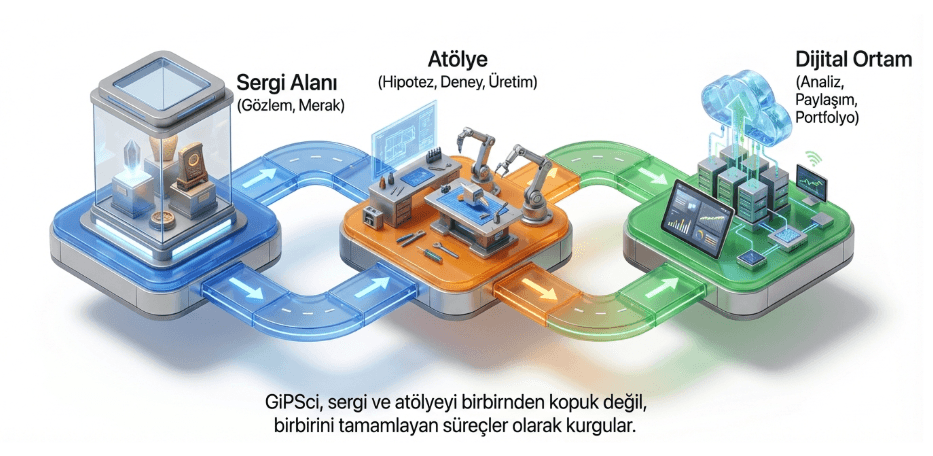
GiPSci Model: Educational Function Diagram (Generated by Artificial Intelligence)
The educational function of the model is grounded in its view of the learning environment as a multidimensional design space. The combined use of exhibitions, workshops, and digital tools enables learners to gain experiences through multiple sensory channels, apply knowledge across diverse contexts, and enhance the durability of learning outcomes. Guided by the principle of guided inquiry, the educator is not an authoritative instructor but a facilitator who organizes the learning process and supports learners’ investigative activities.
The GiPSci approach also prioritizes product-based learning, aiming not only for students to understand information but to develop tangible products. This feature allows learning outcomes to be monitored through performance indicators and shifts the assessment process from outcome-focused to process-focused. The model situates activities conducted in science centers and other informal learning environments within a pedagogical instructional design framework and positions learning as a structured, continuous experience.【6】
In the GiPSci model, technology integration is not a supportive element but a core component of the pedagogical design. Digital tools are systematically used to help students experience and understand scientific concepts, facilitate data collection and analysis, and strengthen interactions between learning environments.
Interactive screens, simulation applications, sensor-based experimental setups, and digital measurement tools used in science centers enable learners to transform abstract scientific concepts into concrete experiences. Through these tools, learners can directly apply scientific processes such as generating data, visualizing results, and comparing variables.
Research indicates that technology-enhanced applications, particularly in experimental learning activities, enhance conceptual understanding and make the learning process more effective.
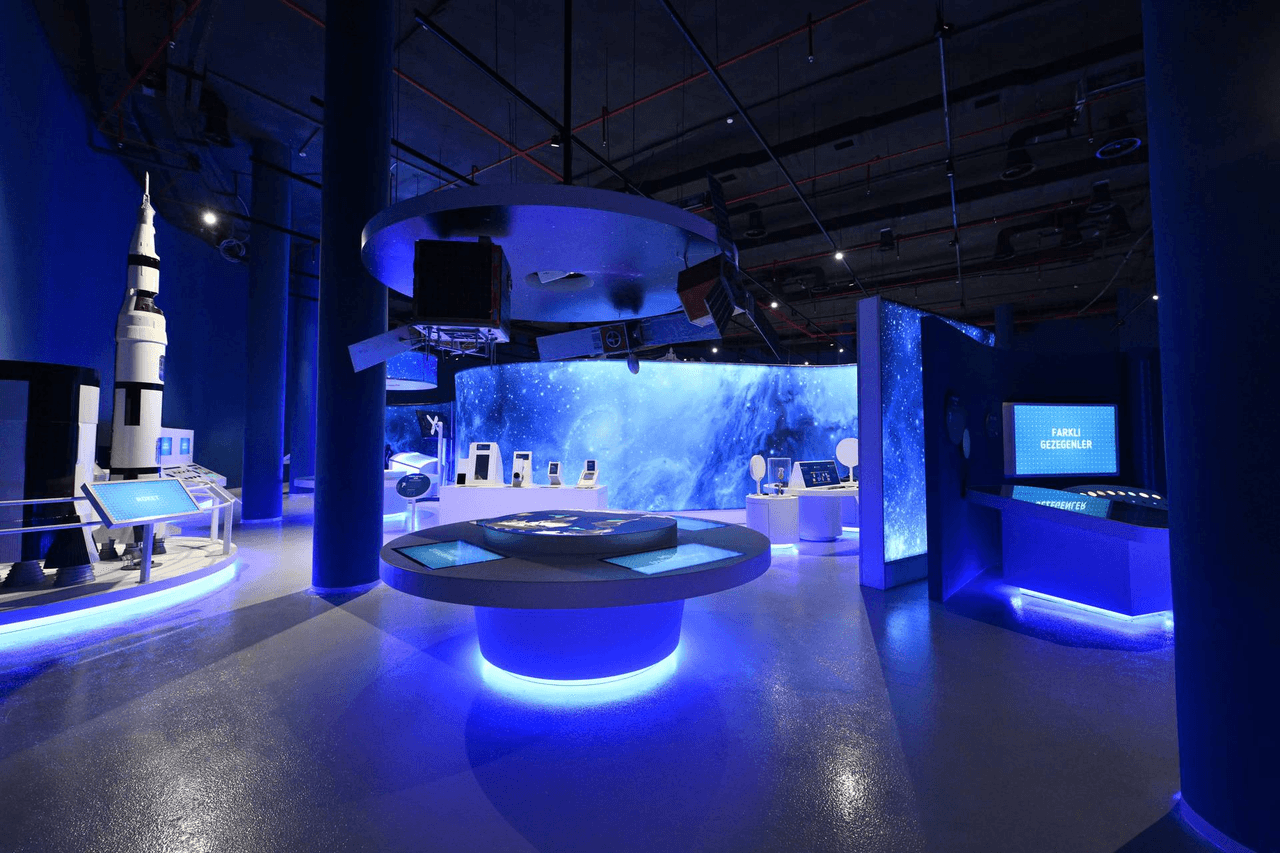
GiPSci Model: Technology Integration in Exhibitions (T3 Foundation Archive, 2026)
In the GiPSci model, digital tools also serve as a connecting link between learning environments.
The learning process initiated through interactive systems in exhibition areas continues through applications and project development activities in workshop settings. This integrated structure enables participants to relate knowledge acquired in different contexts and to structure their learning experience holistically.
The model does not limit technology use to student experience; it also provides functional tools for educators to plan, monitor, and evaluate instruction. Digital assessment systems enable the recording of activity outputs and the multi-dimensional analysis of the learning process.
Thus, technology provides a data-driven support mechanism both for implementing learning activities and for generating pedagogical decisions. Research describes the GiPSci model as a holistic educational approach that links technology use in science centers to pedagogical goals, transforms digital tools into active components of the learning process, and enriches learning through multi-environment experiences.【7】
In the GiPSci model, educators are defined as pedagogical actors at the center of the learning process. Effective implementation of the model is directly linked to educators’ professional competencies. Research data drawn from multiple sources—including classroom observations, educator interviews, trainer training sessions, and expert evaluations—demonstrate that educators’ roles extend beyond content delivery to encompass designing, guiding, and evaluating the learning process.【8】
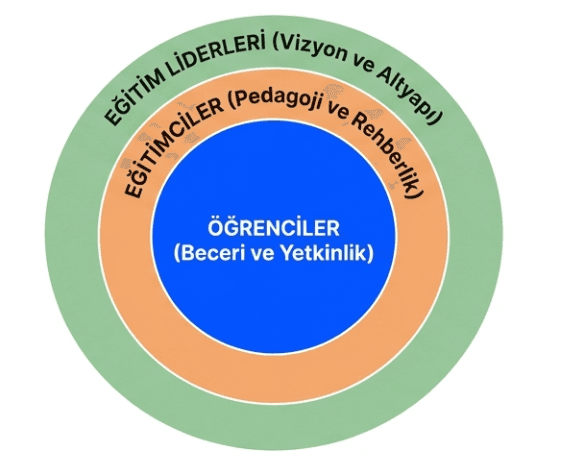
ISTE Standards Diagram (Generated by Artificial Intelligence)
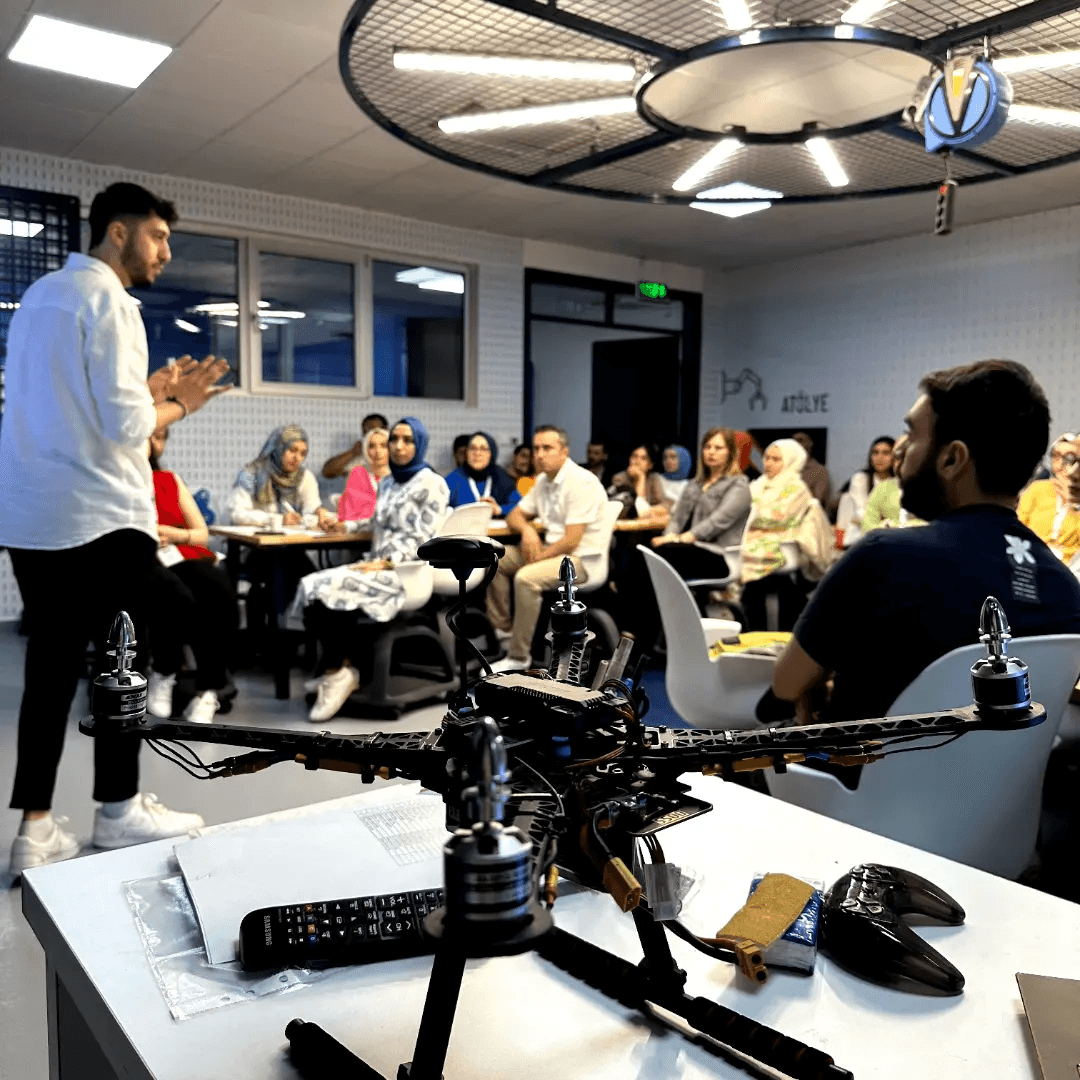
Science Türkiye Project: Educator Training Process (Science Türkiye Archive, 2026)
The “train-the-trainer” programs implemented under the model are structured professional development processes designed to enhance educators’ guided inquiry-based teaching skills. In these programs, educators assume both instructor and learner roles: while supporting young participants’ inquiry skills, they themselves become learners engaged in continuous professional development.
Assessment of educator competencies employs criteria aligned with international educational technology standards. In particular, analyses based on the ISTE Educator Standards reveal that educators are evaluated on their ability to plan learning processes, manage technology integration, and support participants’ inquiry skills.【9】
Research indicates that educators’ implementation of inquiry-based instruction is influenced by structural factors such as time management, infrastructure availability, and student-to-educator ratios. Within the Science Türkiye project, the necessity of continuous and high-quality professional development programs for educators is emphasized.
In the GiPSci model, assessment is based on structured tools designed to monitor not only learning outcomes but the entire learning process. Within this framework, portfolios and rubrics serve as core assessment components, enabling multi-dimensional analysis of participants’ cognitive, practical, and process-based gains.【10】
Portfolio applications involve the systematic collection of products, drafts, experiment logs, observation notes, and project outputs generated by students during activities. This tool documents learning development as a time-extended process and makes progress visible to both educators and students. The process-oriented approach enables assessment not merely based on correct outcomes but on the application of scientific thinking steps.
Rubrics are standardized assessment matrices used to evaluate performance. These tables define distinct performance levels for competencies such as problem-solving, data analysis, design skills, collaboration, creativity, and scientific communication. Thus, the assessment process moves beyond subjective interpretation to a criterion-based structure.
The combined use of portfolios and rubrics in the GiPSci model creates a holistic assessment approach. Portfolios provide qualitative data documenting learners’ developmental journey, while rubrics enable systematic and comparable analysis of this data. This dual use supports both formative (process-oriented) and summative (outcome-oriented) assessment functions within a single system.
In the model, assessment tools are not only used to determine achievement levels but also to generate feedback for improving instructional design. Collected data form the basis for revising activity content, teaching strategies, and learning environments. In this sense, assessment in the GiPSci approach is not the final stage of instruction but a continuous pedagogical component that guides learning.
In the GiPSci model, the interdisciplinary approach is structured as a core pedagogical principle and is linked to the STEAM framework integrating science, technology, engineering, art, and mathematics. This approach advocates examining scientific concepts not within single-discipline boundaries but through the methods and perspectives of multiple fields. Learners thus gain opportunities to simultaneously apply knowledge and skills from various disciplines when solving problems.
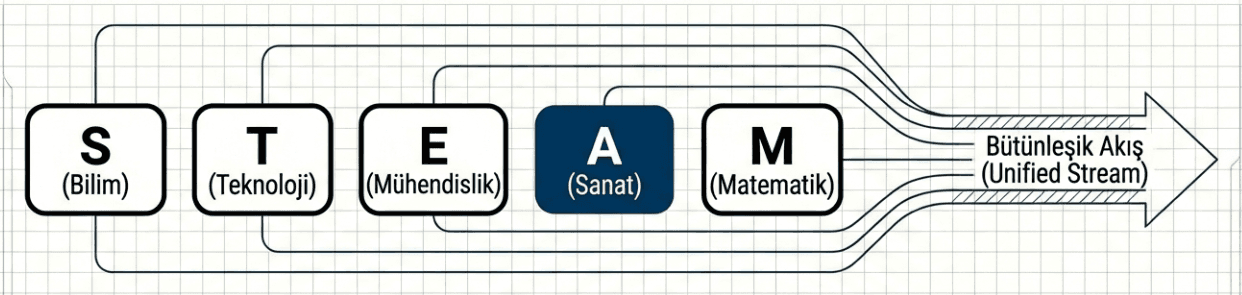
GiPSci Model: STEAM Integration Diagram (Generated by Artificial Intelligence)
The interdisciplinary structure in the model is established at the initial stage of activity design. Workshop scenarios and learning tasks are planned as holistic activities that link scientific concepts to engineering applications, mathematical modeling, technological tools, and design processes. This design philosophy supports not only conceptual knowledge acquisition but also the application of knowledge in diverse contexts and the development of new products.
The inclusion of the arts component in the STEAM approach within the GiPSci model aims to develop aesthetic thinking, creativity, and design-oriented problem-solving skills. Activities incorporate production-based practices such as visual design, model building, prototyping, and presentation preparation. In this context, the role of art is viewed as a complementary domain that supports not only the analytical but also the creative dimensions of scientific thinking.【11】
Another function of the interdisciplinary approach is to facilitate the connection of learning outcomes to real-life contexts. The convergence of multiple disciplines around shared problem areas enables participants to analyze complex situations multi-dimensionally and develop comprehensive solution strategies. The GiPSci model constitutes a holistic educational approach that applies interdisciplinary learning not only at the content level but also in thinking patterns, process management, and product development stages.
As a holistic instructional design framework for science centers and similar informal learning environments, the GiPSci model shares commonalities with inquiry-based learning, project-based learning, and STEM / STEAM approaches; however, it differs in its application structure, contextual integration level, and assessment system.
Similar to inquiry-based learning models, GiPSci centers on learners generating questions, collecting data, and drawing conclusions. However, unlike classical inquiry-based approaches, GiPSci embeds this process within an integrated learning design that combines science center exhibitions, workshop activities, and digital tools. The model is not merely a pedagogical method but a comprehensive implementation system encompassing spatial and technological components.
Compared to project-based learning, GiPSci shares the principle that learning culminates in the development of a tangible product. While project-based learning typically relies on long-term, classroom-centered activities, GiPSci features a modular structure applicable across varying durations—from short-term workshops to long-term programs.
Like STEM and STEAM approaches, GiPSci supports interdisciplinary learning. However, unlike these approaches, GiPSci addresses interdisciplinary integration not only at the content level but also through learning environment design, assessment systems, and educator guidance.
Compared to experiential learning models, one distinguishing feature of GiPSci is its systematic organization of the experiential process through structured instructional cycles. The model arranges exhibition experiences, application activities, product development, and evaluation stages in a specific pedagogical sequence. This organization ensures that learning occurs within a planned instructional design rather than through random experiences.【12】
The learner outcomes targeted by the GiPSci model are examined in four main categories—cognitive, affective, and skill-based—as consistent with empirical research in informal science education, inquiry-based learning, and STEM activities.
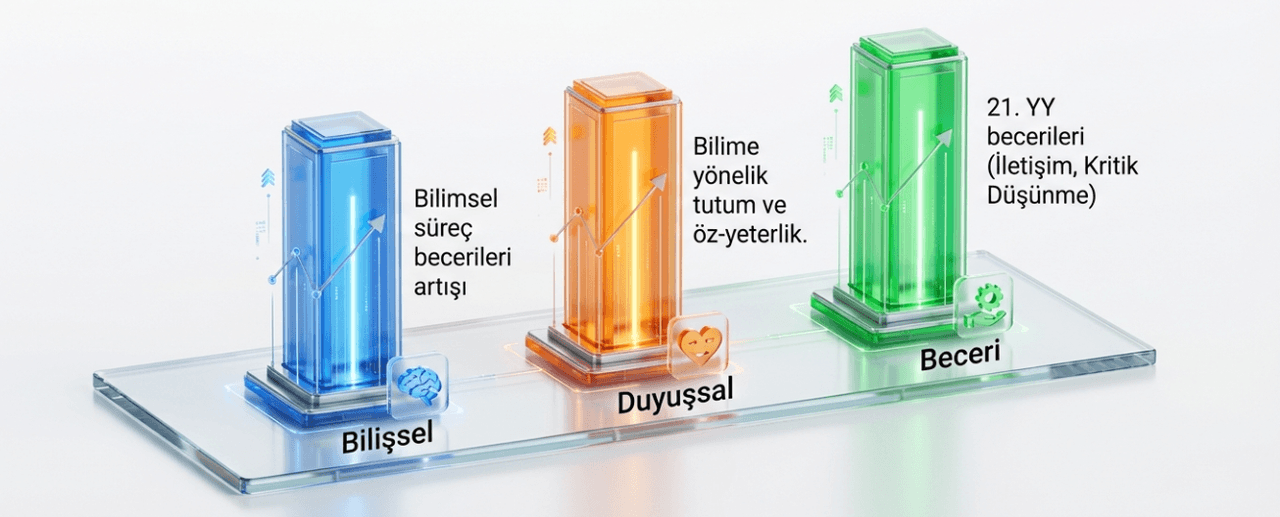
GiPSci Model: Learner Outcomes Diagram (Generated by Artificial Intelligence)
1. Scientific process skills and cognitive development
2. Attitudinal and motivational changes
3. Orientation toward science and long-term impact
4. Interdisciplinary thinking and 21st-century skills
Research shows that inquiry- and production-based science learning models applied to children aged 6–14 support not only academic knowledge acquisition but also multidimensional development in scientific thinking, motivation, self-efficacy, and orientation toward STEM fields. Research findings indicate that the learner outcomes targeted by the GiPSci model are theoretically consistent with those identified in international literature.【13】
In the GiPSci model, inclusivity and accessibility are fundamental principles shaping the entire learning design. Developed for heterogeneous participant profiles typical of science centers, the model is structured to accommodate different learning paces, cognitive characteristics, physical needs, and sensory requirements.【14】
Content and activities in the model are designed using multiple representation formats. Visual materials, tactile models, auditory explanations, simplified instructions, and step-by-step task structures facilitate participation for children with diverse learning styles. This design approach particularly supports participants with learning difficulties or limited attention spans. Additionally, the modular structure of activities allows tasks to be simplified or expanded according to individual needs.
Physical accessibility is a critical dimension of the model’s implementation planning. Workshop setups, workspaces, and experimental stations are arranged to enable participation by individuals with mobility limitations. Similarly, material placement, table heights, and equipment use are designed to support independent participation by individuals with diverse physical needs.
Inclusivity in the GiPSci model extends beyond physical access; pedagogical guidance strategies are also structured accordingly. Educators are trained to use adapted instructions, develop alternative explanation methods, and provide personalized feedback for participants with diverse learning needs.
The model also incorporates group structures that support social inclusion. Collaborative work among students with mixed skill levels encourages peer support and transforms the learning process into a collaborative experience.
In the GiPSci model, accessibility and inclusivity are not afterthoughts or adaptations but structural components planned from the outset of instructional design. The model is recognized as a systematic educational approach that ensures equitable participation of children with diverse learning needs in scientific activities.
The implementation of the GiPSci model in science centers requires alignment between pedagogical design and physical and technological infrastructure. As the model envisions integrated progression of learning processes across exhibition spaces, workshops, and digital learning components, application environments must meet specific minimum equipment standards. These standards form a multidimensional infrastructure framework encompassing not only technical competence but also learning safety, accessibility, and pedagogical functionality.
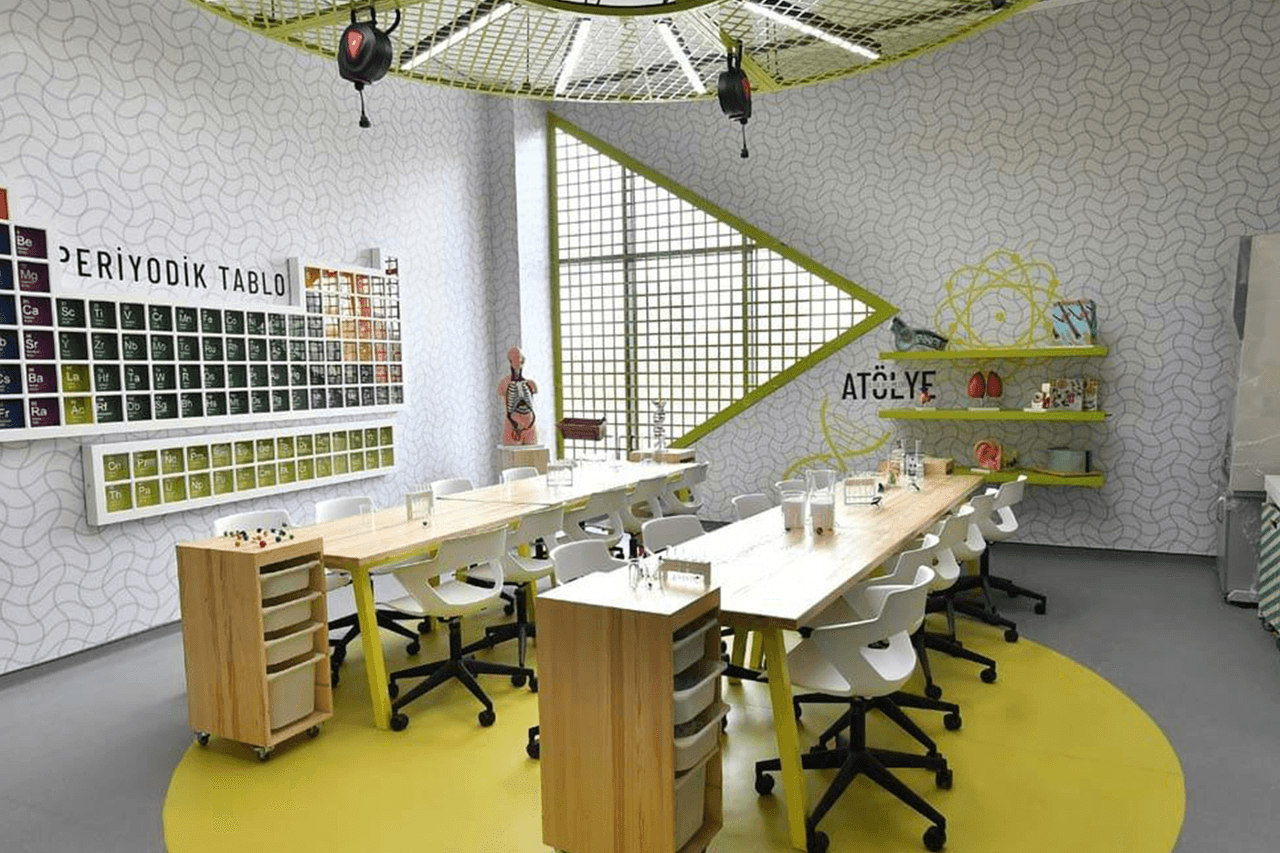
Science Türkiye Project: Natural Sciences Workshop(Science Türkiye Archive, 2026))
Centers implementing the model must include at least one workshop area, an interactive exhibition section, and flexible learning spaces suitable for group work. Workshop areas must feature modular table arrangements adaptable to different activity types, safe electrical infrastructure, and appropriate ventilation conditions for experimental work. The use of mobile furniture enables activities to be conducted in individual, small-group, or whole-class formats.
Materials used in GiPSci applications must support multiple learning modalities. Key requirements include experiment kits, modeling materials, measurement tools, sensors, prototyping equipment, and audiovisual instructional materials. Durability, safety, and reusability of materials are essential for program sustainability. Additionally, materials must be adaptable to different age groups to ensure pedagogical consistency across the model’s broad target age range.
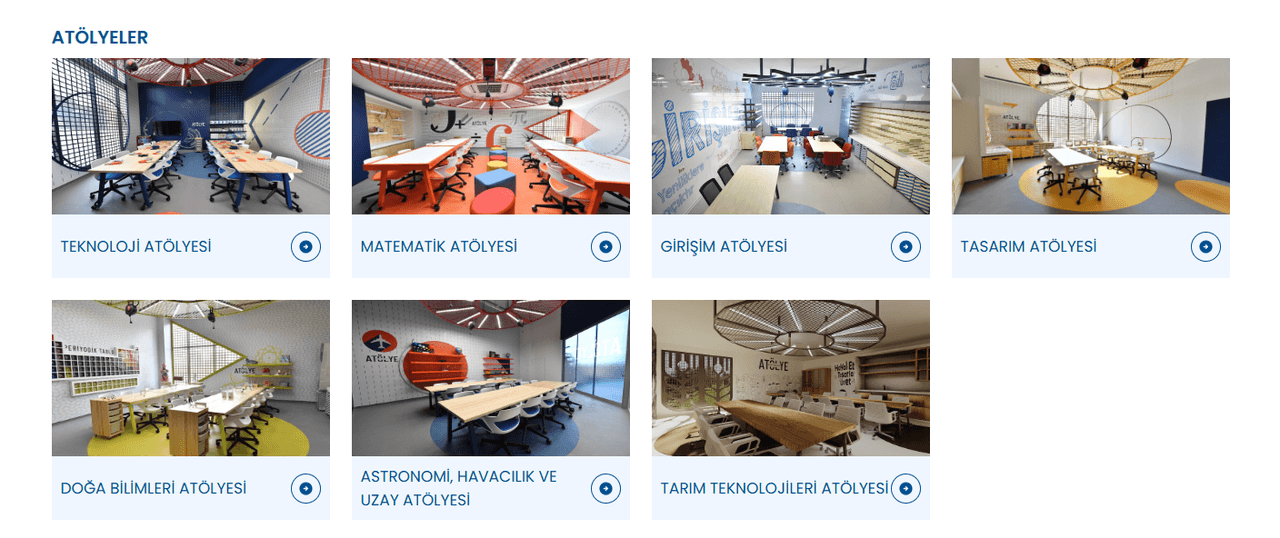
Science Türkiye Project: Workshop Standards (Science Türkiye Archive, 2026)
In line with the model’s technology-enhanced learning approach, centers must have minimum digital infrastructure. This includes interactive screens or projection systems, digital measurement tools for data collection and analysis, basic software applications, and internet connectivity for online content access. The function of technological equipment is to visualize the learning process, analyze experimental results, and support students’ product development stages.
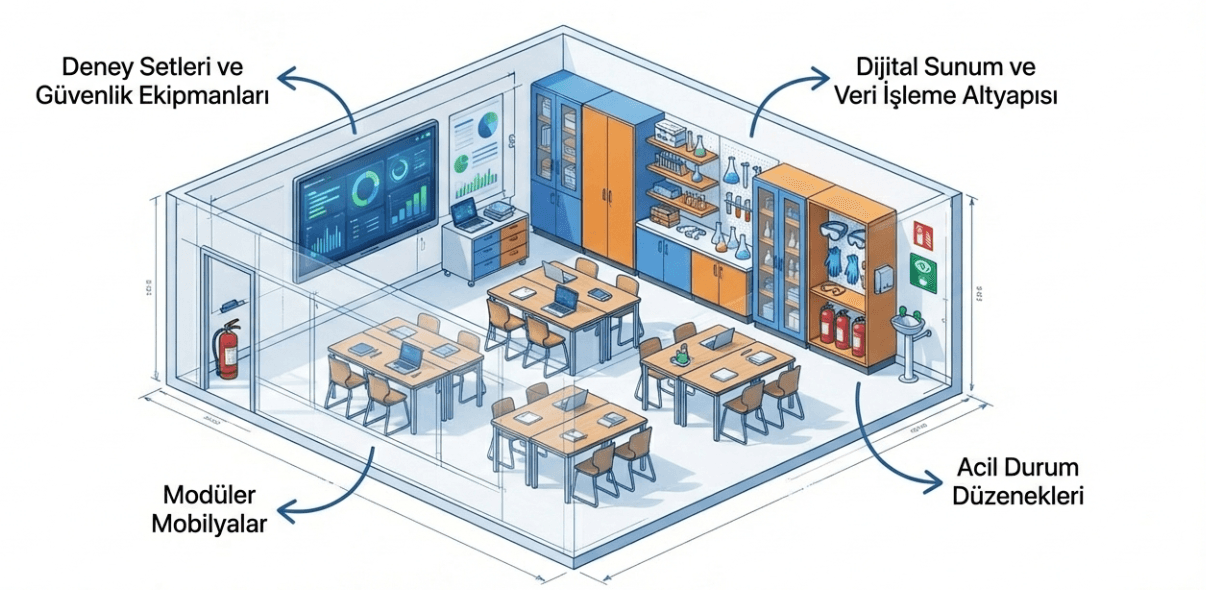
Science Türkiye Project: Material and Infrastructure Standards Diagram (Generated by Artificial Intelligence)
Due to the experimental nature of science center activities, safety equipment is a mandatory infrastructure component. Protective gear, safety guidelines, emergency protocols, and equipment usage instructions must be standard for ensuring the safety of both educators and participants. These measures ensure the uninterrupted and safe implementation of activities, particularly in programs with intensive experimentation and design components.
In addition to physical and technological equipment, pedagogical infrastructure is essential for model implementation. Instructional design tools such as activity plans, rubrics, portfolio systems, and educator guidance documents must be readily available at the center. These elements ensure pedagogical consistency across activities delivered by different educators and enable systematic monitoring of learning outcomes.
In the GiPSci model, material and infrastructure standards constitute not merely a technical equipment list but a holistic application framework that directly influences the quality of the learning experience. Meeting these standards defines the minimum conditions required for consistent pedagogical quality across different science centers.
In the GiPSci model, sustainability refers to transforming educational practices from project-limited initiatives into a continuously evolving system embedded within institutional structures. Accordingly, the model treats instructional design, educator training, content development, and assessment processes as interdependent components. The principle of continuity involves regular data collection, analysis, and feedback mechanisms to monitor implementation and update programs based on findings.
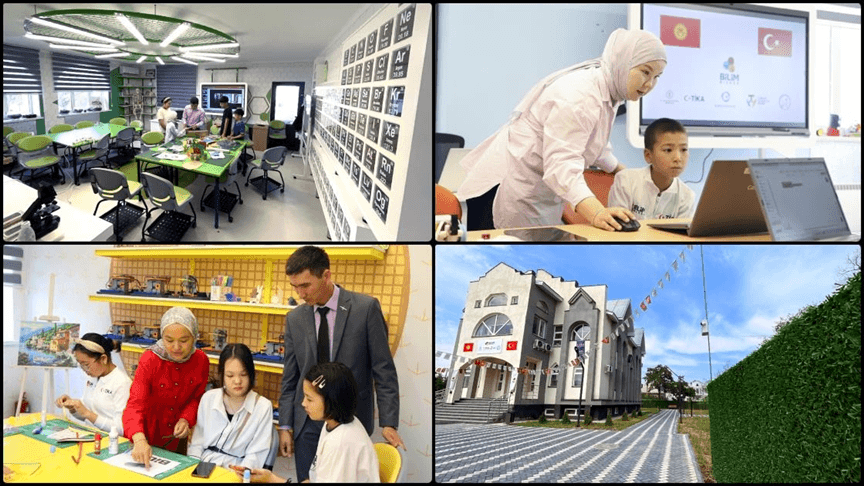
Science Türkiye Project: Bishkek Science Center(Anadolu Agency)
The model’s scaling strategy is based on a multi-center implementation structure. The use of common content standards across science centers and technology workshops ensures pedagogical consistency across diverse application contexts. This structure enables the model to deliver similar learning experiences in different regions and generate comparable data on implementation outcomes.
A key component of sustainability is the development of educator capacity. Professional development programs under the model enhance educators’ pedagogical and technological competencies, supporting the high-quality continuation of activities. The continuous education approach enables educators to adapt model principles to diverse learning environments and develop new content.
Akın, F. Nur, and Bilge Demirdöğen. "Türkiye’de Eğitim Alanında Bilim Merkezi Konusunda Gerçekleştirilen Araştırmaların İçerik Analizi." *Trakya Eğitim Dergisi* 13, no. 2 (2023): 1314–1341. https://doi.org/10.24315/tred.1141882.
Alpaydın, Ethem. Introduction to Machine Learning. 4. baskı. Cambridge: MIT Press, 2020.
Aydın, Lütfi, Ayşe Saylan Kırmızıgül, and Hasan Elcuman. "Kayseri Bilim Merkezindeki Sergilerin Fen Bilimleri Dersi Öğretim Programı Kapsamında Değerlendirilmesine Bir Örnek: Madde Pavilyonu." *Journal of Research in Informal Environments* 9, no. 1 (2024): 62–80. Accessed February 12, 2026. https://izlik.org/JA65EN36RW
Birgili, Bengi, M. Ali Bulut, O. Gülünay, M. Koçoğlu, and F. R. Baş. "Technology-enhanced 'GipSci' Approach in Developing Contexts Performs Well at Interest and Curiosity, Yet, Needs Reinforcing at Inquiry Level." *Research in Science & Technological Education* (2025): 1–38. https://doi.org/10.1080/02635143.2025.2578303
Erdoğan, Sibel. "Steam ve Sanat Eğitimi." *Selçuk Üniversitesi Sosyal Bilimler Enstitüsü Dergisi*, no. 44 (2020): 303–316. Accessed February 12, 2026. https://izlik.org/JA98MX95KY
European Commission. *Digital Education Action Plan (2021–2027): Resetting Education and Training for the Digital Age*. 2022. Accessed February 12, 2026. https://ec.europa.eu/education/sites/default/files/document-library-docs/deap-2021-2027_en.pdf.
Iliman Püsküllüoğlu, Elif. "A Systematic Review of Graduate Studies on Educational Inclusion in Türkiye." *Milli Eğitim Dergisi* 54, no. 247 (2025): 1419–1466. https://doi.org/10.37669/milliegitim.1586204
Karaman, Kenan. "Bilim-Toplum İlişkileri Bağlamında Bilim Merkezleri ve Etkileri Üzerine Bir Değerlendirme." Uluslararası Sosyal ve Eğitim Bilimleri Dergisi 6, no. 11 (2019): 75–91. https://doi.org/10.20860/ijoses.571367
Kızıltepe, İ. Seçkin, and Tezcan Kartal. "Deneyimsel Öğrenme Ölçeğinin Türkçeye Uyarlanması: Geçerlik ve Güvenirlik Çalışması." *Ihlara Eğitim Araştırmaları Dergisi* 10, no. 2 (2025): 142–157. https://doi.org/10.47479/ihead.1656910
Ministry of National Education, General Directorate of Innovation and Educational Technologies. *Eğitimde Yapay Zekâ Uygulamaları Uluslararası Forumu Raporu*. September 2024. Accessed February 12, 2026. https://yegitek.meb.gov.tr/meb_iys_dosyalar/2024_09/11104346_meb_egitimde_uyz_formu_raporu_web_28082024_tr.pdf
Ministry of National Education. "Üsküdar Bilim Merkezi." YouTube video, February 13, 2025. Accessed February 12, 2026. https://youtu.be/KSFWrlg_MBo
T3 Bilim Türkiye. "Hakkımızda." Accessed February 12, 2026. https://t3bilimturkiye.org/tr/hakkimizda/.
T3 Vakfı. "Tarihçemiz." Accessed February 12, 2026. https://t3vakfi.org/tr/hakkimizda/tarihcemiz/.
T3 Vakfı. *Bilim Türkiye Atölyeleri Pedagojik Çerçeve Kılavuzu*. 2024. Accessed February 12, 2026. https://t3vakfi.org/tr/projelerimiz/bilim-turkiye
TÜBİTAK Bilim Centers. "Other Science Centers." Accessed February 12, 2026. https://bilimmerkezleri.tubitak.gov.tr/Icerik/diger-bilim-merkezleri-165
Vygotsky, Lev S. Mind in Society: The Development of Higher Psychological Processes. Edited by Michael Cole, Vera John-Steiner, Sylvia Scribner, and Ellen Souberman. Cambridge: Harvard University Press, 1978.
Yeşilyurt, S., R. Dündar, and R. Z. Demir. "Türkiye’de Yapay Zekâ ve Eğitim İlişkisini İnceleyen Lisansüstü Tezlerin Analizi: Bir Meta Sentez Çalışması." *Journal of Innovative Research in Social Studies* 7, no. 1 (2024): 47–73. https://doi.org/10.47503/jirss.1484848
Yun, J. J., E. Jeong, S. Kim, H. Ahn, K. Kim, S. D. Hahm, and K. Park. "Collective Intelligence: The Creative Way from Knowledge to Open Innovation." *Science, Technology and Society* 26, no. 2 (2021): 201–222. https://doi.org/10.1177/09717218211005604
Yun, Sun-Jin, A. C. Shi, and B. G. Jun. "Dealing with Socio-Scientific Issues in Science Exhibition: A Literature Review." *Research in Science Education* 52, no. 1 (2022): 99–110. https://doi.org/10.1007/s11165-020-09930-0
Yıldırım, Ali and Hasan Şimşek. Sosyal Bilimlerde Nitel Araştırma Yöntemleri. 10. baskı. Ankara: Seçkin Yayıncılık, 2016.
Zawacki-Richter, Olaf, V. I. Marín, M. Bond, and F. Gouverneur. "Systematic Review of Research on Artificial Intelligence Applications in Higher Education – Where are the Educators?" *International Journal of Educational Technology in Higher Education* 16, no. 1 (2019): 1–27. https://doi.org/10.1186/s41239-019-0171-0.
Zervas, Panagiotis, S. Sotiriou, R. Tiemann, and D. G. Sampson. "Assessing Problem Solving Competence Through Inquiry-Based Teaching in School Science Education." In Proceedings of the 12th International Conference on Cognition and Exploratory Learning in Digital Age (CELDA 2015), 2015.
Zhao, M., C. J. Mathews, and K. L. Mulvey. "Promoting Diverse Youth’s Career Development Through Informal Science Learning: The Role of Inclusivity and Belonging." *Journal of Youth & Adolescence* 52, no. 2 (2023): 331–343. https://doi.org/10.1007/s10964-022-01694-2
Özen, Okan, and Osman Mert. "Uluslararası Standartlar Yönünden Eğitim Yöneticilerinin 21. Yüzyıl Becerileri Doğrultusunda Bilgi İletişim Teknülüjileri Yeterlilikleri." *Uluslararası Türkçe Edebiyat Kültür Eğitim (TEKE) Dergisi* 13, no. 1 (2024): 349–370. https://doi.org/10.7884/teke.1368483.
İzci, Kemal, Gökhan Çalışkan, and Ahmet Oğuz Aktürk. "Öğretmen Adaylarının Sınıf İçi Ölçme-Değerlendirme Okuryazarlıklarına Etki Eden Etmenlerin İncelenmesi: Bir Yapısal Eşitlik Modellemesi." *Eğitim Bilim ve Teknoloji Araştırmaları Dergisi* 3, no. 1 (2018): 10–22. Accessed February 12, 2026. https://izlik.org/JA93GW92XW
Şahin, M., S. Keskin, A. Özgür, and H. Yurdugül. "E-Öğrenme Ortamlarında Öğrenen Özelliklerine Dayalı Etkileşim Profillerinin Belirlenmesi." *Eğitim Teknolojisi Kuram ve Uygulama* 7, no. 2 (2017): 172–192. https://doi.org/10.17943/etku.297075
[1]
"Tarihçemiz," Türkiye Teknoloji Takımı Vakfı (T3 Vakfı), erişim 12 Şubat 2026,https://t3vakfi.org/tr/hakkimizda/tarihcemiz/.
[2]
"Hakkımızda," T3 Bilim Türkiye, erişim 12 Şubat 2026,https://t3bilimturkiye.org/tr/hakkimizda/.
[3]
"Diğer Bilim Merkezleri," TÜBİTAK Bilim Merkezleri, erişim 12 Şubat 2026,https://bilimmerkezleri.tubitak.gov.tr/Icerik/diger-bilim-merkezleri-165.
[4]
Bengi Birgili vd., "Technology-enhanced “GipSci” approach in developing contexts performs well at interest and curiosity, yet, needs reinforcing at inquiry level," Research in Science & Technological Education (2025), access date 12 February 2026, https://doi.org/10.1080/02635143.2025.2578303.
[5]
Bengi Birgili vd., "Technology-enhanced “GipSci” approach in developing contexts performs well at interest and curiosity, yet, needs reinforcing at inquiry level," Research in Science & Technological Education (2025), access date 12 February 2026, https://doi.org/10.1080/02635143.2025.2578303.
[6]
F. Nur Akın ve Bilge Demirdöğen, "Türkiye’de Eğitim Alanında Bilim Merkezi Konusunda Gerçekleştirilen Araştırmaların İçerik Analizi," Trakya Eğitim Dergisi 13, no. 2 (2023), access date 12 February 2026, 1318,https://doi.org/10.24315/tred.1141882.
[7]
Lütfi Aydın, Ayşe Saylan Kırmızıgül ve Hasan Elcuman, "Kayseri Bilim Merkezindeki Sergilerin Fen Bilimleri Dersi Öğretim Programı Kapsamında Değerlendirilmesine Bir Örnek: Madde Pavilyonu," Journal of Research in Informal Environments 9, no. 1 (2024): access date 12 February 2026, 65,https://izlik.org/JA65EN36RW.
[8]
Bengi Birgili vd., "Technology-enhanced “GipSci” approach in developing contexts performs well at interest and curiosity, yet, needs reinforcing at inquiry level," Research in Science & Technological Education (2025), access date 12 February 2026, https://doi.org/10.1080/02635143.2025.2578303.
[9]
Okan Özen ve Osman Mert, "Uluslararası Standartlar Yönünden Eğitim Yöneticilerinin 21. Yüzyıl Becerileri Doğrultusunda Bilgi İletişim Teknolojileri Yeterlilikleri," Uluslararası Türkçe Edebiyat Kültür Eğitim (TEKE) Dergisi 13, no. 1 (2024): 355, access date 12 February 2026, https://doi.org/10.7884/teke.1368483
[10]
Kemal İzci, Gökhan Çalışkan ve Ahmet Oğuz Aktürk, "Öğretmen Adaylarının Sınıf İçi Ölçme-Değerlendirme Okuryazarlıklarına Etki Eden Etmenlerin İncelenmesi: Bir Yapısal Eşitlik Modellemesi," Eğitim Bilim ve Teknoloji Araştırmaları Dergisi 3, no. 1 (2018), access date 12 February 2026, 15,https://izlik.org/JA93GW92XW.
[11]
Sibel Erdoğan, "Steam ve Sanat Eğitimi," Selçuk Üniversitesi Sosyal Bilimler Enstitüsü Dergisi, no. 44 (2020), access date 12 February 2026, 305,https://izlik.org/JA98MX95KY.
[12]
İ. Seçkin Kızıltepe ve Tezcan Kartal, "Deneyimsel Öğrenme Ölçeğinin Türkçeye Uyarlanması: Geçerlik ve Güvenirlik Çalışması," Ihlara Eğitim Araştırmaları Dergisi 10, no. 2 (2025), access date 12 February 2026, 145,https://doi.org/10.47479/ihead.1656910.
[13]
Kenan Karaman, "Bilim-Toplum İlişkileri Bağlamında Bilim Merkezleri ve Etkileri Üzerine Bir Değerlendirme," Uluslararası Sosyal ve Eğitim Bilimleri Dergisi 6, no. 11 (2019), access date 12 February 2026, 78,https://doi.org/10.20860/ijoses.571367.
[14]
Elif Iliman Püsküllüoğlu, "A Systematic Review of Graduate Studies on Educational Inclusion in Türkiye," Milli Eğitim Dergisi 54, no. 247 (2025), access date 12 February 2026, 1425,https://doi.org/10.37669/milliegitim.1586204.
(Generated by Artificial Intelligence)
Guided Inquiry and Product-Based Science Education Model (GiPSci)
Teaching Cycle | 5E Model | ||||||||
|---|---|---|---|---|---|---|---|---|---|
Developer | T3 Foundation Türkiye Technology Team Foundation | ||||||||
Main Program | Science Türkiye Project Education and R&D Coordination | ||||||||
Pedagogical Basis | Experiential Learning Theory Constructivist Learning | ||||||||
Methodology | Product-based Learning Technology-supported Interaction Guided Inquiry | ||||||||
Application Area(s) | Science Centers Workshops Planetariums Exhibition Areas | ||||||||
Abbreviation | (Guided Inquiry and Product-based Science) GiPSci | ||||||||
Full Name | Guided Inquiry and Product-based Science Education Model in Science Centers | ||||||||
No Discussion Added Yet
Start discussion for "Guided Inquiry and Product-Based Science Education Model (GiPSci)" article
Science Türkiye Project
Definition of the GiPSci Model
Theoretical Approaches of the Model
Constructivist Learning Theory
Inquiry-Based Learning
Product-Based Learning Approach
Experiential Learning Theory
Social Interaction-Based Learning
Instructional Process Structure
Application Context
Educational Function
GiPSci Model: Technology Integration and Digital Tools
Educator Training and Facilitation Competencies
Assessment Tools (Portfolios and Rubrics)
Interdisciplinary Approach (STEAM) in the GiPSci Model
Comparison with Similar Models
Learner Outcomes
Inclusivity and Accessibility
Material and Infrastructure Standards
Physical Environment Requirements
Educational Material Standards
Technological Infrastructure Requirements
Safety and Usage Standards
Pedagogical Infrastructure Elements
Sustainability and Scaling Strategies