


This article was automatically translated from the original Turkish version.
Guidance is a professional support process provided by experts to help individuals understand themselves, realize their potential, make and implement decisions suited to their nature, and increase their level of awareness regarding their lives. Guidance provides individuals with opportunities to set realistic goals for themselves, cope with challenges, and enhance their awareness during this process. It also helps individuals find their place within their society and benefit from realizing their potential.
The guidance process is a lifelong endeavor aimed at enhancing individual awareness and realizing potential, grounded in the principles of quality of life and well-being, and encompassing various subfields. Guidance services, which aim to assist individuals through more specific methods by narrowing their scope of service, are divided into various subfields and categories.

A counselor meeting with a client, representative image. Generated by artificial intelligence.
The development of guidance dates back to the early 20th century. Initially, it was used to assist individuals in finding careers and placing them in the most suitable professions. Although guidance services were employed in the late 19th century to inform youth about employment opportunities, the first concrete step was taken in 1908 with the opening of the first vocational guidance bureau by Frank Parsons. The first vocational guidance conference was held in Boston in 1910, during which the National Vocational Guidance Association was established. By 1952, various associations had been formed in different subfields, and with the founding of the American Association for Personality and Guidance, which brought together personality and guidance services under one umbrella, other associations were unified under a single organization.
Guidance practices in Europe and Türkiye began later than in the United States. Guidance services were first introduced at Gazi Education Institute as independent courses. In 1953, with assistance from American experts, the Testing and Research Office was established. Since then, guidance practices expanded to various cities and schools, gradually evolving into their current form.
The first psychological tests were developed by the United States during the Second World War to place soldiers in roles suited to their personalities and to maximize their efficiency. In recent years, the psychological counseling function of guidance has gained increasing importance. Psychological counseling has nearly become a separate discipline from guidance. In fact, there has been recent discussion about eliminating the term “guidance” entirely and referring only to “psychological counselors.” This is because the term “guidance” is often understood as directing individuals only in specific areas while placing their autonomy in the background.
Guidance services can be examined under the following categories:
Some of the primary objectives of personal guidance are to prepare students optimally for education and to enhance their willingness to learn. It can also contribute to individuals’ psychological well-being. Examples of areas addressed by personal guidance include:
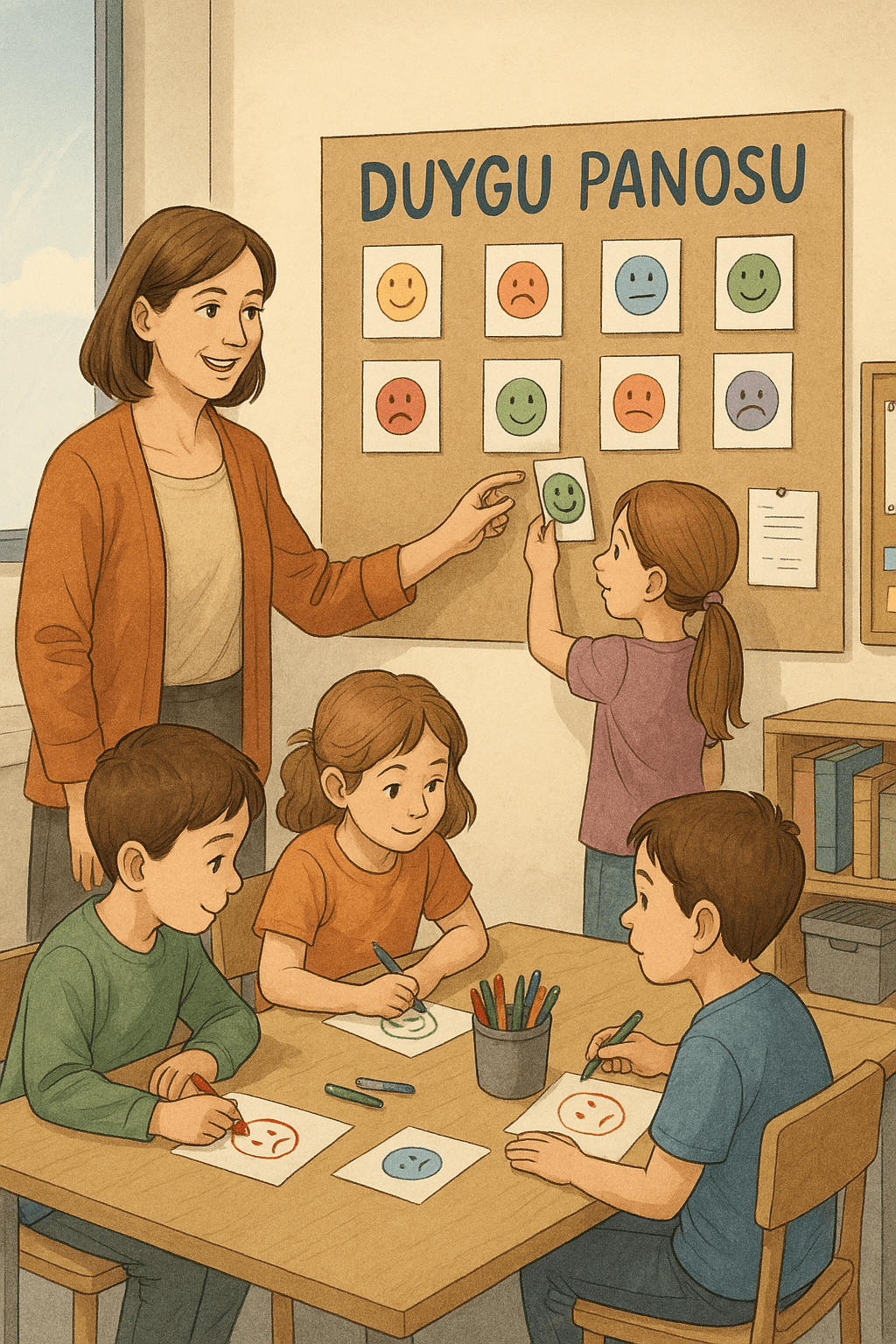
A teacher providing educational guidance to children, representative image. Generated by artificial intelligence.
The importance of guidance in education and instruction cannot be denied. The primary aim of educational guidance is to enable individuals to achieve maximum benefit from educational and instructional activities. Educational guidance supports individuals in meeting the academic demands of their developmental stage. It helps individuals obtain maximum benefit from education and fulfill their personal needs. Academically, individuals receiving educational guidance are more likely to set goals and work toward them.
One of the most important steps along the career path is deciding in which field to build one’s career. Vocational guidance plays a crucial role in helping individuals choose their sectors and determine the profession they wish to pursue. In today’s rapidly changing and evolving world, it has become increasingly difficult for individuals to select suitable careers simply by observing professions. Therefore, preparing youth for careers and guiding them through the selection process has become the responsibility of educational institutions and vocational guidance programs. A career should not be viewed merely as a source of income; it must be remembered that it significantly influences the lives of most individuals.
One of the most important factors in achieving success in guidance services is adherence to established principles and systematic implementation based on them. The term “principle” refers to the underlying thought or foundational idea. In this context, the principles of guidance can be regarded as its rules. Adherence to these rules and principles is of the utmost importance from both a professional ethics standpoint and for ensuring the healthy progression of the process, as it also supports the protection of the rights of both the counselor and the client.
These principles can be listed as follows:
Erkan, Serdar. "Rehberlik Nedir?" In İlköğretimde Rehberlik, edited by Yıldız Kuzgun, 1–16. 2003.
Kepçeoğlu, Muharrem. Psikolojik Danışma ve Rehberlik. 8. baskı. Ankara: Özerler Matbaası, 1994.
Kiye, Sümeyye. "Psikolojik Danışma ve Rehberlik Hizmetleri: Tarihi Gelişimi, Modelleri ve Programı." Gazi Üniversitesi Gazi Eğitim Fakültesi Dergisi 44, no. 1 (2024): 601–629. Accessed March 31, 2025.
Kuzgun, Yıldız. "İlköğretimde Rehberlik." Hacettepe Üniversitesi Eğitim Fakültesi Dergisi 8 (1992). Accessed March 31, 2025.https://www.acarindex.com/pdfs/1313599
Ministry of National Education. "Rehberlik ve Psikolojik Danışma Hizmetleri Türkiye’de." Accessed March 31, 2025.https://orgm.meb.gov.tr/meb_iys_dosyalar/2025_01/22170504_13143043_turkyyeyde_rehberlyk_ve_psykolojyk_daniyma_hyzmetlery.pdf.

History of Guidance
Types of Guidance
Personal Guidance
Educational Guidance
Vocational Guidance
Principles of Guidance