


This article was automatically translated from the original Turkish version.
+2 More
Green mining approaches; are a set of practices aimed at reducing environmental impacts, increasing resource efficiency, and strengthening social acceptance across all stages of mining including exploration, extraction, beneficiation, transportation, waste management, closure, and post-closure monitoring. This approach focuses not only on on-site pollution control but also on water, energy, and material use throughout the life cycle of mineral-based products. The concept addresses impacts inherent to mining activities—such as land degradation and waste generation—by aiming to reduce them to an “acceptable level”; it acknowledges that applications may vary according to local ecosystem sensitivities, legal frameworks, technological capacity, and stakeholder expectations.
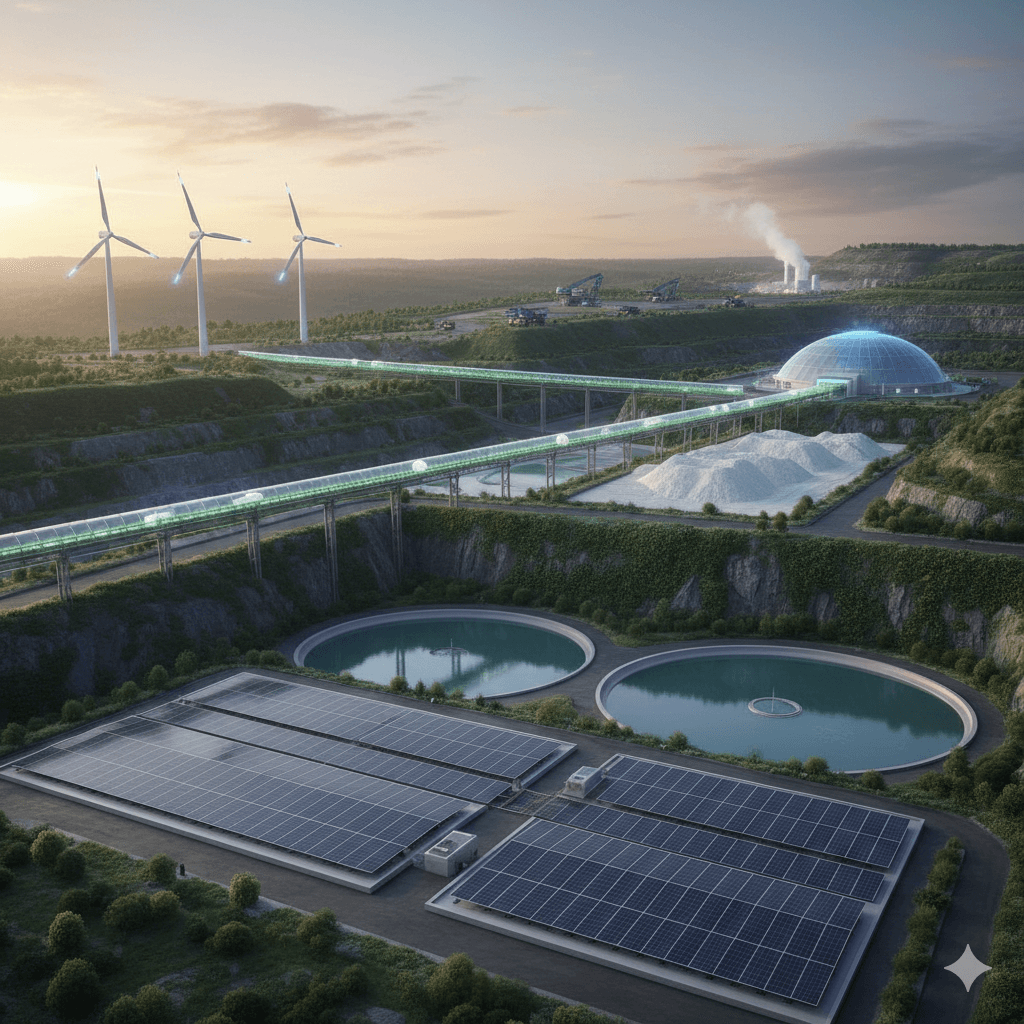
A Visual Representing Green Mining Approaches (Generated by Artificial Intelligence.)
Green mining integrates the “less impact production” philosophy with business management, technology selection, and site planning. It is viewed as a framework that operates in collaboration with stakeholders from site preparation through mine closure, adhering to ecological sustainability goals and aligning with human rights and environmental standards. The precautionary approach in the face of uncertain risks, environmental awareness training for personnel, effective communication, site-specific flexibility, and a continuous improvement cycle are common components of this framework. Therefore, rather than a “one-size-fits-all” green mining recipe, adaptable designs that account for local risks and sensitivities are emphasized.
A significant portion of these approaches focuses on enhancing material efficiency along the value chain from ore extraction to final product. Selective production methods aim to reduce land pressure and energy consumption by limiting unnecessary excavation and tailings transport. Process designs that minimize ore loss and enable by-product recovery are associated with lower raw material inputs and reduced waste generation per unit of equivalent product. The resource efficiency perspective extends beyond extraction and beneficiation; strategies such as recycling, use of secondary material flows, and reducing material intensity in product design are considered complementary components that offset primary mining demand.
In green mining, energy management involves not only reducing energy consumption per unit of production but also lowering the carbon intensity of energy sources. Electrification, more efficient transport systems, equipment with energy recovery capabilities, and renewable energy integration are evaluated within this scope. Improving equipment efficiency in high-energy processes such as hauling and drilling in open-pit mines is considered critical for reducing fuel consumption and emissions. In some applications, alternative fuel options and hydrogen-based solutions are also discussed, particularly in the context of fleet transition and site logistics. Energy strategies also encompass auxiliary systems such as ventilation, cooling, and crushing-screening; smart control and process optimization aim to reduce unnecessary energy losses.
Water management lies at the heart of green mining approaches because mining activities directly affect local ecosystems through water consumption, transport, and contamination risks. Methods such as closed-loop water recovery, reuse of process water, and safe reinjection of treated water aim to reduce freshwater withdrawals. Wastewater treatment is sometimes combined with metal recovery to simultaneously reduce pollution loads and generate economic value. On-site drainage control, precipitation and surface runoff management, leakage monitoring, and engineering measures that limit interactions with groundwater play a complementary role in managing water quality risks.
One of mining’s most enduring impacts is the large volume of tailings and beneficiation residues. Green mining approaches in this area evolve along the axis of “reduce, stabilize, and revalue.” Options such as dry stacking, concentrated or paste-like residue management aim to reduce dependence on water and dam-related risks. Improving the engineering properties of residues emphasizes impermeability, encapsulation, and long-term geochemical stability. Additionally, waste piles and residue storage facilities can be viewed as secondary resources; approaches focused on reprocessing, metal recovery from fine particles, and utilization of by-products in other sectors are evaluated within the framework of a circular economy.
Ore preparation and beneficiation processes are areas where environmental risks are concentrated due to chemical use and generation of fine particulate waste. Dry or water-limiting processes that reduce water demand are gaining importance in terms of lowering both water consumption and wastewater loads. Low-carbon process approaches are linked to improved efficiency and use of alternative energy in heat- and energy-intensive stages. Optimizations that reduce reagent consumption, more selective separation techniques, and enhanced process control are among the methods aimed at reducing chemical risks. Long-term risks such as acid rock drainage and metal leaching are managed through geochemical characterization, appropriate storage design, and limiting contact with water.
Within the green mining framework, biological methods are considered alternative tools for both pollution control and metal recovery. Methods such as bioleaching and biosorption operate by dissolving or immobilizing metals under specific conditions. Phytoremediation aims to reduce the mobility of contaminants in soil and water environments using plant uptake and stabilization mechanisms. Microbial degradation and biological remediation applications are evaluated as strategies to mitigate the impact of organic pollutants and certain toxic components. Such approaches are typically designed not as replacements for conventional engineering measures but as complementary layers dependent on site-specific conditions.
Digitalization and automation serve a dual function in green mining: on one hand, they enhance efficiency by optimizing energy, water, and material use; on the other, they enable more continuous and detailed monitoring of environmental impacts. Autonomous or remotely operated equipment can contribute to improved operational safety while reducing fuel consumption and operational losses. Sensor networks and data analytics facilitate monitoring of variables such as dust generation, noise, vibration, water quality, leakage risks, and equipment performance. AI-supported exploration and planning applications are among the approaches designed to increase targeting accuracy and limit unnecessary excavation and site degradation.
In green mining approaches, closure is not treated as a final activity but as a process planned throughout mine operations. Phased rehabilitation aims to restore disturbed areas during ongoing operations and reduce the burden of closure. Soil stripping and storage strategies are considered critical for enabling the reestablishment of native vegetation. Landscape reshaping, erosion control, support for habitat connectivity, and design of biodiversity corridors strengthen the ecological dimension of restoration. Post-closure monitoring includes long-term management of processes such as water quality, geotechnical stability, and ecosystem recovery.
Green mining is viewed not merely as an environmental performance issue but as a governance domain. Early and continuous engagement with local communities, transparency, complaint mechanisms, and participatory decision-making processes are considered fundamental components of social acceptance. In regions highly dependent on mining, economic diversification, local capacity building, and equitable benefit sharing, when addressed alongside environmental measures, yield more sustainable outcomes. Issues such as occupational health and safety, working conditions, and compliance with human rights are included in approaches that emphasize that the “green” claim cannot be limited to environmental management alone.
Multi-criteria evaluation frameworks have been developed to make green mining practices comparable and verifiable. These frameworks typically integrate environmental, economic, and social dimensions, assessing criteria such as water management, energy and emissions, waste and risk management, restoration plans, governance capacity, and stakeholder relations. Decision-support methods that incorporate strategic analysis tools for uncertainty management aim to establish a more systematic basis for defining “green” performance across different mine types and regional conditions. However, the effectiveness of measurement systems depends on governance conditions such as data quality, independent auditing, and selection of site-appropriate indicators.
Although green mining approaches offer concrete tools to reduce mining impacts, debates surround their application. Some assessments emphasize that efficiency gains may have limited effects on absolute resource consumption and total environmental pressure, and therefore the “greener production” narrative may be insufficient unless complemented by demand management and circularity policies.【1】 Within this framework, system-level measures such as expanding recycling and secondary material use, reducing material intensity in product design, extending product lifespan, and lowering consumption levels are discussed as a broader policy domain that supports improvements in mining. Thus, green mining becomes a more meaningful transformation approach when addressed alongside decisions regarding the overall demand and supply structure of the mineral-based economy.
Abidin, Amanda Namira, and Murniati Murniati. “Environmental Sustainability in Mining Industry: A Systematic Review of Economy Perspective for Achieving Sustainability Development Goals.” *Edelweiss Applied Science and Technology* 9, no. 7 (2025): 851–861. Accessed January 27, 2026. https://ideas.repec.org/a/ajp/edwast/v9y2025i7p851-861id8758.html
Bolger, Meadhbh, Diego Marin, Adrien Tofighi-Niaki, and Louelle Seelmann. *'Green Mining' Is a Myth: The Case for Cutting EU Resource Consumption.* Report. European Environmental Bureau (EEB) and Friends of the Earth Europe, 2021. Accessed January 27, 2026. https://eeb.org/wp-content/uploads/2021/10/Green-mining-report_EEB-FoEE-2021.pdf
Gairola, S. U., A. K. Khanduri, and V. Bhuvaneswari. “Sustainable Mining: Reducing Waste and Enhancing Resource Efficiency.” *Discover Civil Engineering* 2 (2025): 75. Accessed January 27, 2026. https://doi.org/10.1007/s44290-025-00233-9
Maddala, Venkata Kanaka Srivani, Shubham Sharma, Jasgurpreet Chohan, Raman Kumar, and Sandeep Singh. “Green Mining Techniques to Curb Environmental Problems: A Review.” *IOP Conference Series: Earth and Environmental Science* 889 (2021): 012026. Accessed January 27, 2026. https://doi.org/10.1088/1755-1315/889/1/012026
Nurmi, P. “Green Mining – A Holistic Concept for Sustainable and Acceptable Mineral Production.” *Annals of Geophysics* 60 (2017). Accessed January 27, 2026. https://doi.org/10.4401/ag-7420
Onifade, Moshood, Tawanda Zvarivadza, John A. Adebisi, Khadija Omar Said, Oluwatobi Dayo-Olupona, Abiodun Ismail Lawal, and Manoj Khandelwal. “Advancing Toward Sustainability: The Emergence of Green Mining Technologies and Practices.” *Green and Smart Mining Engineering* 1, no. 2 (2024): 157–174. Accessed January 27, 2026. https://doi.org/10.1016/j.gsme.2024.05.005
Sayed, E., A. M. Ali, I. Alrashdi, K. M. Sallam, M. Abdel-Basset, and M. M. Ismail. “A Robust Framework for Evaluating Green Mines towards Sustainable Development.” *Scientific Reports* 15 (2025): 37739. Accessed January 27, 2026. https://doi.org/10.1038/s41598-025-21237-6
Yu, Haoxuan, Izni Zahidi, Chow Ming Fai, and Dongfang Liang. “From Devastation to Restoration: Charting the Course towards Sustainable Mining Practices.” *Journal of Environmental Management* 391 (2025): 126660. Accessed January 27, 2026. https://doi.org/10.1016/j.jenvman.2025.126660
[1]
Meadhbh Bolger, Diego Marin, Adrien Tofighi-Niaki ve Louelle Seelmann, 'Green Mining' Is a Myth: The Case for Cutting EU Resource Consumption, Rapor, European Environmental Bureau (EEB) ve Friends of the Earth Europe 2021: 3, Erişim Tarihi: 27 Ocak 2026, https://eeb.org/wp-content/uploads/2021/10/Green-mining-report_EEB-FoEE-2021.pdf

No Discussion Added Yet
Start discussion for "Green Mining Approaches" article
Scope and Core Principles
Life Cycle and Resource Efficiency
Energy and Emission Management
Water Management and Water Quality Protection
Waste, Tailings, and Residue Management
Process Innovations and Reduction of Chemical Risks
Biotechnological and Nature-Based Solutions
Digitalization, Automation, and Monitoring
Ecosystem Restoration and Mine Closure
Social Dimension, Governance, and Social Acceptance
Evaluation Approaches and Performance Measurement
Limitations and Debates