


This article was automatically translated from the original Turkish version.

Gestalt Theory
(Generated by Artificial Intelligence)
Gestalt Theory
Principle | Whole > Sum of Parts | ||||||||
|---|---|---|---|---|---|---|---|---|---|
Focus | Visual Perception Organization | ||||||||
Era | 1912, Phi Phenomenon | ||||||||
Application | Logo, Typography, Graphic | ||||||||
Meaning | Shape Form Whole | ||||||||
Gestalt theory is a psychological approach aimed at explaining perception processes. The German term “Gestalt” means form, shape, or form, and the theory emphasizes that individuals tend to perceive stimuli in their environment not as isolated parts but as unified structures. According to the Gestalt approach, perception is organized through various principles of organization, which contribute to the understanding of learning, visual perception, and meaning-making processes.
The emergence of Gestalt theory began with Max Wertheimer’s 1912 article on the “phi phenomenon” (apparent motion). Wertheimer described how stationary lines presented in rapid succession are perceived as moving, characterizing this as a “holistic experience” distinct from the sum of its parts. Other founding figures of the theory include Wolfgang Köhler and Kurt Koffka; all three scholars were trained in phenomenological philosophy and psychology.
In the 1920s, the theory developed around the journal Psychologische Forschung in Germany. Due to repression and censorship under Nazi Germany, its founders emigrated to the United States, giving the theory an international dimension.
In Türkiye, the first introductions to the theory occurred in 1938 with the translation of an article by Pierre Jeunet.
Gestalt theory is an approach focused on explaining how perception is organized. According to the theory, people perceive visual and sensory stimuli from their environment not as independent elements but as meaningful wholes. Therefore, the perceptual process is closely related to the patterns of organization formed in the individual’s mind.
Gestalt theorists argue that the laws of perceptual organization play a crucial role in explaining learning. These laws are considered fundamental principles that enable individuals to organize environmental stimuli into orderly and meaningful wholes. [1] In visual communication and design, these principles are among the core guidelines that guide viewer perception.

Figure–Ground Relationship
(Generated by Artificial Intelligence)
Gestalt theory identifies several principles that shape human perception. These principles are used to explain how individuals organize and interpret visual stimuli.
Figure–ground relationship refers to the process by which an object is perceived as distinct from its background. This principle concerns how a portion of the visual field is perceived as “figure” while the remainder is perceived as “ground.”
The similarity principle describes the tendency for elements with similar characteristics—such as shape, color, or size—to be perceived together. The perceptual system tends to interpret elements with similar features as parts of the same whole.
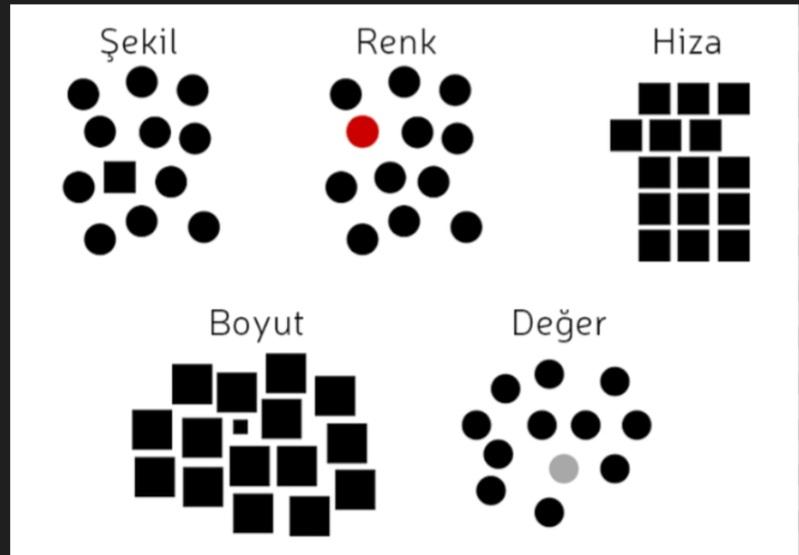
Similarity Principle
The closure principle describes the tendency of the mind to complete incomplete or fragmented shapes. Human perception tends to fill in missing parts to form a coherent structure.
The simplicity principle (Prägnanz) states that perception favors more regular, simple, and balanced forms over complex ones. This principle emphasizes the tendency of perception to organize stimuli in the simplest and most orderly way possible.

Simplicity Principle
(Generated by Artificial Intelligence)
Continuity Principle
The continuity principle explains the tendency of human perception to follow uninterrupted and orderly lines or directions. According to this principle, elements that exhibit continuity within a visual arrangement are perceived as belonging together.
Gestalt theory is applied across various disciplines to explain perception and learning processes. In education, particularly in developing skills requiring visual information processing such as map reading and interpretation, Gestalt principles are utilized. In this context, perceptual organization processes provide a framework that facilitates the understanding of maps.
In visual communication and design, Gestalt principles also hold significant importance. These principles are employed in graphic design, poster design, and advertising to guide viewers’ attention and support meaning creation. In particular, Gestalt principles are used to explain how visual perception arises in cases of pareidolia, where familiar forms are perceived from ambiguous stimuli.
Logos are simple and powerful visual elements that represent a brand’s identity. Gestalt principles are consciously applied to ensure logos are recognizable and memorable. The simplicity principle (Prägnanz), in particular, enables a logo to be perceived within seconds and allows complex structures to be easily encoded in the mind.
In kinetic typography, Gestalt theory serves as a framework for understanding how text is perceived and interpreted while in motion. Research has shown that teaching these principles helps students more consciously manage the “comparison,” “design,” and “production” stages of their design processes.
Erdoğan, Sezer. "Gestalt Kuramı ve Logo Tasarımında Etkili Kullanımı." Kafdağı 9, no. 1 (December 2024): 39-53. Accessed March 5, 2026. https://doi.org/10.51469/kafdagi.1605609.
Koç, Hakan and İhsan Bulut. “Gestalt Kuramının Öğrencilerin Harita Okuma ve Yorumlama Beceri Düzeyleri Üzerine Etkisini Belirlemeye Yönelik Bir İnceleme.” *Marmara Coğrafya Dergisi.* Accessed March 5, 2026. https://doi.org/10.14781/mcd.26337
Mungan, Esra. "Geştalt Kuramı: Bir 'Nazariye'nin Mazisi, Akameti ve Akıbeti...". *Nesne Psikoloji Dergisi* 8, no. 18 (2020): 585-618. Accessed March 5, 2026. https://doi.org/10.7816/nesne-08-18-15.
Sandal, Lefika Yılmaz, and Metin İnce. "Gestalt Kuramı ve Hareketli Tipografi: Uzaktan Öğretim Yöntemiyle Öğrenci Deneyimleri - Fenomenolojik Bir İnceleme." *Ordu Üniversitesi Sosyal Bilimler Araştırmaları Dergisi (ODÜSOBİAD)* 14, no. 4 (2024): 1369-1385. Accessed March 5, 2026. https://doi.org/10.48146/odusobiad.1395230.
Üstündağ, Emine Nilüfer. “Gestalt İlkeleri Perspektifinden Pareidolia Temalı Afiş Tasarımlarının Değerlendirilmesi.” SDÜ ART-E Güzel Sanatlar Fakültesi Sanat Dergisi. Accessed March 5, 2026. https://doi.org/10.21602/sduarte.1463145

Gestalt Theory
(Generated by Artificial Intelligence)
Gestalt Theory
Principle | Whole > Sum of Parts | ||||||||
|---|---|---|---|---|---|---|---|---|---|
Focus | Visual Perception Organization | ||||||||
Era | 1912, Phi Phenomenon | ||||||||
Application | Logo, Typography, Graphic | ||||||||
Meaning | Shape Form Whole | ||||||||
History
Theoretical Framework
Principles of Perceptual Organization
Figure–Ground Relationship
Proximity Principle
Closure Principle
Simplicity Principle
Application Areas
Logo Design
Kinetic Typography