


This article was automatically translated from the original Turkish version.
+2 More
Genogram Analysis is a clinical assessment tool developed as part of Bowen’s Family Systems Theory, which schematically represents an individual’s intergenerational relationships, medical history, demographic characteristics, and key family turning points.【1】 Also known as a family pedigree, gene map, or genetic chart, this tool facilitates the collection of detailed information about a family’s formation and internal dynamics, enables the analysis of complex relational patterns, and allows for tracking how health risks are transmitted across generations.
Typically depicting structural features, life cycle events, and interpersonal connections across at least three generations, genograms are used to understand how changes within the system affect the entire family, based on the assumption that family members are physically, socially, and emotionally interconnected.【2】
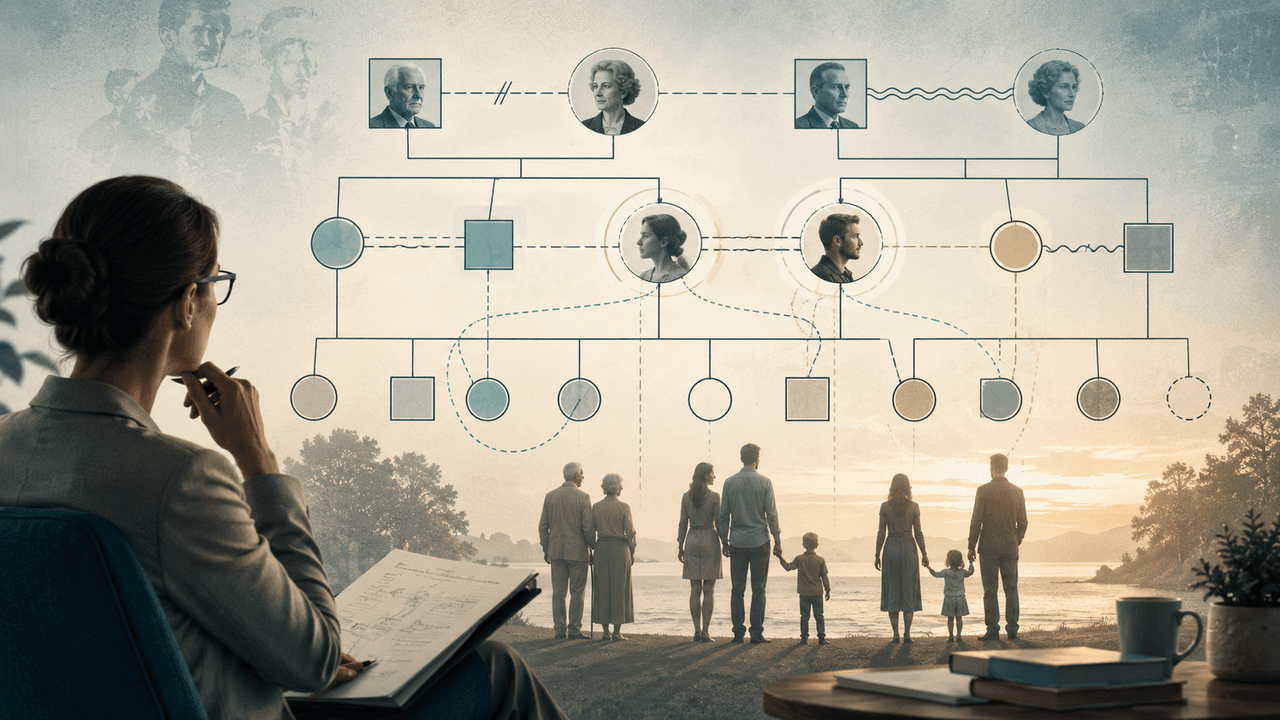
Genogram Analizini temsil eden görsel (Yapay zeka ile oluşturulmuştur)
The foundations of the genogram technique entered clinical practice for the first time in the 1970s through the pioneering work of American psychiatrist Murray Bowen on family and systems therapy.【3】 Initially focused primarily on biological kinship and legal marital ties, this approach evolved by the 1990s into a cultural genogram format that incorporated elements such as ethnic origin, religion, sexual orientation, and social class that shape individual identity.
While the concept of family in Western societies long remained confined to definitions based on blood and marriage ties, anthropological research led to the acceptance that kinship can also be understood through social and cultural bonds such as cohabitation and mutual care.【4】
Today, genograms are designed with sufficient flexibility to encompass complex contemporary family structures, including legal recognition of parents with diverse sexual orientations, blended and stepfamilies, honorific titles such as aunt or uncle used in non-biological contexts, adoption, and biological secrets revealed through DNA testing.【5】
The genogram technique is widely applied across a broad scientific spectrum including family counseling, individual psychotherapy, psychiatry, medicine, genetic research, social work, spiritual counseling, career counseling, and educational psychology. As an assessment and therapeutic tool, it provides professionals with the opportunity to deeply examine patients’ and clients’ family patterns, partner selection dynamics, and intergenerational repetitive behavioral patterns.
Depending on the context and intended purpose, the literature recognizes various subtypes of genograms. Beyond standard genograms that assist clinicians in generating hypotheses, specialized subtypes are actively applied, including cultural genograms for evaluating multicultural heritages, spiritual genograms that map individuals’ worldviews and belief systems, ethical genograms addressing moral dilemmas, sexual genograms that delineate sexual identity and boundaries, career genograms illustrating factors influencing professional choices, as well as political and infant feeding genograms.【6】
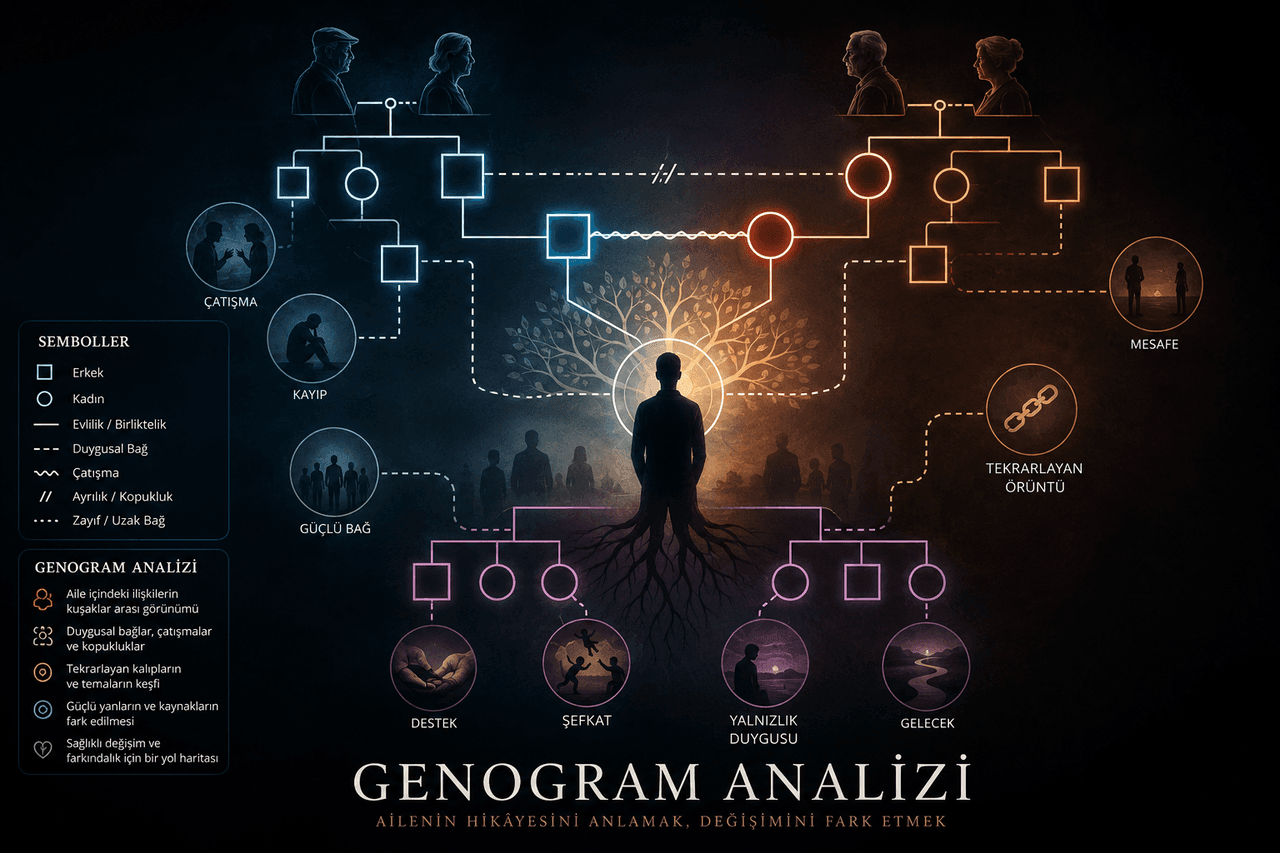
Genogram Analizini temsil eden görsel (Yapay zeka ile oluşturulmuştur)
To present complex data in a universally comprehensible language, genograms employ internationally standardized shapes, lines, and colors. According to fundamental representation principles, males are represented by squares and females by circles, while unique notations such as inverted triangles are preferred to denote non-binary or diverse sexual orientations.【7】
Demographic data such as age, education, and occupation are typically written inside the symbols. Death is indicated by a cross placed over the symbol, and household pets are represented by a baklava slice shape. The nature of relationships between individuals is denoted by specific line styles:
In addition, relationship dynamics such as enmeshment, hostility, closeness, sexual or physical abuse, as well as conditions like alcohol or substance dependence, are detailed using zigzag lines or color codes—for example, red for conflict and green for dependence. Furthermore, specialized markers have been developed to depict complex scenarios such as growth in a foster family or adoption.
The creation of a genogram occurs in three main stages: identifying the details of the family structure, recording the collected information, and defining relationships in a multidimensional manner. This process is not merely a data collection activity but a mutual exploration process between family members and the therapist, using circular questioning to reveal different perspectives. Visualizing events and relationships in this way enables family members to break free from rigid relational patterns, develop empathy, and adopt a more comprehensive perspective on their problems through externalization.
In scenarios involving children, play genograms are designed using toys, buttons, and objects to reduce conceptual abstraction, thereby establishing a developmentally appropriate communication channel. In some applications, the inclusion of family photographs in standard mappings has been found to activate visual memory, enabling clients to construct their cultural or social narratives with deeper insight.
With the integration of technology into psychotherapy and counseling practices, genograms have transitioned from traditional paper-and-pencil methods to digital software. Specialized programs such as GenoPro offer clinicians significant functional advantages, including the flexibility to update information at any time, secure long-term electronic storage of data, and the ability to generate practical reports for interprofessional collaboration. These programs significantly accelerate the construction of complex, multicultural family trees through their extensive symbol libraries and the ability to represent ethnic origins using color-coded percentages.
On the other hand, the learning curve for novice users, licensing costs, software and hardware incompatibilities, and concerns regarding data privacy arising from the digital storage of sensitive family information are considered key limitations of these technological tools. Overall, however, the speed and functionality introduced by digital genogram tools directly enhance clinical success by enabling objective and comprehensive mapping of family structures.
Biçer, Mehmet, Nuray Müge Çetindağ, and Mustafa Özgür Kopar. "GenoPro ile Genogram Oluşturulmasına İlişkin Aile Danışmanlarının Algıları: Bir Q Metodu Analizi." *Psikolojik Araştırma Perspektifleri Dergisi* 2, no. 2 (2025): 154-179. Accessed July 5, 2026.https://dergipark.org.tr/tr/download/article-file/6123854
Karakuş, Sena, and Zülal Erkan. "Genogram Kullanımına Yönelik Çalışmaların İncelenmesi." Mersin Üniversitesi Eğitim Fakültesi Dergisi 15, no. 3 (2019): 815-830. Accessed July 5, 2026.https://dergipark.org.tr/en/download/article-file/890572
Scott, Hannah. "Using Genograms in Practice." Totnes: Research in Practice, 2021: 2-20. Accessed July 5, 2026.
[1]
Mehmet Biçer, Nuray Müge Çetindağ, ve Mustafa Özgür Kopar, "GenoPro ile Genogram Oluşturulmasına İlişkin Aile Danışmanlarının Algıları: Bir Q Metodu Analizi," Psikolojik Araştırma Perspektifleri Dergisi 2, no. 2 (2025): 155, erişim tarihi: 5 Temmuz 2026. https://dergipark.org.tr/tr/download/article-file/6123854
[2]
Sena Karakuş ve Zülal Erkan, "Genogram Kullanımına Yönelik Çalışmaların İncelenmesi," Mersin Üniversitesi Eğitim Fakültesi Dergisi 15, no. 3 (2019): 825, erişim tarihi: 5 Temmuz 2026. https://dergipark.org.tr/tr/download/article-file/890572
[3]
Biçer, Çetindağ, ve Kopar, "GenoPro ile Genogram Oluşturulmasına İlişkin Aile Danışmanlarının Algıları," 155.
[4]
Hannah Scott, Using Genograms in Practice (Totnes: Research in Practice, 2021),2, erişim tarihi: 5 Temmuz 2026. https://www.researchinpractice.org.uk/media/mkydyt3f/cf_pt_using-genograms-in-practice_final.pdf.
[5]
Scott, "Using Genograms in Practice,"3.
[6]
Karakuş ve Erkan, "Genogram Kullanımına Yönelik Çalışmaların İncelenmesi," 824.
[7]
Karakuş ve Erkan, "Genogram Kullanımına Yönelik Çalışmaların İncelenmesi," 816-817.
[8]
Karakuş ve Erkan, "Genogram Kullanımına Yönelik Çalışmaların İncelenmesi," 816-817.

Historical Development and Socio-Cultural Evolution
Applications and Types of Genograms
Structural Features and Symbolic Representation
Application Process and Therapeutic Dynamics
Digitalization and Genogram Software