


This article was automatically translated from the original Turkish version.
+1 More
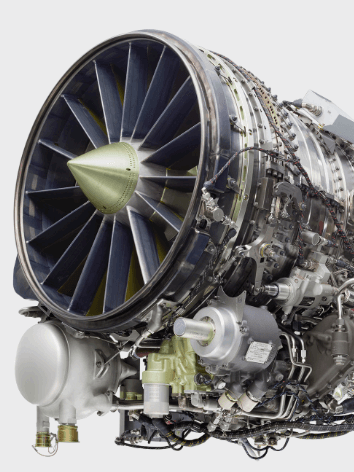
GE F404 Engine
Engine Name | General Electric F404 | ||||||||
|---|---|---|---|---|---|---|---|---|---|
Manufacturer | General Electric Aerospace | ||||||||
Initial Development | late 1970s | ||||||||
Thrust | 70–85 kN | ||||||||
Bypass Ratio | 0.34 | ||||||||
Weight | ~988 kg (dry) | ||||||||
Length | ~4.03 m | ||||||||
Thrust-to-Weight Ratio | 7.3 | ||||||||
Specific Fuel Consumption | 0.78 kg/h/kg (dry), 1.84 kg/h/kg (afterburning) | ||||||||
Key Feature | Digital control (FADEC) (in some variants) Advanced cooling and monitoring systems Easy maintenance (modular design) High performance and reliability | ||||||||
Key Derivatives | F404-GE-402, F404-GE-102, F404-GE-103, F404/RM12, F404-GE-IN20 | ||||||||
Platforms Used | F/A-18 Hornet, HAL Tejas, Saab Gripen, T-7A Red Hawk, KAI T-50, F-117 Nighthawk, A-4SU Super Skyhawk | ||||||||
General Electric F404 Turbofan Engine is a military turbofan engine family developed by GE. Originally designed for the Boeing F/A-18 Hornet fighter aircraft, it is a low bypass ratio engine used in various combat and training aircraft. The F404 turbofan engine, noted for its high performance reliability and ease of maintenance, is deployed worldwide in diverse missions with a thrust capacity of 70–85 kN in afterburner mode and multiple variants.
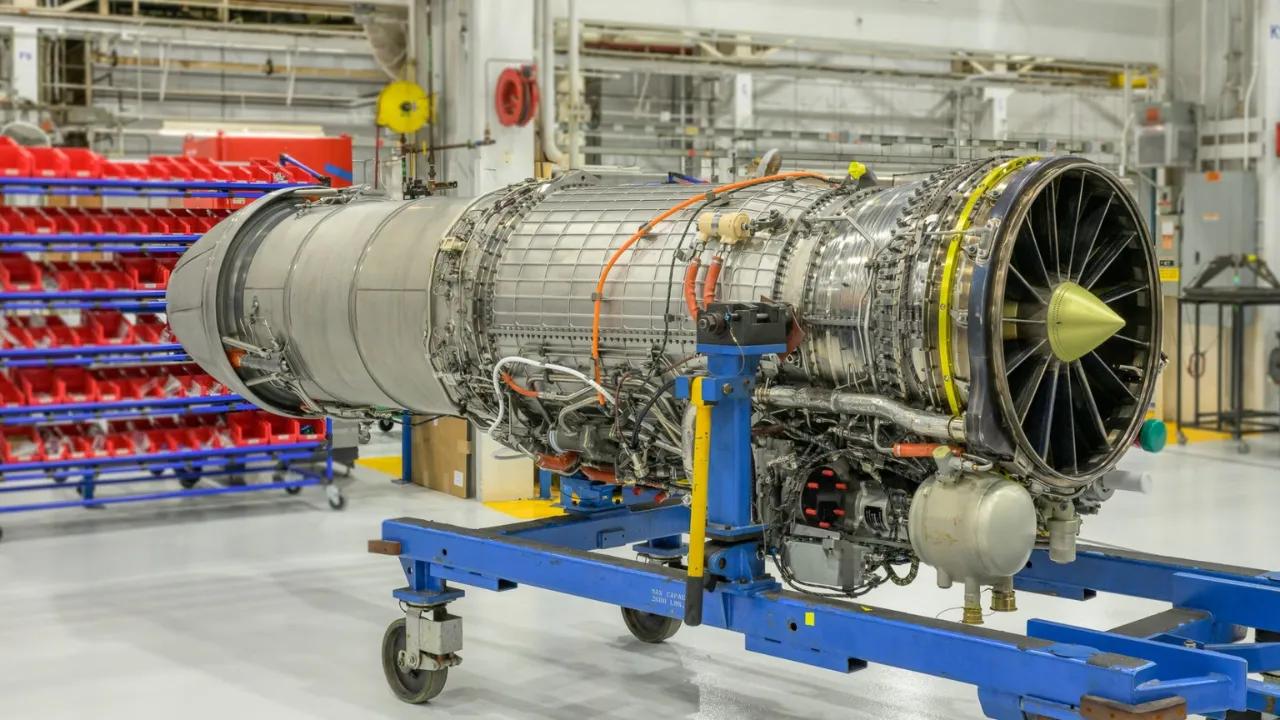
General Electric F404 Motoru (Kaynak: Wion)
The F404 engine traces its origins to General Electric’s YJ101 engine developed in the 1970s for the U.S. Air Force’s Light Weight Fighter program. The YJ101 was tested in the Northrop YF-17 prototype aircraft and gained attention during 1974 flight tests by operating for 288 flights without stalls or flameouts. With the YF-17’s evolution into the F/A-18 Hornet the engine was redesigned to become the F404-GE-400 model. During this process part count was reduced to lower weight cost and maintenance complexity while improving reliability and serviceability.
The U.S. Navy’s Full Scale Development (FSD) program focused on operational suitability reliability and ease of maintenance. As part of this program procedures such as a 150-hour durability test the Simulated Mission Durability Test (SMET) and Accelerated Service Test (AST) were conducted. Additionally flight data recording of engine power usage was used to evaluate component life due to low cycle fatigue. The F404 entered operational service in 1981 with the U.S. Navy on the F/A-18 in 1983 with the Canadian Armed Forces on the CF-18 and around 1985 with the Royal Australian Air Force.
The F404-GE-400 model produces over 10000 lb (44.5 kN) thrust in dry mode and approximately 16000 lb (71.2 kN) with afterburner. The engine measures 391 cm in length 89 cm in diameter (fan inlet) and weighs approximately 2365 lb (1072 kg). The pressure ratio ranges from 25:1 to 28:1 and the airflow rate is at 152–153 lb/s (69–70 kg/s).
The F404 is a low bypass ratio turbofan engine and is often described as a “leaky turbojet.” While this design sacrifices fuel economy it provides rapid gas response and reliable afterburner operation. The engine’s main components include:
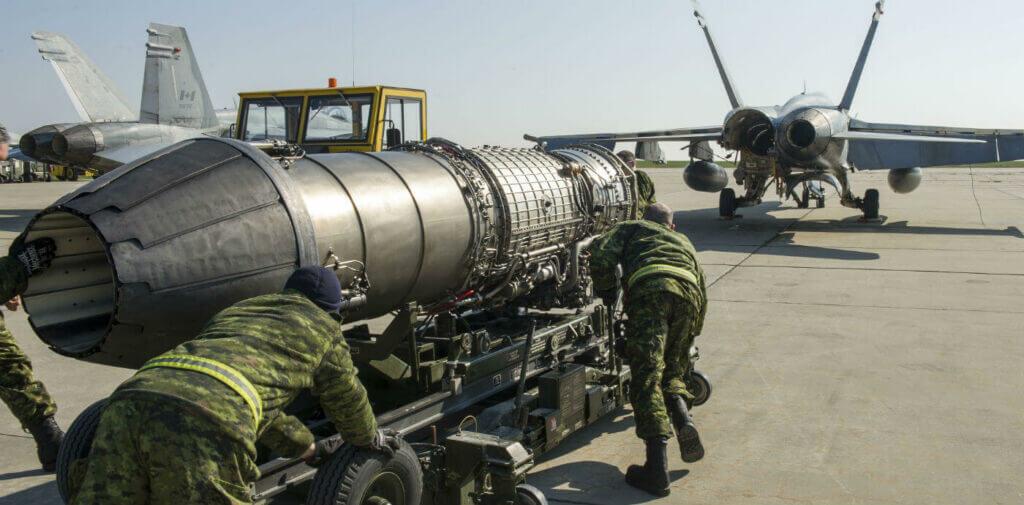
Kanada Hava Kuvvetleri F404 Motoru (Kaynak: SkiesMag)
The F404 engine family has produced numerous variants adapted for different aircraft types:
The F404 engine family powers the following aircraft:
Compared to the Pratt & Whitney TF30 (used in the F-111C) the F404 stands out with smaller dimensions lower weight and similar thrust levels. The TF30 is 12% longer 9% wider in diameter 88% heavier and consumes 2% more fuel. The F404’s design leverages 15 years of technological advancement to deliver higher reliability durability and ease of maintenance. For example on the F/A-18 the F404 provides 20% more non-afterburner thrust than a hypothetical scaled-up version of the TF30 enhancing range and speed performance.
The engine’s high pressure ratio (25:1) and turbine inlet temperature improve thermal efficiency while the single-stage turbine design reduces weight and complexity. However this design slightly reduces turbine efficiency keeping specific fuel consumption (SFC) comparable to the TF30. The low bypass ratio offers advantages in rapid gas response and afterburner performance making the F404 well suited for fighter aircraft.
The F404 engine is not merely a basic power unit but is equipped with numerous advanced systems that enhance operational performance and provide maintenance and reliability benefits.
The F404 is designed to operate without stalls under high maneuverability flight conditions such as angles of attack exceeding 90 degrees. Extensive testing has demonstrated the engine’s ability to automatically recover even under severe distortion conditions. The control system operates via a combination of a hydro-mechanical unit and an Electronic Control Unit (ECU). The ECU activates during afterburner mode and maximum power and performs the following functions:
The F404 is designed using an On Condition Maintenance approach. The In-Engine Condition Monitoring System (IECMS) records data on low cycle fatigue performance trends and fault indicators to support maintenance planning. The RAAF uses the Maintenance Data and Service Life Monitoring System (MD&SLMS) to process this data. In addition boroscope inspections oil analysis and vibration measurements are used to evaluate engine condition.
Material selection for the F404 engine considers the thermal mechanical and chemical loads experienced by each component. The materials used extend beyond superalloys to encompass a broad and specific range:
These materials are specifically selected to meet requirements for temperature resistance oxidation resistance fatigue life and light weight. Internal cooling and ceramic coatings enable turbine blades to withstand extreme temperatures. Titanium provides advantages in the fan and compressor regions due to its high strength and low weight while nickel and cobalt-based alloys deliver high-temperature performance in the turbine and afterburner sections.
The F404’s modular design consists of six main modules reducing maintenance time. The modular structure provides logistical advantages and can be adapted to user maintenance needs. By 1985 the engine had accumulated approximately 250000 flight hours with major issues resolved. The Component Improvement Program continues efforts during the engine’s maturation phase (targeting one million hours) to enhance reliability and durability.
Department of Defence, Defence Science and Technology Organisation, Aeronautical Research Laboratories. 1985. *The General Electric F404- Engine of the RAAF’s New Fighter*. Aero Propulsion Technical Memorandum 426.Accessed Adresi.
GE Aerospace. 2022. *F404 Family Data Sheet*.Accessed Adresi.
Magellan Aerospace. 2024. “Magellan Aerospace Awarded Engine Maintenance Contract CF-188 F404.” *Skies Magazine*. Accessed April 2025.Accessed Adresi.
Sidhart, M. P. 2025. “After Delays, GE Resumes Engine Delivery for India’s Tejas Fighter Jets.” WION News. Accessed April 2025.Accessed Adresi.

GE F404 Engine
Engine Name | General Electric F404 | ||||||||
|---|---|---|---|---|---|---|---|---|---|
Manufacturer | General Electric Aerospace | ||||||||
Initial Development | late 1970s | ||||||||
Thrust | 70–85 kN | ||||||||
Bypass Ratio | 0.34 | ||||||||
Weight | ~988 kg (dry) | ||||||||
Length | ~4.03 m | ||||||||
Thrust-to-Weight Ratio | 7.3 | ||||||||
Specific Fuel Consumption | 0.78 kg/h/kg (dry), 1.84 kg/h/kg (afterburning) | ||||||||
Key Feature | Digital control (FADEC) (in some variants) Advanced cooling and monitoring systems Easy maintenance (modular design) High performance and reliability | ||||||||
Key Derivatives | F404-GE-402, F404-GE-102, F404-GE-103, F404/RM12, F404-GE-IN20 | ||||||||
Platforms Used | F/A-18 Hornet, HAL Tejas, Saab Gripen, T-7A Red Hawk, KAI T-50, F-117 Nighthawk, A-4SU Super Skyhawk | ||||||||
No Discussion Added Yet
Start discussion for "General Electric F404 Engine" article
History and Development
Basic Technical Specifications
Structural Features and Systems
Key Variants and Applications
Performance and Comparison
Advanced Systems
Operational Characteristics
Material Usage
Maintenance and Modularity