


This article was automatically translated from the original Turkish version.
+1 More
Foucault’s pendulum is one of the most important experimental setups that allow direct observation of the Earth’s rotation around its own axis. Developed in the mid-19th century by French physicist Léon Foucault, this device holds great significance not only in the history of modern science in terms of astronomy and physics but also in the context of empirical validation of knowledge. Although the Foucault pendulum appears to be a simple pendulum system, it embodies a complex physical mechanism and provides visible evidence of the Earth’s rotational motion.
This experiment has moved beyond being merely a demonstration in physics laboratories and has become a public exhibit in science centers, universities, and museums across many countries. Today, the Foucault pendulum is regarded as one of the most important tools for making science accessible to the public.

Foucault’s Pendulum (TÜBİTAK Science Young)
The rotational motion of the Earth has been debated by philosophers, scientists, and astronomers throughout history. Observations of celestial movements since antiquity raised the question of whether the Earth was stationary. Although the Copernican Revolution established the idea that the Earth rotates around its axis at the center of modern astronomy, a direct experimental proof of this motion remained elusive for a long time.
By the 19th century, with advances in scientific methods, various mechanical systems were proposed to observe the Earth’s rotation. Foucault provided a definitive answer to this question in 1851 with his pendulum experiment displayed in the dome of the Panthéon in Paris. A 28-kilogram brass sphere suspended from a steel cable approximately 67 meters long showed that its plane of oscillation gradually changed over time. This change could not be explained by any cause other than the Earth’s rotation.
The principle of the Foucault pendulum is based on the law of inertia. According to Newtonian mechanics, in the absence of external forces, a body continues in its state of linear motion. In a pendulum system, the oscillatory motion occurs along a straight line. However, since the pendulum is attached to the Earth, the rotation of the Earth causes the pendulum’s plane of oscillation to appear to shift relative to the observer.
This phenomenon is explained by the Coriolis force, which affects any moving object on the rotating Earth. In the Northern Hemisphere, such objects tend to deflect to the right, while in the Southern Hemisphere they deflect to the left. The Foucault pendulum makes this deflection visible, thereby demonstrating the Earth’s rotational motion.
The rate at which the pendulum’s plane of oscillation rotates depends on the latitude at which the experiment is conducted. At the poles, the plane completes a full rotation every 24 hours, while at the equator, the plane does not change at all. This relationship demonstrates not only that the Foucault pendulum experimentally confirms the Earth’s rotation but also that it can be directly correlated with latitude information.
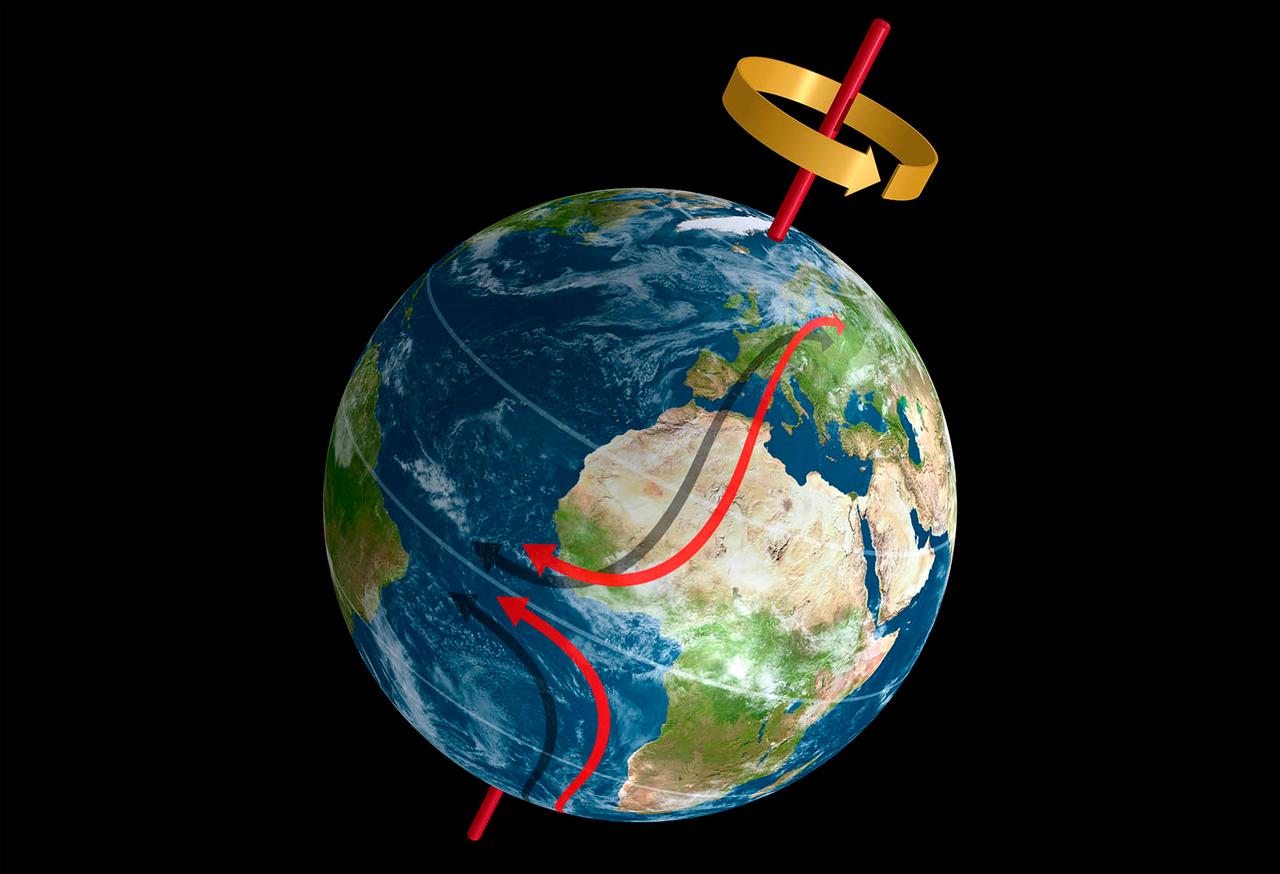
Coriolis Deflection Effect (TÜBİTAK Science Young)
The mathematical analysis of the Foucault pendulum is carried out using differential equations. The motion of the pendulum is modeled by adding Coriolis terms to the equations of a simple harmonic oscillator.
If the latitude is defined as , the angular velocity of the plane’s rotation is expressed as . Here, is the angular velocity of the Earth. This relationship allows the rotation period of the plane to be calculated for experiments conducted at different latitudes. For example, in Paris (approximately 48° latitude), the plane completes a full rotation every 32 hours.
The mathematical model not only confirms the Earth’s rotation but is also applied in research on rotating systems in geophysics and engineering.
The core of the Foucault pendulum experiment lies in suspending a large mass from a long cable. The pendulum is typically installed in buildings with high ceilings to allow free oscillation. To initiate the motion, the sphere is pulled to a specific angle and released. The initially defined plane of oscillation gradually shifts over time, and observers track this change using markers or indicators placed on the ground.
Following the first experiment at the Panthéon, similar setups have been installed in many locations around the world. In particular, in science museums, the Foucault pendulum has become a tangible instrument enabling visitors to observe the Earth’s rotation directly.
The Foucault pendulum is a landmark example of direct empirical validation in modern science. Although the Earth’s rotation had been theoretically accepted since Copernicus, it was Foucault’s experiment that made this knowledge visibly evident to the public.
The pendulum also played a role in popularizing science. Thousands of people visited the exhibition at the Panthéon, generating widespread public interest. Thus, it contributed significantly to the acceptance of scientific knowledge not only within academic circles but also among broad segments of society.
Today, Foucault pendulums can be found in many cities around the world. Universities, science centers, and museums display these devices both as educational tools and as scientific demonstrations. In Türkiye, Foucault pendulum setups have also been installed in some universities and science centers.
Despite technological advances, the Foucault pendulum retains its importance because it demonstrates the Earth’s rotation in a simple and effective manner without requiring complex equipment.
In addition to directly proving the Earth’s rotation, the Foucault pendulum has generated indirect impacts across various fields. It has contributed to the understanding of rotational motion in mechanical systems and has been used in geophysical studies to calculate the Earth’s rotational speed. Moreover, in education, it has helped concretize abstract concepts through experimental demonstrations.
The pendulum is frequently used as an illustrative problem in studies involving differential equations, dynamical systems, and the Coriolis force. In this sense, the Foucault pendulum is not merely an experimental apparatus but also a pedagogical tool.
The Foucault pendulum has become not only a scientific instrument but also a cultural symbol. Its ability to directly demonstrate the Earth’s rotation prompted humanity to reconsider its place in the universe. Following the scientific revolutions, this experiment marked a crucial step in moving away from the geocentric worldview and toward an understanding of celestial bodies moving within a dynamic order.
References to the Foucault pendulum appear in literature and works of art, where the device carries symbolic meanings related to humanity’s position in the cosmos.
Bilimgenc, Tübitak. "Coriolis Saptırma Etkisi Görseli." Accessed August 20, 2025. https://bilimgenc.tubitak.gov.tr/sites/default/files/coriolis_saptirma_etkisi.jpg
Bilimgenc, Tübitak. “Foucault Sarkacı: Dünyanın Döndüğünün İlk Deneysel İspatı.” Accessed August 20, 2025. https://bilimgenc.tubitak.gov.tr/makale/foucault-sarkaci-dunyanin-dondugunun-ilk-deneysel-ispati#:~:text=Foucault%20sarkacı%20fizik%20laboratuvarlarında%20karşılaşabileceğimiz,basit%20sarkacın%20hareket%20doğrultusu%20değişmez
Bilkent University, Department of Physics. "Foucault Pendulum Experiment." Accessed August 20, 2025. https://physics.bilkent.edu.tr/sarkac
Yılmaz, Oktay, and Çılga Misli Uçmaz. “Foucault Sarkacı ve Salınım Düzleminin Hareketi.” DergiPark, Accessed August 20, 2025. https://dergipark.org.tr/en/download/article-file/2569980

Historical Background
Principle of the Experiment
Mathematical Foundations
Implementation of the Experiment
Significance in the History of Science
The Foucault Pendulum Today
Scientific Impacts and Applications
Cultural and Philosophical Dimensions