This article was automatically translated from the original Turkish version.
Approximate Distance | 2,000–3,000 light years (∼600–900 parsecs) | ||||||||
|---|---|---|---|---|---|---|---|---|---|
Angular Size | Approximately 30 arcminutes × 15 arcminutes | ||||||||
Observable Wavelengths | [O III] (500.7 nm) [S II] (671.6 and 673.1 nm) Hα (656.3 nm) | ||||||||
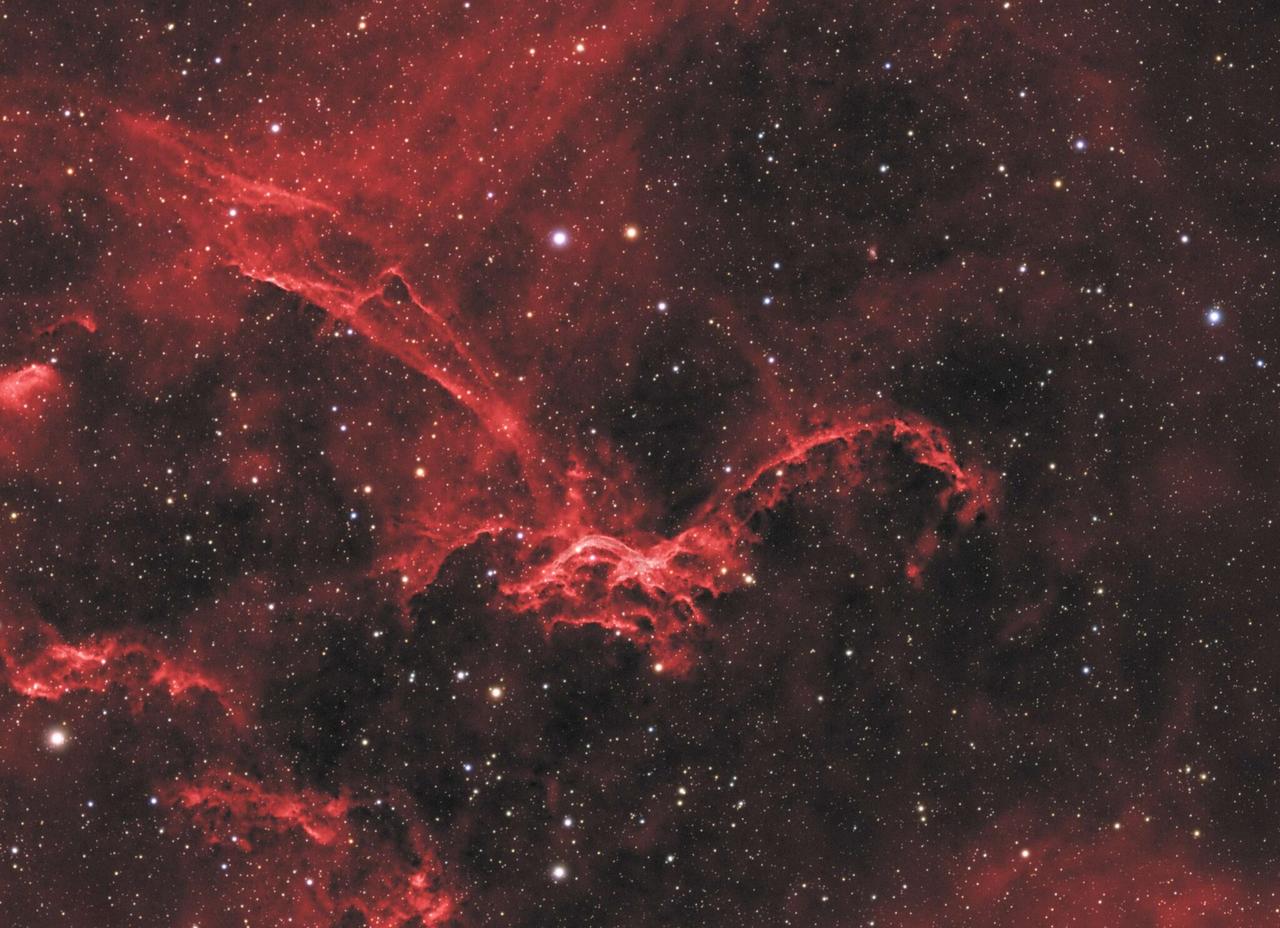
Flying Dragon Nebula (Sh2-114) is an irregular emission nebula composed of highly ionized gas located within the Milky Way Galaxy. Due to its complex morphology and faint brightness, this object has been relatively understudied in astronomical literature for many years. The nebula derives its name from its structure, which resembles a dragon when observed through telescopes in optical wavelengths.
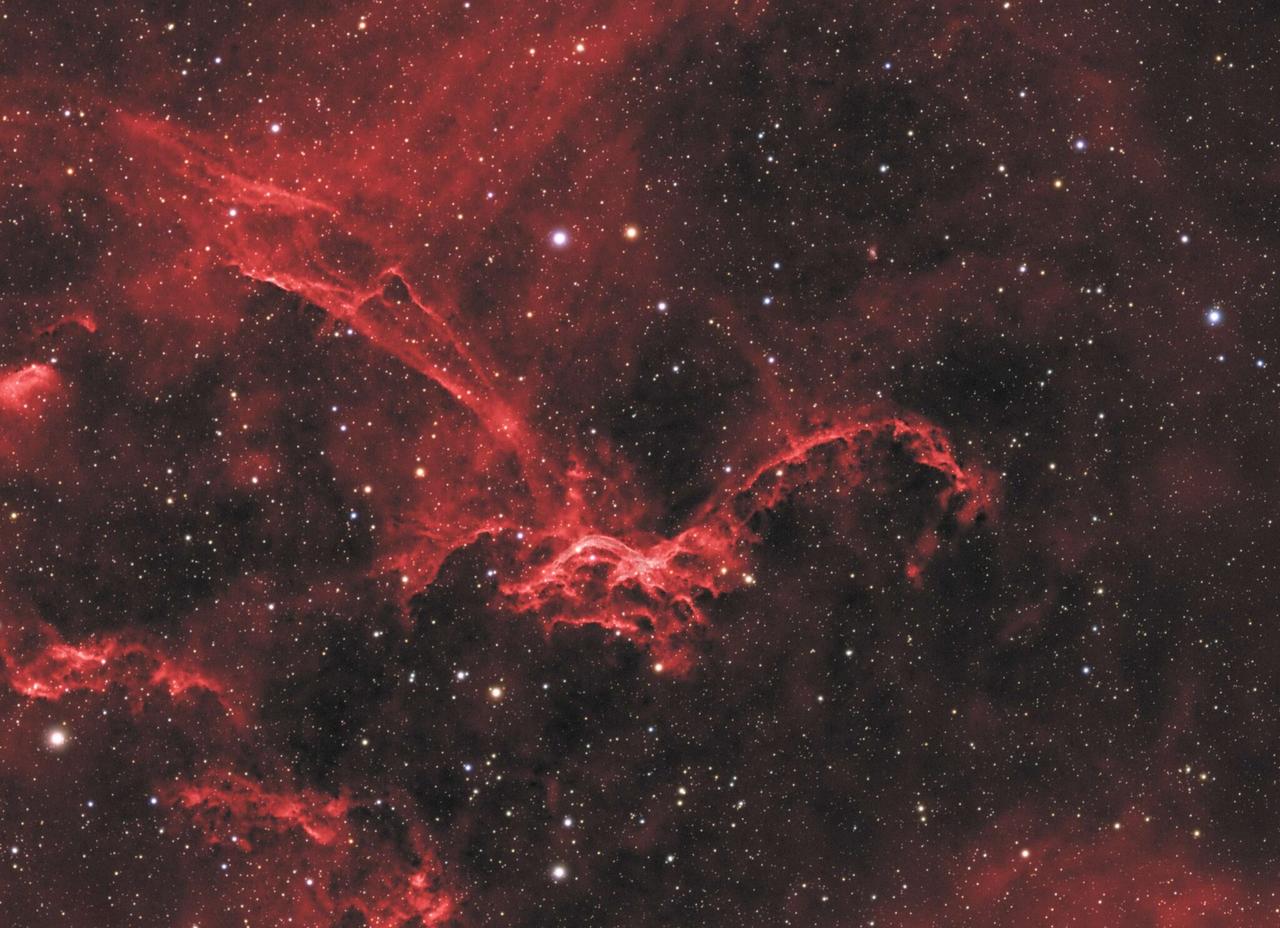
Dragon Nebula (Sky and Telescope)
Sharpless 2-114 (Sh2-114) is listed in the Sharpless Catalogue, compiled by Stewart Sharpless in 1959, as a faint and diffuse emission nebula. Located in the constellation Cygnus, it has a right ascension of 20 hours 38 minutes and a declination of +43° 50′. Sh2-114 is estimated to lie at a distance of approximately 2,000 to 3,000 light years and spans an area of about 30 arcminutes by 15 arcminutes on the sky. With no prominent total brightness and too dim to be visible to the naked eye, its detection is only possible through deep exposure techniques. It is positioned at galactic coordinates l = 82.6° and b = +2.0°.
The Dragon Nebula is a faint emission nebula notable for its irregular, filamentary gas structures, which are especially prominent in the H-alpha (Hα) emission line. In addition to ionized hydrogen, its structure contains ionized forms of helium, nitrogen, and oxygen. The presence of emission lines such as [S II] and [O III], alongside Hα, has sparked debate over whether this object is a classical H II region, a supernova remnant (SNR), or possibly both.
Another striking feature of the Dragon Nebula is the absence of a clearly identified central ionizing star. This uncertainty leaves open questions regarding the source of its ionization and its formation history. Due to the low gas density, its surface brightness is very low, making observation difficult for amateur astronomers. It is typically visible only using narrowband filters (such as Hα, [S II], and [O III]) combined with long-exposure techniques. Its extremely faint visual appearance renders it observable only with specialized equipment.
Sharpless 2-114 (Sh2-114) is a faint emission nebula that can be observed only through specialized techniques such as long-exposure imaging and narrowband filtering. Observations commonly employ narrowband filters such as Hα (656.3 nm), [S II] (671.6/673.1 nm), and [O III] (500.7 nm) to reveal the nebula’s distinct chemical components. This method enables clearer visualization of the distribution and structural details of the ionized gas.
Observations conducted with high-sensitivity CCD cameras have made visible the complex filamentary structure of Sh2-114 by detecting its faint emissions. A significant portion of the highest-resolution images currently available have been captured by amateur astrophotographers using advanced equipment. In terms of radio and X-ray observations, no strong emission has been reported in the literature to date. This absence prevents a definitive determination of whether Sh2-114 is a supernova remnant or a different type of emission structure.
Efforts to classify the nature and origin of Sharpless 2-114 have not reached a definitive conclusion due to its unique morphology and physical properties. Three primary hypotheses have been proposed:
1. H II Region Hypothesis: It has been suggested that Sh2-114 could be an H II region, defined by its ionized hydrogen content and strong H-alpha emission. Such regions form when ultraviolet radiation from young, hot stars ionizes surrounding gas and typically contain a central ionizing star. However, the failure to identify such a central star in Sh2-114 weakens this hypothesis.
2. Supernova Remnant (SNR) Hypothesis: The filamentary gas structure and extended shell-like morphology of the nebula have led some studies to interpret it as the remnant of a supernova explosion. Nevertheless, the lack of detectable emission in radio or X-ray wavelengths has prevented confirmation of this view.
3. Galactic Wind Interaction: A third explanation proposes that interstellar winds interacting with the surrounding medium may have shaped this irregular structure. This model is consistent with Sh2-114’s lack of directional symmetry and filamentary morphology and is considered an alternative origin scenario.
Current observational data remain insufficient to conclusively confirm any of these three scenarios. As a result, the classification of Sh2-114 remains a subject of ongoing debate among astronomers.
Sh2-114 is sometimes regarded as a binary structure in some catalogs alongside Sh2-113, another faint emission region in its vicinity. However, whether these two regions share a common origin remains unclear.
The Flying Dragon Nebula (Sh2-114) is a poorly studied galactic emission nebula distinguished by its morphological complexity, irregular distribution of ionized gas, and faint brightness. Although detailed features have been revealed through technical observations, it remains an object not yet fully classified by astronomers. Higher-resolution observations and multi-wavelength studies will be essential to obtain clearer insights into the origin and nature of Sh2-114.
Astrodoc. "Sh2-114, The Flying Dragon Nebula." *Astrodoc.ca.* Accessed July 16, 2025. https://astrodoc.ca/sh2-114/.
NOIRLab. “Emission Nebula Sh2-114.” *NSF's NOIRLab.* Accessed July 16, 2025. https://noirlab.edu/public/images/noao-sh2-114/.
Sky & Telescope. “Flying Dragon Nebula Sh2-114.” Sky & Telescope. Accessed July 16, 2025. https://skyandtelescope.org/online-gallery/flying-dragon-nebula-sh2-114/.

Approximate Distance | 2,000–3,000 light years (∼600–900 parsecs) | ||||||||
|---|---|---|---|---|---|---|---|---|---|
Angular Size | Approximately 30 arcminutes × 15 arcminutes | ||||||||
Observable Wavelengths | [O III] (500.7 nm) [S II] (671.6 and 673.1 nm) Hα (656.3 nm) | ||||||||
No Discussion Added Yet
Start discussion for "Flying Dragon Nebula (Sh2-114)" article
Location and General Properties
Physical Properties
Observational Challenges and Technical Observations
Origin and Classification Debates
Related Structures