


This article was automatically translated from the original Turkish version.
+1 More
The Floyd-Warshall Algorithm is a method designed to find the shortest paths between all pairs of nodes in graph theory. This algorithm employs a dynamic programming approach and can operate on graphs with both positive and negative edge weights, provided there are no negative-weight cycles. The algorithm was developed independently by Robert Floyd and Stephen Warshall in 1962.
The Floyd-Warshall Algorithm uses a stepwise approach to determine the shortest paths between all pairs of nodes in a graph. At each step, it updates the shortest paths by introducing an intermediate node.
1- Initialization:
2- Dynamic Programming Approach:
Where:
3- Processing All Intermediate Nodes:
4- Result:
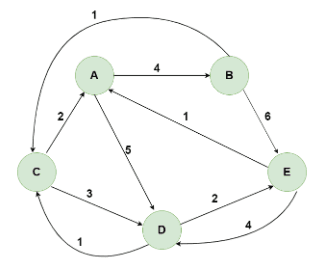
class=\
The time complexity of the Floyd-Warshall Algorithm is O(V³), where V represents the number of nodes. This means the algorithm can be slow for large graphs, but it remains an effective method for computing shortest paths between all pairs of nodes.
GeekforGeeks. (2024). *Floyd Warshall Algorithm.*https://www.geeksforgeeks.org/floyd-warshall-algorithm-dp-16/
Programiz. *Floyd-Warshall Algoritm.*https://www.programiz.com/dsa/floyd-warshall-algorithm
Takeuforward. (2023). Floyd Warshall Algorithm:G-42.

No Discussion Added Yet
Start discussion for "Floyd-Warshall Algorithm" article
Working Principle
Floyd-Warshall Algorithm in Java Code
Time Complexity
Limitations