This article was automatically translated from the original Turkish version.
+1 More
Length(s) | 3 kilometers | ||||||||
|---|---|---|---|---|---|---|---|---|---|
Width | 16 meters | ||||||||
Construction Date(s) | 18 June – 3 July 2016 | ||||||||
Location | Italy Lombardy Lake Iseo | ||||||||
Visitor Access | Open to the Public Free | ||||||||
Founders | Jeanne-Claude Christo | ||||||||
Fabric Color | Bright Orange | ||||||||
Building Type | Modular Floating Pier | ||||||||
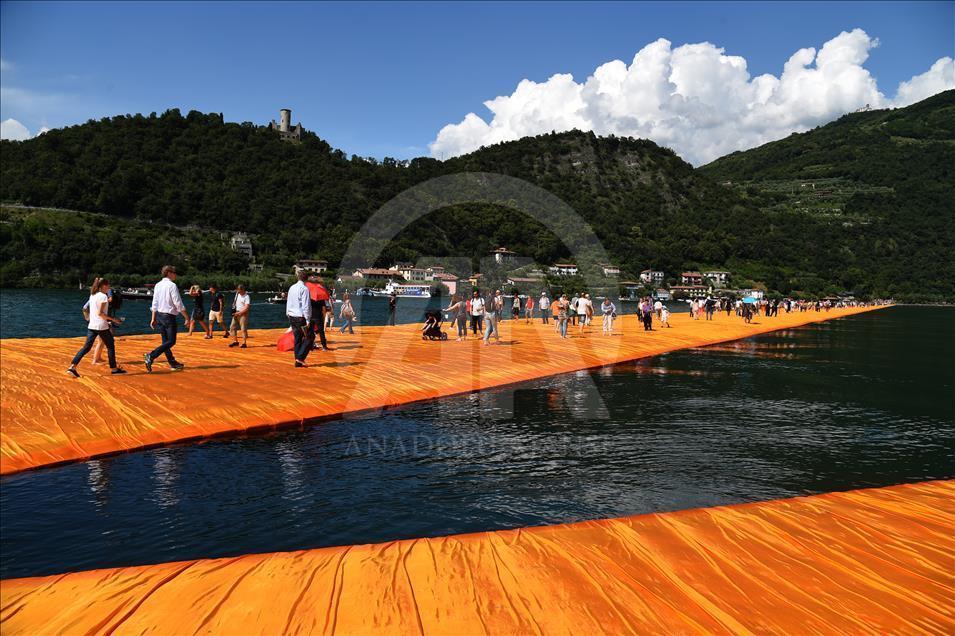
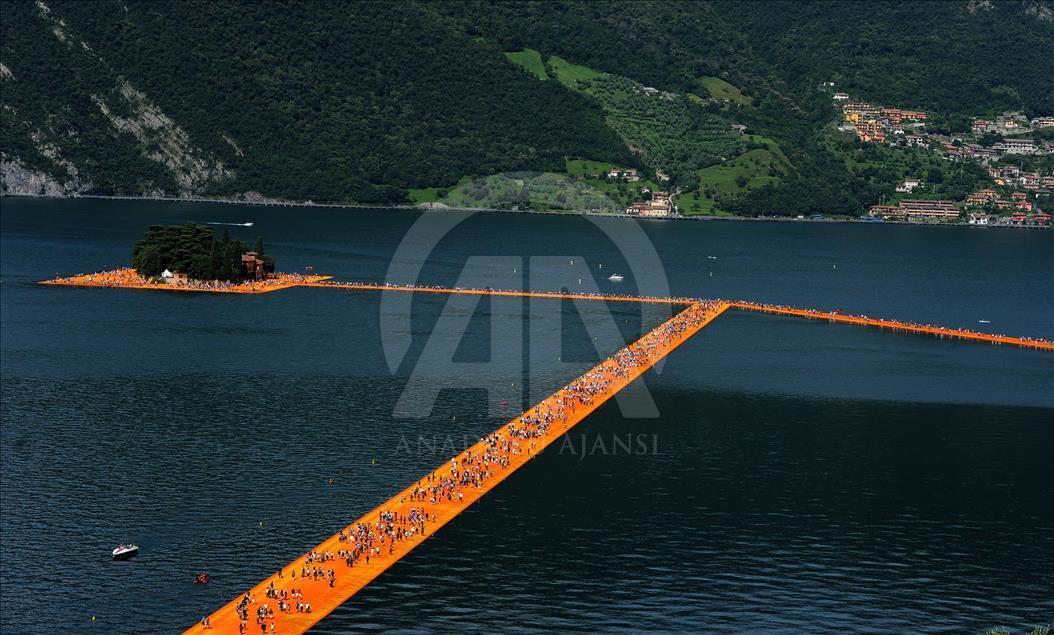
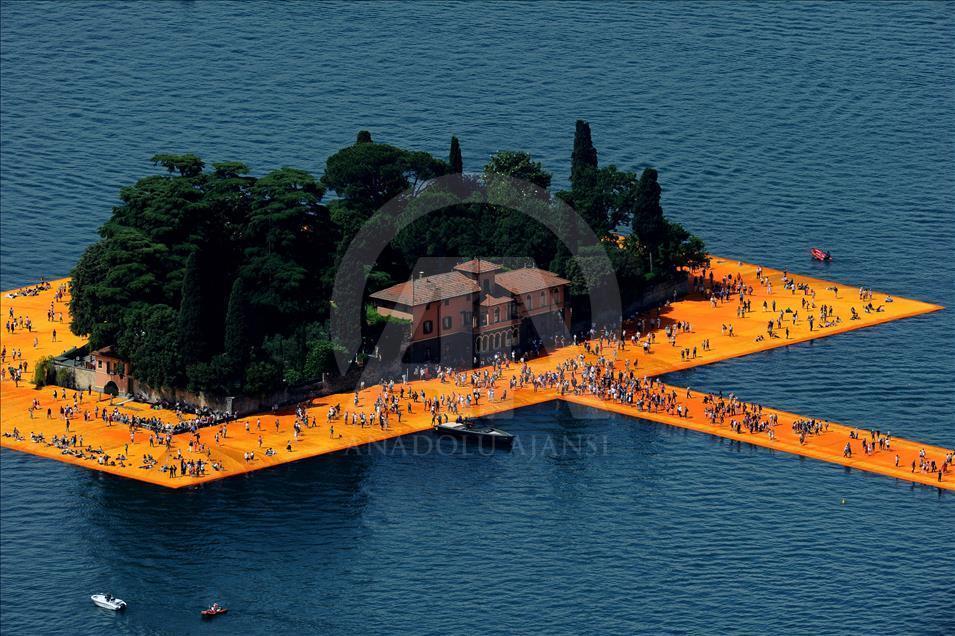
Floating Piers are a temporary floating structure system installed on Lake Iseo in northern Italy between 18 June and 3 July 2016. The floating piers created a walkable path over the water’s surface using bright orange fabric placed atop a modular system of high-density polyethylene cubes. This system extended from Sulzano to the islands of Monte Isola and San Paolo, integrating seamlessly with the lake’s natural topography and offering visitors an experience of walking on water.
The installation of the Floating Piers began in the Montecolino region of northern Italy. The modular cubes were assembled in segments, transported to the lake and placed on the water. Anchoring systems submerged beneath the surface secured each segment, ensuring the piers’ stability against waves. During installation, French divers were assigned to mount the underwater anchors, and teams worked to align all segments precisely.
Floating Piers (Anadolu Ajansı)
The fabric covering and walkway surfaces were installed after the piers were placed on the water. The fabric was unfurled and tensioned over the modular cubes by specialized teams. After the project’s completion, all components were dismantled and the majority of materials were recycled to industrial standards. This process was planned in accordance with the structure’s temporary nature and aimed to minimize environmental impact.
The Floating Piers were designed by Christo and Jeanne-Claude, conceived as a walkway across the lake’s surface using a textile covering placed over modular floating cubes. The overall design was carefully integrated with the lake and its surrounding natural landscape. The system was positioned to gently respond to the water’s movement, creating a subtle undulating effect. The project’s goal was to offer visitors a unified experience of walking on water.
The Floating Piers were constructed on a modular floating system composed of 220,000 high-density polyethylene (HDPE) cubes.【1】 These cubes were interconnected to form a stable platform on the lake’s surface, designed to respond to slight water movements. Thanks to their modular structure, the piers could be assembled in segments of varying sizes and shapes, creating a continuous walkway stretching from Sulzano to Monte Isola and San Paolo.
The system’s lightness and flexibility enabled it to adapt to the lake’s natural wave motion while maintaining durability over extended use. The production of the floating cubes was carried out by four different Italian companies, each undergoing rigorous quality control procedures.
Floating Piers (Anadolu Ajansı)
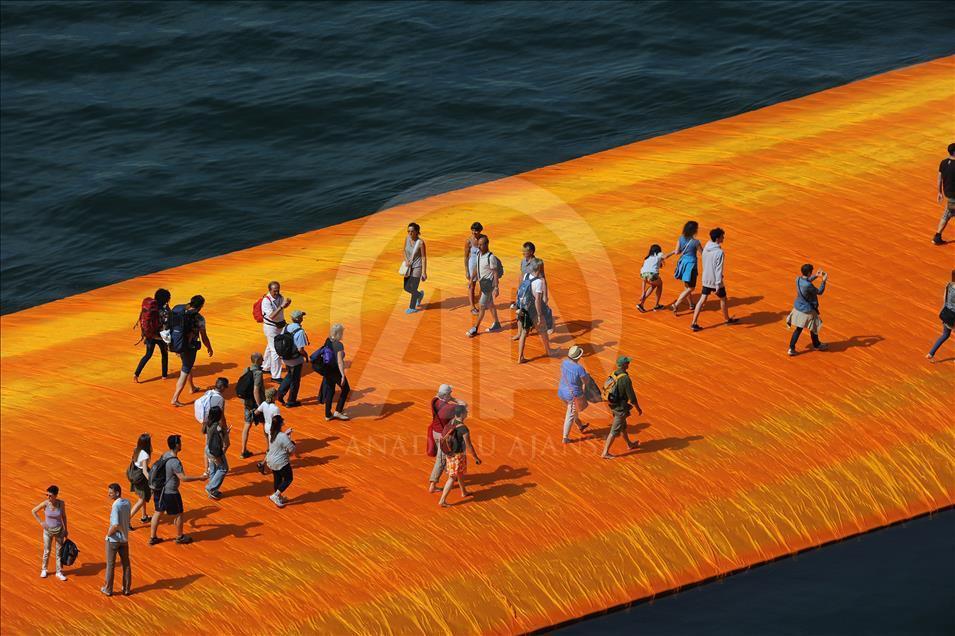
The fabric chosen for the Floating Piers consisted of 100,000 square meters of bright orange woven material, designed to create a striking visual contrast against the lake’s surface.【2】 The orange color interacted with daylight and water reflections, shifting into shades of red and gold and altering the perception of the structure from different viewpoints. The fabric was engineered for durability and flexibility and installed with precise tension over the modular system.
The Floating Piers were built on a modular system that formed a stable platform over the lake. The overall design was engineered to be flexible and resilient, accommodating the water’s undulating motion. The piers were elevated slightly above the water level, providing a safe walking path without disrupting the lake’s natural appearance. The integrity of the structure was maintained by connecting the segments, creating a continuous platform along the entire length of the piers.
The Floating Piers were designed to form a walking path approximately three kilometers in total length. The piers are 16 meters wide and positioned about 35 centimeters above the water surface, with gently sloping edges.【3】 These dimensions ensured both safety and comfort for pedestrians.
The modular cube system was assembled in 100-meter-long segments. Connecting to pedestrian pathways in Sulzano and Peschiera Maraglio, the system added over 2.5 kilometers of additional walkway, transforming the lake’s connections into a continuous pedestrian route.【4】 This design enabled visitors to experience the lake and its surroundings from multiple perspectives.
Floating Piers (Anadolu Ajansı)
The Floating Piers were designed to respond directly to the lake’s waves through their modular cube structure. The lightness of the cubes and their flexible connections allowed the piers to remain stable on undulating water while producing subtle movements that gave the structure the appearance of flowing naturally with the environment. This feature contributed to both the safety and comfort of the walking experience for visitors.
The floating system was assembled in segments and positioned according to the lake’s depth and surface conditions. Each segment was engineered to withstand the lake’s variable water movements and weather conditions, with underwater anchors securing the system’s integrity. This structural approach supported both short-term use and safety during installation.
The Floating Piers provided visitors with a direct experience of walking across the lake, connecting Sulzano to Monte Isola and San Paolo. Due to the structure’s temporary nature, access was free to all visitors with no tickets, reservations, or ownership systems in place. Visitors walking along the piers could view the structure from different angles against the surrounding mountains and observe the shifting color tones created by light reflecting off the fabric. Over its 16-day duration, the project attracted large crowds and functioned as both an aesthetic landmark and a vibrant social space.
Anadolu Ajansı. “İtalya’da yüzen iskele.” Anadolu Ajansı, June 18, 2016. Accessed February 27, 2026. https://www.aa.com.tr/tr/pg/foto-galeri/italyada-yuzen-iskele-
Christo and Jeanne-Claude. “The Floating Piers, Lake Iseo, Italy, 2014–16.” *Christo and Jeanne-Claude website.* Accessed February 27, 2026. https://christojeanneclaude.net/artworks/the-floating-piers/
Politecnico di Milano. "Floating Habitat." Floating Habitat website. Accessed February 27, 2026. https://floatinghabitat.polimi.it/
Visit Lake Iseo. “The Floating Piers.” Visit Lake Iseo website. Accessed February 27, 2026. https://visitlakeiseo.info/arte-e-cultura/the-floating-piers/
Visit Monte Isola. "The Floating Piers." Visit Monte Isola website. Accessed February 27, 2026. https://www.visitmonteisola.it/arte-e-cultura/the-floating-piers/
[1]
Christo and Jeanne‑Claude, “The Floating Piers, Lake Iseo, Italy, 2014‑16,” Christo and Jeanne‑Claude website, Last Access: 27 February 2026, https://christojeanneclaude.net/artworks/the-floating-piers/
[2]
A.e.,
[3]
A.e.,
[4]
A.e.,

Length(s) | 3 kilometers | ||||||||
|---|---|---|---|---|---|---|---|---|---|
Width | 16 meters | ||||||||
Construction Date(s) | 18 June – 3 July 2016 | ||||||||
Location | Italy Lombardy Lake Iseo | ||||||||
Visitor Access | Open to the Public Free | ||||||||
Founders | Jeanne-Claude Christo | ||||||||
Fabric Color | Bright Orange | ||||||||
Building Type | Modular Floating Pier | ||||||||
Installation and Dismantling Process
Architectural Design
Materials and Modular System
Fabric Covering and Color Selection
Technical Features
Surface Dimensions and Length
Interaction with Water and Floating System
Usage and Visitor Experience