


This article was automatically translated from the original Turkish version.

Fleming and Mill Learning Style Model (VARK)
Description | Modern teaching methods are activity-based and aim to fully engage students' minds in the learning process. Individual differences among students are emphasized, and learning styles have been studied in this context. | ||||||||
|---|---|---|---|---|---|---|---|---|---|
Learning Styles and Personal Differences | Using teaching methods suited to individuals can enhance their academic success. Each individual's learning process is different, and individual differences determine learning styles. | ||||||||
Fleming & Mill (VARK) Learning Style Model | Kinesthetic: They learn through experiential and practical activities involving physical movement. Read-Write: They learn by taking notes, reading written texts, and summarizing them. Aural: They learn by listening, participating in discussions, and repeating aloud. Visual: They learn through diagrams, maps, graphs, and written materials. | ||||||||
Modern teaching methods, known as activity-based approaches, focus primarily on activities and aim to fully engage the student’s mind in the learning process. In modern teaching methods, the student is the primary consideration in curriculum design and planning. Special importance is given to individual differences among students. Numerous factors influence the process of knowledge acquisition, including society, family, emotions, past experiences, prior assumptions, ability, skill, intelligence, and social environment... The combinations of these factors lead to variations in learning pathways and adaptation to knowledge, resulting in each individual exhibiting a subjective learning style. These individual differences have driven research into learning styles.
According to the Turkish Language Association (TDK), style is a person’s unique way of expressing their views, feelings, and understanding. A learning style can be defined as the individual’s unique manner of comprehending and internalizing acquired knowledge. Learning styles are personal and therefore constitute an individual difference. Learning style models, on the other hand, aim to establish a general structure for learning styles. Many learning style models exist. The 14 most well-known models are presented in Figure 1. Among these, the Fleming & Mill learning style model is discussed in this text.
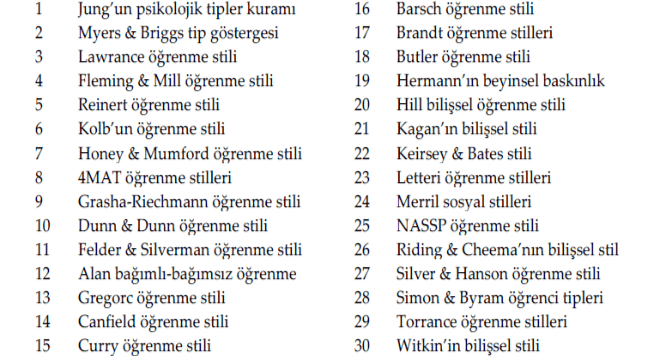
class=\
Developed by Neil Fleming in 1987, it is also known as the VARK or VAK model. The acronym VARK or VAK stands for the following terms in English:
General characteristics are as follows:
This style involves the use of visible and observable elements. Learners with this style acquire information best when it is presented visually or in written form. In a classroom setting, they learn effectively from instructors who use visual aids such as whiteboards and presentation tools to highlight key terms and important points. Textbooks and notes are essential for their learning. These learners prefer studying alone in quiet environments. To recall learned information, they use visualization techniques (mental imagery). Some personality traits of visual learners may include:
They understand through self-talk and listening. Individuals with this learning style acquire information most effectively when it is presented verbally. In class, they learn well by listening to lectures, participating in active group discussions, and, if available, reviewing audio recordings. They recall learned information by repeating it aloud. Some personality traits of auditory learners may include:
According to the Turkish Language Association (TDK), kinesthetic refers to the use of the sense of touch as the primary means of interpretation or thought formation. Kinesthetic learning involves physical experiences such as touching, feeling, active participation, and hands-on application. Individuals with this learning style learn best through physical activities and direct experiences. In the classroom, they acquire knowledge by using materials and experimenting through trial and error. Effective learning for them requires classroom activities in which they actively participate and experience. Some personality traits of kinesthetic learners may include:

class=\
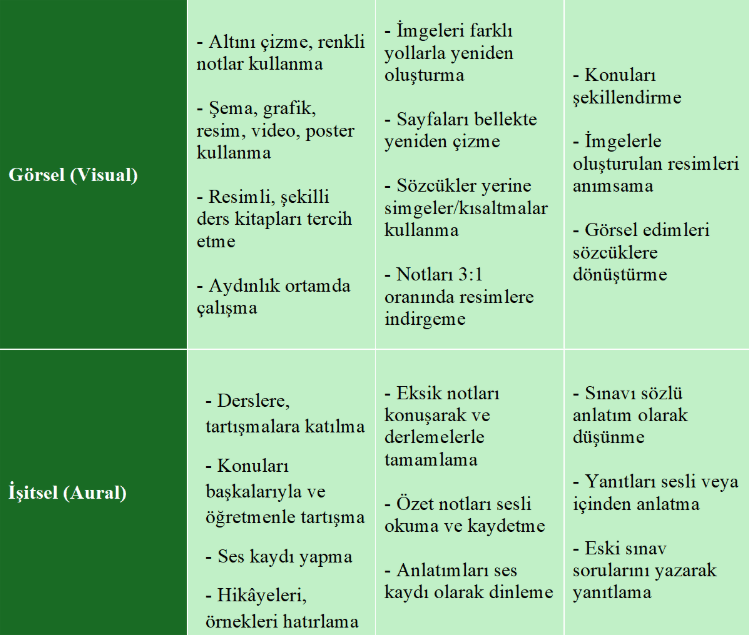
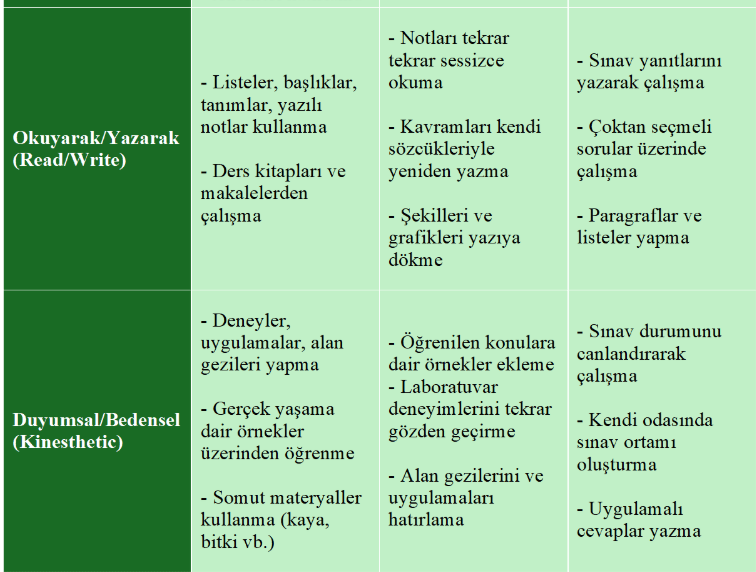
If your learning preferences are multimodal, you are in the majority (50–70%). This means you can effectively combine two (V-A, R-K), three (V-A-R, A-R-K), or all four (V-A-R-K) learning styles.
Multimodal learners can easily adapt to different environments due to their flexibility, but they may need to combine multiple strategies to achieve effective learning.
Turk Dil Kurumu (TDK). "Güncel Türkçe Sözlük." TDK. Accessed February 18, 2025.https://www.tdk.gov.tr
Usta, İlker. "Uzaktan Öğrenenlerin Öğrenme Biçimlerinin İncelenmesi." Bilecik Şeyh Edebali Üniversitesi Sosyal Bilimler Dergisi 4, no. 1 (2019): 371-384.
VARK Learn. "Öğrenme Stilleri." Accessed February 18, 2025.http://vark-learn.com/home-turkish
Yeşilyurt, Etem. "Öğrenme Stili Modelleri: Teorik Temelleri Bağlamında Kapsayıcı Bir Derleme Çalışması." *OPUS International Journal of Society Researches* 14, no. 20 (2019): 2169-2226.https://doi.org/10.26466/opus.603506.

Fleming and Mill Learning Style Model (VARK)
Description | Modern teaching methods are activity-based and aim to fully engage students' minds in the learning process. Individual differences among students are emphasized, and learning styles have been studied in this context. | ||||||||
|---|---|---|---|---|---|---|---|---|---|
Learning Styles and Personal Differences | Using teaching methods suited to individuals can enhance their academic success. Each individual's learning process is different, and individual differences determine learning styles. | ||||||||
Fleming & Mill (VARK) Learning Style Model | Kinesthetic: They learn through experiential and practical activities involving physical movement. Read-Write: They learn by taking notes, reading written texts, and summarizing them. Aural: They learn by listening, participating in discussions, and repeating aloud. Visual: They learn through diagrams, maps, graphs, and written materials. | ||||||||
No Discussion Added Yet
Start discussion for "Fleming and Mill Learning Style Model (VARK)" article
Fleming & Mill Learning Style Model (VARK)
Visual Learning Style
Auditory Learning Style
Kinesthetic (Tactile) Learning Style
MULTIMODAL LEARNING STRATEGIES