


This article was automatically translated from the original Turkish version.
Fine-tuning in artificial intelligence is the process of adapting a pre-trained model to a specific task or dataset. This approach enables the model to respond more effectively to new data while preserving its existing knowledge. It is widely used especially in large language models (LLMs) and deep learning systems.
Fine-tuning is a powerful technique that helps extract additional information from data. To understand fine-tuning, one must first understand transfer learning. Transfer learning is a machine learning technique in which a model trained on one task is re-purposed for a second related task. During this process, some layers of the trained model are frozen to remain unchanged while other layers are retrained using new data. This allows the model to retain its general knowledge while developing task-specific capabilities. Fine-tuning is applied when the available data is insufficient to train a model from scratch and consists of relatively small datasets.
Farklı görevler için yapay zeka kullanmak tasviri (Freepik)
Fine-tuning in large language models is the process of retraining a model that has been previously trained on extensive data, to specialize it for a particular task or dataset. This method preserves the model’s general language understanding while improving accuracy and contextual relevance in the target domain. For example, a language model fine-tuned on customer support texts can provide more appropriate and accurate responses to technical support queries. Typically, only a portion of the model’s parameters are updated during this process, which conserves computational resources and helps prevent the model from forgetting its prior knowledge.
Fine-tuning allows you to customize a pre-trained large language model to excel at a specific task without affecting all of its parameters. Compared to prompt engineering, fine-tuning offers several additional advantages:
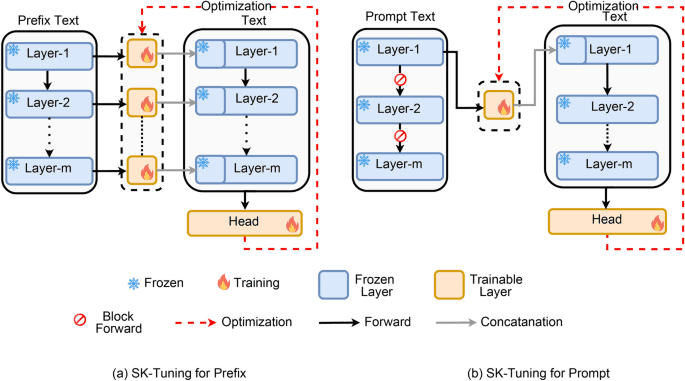
Fine Tuning şeması Prottasha vd. (2024)
One of the most critical steps in fine-tuning large language models is dataset preparation. This phase directly affects the model’s ability to perform effectively on the target task. The dataset must be high-quality, aligned with the target task, and as balanced as possible.
Before constructing the dataset, the target task for the model must be clearly defined. For example, if the goal is to develop a conversational assistant, dialogue data is required; for sentiment analysis, labeled text data is needed. Data is collected from appropriate sources based on the task definition. These sources may include publicly available datasets, internal company documents, user interactions, or human-generated specialized texts.
The collected data undergoes a standard preprocessing pipeline for natural language processing. During this process, spelling errors are corrected, unnecessary symbols are removed, and inconsistencies are resolved. If the model is to be trained on structured data—for example, question-answer pairs—the text is converted into the appropriate format.
For supervised fine-tuning, the data must be appropriately labeled. This labeling process can be performed manually or, in some cases, using automated rules. For example, in a classification task, each text must be assigned the correct class label. Additionally, the data must be formatted to match the model’s input structure—for instance, using a “prompt-response” format.
To enable balanced learning, attention must be paid to class balance within the dataset. Otherwise, the model may become biased toward classes with more examples. Low-quality, contradictory, or semantically incorrect data must be removed. In some cases, working with a small but high-quality dataset can be more efficient than using a large but disorganized one.
When preparing the dataset, any data containing personal or sensitive information must be anonymized. This is an essential step both ethically and legally. Data protection regulations such as GDPR and KVKK must be taken into account.
Google Cloud Blog. Huizenga, Erwin and May Hu. “When to Use Supervised Fine-Tuning for Gemini.” Google Cloud Blog. Accessed May 16, 2025.Accessed Adresi.
Microsoft. "Yapay Zeka Modeli İnce Ayarlama Kavramları." Microsoft Learn. Accessed May 16, 2025.Accessed Adresi.
OpenAI. "Fine-Tuning." OpenAI Platform. Accessed May 16, 2025.Accessed Adresi.
Prottasha, N. J., A. Mahmud, M. S. I. Sobuj, et al. “Parameter-Efficient Fine-Tuning of Large Language Models Using Semantic Knowledge Tuning.” Scientific Reports 14, no. 30667 (2024).Accessed Adresi.
Zhang, Shengyu, et al. “Instruction Tuning for Large Language Models: A Survey.” Accessed May 16, 2025.Accessed Adresi.

Fine-Tuning Technique
Fine-Tuning in Large Language Models
Types of Fine-Tuning for Large Language Models
Dataset Preparation
Task Definition and Data Selection
Cleaning and Preprocessing
Labeling and Task Formatting
Data Quality and Balance
Anonymization and Privacy