


This article was automatically translated from the original Turkish version.
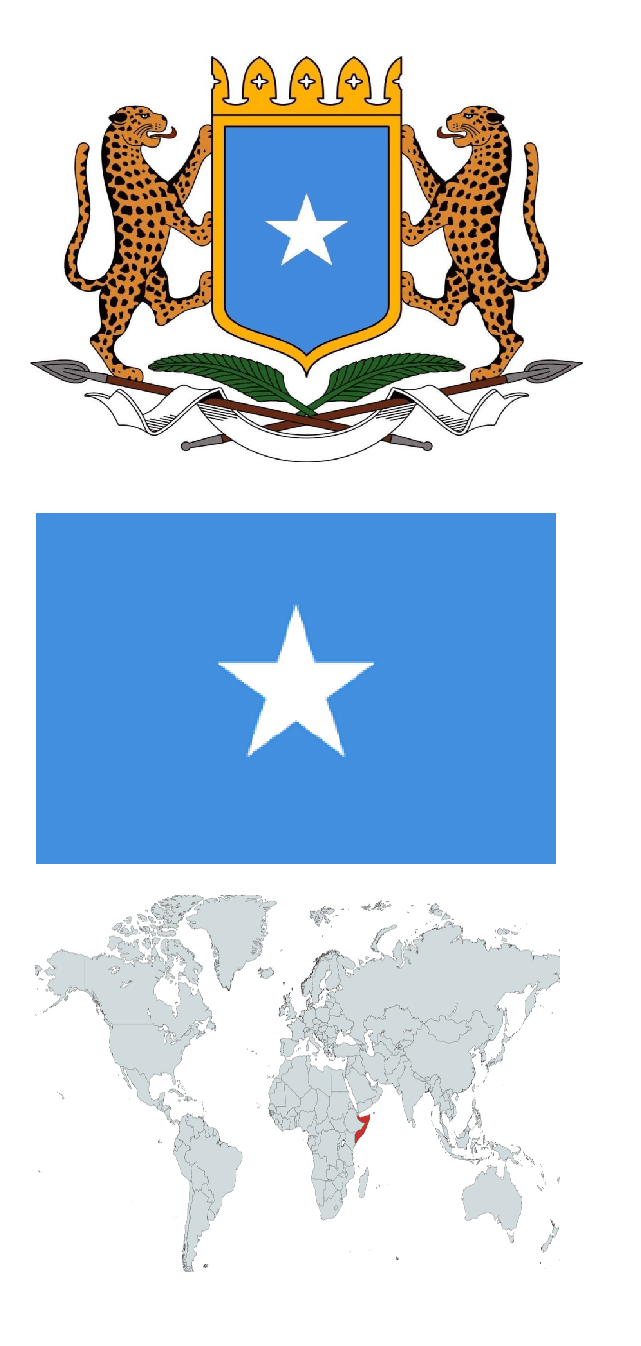
Official Name | Federal Republic of Somalia | ||||||||
|---|---|---|---|---|---|---|---|---|---|
Form of Government | Federal Republic | ||||||||
Date of Independence | 1 Temmuz 1960 (İtalyan ve İngiliz Somalilerinin birleşmesi) | ||||||||
Capital | Mogadishu (Muqdisho) | ||||||||
Head of State | Hassan Sheikh Mahmud (in office: 2022–) | ||||||||
Official Language | Arabic Somali | ||||||||
Common Languages | English, Italian | ||||||||
Religious Affiliation | Almost the entire population is Muslim (%99 Sunni – Shafi'i school) | ||||||||
National Day | 1 July (Independence Day) | ||||||||
Area | 637,657 km² | ||||||||
Total Population | 15.4 million (2025) | ||||||||
Climate | Irregular rainfall and seasonal droughts High temperatures throughout the year Semi-arid and tropical | ||||||||
GDP (Nominal) | 5.8 billion US dollars (2010) | ||||||||
GDP per Capita | Approximately 500 US dollars | ||||||||
Ethnic Groups | Somali (>85%) Bantu (~%5) Arabs and other minorities (%10) | ||||||||
Telephone Code | 252 | ||||||||
Internet Domain Code | so | ||||||||
The Federal Republic of Somalia is strategically located at the eastern tip of the Horn of Africa, between the Red Sea and the Indian Ocean. Bordered by Djibouti to the northwest, Ethiopia to the west, and Kenya to the southwest, the country possesses a coastline of approximately 3,000 kilometers, making it a vital transit point for regional trade and maritime transport.
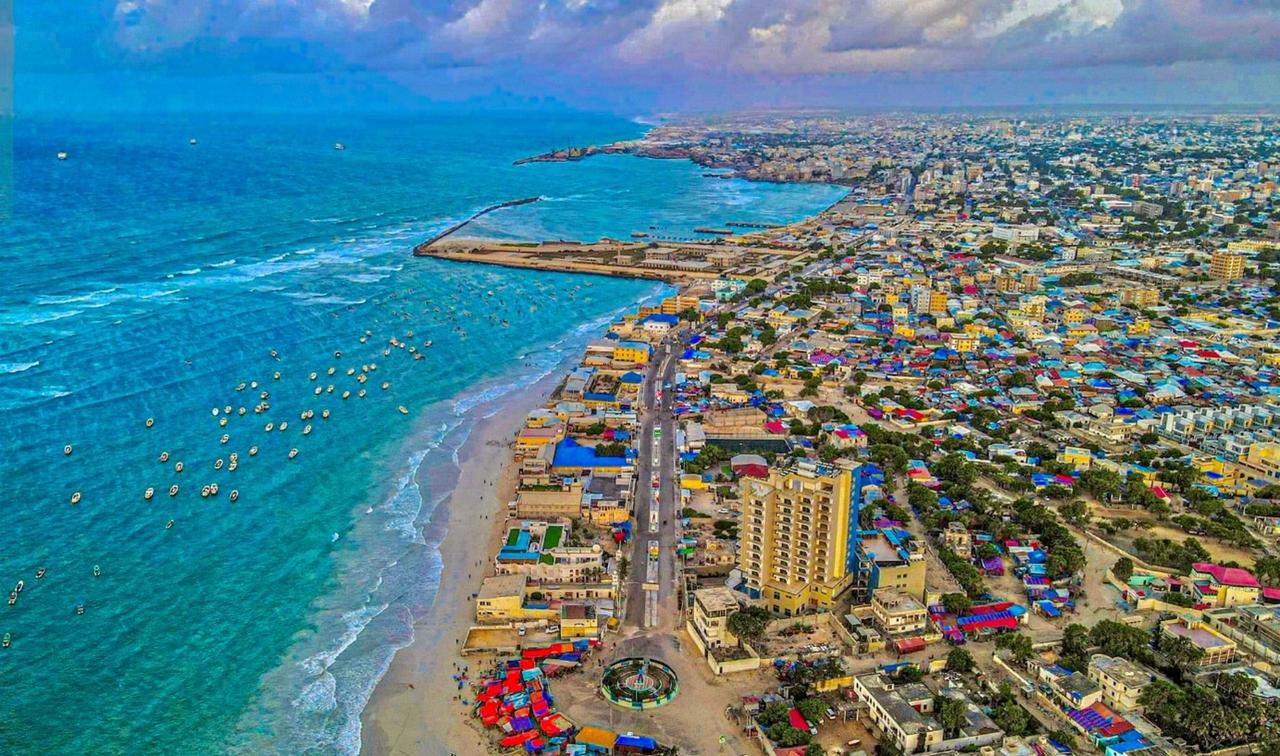
View from Mogadishu, the Capital of Somalia (Federal Republic of Somalia)
Somali society is largely unified around a single ethnic identity, language, and religion. The majority of the population identifies as ethnically Somali, speaks the Somali language, and practices Islam. The five points of the white star on the Somali flag symbolize the regions historically inhabited by the Somali people: Somaliland, South Somalia, Djibouti, Ogaden, and Northern Kenya.
Throughout history, the region was ruled by sultanates such as Ifat, Adal, and Ajuran. In the 19th century, it was divided between British and Italian administrations; in 1960, the independent Somali Republic was established. However, following the collapse of the central government in 1991, the country entered a prolonged period of civil war and reconstruction.
Today, Somalia has a federal structure, and its economy is largely based on agriculture, livestock, and remittances from the diaspora. Due to its geopolitical position, it is engaged in security and reconstruction efforts supported by actors such as the African Union, Türkiye, the United States, and the European Union. Somalia maintains a historical bridge between Africa and the Arab world through its cultural heritage, poetry, and seafaring traditions.
Somalia’s national anthem, “Qolobaa Calankeed” (Every Nation Has Its Own Flag), is a significant composition symbolizing the nation’s struggle for independence and national unity. The lyrics and music were composed by Abdullahi Qarshe and first emerged in the 1950s as a national symbol during Somalia’s process of gaining independence from colonial rule. It was officially adopted as the national anthem by the new constitution of 1 July 2012. The anthem elevates the Somali people’s spirit of independence, shared identity, and the meaning of the Somali flag with its five-pointed star on a blue background.
The anthem, lasting approximately two minutes, has a moderate tempo built on traditional melodies. Qolobaa Calankeed incorporates musical elements from both local rhythms and classical national anthem forms. It replaced the previous anthem, Soomaaliyeey toosoo (Awaken, Somalia), which was in use until the 2000s, offering a more inclusive and modern emphasis on national unity. Today, Somalia’s national anthem is sung at state ceremonies, international events, and national holidays as one of the strongest cultural symbols of Somali identity.
Somali National Anthem (Urumaxi Anthems)
In ancient sources, Somali territories were known to the ancient Egyptians as Punt. The region was described by geographers from the 1st century CE onward and came under the dominion of the Aksumite Kingdom in Ethiopia by the 3rd century. Trade across the Gulf of Aden turned Somali coasts into hubs for Arab and Persian merchants. During this period, cities such as Zeila (Seylac) and Mogadishu gained importance through the trade in slaves, coffee, and amber.
With the settlement of Arab tribes along the Somali coast from the 8th century onward, Islam spread throughout the region, and Zeila and Mogadishu became Muslim trading centers. In the 13th century, the Mogadishu Sultanate was established under the leadership of Abu Bakr ibn Fakhr al-Din, and the city flourished economically during these centuries.
Muslim communities in the Horn of Africa waged prolonged struggles against the Christian Kingdom of Abyssinia. During this period, the Adal Sultanate, centered in Zeila, gained strength under the leadership of Ahmed ibn Ibrahim al-Ghazi (Ahmed Gran) and launched major campaigns against the Abyssinian Kingdom in the mid-16th century. The Ottoman Empire provided Ahmed ibn Ibrahim with firearms support. After Ahmed ibn Ibrahim’s death in 1543, the Adal Sultanate weakened, but the Ottomans annexed Zeila in 1559 and incorporated the region into the Habesh Eyalet.
Alongside the Adal Sultanate and other smaller sultanates, large political formations such as the Ifat Kingdom (12th–15th centuries) and the Adal Kingdom (15th–17th centuries) also emerged. In the early 18th century, some of the major port cities along the East African coast came under the protection of the Oman Sultanate and later the Zanzibar Sultanate. However, the northern Somali port cities of Zeila and Berbera remained under the protection of the Sharif of Mecca and were indirectly tied to the Ottoman Empire.
In the second half of the 19th century, Somalia’s strategic location attracted European powers. Britain’s interest in Somalia began with the occupation of Aden in 1839 to secure the route to India; during the same period, France colonized the Obock (Djibouti) region, while Italy established influence along the Benadir coast (Berawa, Merca). In response, the Ottoman Empire incorporated the Somali coast into the Egyptian Vilayet in 1865. In the 1870s, Egypt’s Khedive Ismail Pasha assumed control of the Somali coastal regions on behalf of the Ottomans, but this authority was short-lived due to British pressure.
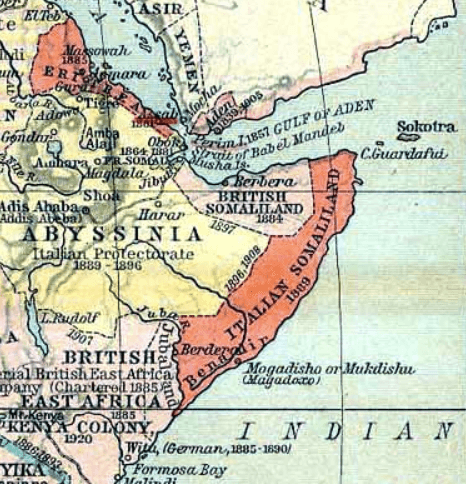
Map Showing the Colonial Period in East Africa (British Empire)
The Benadir coast, under the influence of the Zanzibar Sultanate, was divided among European powers from the 1880s onward. Britain seized Zeila, Berbera, and Tugur, establishing the Somaliland colony. Italy, meanwhile, took control of the southern coastal cities of Benadir (Berawa, Merca).
Resistance movements against colonialism strengthened during this period. The Dervish State, founded by Muhammad Abdullah Hassan, repelled British forces four times along the coast and waged a two-decade-long resistance movement. Supported by the Ottomans, this movement ended after the death of Imam Muhammad in 1920. After prolonged conflicts, Somali territories were divided into three distinct colonies: British Somaliland, Italian Somaliland, and French Somalia (Djibouti). This division persisted until Somalia’s independence in 1960.
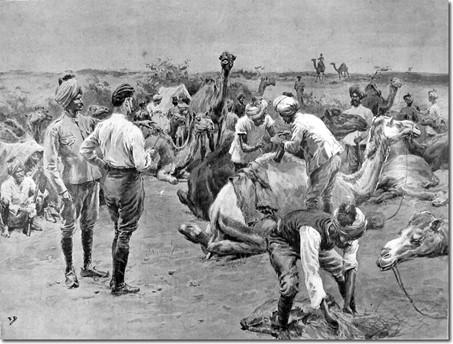
Image showing the Bikanir Camel Corps from India participating in its first operation against the forces of Muhammad Abdullah Hasan in 1903 British Empire)
During World War II, Somali territories changed hands between British and Italian forces. After the war, organizations such as the Somali Youth League and the Somali Youth Club launched the independence struggle. In 1948, a commission of major powers referred Somalia’s future to the United Nations. That same year, the Ogaden region was transferred to Ethiopia, while British Somaliland was placed under Italian administration for ten years.
In accordance with a 1949 UN resolution, Somalia was to achieve independence within ten years. Under a plan implemented on 1 April 1950, the territories from Djibouti to Kenya were collectively named “Somalia.” As a result, on 1 July 1960, British and Italian Somalilands united to proclaim the Somali Republic as an independent state.
After independence, Aden Abdullah Osman was elected president, and the country was briefly governed under a parliamentary system. The newly formed government sought to realize the goal of a “Greater Somali State” by uniting Somali communities in neighboring regions, but this policy generated tensions with neighboring countries. Democratic decay, economic hardship, and clan-based fragmentation increased social unrest.
In 1967, Abdurashid Ali Shermarke became president but was assassinated in 1969. On 21 October 1969, a military coup led by General Muhammad Siad Barre overthrew the government, and the state’s name was changed to the Somali Democratic Republic.
On 21 October 1969, a coup led by General Muhammad Siad Barre changed the state’s name to the Somali Democratic Republic, and the country aligned itself with the socialist bloc.
In the early years, Barre prioritized infrastructure projects and later strengthened ties with the Soviet Union. In 1970, a socialist system was declared, and in 1974, drought and economic problems pushed the country toward membership in the Arab League. In 1975, taking advantage of unrest in Ethiopia, the Somali army, alongside the Western Somali Liberation Front, launched an offensive into the Ogaden region. Initially successful, the Somali army was forced to retreat after the Soviet Union shifted its support to Ethiopia.
Following the war, economic difficulties deepened, and the regime’s authoritarian practices intensified. Although a military cooperation agreement was signed with the United States in the 1980s, social unrest and opposition movements grew, leading the country into civil war by 1991.
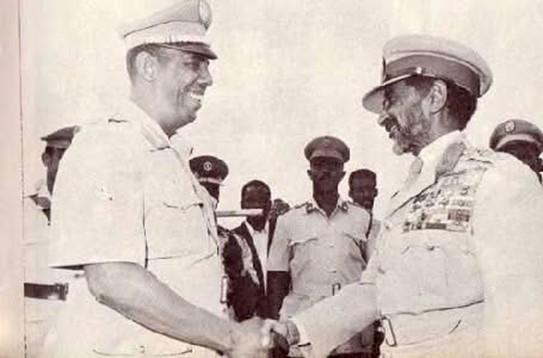
Somali State President Siad Barre (left) meets with Emperor Haile Selassie of Ethiopia in 1974, before the invasion of Ethiopia’s Ogaden province. (SLN)
After the overthrow of Siad Barre in 1991, rival factions began fighting for power, and the country effectively fragmented into clan-based administrative regions. With the collapse of central authority, state institutions became dysfunctional, and drought and famine caused the deaths of tens of thousands. Over 50,000 people died during this period, and hundreds of thousands perished from starvation. In 1991, the Somaliland region unilaterally declared independence but was not recognized by the international community.
The United Nations launched the Operation Restore Hope in 1992 for humanitarian intervention, followed by the deployment of UNOSOM I and UNOSOM II peacekeeping forces. However, a perception emerged among the local population that UN forces pursued imperialist objectives, contributing to the mission’s failure.
The deaths of 18 American soldiers during clashes in Mogadishu on 3 October 1993 (the “Black Hawk Down” incident) marked the end of international intervention, prompting the United States and other countries to withdraw their forces. By 1995, UN troops had fully departed, and fighting continued.
During this period, Somaliland (1991) and later the Puntland region (1998) declared autonomy, but neither received international recognition.
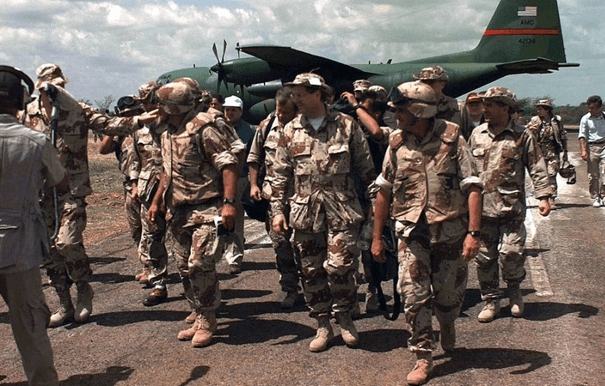
Photograph of U.S. Marine officers escorting a U.S. Congressman down an airstrip in Baidoa during Operation Restore Hope (Nara Getarchive)
In 2000, under United Nations supervision and with the participation of four major clans, the Transitional Federal Government (TFG) was established. In 2004, Abdullahi Yusuf Ahmed was elected president and Ali Mohamed Gedi became prime minister. Around the same time, the Union of Islamic Courts (UIC) gained control over large parts of the country but was dismantled in 2006 following intervention by forces backed by the United States and Ethiopia.
In 2006, the UIC, starting from the south, seized control of much of the country and captured the capital Mogadishu. The United States claimed the UIC had links to Al-Qaeda and, with Ethiopian support, launched a military operation against it. In 2007, the African Union Mission in Somalia (AMISOM) assumed responsibility for security, and in 2012, under a new constitution, the Somali Federal Government (SFG) was established.
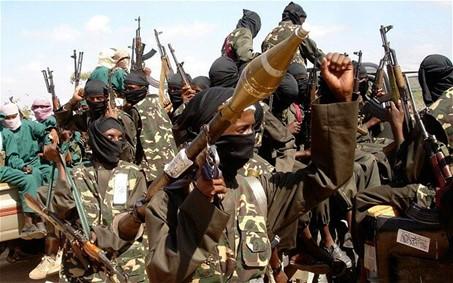
Al-Shabaab, linked to Al-Qaeda Stamp World History)
In 2012, the Somali Parliament reconvened in Mogadishu, and the transitional administration handed power to the Somali Federal Government (SFG). That same year, Hassan Sheikh Mahmud was elected president, and the country adopted a federal structure. In 2017, Muhammad Abdullahi Mohamed (Farmajo) assumed office. The country’s reconstruction process continues with support from the international community, particularly Türkiye.
Somalia’s governance is based on the so-called “4.5 clan system”: the major clans—Hawiye, Darod, Dir, and Rahanweyn (Digil-Mirifle)—form the core, while smaller groups are represented at a 0.5 level. The country’s reconstruction process continues with support from the international community, particularly Türkiye. However, strengthening the Somali National Army, combating the Al-Qaeda-linked Al-Shabaab, constitutional reform, and transitioning to direct elections remain Somalia’s primary challenges.
Somalia is located at the eastern tip of the African continent, in the region known as the Horn of Africa. To the east lie the Indian Ocean and the Gulf of Aden, to the west Ethiopia, to the northwest Djibouti, and to the southwest Kenya.
The country lies between 10° north latitude and 49° east longitude and has a total area of 637,657 km², of which 627,337 km² is land and 10,320 km² is water. With this size, Somalia ranks among the medium-sized countries of Africa and is slightly smaller than the U.S. state of Texas.
With a 3,025-kilometer coastline, Somalia possesses one of the longest coastlines on the African continent. This coastline lies at the southern approach to the strategic maritime passage connecting the Gulf of Aden to the Bab el-Mandeb Strait and the Suez Canal, leading to the Mediterranean Sea. This location has made Somalia an important transit point historically, both commercially and geopolitically.
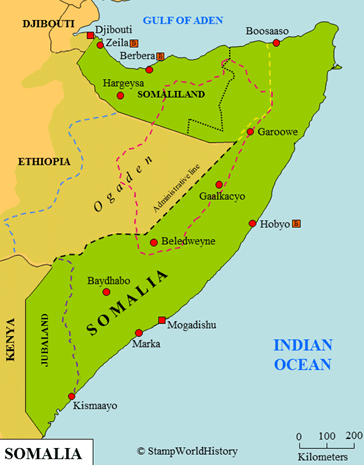
Geography of Somalia (Stamp World History)
The northern part of the country consists of the high and mountainous Somali Plateau, which descends steeply toward the Gulf of Aden and includes Shimbiris Mountain (approximately 2,460 meters), the country’s highest point. As one moves south and east, the terrain gradually lowers, giving way to plains and gently undulating plateaus. This structure imparts a generally monotonous and expansive steppe character to the country’s surface. The average elevation is 410 meters.
Somalia’s most fertile lands are found in the valleys irrigated by the Shabelle and Jubba rivers, located in the central part of the country. These two rivers originate in the highlands of Ethiopia and lose much of their water due to high evaporation as they flow through Somali territory. The most suitable areas for agriculture are the deltas and floodplains between these rivers.
Somalia’s climate is generally characterized as a hot and arid desert climate. The amount and seasonal distribution of rainfall are the primary factors determining the lifestyle of the nomadic population.
The country experiences four distinct seasons:
The average annual rainfall is below 500 mm; in the north and northeast, it drops to 50–150 mm, while in the southwest, it ranges between 330–500 mm. Some highland and coastal areas receive over 500 mm. Rainfall typically occurs as short, localized downpours.
Temperature values are high throughout the country, with average maximum temperatures ranging from 30–40°C and minimum temperatures between 20–30°C. Northern Somalia experiences the most pronounced temperature variations; in December, temperatures in highland areas can fall below zero, while in July, temperatures along the Gulf of Aden coast exceed 45°C. In the south, temperature differences are less extreme, with February–April being the hottest period. Coastal areas are 5–10 degrees cooler than inland regions due to maritime influence.
Relative humidity ranges from 40–85% in the north and averages around 70% along the coasts. Dense fog is common in highland areas during December–February. Dust storms in summer and floods during rainy seasons are frequent natural hazards.
Although narrow forest strips exist along the coast, the majority of the country is covered by steppe and scrubland vegetation. Approximately 70% of Somalia’s land is used for agriculture and pasture; 68.5% is permanent pasture and 1.8% is arable land. Forest cover accounts for 9.3%.
Somalia’s territory contains largely untapped natural resource reserves, including uranium, iron ore, tin, gypsum, bauxite, copper, salt, natural gas, and potential oil reserves. The main underground water system is the Ogaden–Jubba basin.
The country has limited industrial development. The road network spans approximately 22,100 kilometers. Major port cities include Benderkāsım, Berbera, Kismayo, and Mogadishu. The capital, Mogadishu, has an international airport.
Agriculture and livestock form the backbone of the economy. Sugarcane, rice, cotton, groundnuts, cereals, legumes, vegetables, and fruits (especially bananas and grapefruit) are the main agricultural products. Sheep, goats, cattle, and camel herding play a major role in the national economy. Fishing is also an important activity along the coasts.
Somalia’s economy has long been fragile due to decades of civil war, political instability, and natural disasters such as drought. The conflicts following the overthrow of Siad Barre’s regime in 1991 severely weakened the national economy, particularly affecting key port cities such as Mogadishu, Kismayo, Bosaso, and Berbera, which lost their importance in East Africa’s trade network.
After independence (1960–1991), Somalia was a major regional trade hub. From the 1990s onward, however, infrastructure decay and declining production capacity led to economic collapse. Today, the economy is based on agriculture, livestock, diaspora remittances, and the telecommunications sector. Agriculture and livestock account for approximately 65% of national income and employment.
The country’s economic activities largely operate within the informal (unregistered) sector. Small-scale trade, nomadic herding, and remittances from Somalis abroad are the primary sources of income. Formal banking services are limited, and mobile money transfer systems have become widespread for financial transactions.
Somalia is classified as a low-income country and remains heavily dependent on foreign aid and foreign currency inflows. According to World Bank data, Somalia’s gross domestic product (GDP) was $6.9 billion in 2020, $7.3 billion in 2021, and an estimated $8.5 billion in 2022.
Agriculture and livestock form the foundation of Somalia’s economy. The agricultural sector contributes more than 50% of GDP, with main products including sugarcane, maize, sorghum, cassava, fruits, and vegetables. Due to drought and inadequate infrastructure, the sector is highly climate-dependent. Goat, sheep, camel, and cattle herding make a major contribution to national income. Animal products and live animal exports account for approximately 25–30% of total exports.
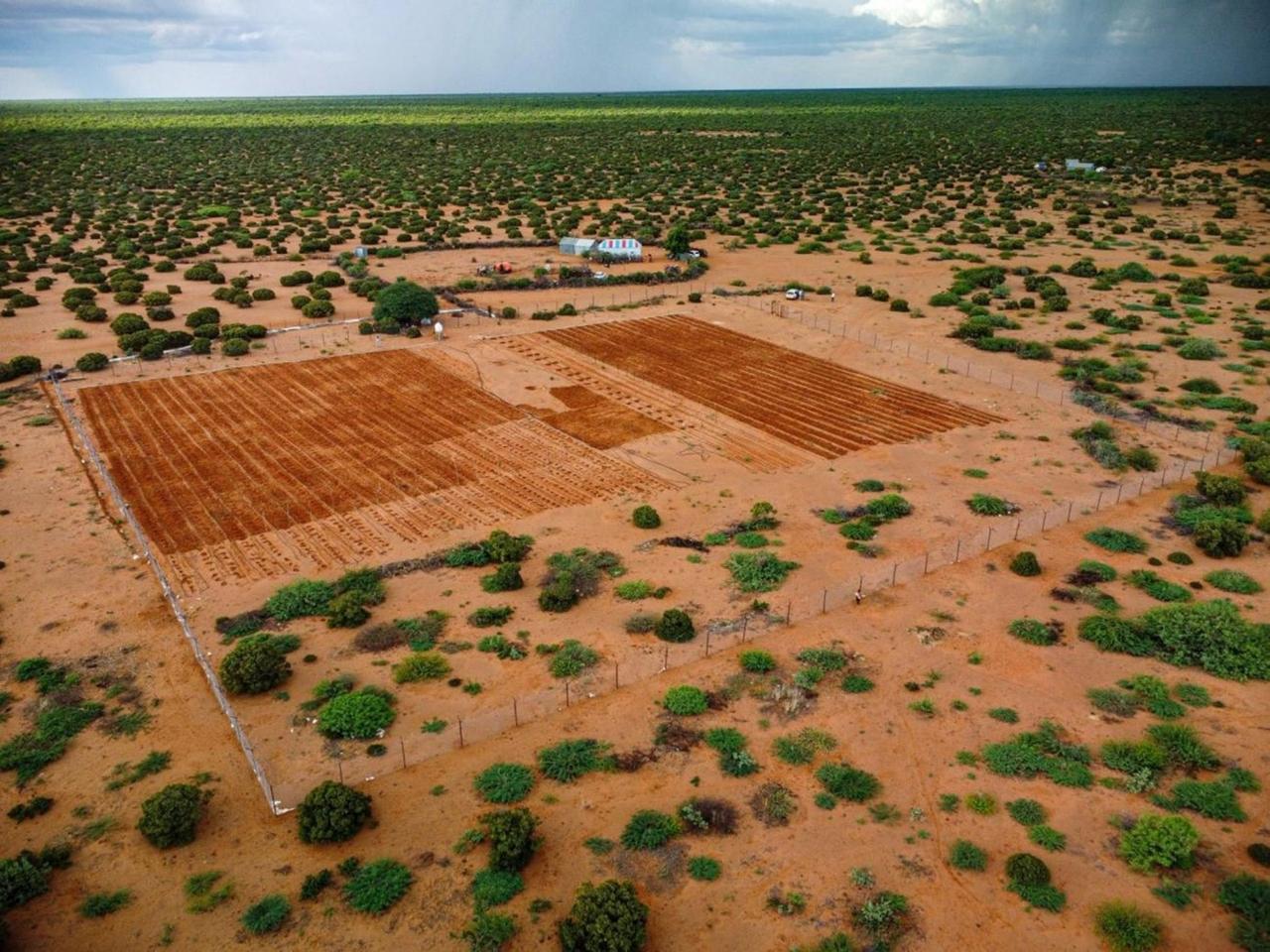
View of Agricultural Fields in Somalia (IOM)
The industrial sector is limited and contributes approximately 13% to GDP. Activities are restricted to sugar refining, textile production, and flour and food processing plants. Decades of civil war have destroyed much of the industrial infrastructure. The construction sector, however, holds growth potential as part of post-war reconstruction.
Telecommunications, trade, and transport are the main components of the service sector. In particular, mobile money transfer applications enable economic transactions in rural areas where banking services are scarce.
Somalia’s foreign trade has long been in deficit. Between 2016 and 2021, exports fell by 74% to $165 million, while imports rose by 10% to $3.2 billion.
Somalia’s reconstruction is being carried out with international support. Between 2013 and 2016, development assistance was provided under the “New Deal” framework, and in 2017–2020, the Somali Federal Government signed a “New Partnership Agreement.”
Relations with the IMF were re-established in 2013, and in 2015, after a 25-year gap, an Monitoring Program was launched. In 2020, Somalia qualified for debt relief under the HIPC (Heavily Indebted Poor Countries) initiative; Paris Club countries forgave 67% of Somalia’s $1.4 billion debt. The European Union provided €100 million in budget support.
These developments have contributed to progress in strengthening fiscal discipline and increasing public revenues. However, the country’s economy remains fragile due to drought, security challenges, and dependence on foreign aid.
Türkiye is a major trade partner of Somalia. Türkiye’s exports to Somalia were below $100 million before 2016 but reached $355 million in 2021. In the first five months of 2022, this figure increased by 29% compared to the previous year, reaching $156 million.
Türkiye’s investments in Somalia are concentrated in infrastructure, construction, logistics, and the food industry.
Somalia, located in the Horn of Africa with an area of 637,657 km², had an estimated population of approximately 15.4 million in 2025, nearly double its 1975 population of 8.3 million. 47.9% of the population lives in urban areas, with an annual urbanization rate of approximately 4.2%. The most densely populated areas are the capital Mogadishu (2.61 million) and Hargeisa (1.12 million). A significant portion of the population is concentrated in the southern and coastal regions; the northeast, central, and areas near the Kenyan border are the least densely populated.
Approximately 85% of Somalia’s population is ethnically Somali. The remainder consists mostly of minority communities living in the southern part of the country, including Benadiri, Bravanese, Bantu, Ethiopian, Indian, Persian, and Italian descendants. The Bantu are descendants of slaves brought by Arab slave traders.
Approximately 99.9% of the Somali population is Muslim; 98.1% are Sunni, 1.2% are Shia, and 0.6% belong to other Islamic orientations. The Shafi’i school is predominant, and religious life has been shaped historically by influential Sufi orders. The most widespread order is the Qadiriyya, which was spread in the northern regions by Sheikh Abdurrahman Zeilai and in the south by Sheikh Uways ibn Muhammad and Abdurrahman ibn Abdullah ash-Shashi. Other influential orders include the Idrisiyya branch known as Salihyya and the Rifa’iyya.
As of 2024, 41.4% of Somalia’s population is aged 0–14, 55.8% is aged 15–64, and 2.8% is aged 65 and over. The median age is 19.1 years (19.3 for men, 18.9 for women). The birth rate is 37.4 per 1,000, and the death rate is 11.2 per 1,000. The fertility rate is 5.12 children per woman, and the infant mortality rate is 83.6 per 1,000. Life expectancy is estimated at an average of 56.5 years (54.1 for men, 59.0 for women). The net migration rate is -0.7/1,000, indicating that Somalia is a net emigration country.
The civil wars and political instability of the 1990s led to the emigration of a significant portion of the educated and skilled population. Diaspora communities are concentrated primarily in the Middle East, Europe, and North America. Persistent droughts and inadequate infrastructure in rural areas have also increased internal migration.
Somalia’s education system has been severely affected by decades of civil war. However, recent efforts to rebuild state institutions have led to progress in education. Educational activities are carried out by both formal institutions and civil society and religious organizations.
Qur’anic schools are widespread at the primary level in Somalia. The Directorate of Education under the Ministry of Culture oversees basic education activities, including Qur’anic instruction at preschool and primary levels. Secondary schools are generally located in major cities, and the number of vocational and technical schools is limited.
In higher education, institutions such as Mogadishu University and Hargeisa University have been restructured in recent years.
Somali culture is rooted in Islamic values. The Somali language is one of the strongest elements of national identity. Folk literature, poetry, proverbs, and oral traditions hold an important place in Somali society. In the arts, traditional music, dance, and folk tales are integral parts of cultural life. In Somali culture, hospitality, family ties, and social solidarity are fundamental values. Religious holidays, communal worship, and local festivals sustain cultural continuity.
Somalia, located along the eastern coast of the Horn of Africa and possessing an extensive shoreline along the Indian Ocean, is gaining attention for its rich historical heritage, natural beauty, and cultural diversity. As part of its reconstruction process, Somalia has begun developing its tourism potential. The country features a wide range of cultural and natural attractions, from prehistoric rock art to architectural sites along coastal towns. Although tourism infrastructure is still developing, Somalia holds significant potential for historical, cultural, and eco-tourism.
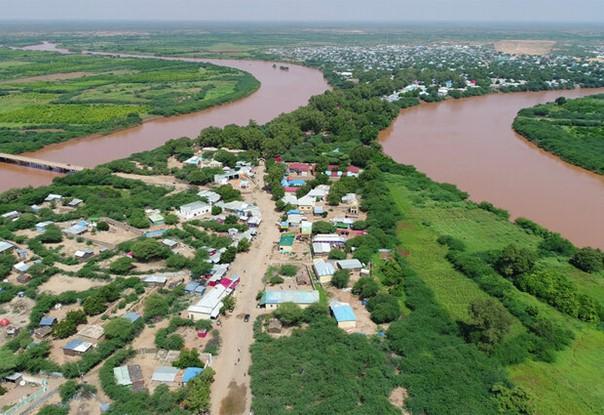
Capital of Mogadishu (Somali Ministry of Tourism)
Somalia’s foreign policy and security are shaped around the goals of preserving sovereignty and territorial integrity, combating terrorism, and ensuring regional stability. The country maintains international military and diplomatic cooperation, particularly against the Al-Shabaab threat, and has developed close security relations with the United States and Türkiye. Coordination with the African Union’s mission, balanced policies with Ethiopia and Kenya on border security and maritime jurisdiction, and strengthened economic partnerships with the UAE, the EU, and Arab countries are key priorities.
Türkiye–Somalia relations have historical roots extending back to the Ottoman period. Modern diplomatic relations were established in 1979, but Türkiye’s Embassy in Mogadishu was closed following the outbreak of civil war in Somalia in 1991. The embassy was reopened on 1 November 2011, revitalizing bilateral ties. In 2014, the Consulate General in Hargeisa was opened, expanding Türkiye’s diplomatic presence in the country.
A turning point in Türkiye–Somalia relations was the visit of then-Prime Minister Recep Tayyip Erdoğan to Mogadishu on 19 August 2011. This visit brought Somalia back onto the global agenda after years of international isolation. Following the visit, Türkiye launched a comprehensive humanitarian operation through TİKA, the Turkish Red Crescent, AFAD, and civil society organizations, providing over $1 billion in aid to Somalia.
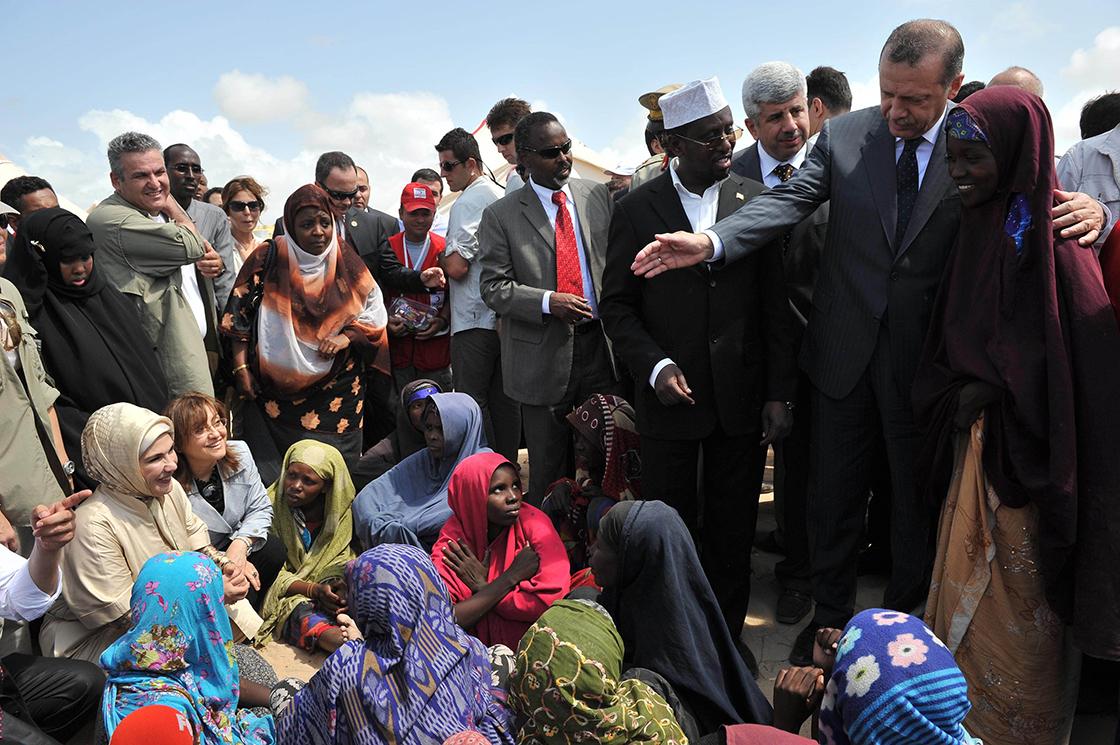
Image from Recep Tayyip Erdoğan’s 2011 Visit to Somalia (AA)
These aid efforts covered food, health, and infrastructure, as well as education, public administration, and reconstruction. Unlike Western donors’ short-term humanitarian models, Türkiye’s assistance focused on long-term institutional capacity building.
Türkiye has contributed to Somalia’s state-building by constructing hospitals, schools, roads, and public buildings. The Mogadishu Recep Tayyip Erdoğan Education and Research Hospital has become one of the country’s most advanced medical facilities.
Turkish Maarif Foundation and YTB scholarship programs have enabled hundreds of Somali students to pursue education in Türkiye. Since 1992, 1,092 Somali students have received higher education under Türkiye’s scholarship program; in the 2019–2020 period, 98 new scholarships were awarded. Türkiye’s educational activities in Somalia have deepened bilateral relations on the basis of humanitarian diplomacy.
Türkiye’s military presence in Somalia has been shaped by principles of security assistance and institutional capacity building. The TURKSOM Military Training Base, opened in 2017, is Türkiye’s largest overseas military training facility and plays a key role in professionalizing the Somali armed forces.
Built at a cost of approximately $50 million, the base covers 400 hectares and aims to train over 500 Somali soldiers annually. This training supports the Somali National Army’s assumption of security responsibilities after AMISOM and enhances its capacity to combat Al-Shabaab.
TURKSOM is also a concrete application of Türkiye’s “stability through capacity transfer” approach. Turkish officers provide training not only in military techniques but also in leadership, discipline, and national army consciousness. In this way, Türkiye contributes to the nationalization of Somalia’s security institutions.
Türkiye has also supported Somalia’s reconstruction economically. Turkish Airlines’ direct flights to Mogadishu, launched in 2012, reintegrated Somalia into the international aviation network. Mogadishu Port and International Airport are operated by Turkish firms, increasing the country’s foreign trade revenues. As of 2020, bilateral trade volume reached $280 million, and Türkiye is among Somalia’s priority trade partners. Private sector investments by Turkish companies have played a vital role in rebuilding Somalia’s infrastructure and service economy.
In addition to supporting Somalia’s internal stability, Türkiye has assumed a mediating role in regional peace processes. In 2024, under Türkiye’s mediation, the Ankara Peace Talks produced a diplomatic solution to the longstanding border and maritime access crisis between Somalia and Ethiopia.
The Ankara Agreement reached between Turkish President Recep Tayyip Erdoğan, Somali President Hassan Sheikh Mahmud, and Ethiopian Prime Minister Abiy Ahmed launched a “new era based on peace, cooperation, and mutual respect” between the two countries.
This process has positioned Türkiye not merely as a military actor in Somalia but as a trusted mediator and diplomatic balancing force.
The African Union Mission in Somalia (AMISOM), established in 2007 with United Nations approval, aimed to fill the security vacuum and eliminate the Al-Shabaab threat. The mission reached a force structure of approximately 22,000 personnel drawn from Uganda, Burundi, Ethiopia, Kenya, Djibouti, and Sierra Leone.
AMISOM’s operational structure was heavily dependent on external funding. The European Union covered a significant portion of troop salaries, while the United Nations provided logistical support. This dependence undermined the mission’s institutional sustainability.
Over time, regional actors such as Ethiopia and Kenya operated within the mission framework, driven by their own security interests and perceptions of cross-border threats. This raised questions in public opinion regarding AMISOM’s neutrality. Major challenges included lack of political coordination, inadequate equipment (particularly air support and helicopters), weak local legitimacy, and Al-Shabaab’s persistent capacity to reorganize.
AMISOM’s mandate officially ended on 1 April 2022, replaced by the African Union Transition Mission in Somalia (ATMIS). This change was approved by the United Nations Security Council on 31 March 2022, aiming for the gradual assumption of security leadership by Somali security forces.
Although ATMIS was planned as a two-year transition, its funding has not yet been guaranteed. The African Union has sought alternative funding from China, Russia, and Middle Eastern countries. AMISOM’s inability to hold a formal closure ceremony due to budget shortfalls underscores the economic difficulties surrounding this transition.
U.S.–Somalia relations have been largely shaped by security concerns since the Cold War. After the 1993 Battle of Mogadishu, the United States avoided direct military presence in Somalia and preferred to conduct its security policy through indirect means. In this context, Somalia became a central focus of U.S. counterterrorism strategy but remained under a relationship framework managed through diplomatic, military, and intelligence intermediaries for many years.
U.S. operations in Somalia were largely conducted through private security companies and third-party military forces. The U.S.-based private company Bancroft Global Development provided tactical training to AMISOM units, with funding indirectly provided by the U.S. Department of State. Meanwhile, the CIA supported the Somali National Intelligence Agency and established an intelligence facility near Mogadishu Airport known as the “Pink House.” The Pentagon provided military equipment and financial aid to Ugandan and Burundian armies rather than deploying U.S. troops directly.
U.S. support for Somalia has been channeled since 2007 through the African Union Mission (AMISOM) and later the Somali National Army (SNA). During this period, the United States played a central role in training and equipping the Danab Special Forces. As AMISOM began to withdraw, the United States intensified direct capacity-building efforts for the Somali army, continuing to support the Somali government against Al-Shabaab through air strikes, reconnaissance operations, and intelligence sharing.
However, Somalia’s security environment remains highly fragile. The U.S. Department of State’s 2023 Country Reports maintain a “high-risk” security warning for the entire country, noting ongoing Al-Shabaab attacks, kidnappings, and armed robberies in all regions, including Mogadishu. As a result, U.S. diplomatic services in Somalia are conducted through embassies in Nairobi (Kenya) and Djibouti; there is no official U.S. embassy or consulate operating within Somalia.
A new area of debate in U.S. policy toward Somalia is Somaliland. Since 1991, Somaliland has operated as a de facto independent administration and has continued its democratic transition process following the November 2024 elections. In U.S. domestic politics, particularly among Republican circles, there has been growing support for deepening ties with Somaliland. However, the current U.S. administration (Biden era) maintains a “One Somalia Policy,” preferring to develop “advanced partnership” relations with Somaliland rather than recognizing its independence. The Biden administration continues to view Somalia as the primary partner in security cooperation and counterterrorism in the Horn of Africa.
Since 2022, the United States has redeployed troops to Somalia, expanded training for Danab forces, and increased operations against Al-Shabaab. At the same time, due to Somaliland’s strategic location along the Gulf of Aden, the Washington administration is inclined to carefully deepen relations with this region in the future.
Ethiopia is one of the most influential actors in Somalia’s security architecture among its neighbors. Since the 1990s, regional spillovers from Somalia’s civil war have led to periodic conflicts and cross-border operations between the two countries.
In 2007, the Ethiopian military entered Somalia under the umbrella of the African Union Mission (AMISOM) to combat Al-Shabaab, and later integrated some units into the mission.
Although Ethiopia’s military presence in Somalia has been justified on security grounds, it has at times drawn criticism as “unilateral operations.” In Somali public opinion, there has been a perception that Ethiopian forces within AMISOM have acted in pursuit of their own national interests. This has strengthened debates about the mission’s neutrality.
At the beginning of 2024, Ethiopia signed a maritime access and base agreement with Somaliland, triggering a major diplomatic crisis on the grounds that it violated Somalia’s sovereignty. The Somali Federal Government declared the move illegal and suspended military and diplomatic cooperation.
Following the crisis, talks mediated by Türkiye led to the signing of the Ankara Declaration in December 2024, with both sides agreeing to restore relations on the basis of respect for sovereignty and territorial integrity. In January 2025, during a meeting in Addis Ababa, the two countries agreed to reinstate full diplomatic representation.
This process marks a significant shift from regional competition to dialogue-based normalization in Somalia–Ethiopia relations. However, mutual caution persists regarding security cooperation, the Al-Shabaab threat, border security, and maritime access.
Somalia–Kenya relations have historically been complex due to colonial-era border arrangements, security concerns, and migration patterns. The presence of a large Somali-origin population in northern Kenya has contributed to persistent mistrust between the two countries since independence.
As the Somali civil war intensified in the 1990s, approximately 400,000 Somali refugees settled in Kenya’s Dadaab and Kakuma camps, affecting bilateral relations on humanitarian and security grounds.
In 2011, the Kenyan military launched Operation Linda Nchi into southern Somalia to counter Al-Shabaab’s cross-border attacks and later integrated its forces into AMISOM. During this period, Kenya maintained a prolonged military presence in Somali territory under the pretext of border security.
The main dispute between Somalia and Kenya concerns a maritime jurisdiction area of approximately 100,000 km² in the Indian Ocean. Kenya advocates the parallel line method, while Somalia upholds the equidistance principle. In 2021, the International Court of Justice ruled in favor of Somalia, but Kenya rejected the decision and refused to participate in hearings. Diplomatic relations, suspended between 2020 and 2021, were restored in May 2021 under Qatari mediation. However, border security, refugee policies, and economic competition remain fundamental sources of tension between the two countries.
Somalia–United Arab Emirates (UAE) relations have followed a volatile course since the 2010s, marked by mutual distrust. The core of the tension lies in the UAE’s military and economic activities in Somaliland, which the Somali Federal Government considers a violation of sovereignty.
2018 marked a critical turning point in Somalia–UAE relations. After Somali security forces seized $9.6 million in cash from a UAE aircraft at Mogadishu Airport, the UAE terminated its military training program for the Somali army and began operating through Somaliland and Puntland. This incident created diplomatic tension, with Mogadishu viewing the UAE’s military contacts with Somaliland as interference in Somalia’s internal affairs. As of 2025, the UAE continues to deepen military cooperation with Somaliland and maintains military presence and technical support around Berbera Port.
Somalia’s military strength is limited due to decades of civil war, economic hardship, and institutional weaknesses. The country’s defense structure is primarily composed of ground forces and paramilitary units, while air and naval forces are not operationally effective. The Somali military’s primary objective is to ensure national security, control internal instability, and combat terrorist organizations.
As of 2025, Somalia’s purchasing power parity (PPP) is $26.351 billion, its defense budget is $171 million, its foreign exchange and gold reserves are $167.475 million, and its external debt stands at $5.83 billion.
Somalia has a total area of 637,657 km² and a coastline of 3,025 km. Its land borders of 2,385 km are shared with Ethiopia, Djibouti, and Kenya. Due to its location on the Horn of Africa, the country holds strategic importance; however, infrastructure deficiencies and maritime security challenges prevent full exploitation of this advantage. There are no navigable waterways in the country.
As of 2025, Somalia’s population is approximately 13 million. Of this, approximately 3 million (23%) are considered eligible for military service, and 1.8 million (13.8%) are deemed suitable for active duty.
The total military personnel number is 17,000, of which 15,000 are active and 2,000 are paramilitary. There are no reserve forces. The force distribution includes approximately 10,000 in the army, and approximately 300 each in air and naval forces.
The annual number of individuals reaching military age is approximately 130,000. The mobilization potential covers approximately 128,000 new recruits annually, reaching a theoretical potential of approximately 530,000 after four years. However, due to economic and logistical constraints, this theoretical capacity is not practically utilized.
The Somali Air Force is not operationally active. It has no combat aircraft, transport aircraft, helicopters, or attack platforms in its inventory.
The Somali army is the country’s most active and largest military branch. It has an inventory of 682 armored vehicles, of which approximately 307 are in active use.
The country has no main battle tanks, motorized howitzers, towed artillery, or multiple rocket launchers. Army units are primarily equipped with light armored vehicles, trucks, and infantry rifles. The Somali army’s ground forces are generally used for internal security operations and asymmetric threat responses.
The Somali Navy consists of 10 offshore patrol vessels. The fleet has no aircraft carriers, submarines, frigates, corvettes, or mine warfare vessels.
The navy’s primary missions are coastal security, combating smuggling, and preventing piracy. Somalia’s long coastline (3,025 km) constitutes a significant security responsibility, but the navy’s capacity is insufficient to effectively monitor this area.
Somalia’s total labor force is 3.27 million. The country has 4 commercial ships, 6 ports, 38 airports, and 15,000 kilometers of roads. There is no railway or navigable waterway infrastructure.
Somalia has no crude oil production. Daily oil consumption is approximately 6,000 barrels. The country’s estimated natural gas reserves are approximately 5.7 billion cubic meters, but these reserves remain untapped. There is no coal production, consumption, or reserves. Energy dependency directly affects Somalia’s defense and transportation capacity.
The Somali Turkish Mission Command (STMC) was established in accordance with the Framework Agreement signed between Türkiye and Somalia in 2010, the Military Education Cooperation Agreement of 2012, the 2014 Turkish Mission Protocol, and the 2015 Council of Ministers Decision, and became operational on 30 September 2017.
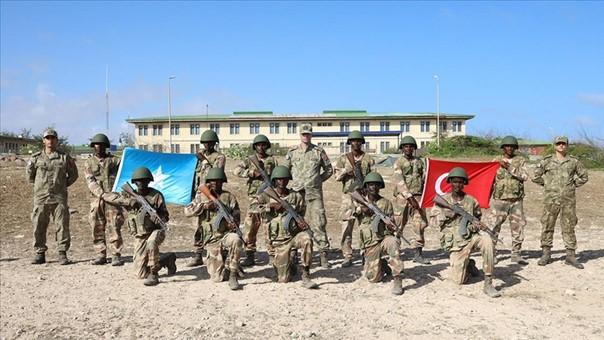
TURKSOM Military Base (AA)
Based at the Anadolu Barracks in Mogadishu, the base conducts activities in the organization, military training, infrastructure, logistics, and advisory capacities for the Somali Armed Forces. The “Eagle Brigades” and Special Forces Battalions trained by Türkiye have been engaged since 2023 in operations to reestablish state authority in the Galguduud and Hirshabelle regions. Turkish advisors within TURKSOM provide advisory services at the level of the Somali Presidency, Ministry of Defense, General Staff, and the Army, Navy, and Air Force.
Outside Türkiye, other actors operating in Somalia include the UN, the United States, the UAE, the African Union, the United Kingdom, the European Union Training Mission (EUTM), and various organizations. As of September 2025, 11,467 troops from Uganda, Burundi, Ethiopia, Kenya, and Djibouti are operating under the African Union Support and Stabilization Mission in Somalia (AUSSOM).
Türkiye has been conducting efforts to reconstruct the Somali police force since 2018. These activities are carried out under the Ministry of Interior Advisory Office at the Turkish Embassy in Mogadishu and through the expertise of Turkish law enforcement institutions.
In accordance with security agreements between the two countries, short-term training courses were launched in 2012, and since 2015, undergraduate and graduate programs have been initiated at the level of the Police Academy, Gendarmerie Academy, and Coast Guard Academy.
Somali police officers trained in Türkiye return to their country and serve in active roles. The Somali Police Special Operations Unit (Haramcad / “Hawk”) has been conducting high-risk operations since 2019, including hostage rescue, response to vehicle-borne explosives, and facility defense.
Ali, Faisal. “Somalia and Ethiopia Agree to Restore Diplomatic Ties after Year-Long Rift.” *The Guardian*, February 12, 2025. Accessed October 18, 2025.https://www.theguardian.com/world/2025/jan/12/somalia-and-ethiopia-agree-to-restore-diplomatic-ties-after-year-long-rift/.
Anadolu Ajansı. "Somali, artan güvenliğiyle turistlerin ilgi odağı haline geliyor." Anadolu Ajansı, September 19, 2025. Accessed October 18, 2025.https://www.aa.com.tr/tr/dunya/somali-artan-guvenligiyle-turistlerin-ilgi-odagi-haline-geliyor/3692245
Anadolu Ajansı. "Somali’nin Güvenliği ve İstikrarında Stratejik Adım: TURKSOM Askerî Eğitim Üssü." Anadolu Ajansı, October 9, 2025. Accessed October 18, 2025.https://www.aa.com.tr/tr/dunya/somalinin-guvenligi-ve-istikrarinda-stratejik-adim-turksom-askeri-egitim-ussu/3712208
Anadolu Ajansı. "Türkiye’de eğitim alan Somalili polisler, ülke güvenliğine katkı sağlıyor." Anadolu Ajansı, October 18, 2025. Accessed October 18, 2025.https://www.aa.com.tr/tr/insana-dair/turkiyede-egitim-alan-somalili-polisler-ulke-guvenligine-katki-sagliyor/3720283
Anadolu Ajansı. “Ethiopia, Somalia Reach Agreement in Ankara-Mediated Peace Talks, Turkish President.” Accessed October 18, 2025.https://www.aa.com.tr/en/africa/ethiopia-somalia-reach-agreement-in-ankara-mediated-peace-talks-turkish-president/3422113
Central Intelligence Agency. 2025. *The World Factbook: Somalia.* Washington, DC: Central Intelligence Agency. Accessed October 18, 2025.https://www.cia.gov/the-world-factbook/countries/somalia/
CountryReports. "Somalia | Culture, Facts & Travel." CountryReports.org. Accessed October 18, 2025.https://www.countryreports.org/country/Somalia.htm.
Devecioğlu, Kaan. “Somali–Kenya İlişkilerinde Normalleşme ve Katar Arabuluculuğu.” ORSAM Analiz, no. 268, May 2021. Accessed October 25, 2025.https://orsam.org.tr/yayinlar/somali-kenya-iliskilerinde-normallesme-ve-katar-arabuluculugu/
External Economic Relations Council. *Somalia Country Information Note, June 2022.* Istanbul: External Economic Relations Council, June 2022. Accessed October 18, 2025.https://www.deik.org.tr/ulke-bultenleri-somali-ulke-bilgi-notu-haziran-2022
Federal Republic of Somalia. “Tourism.” Last modified 2024.https://www.somalia.gov.so/about-somalia/tourism.
Gettleman, Jeffrey; Mazzetti, Mark; Schmitt, Eric. “U.S. Relies on Contractors in Somalia Conflict.” *The New York Times*, August 11, 2011. Accessed October 18, 2025.https://www.nytimes.com/2011/08/11/world/africa/11somalia.html
Global Firepower. "2025 Somalia Military Strength." Accessed October 18, 2025.https://www.globalfirepower.com/country-military-strength-detail.php?country_id=somalia.
Hiiraan Online. “UAE Expands Military Ties with Somaliland as Somalia Looks On.” Hiiraan Online, February 20, 2025. Accessed October 18, 2025.https://www.hiiraan.com/news4/2025/Feb/200338/uae_expands_military_ties_with_somaliland_as_somalia_looks_on.aspx
Hussein, Abdirahman, and Orhan Çoşkun. “Turkey Opens Military Base in Mogadishu to Train Somali Soldiers.” *Reuters*, September 30, 2017. Accessed October 18, 2025.https://www.reuters.com/article/world/turkey-opens-military-base-in-mogadishu-to-train-somali-soldiers-idUSKCN1C50J9/
Karataş, İbrahim. 2022. *Turkey’s Military Presence in Somalia: Doing What, Why and for Whom?* *Theorising Somali Society: Hope, Transformation and Development.* Accessed October 18, 2025.https://www.researchgate.net/publication/361558496_Turkey%27s_Military_Presence_in_Somalia_Doing_What_Why_and_for_Whom.
Köksal, Aydoğan, and Ahmet Kavas. 2009. “Somali.” *TDV İslâm Ansiklopedisi*. Ankara: Türkiye Diyanet Vakfı İslâm Araştırmaları Merkezi. Accessed October 14, 2025.https://islamansiklopedisi.org.tr/somali
MapChart. n.d. “World Map – Simple.” MapChart. Accessed October 18, 2025.https://www.mapchart.net/world.html
Richards, Vaughan P. J. “Somalia Is a Country Without an Army.” Foreign Policy, August 7, 2018. Accessed October 18, 2025.https://foreignpolicy.com/2018/08/07/somalia-is-a-country-without-an-army-al-shabab-terrorism-horn-africa-amisom/
Siradag, Abdurrahim. “Turkey’s Growing Role As a Security Actor in Somalia: Dynamics and Motivations.” *Akademik İncelemeler Dergisi* 17, no. 2 (October 2022): 389–404.https://doi.org/10.17550/akademikincelemeler.1115931.
The Africa Report. "Somalia: Uncertain Future as AMISOM Transitions to ATMIS." The Africa Report, April 1, 2022. Accessed October 18, 2025.https://www.theafricareport.com/190409/somalia-uncertain-future-as-amisom-transition-to-atmis/.
Türkiye Cumhuriyeti Dışişleri Bakanlığı. "Somali / Somali’nin Ülke Künyesi." Accessed October 18, 2025.https://www.mfa.gov.tr/sub.tr.mfa?14ad09f4-0894-4142-9492-7d48687e8e41.
Webb, Maxwell. “There’s a Rare Opportunity to Deepen US-Somaliland Ties. But Several Obstacles Stand in the Way.” *Atlantic Council AfricaSource*, December 17, 2024. Accessed October 18, 2025.https://www.atlanticcouncil.org/blogs/africasource/theres-a-rare-opportunity-to-deepen-us-somaliland-ties-but-several-obstacles-stand-in-the-way/
Williams, Paul D., and Abdirashid Hashi. “Exit Strategy Challenges for the AU Mission in Somalia.” Heritage Institute for Policy Studies, 2016. Accessed October 18, 2025.https://heritageinstitute.org/exit-strategy-challenges-for-the-au-mission-in-somalia/
World Population Review. "Somalia Population 2025." World Population Review. Accessed October 18, 2025.https://worldpopulationreview.com/search?query=Somalia.
Özkan, Mehmet. *Doğu Afrika Jeopolitiği ve Türkiye’nin Somali Politikası.* Istanbul: Siyaset Ekonomi ve Toplum Araştırmaları Vakfı (SETA), 2014. Accessed October 18, 2025.https://www.setav.org/dogu-afrika-jeopolitigi-ve-turkiyenin-somali-politikasi
Şahin, M. 2022. “Türkiye’nin Somali Politikasının İncelenmesi: 2011–2020 Dönemi.” *Türkiye Ortadoğu Çalışmaları Dergisi* 9(1): 109–147.https://doi.org/10.26513/tocd.863114
Official Name | Federal Republic of Somalia | ||||||||
|---|---|---|---|---|---|---|---|---|---|
Form of Government | Federal Republic | ||||||||
Date of Independence | 1 Temmuz 1960 (İtalyan ve İngiliz Somalilerinin birleşmesi) | ||||||||
Capital | Mogadishu (Muqdisho) | ||||||||
Head of State | Hassan Sheikh Mahmud (in office: 2022–) | ||||||||
Official Language | Arabic Somali | ||||||||
Common Languages | English, Italian | ||||||||
Religious Affiliation | Almost the entire population is Muslim (%99 Sunni – Shafi'i school) | ||||||||
National Day | 1 July (Independence Day) | ||||||||
Area | 637,657 km² | ||||||||
Total Population | 15.4 million (2025) | ||||||||
Climate | Irregular rainfall and seasonal droughts High temperatures throughout the year Semi-arid and tropical | ||||||||
GDP (Nominal) | 5.8 billion US dollars (2010) | ||||||||
GDP per Capita | Approximately 500 US dollars | ||||||||
Ethnic Groups | Somali (>85%) Bantu (~%5) Arabs and other minorities (%10) | ||||||||
Telephone Code | 252 | ||||||||
Internet Domain Code | so | ||||||||
No Discussion Added Yet
Start discussion for "Federal Republic of Somalia" article
National Anthem
History
Ancient Times and Pre-Islamic Period
Early Period and the Spread of Islam (8th–16th Centuries)
Colonial Era (19th Century)
Pre-Independence Period (1941–1960)
Independence and the Establishment of the Somali Republic (1960–1969)
Siad Barre Era and the Ogaden War (1969–1991)
Civil War and United Nations Intervention (1991–2000)
Transitional Federal Government and the Union of Islamic Courts (2000–2012)
Federal Period and the Present (2012–Present)
Geography
Location and General Features
Topography and Geomorphology
Climate
Vegetation and Natural Resources
Transportation and Economic Geography
Economy
Macroeconomic Indicators
Sectoral Distribution
Agriculture and Livestock
Industry
Services and Financial System
Foreign Trade and Current Account
International Support and Economic Reforms
Türkiye–Somalia Economic Relations
Demography, Education, and Culture
Population Distribution and Urbanization
Ethnic Composition
Religious Distribution
Age Structure and Population Characteristics
Education
Culture
Tourism
Foreign Policy and Security
Relations with Türkiye
2011 Visit and Humanitarian Turning Point
Education, Health, and Development Cooperation
Military Cooperation and TURKSOM Base
Economic and Transportation Cooperation
Mediation and Regional Diplomacy
African Union Mission (AMISOM)
Relations with the United States
Relations with Ethiopia
Relations with Kenya
Relations with the United Arab Emirates
Military and Defense Capacity
Financial Indicators
Geographical and Strategic Position
Human Resources and Mobilization Capacity
Land, Air, and Naval Components
Air Force
Ground Forces
Naval Forces
Logistical Infrastructure
International Military Cooperation and Training Programs
TURKSOM Military Training Base
Reconstruction of the Somali Police Force