


This article was automatically translated from the original Turkish version.
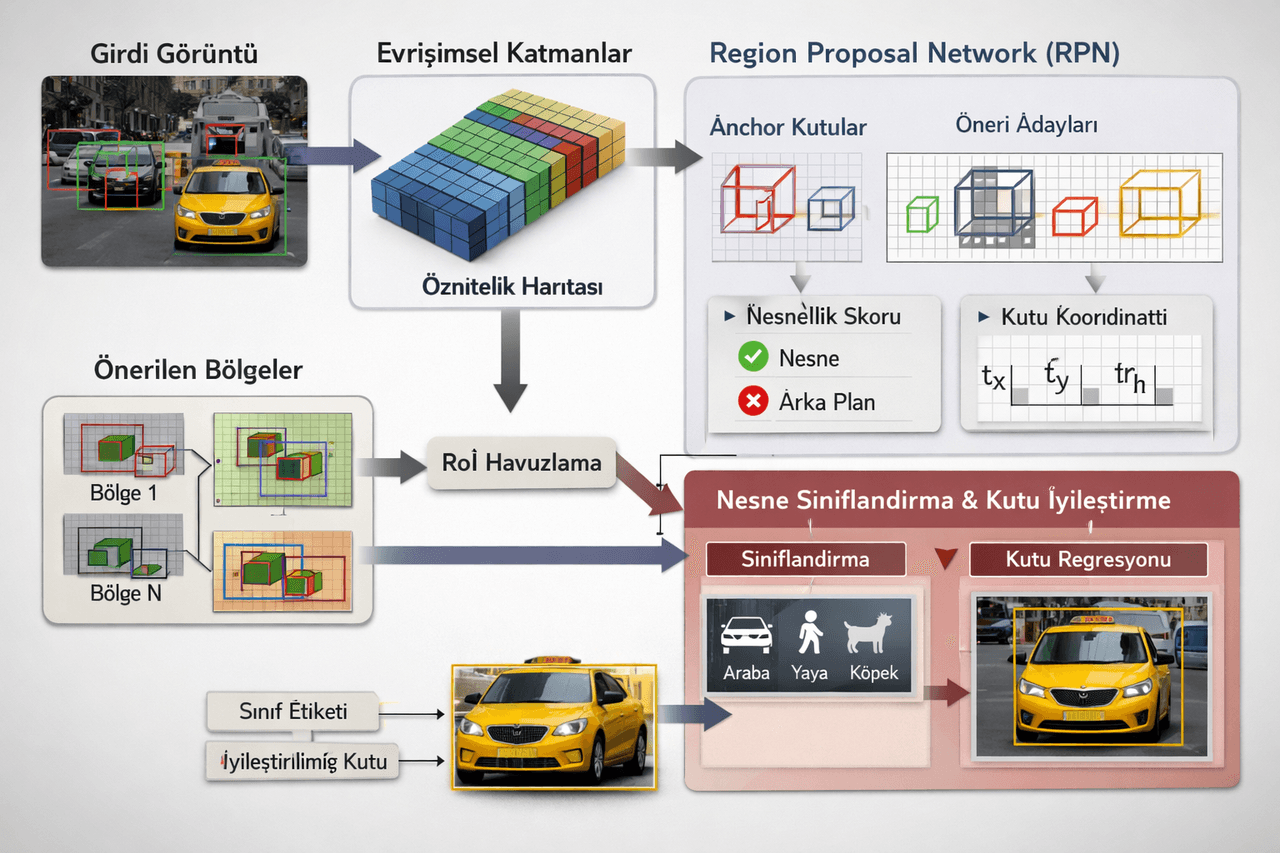
Faster R-CNN Deep Learning Model (generated by artificial intelligence)
Model Type | Deep learning-based object detection model | ||||||||
|---|---|---|---|---|---|---|---|---|---|
Model Family | R-CNN-based object detection models | ||||||||
Main Datasets | ILSVRC PASCAL VOC MS COCO | ||||||||
Primary Use Cases | Autonomous vehicle detection systems Security and surveillance systems Video analysis systems Image analysis Object detection | ||||||||
Developer | Kaiming He Shaoqing Ren Ross Girshick Jian Sun | ||||||||
Area | Computer Vision | ||||||||
Faster R-CNN is a two-stage deep learning architecture developed by Shaoqing Ren, Kaiming He, Ross Girshick and Jian Sun for object detection in images. The model integrates the processes of identifying object candidate regions and classifying these regions within a single convolutional neural network. This approach transforms region proposal generation into a learned operation within the network, offering a more integrated structure compared to previous methods. Faster R-CNN was developed as an extension of R-CNN and Fast R-CNN approaches and enables the model itself to directly generate region proposals during the object detection process.
Region-based object detection methods consist of two main stages: identifying candidate regions and classifying these regions. In the R-CNN approach, each candidate region was processed individually, resulting in high computational cost.
The Fast R-CNN method reduced this cost by performing feature extraction from the image in a single pass and introduced the RoI Pooling mechanism for region-based evaluation. However, this method still relied on external region proposal algorithms. Faster R-CNN eliminated this dependency by integrating region proposal generation directly into the network as a learned process.
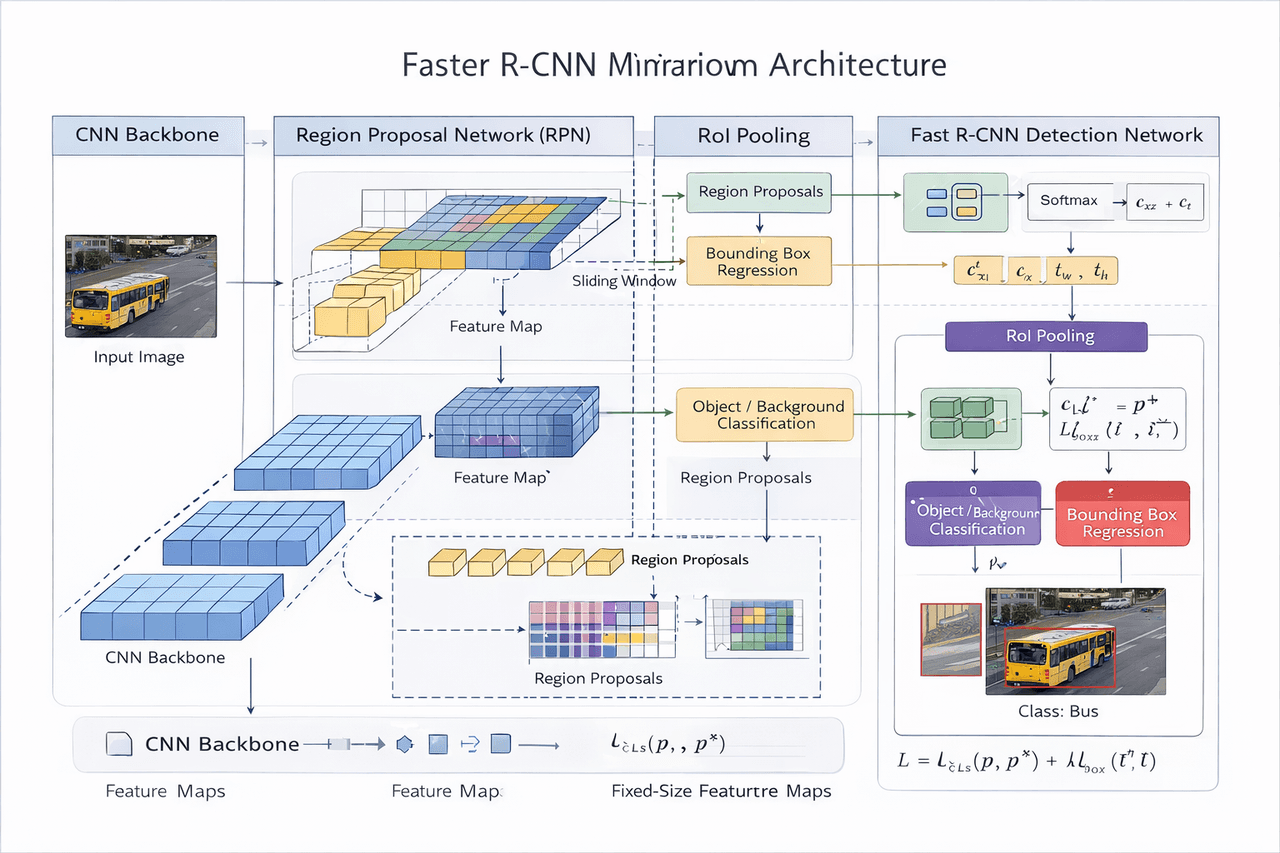
Diagram illustrating the processing flow of the Faster R-CNN architecture. The image shows feature map generation, Region Proposal Network, RoI Pooling and object detection stages. (Generated by artificial intelligence)
The Faster R-CNN architecture consists of a shared convolutional feature extraction network, a Region Proposal Network and an object detection network. The model’s operation follows a pipeline. In the first stage, the input image is processed by a convolutional neural network to produce a feature map. This feature map is shared for both region proposal generation and object classification, eliminating redundant feature extraction for the same image and reducing computational cost. The Region Proposal Network operates as a sliding window over this feature map, generating numerous anchors at each location. From these anchors, object/background classification and bounding box coordinate predictions are made. The proposed candidate regions are converted into fixed-size feature vectors through the RoI Pooling operation, enabling inputs of varying sizes to be fed into the same classification layer. In the final stage, the object detection network classifies these regions and refines their positions using bounding box regression.
Faster R-CNN uses reference boxes called anchors. At each feature map location, anchors with different scales and aspect ratios are defined, enabling the detection of objects of various sizes. The overlap between anchors and ground truth bounding boxes is measured using the Intersection over Union metric. Typically, anchors with IoU ≥ 0.7 are labeled positive, and those with IoU ≤ 0.3 are labeled negative. Anchors falling between these thresholds are ignored during training. Additionally, the anchor with the highest IoU for each ground truth object is assigned as positive.
Multiple predictions for the same object may be generated by the model. This is resolved by the Non-Maximum Suppression algorithm, which retains the prediction with the highest confidence score and suppresses the others. Bounding box regression is optimized to adjust the center coordinates and dimensions of anchor boxes to better match the true object boundaries.
The Faster R-CNN model is trained using a multi-task loss function that jointly optimizes classification and regression tasks. The total loss function is expressed as:
In this expression, the classification loss determines whether an anchor contains an object, while the regression loss ensures that the bounding box parameters converge to their true values. The regression component is computed only for positive anchors. The Smooth L1 function used in regression is defined as:
This function behaves quadratically for small errors and linearly for large errors, providing more stable optimization during training and greater robustness to outliers compared to the classical L2 loss. During anchor labeling, positive and negative samples are determined based on IoU thresholds. Additionally, the anchor with the highest overlap for each ground truth object is assigned as positive, while anchors within a specified range are excluded from training. This approach regulates the model’s learning process by maintaining sample balance. The training process can be performed by alternately training the Region Proposal Network and the object detection network. An approximate joint training method that optimizes the entire network in a single stage has also been defined.
The Faster R-CNN model is evaluated on the PASCAL VOC and MS COCO datasets. Model performance is measured using metrics such as accuracy, precision and mean Average Precision (mAP). The mAP metric is calculated by averaging precision values across multiple IoU thresholds. While PASCAL VOC typically uses a fixed IoU threshold, MS COCO employs an average over multiple IoU thresholds to provide a more comprehensive evaluation.
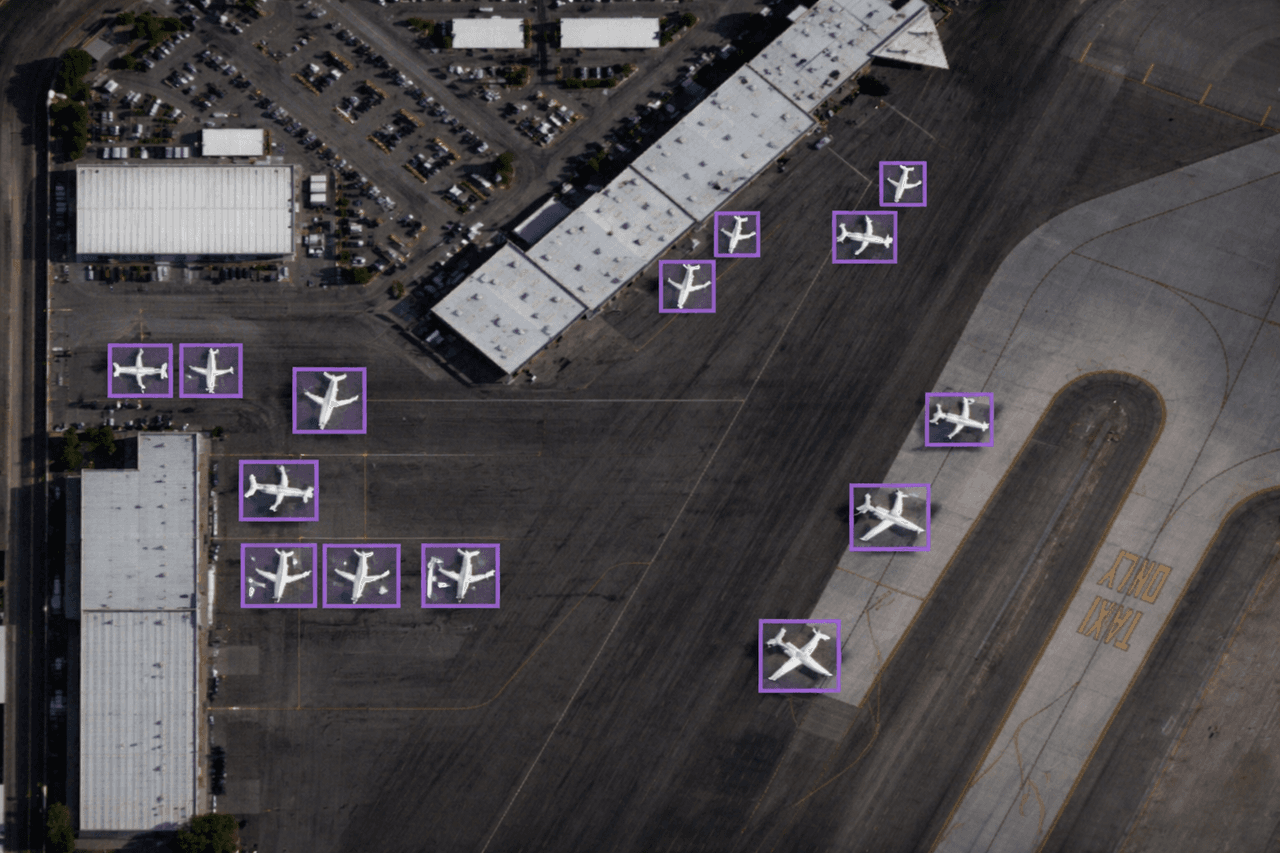
Example of object detection using Faster R-CNN on satellite imagery. Aircraft detected by the model are marked with bounding boxes. (Generated by artificial intelligence)
Faster R-CNN is an architecture widely used for general object detection tasks and is employed to identify objects in various types of images. In this context, the model is applied to perform object detection in autonomous driving systems, video analysis and various computer vision applications.
Girshick, Ross. “Fast R-CNN.” *arXiv preprint* arXiv:1504.08083 (2015). Accessed March 9, 2026. https://arxiv.org/pdf/1504.08083
Li, Fei-Fei, Justin Johnson, and Serena Yeung. *Lecture 14: Object Detection and Segmentation.* CS231n: Convolutional Neural Networks for Visual Recognition, Stanford University, 2020. Accessed March 9, 2026. https://cs231n.stanford.edu/slides/2020/lecture_14.pdf
PyTorch. "Smooth L1 Loss." Accessed March 9, 2026. https://pytorch.org/docs/stable/generated/torch.nn.SmoothL1Loss.html
Ren, Shaoqing, Kaiming He, Ross Girshick, and Jian Sun. “Faster R-CNN: Towards Real-Time Object Detection with Region Proposal Networks.” Advances in Neural Information Processing Systems 28 (2015): 91–99. Accessed March 9, 2026. https://papers.nips.cc/paper/5638-faster-r-cnn-towards-real-time-object-detection-with-region-proposal-networks.pdf
Ren, Shaoqing, Kaiming He, Ross Girshick, and Jian Sun. “Faster R-CNN: Towards Real-Time Object Detection with Region Proposal Networks.” arXiv preprint arXiv:1506.01497 (2015). Accessed March 9, 2026. https://arxiv.org/pdf/1506.01497

Faster R-CNN Deep Learning Model (generated by artificial intelligence)
Model Type | Deep learning-based object detection model | ||||||||
|---|---|---|---|---|---|---|---|---|---|
Model Family | R-CNN-based object detection models | ||||||||
Main Datasets | ILSVRC PASCAL VOC MS COCO | ||||||||
Primary Use Cases | Autonomous vehicle detection systems Security and surveillance systems Video analysis systems Image analysis Object detection | ||||||||
Developer | Kaiming He Shaoqing Ren Ross Girshick Jian Sun | ||||||||
Area | Computer Vision | ||||||||
No Discussion Added Yet
Start discussion for "Faster R-CNN Deep Learning Model" article
Development Context
Architecture and Workflow
Technical Components
Training Process
Performance and Evaluation
Applications