This article was automatically translated from the original Turkish version.
Type | Sports ethics and behavioral principles | ||||||||
|---|---|---|---|---|---|---|---|---|---|
Scope | Behavior of spectators in sports environments Behavior of athletes during and outside competitions | ||||||||
Basic Principles | Honesty Adherence to rules Mutual respect Justice Respect for opponents and the game | ||||||||
Fair Play is an ethical concept based on honesty, adherence to rules, respect for opponents, and courteous behavior. This understanding reveals that sport is not merely a physical competition but also a cultural domain aimed at upholding moral values, mutual respect, and human dignity. Fair Play is regarded as a comprehensive ethical approach encompassing all individuals and institutions within the sporting environment.
The concept of Fair Play is considered one of the fundamental components of sports ethics. This ethical framework is grounded in both formal and informal norms that govern the behavior of athletes and other stakeholders. Honesty, justice, and responsibility are among the primary elements forming the ethical foundation of Fair Play.
In this context, Fair Play is understood as an approach that not only requires athletes to comply with the rules but also to act with a conscious sense of ethical responsibility. The distinction between rule compliance and ethical compliance is regarded as one of the distinguishing features of the Fair Play concept【1】 .
Fair Play provides a normative structure that defines acceptable behaviors in sporting activities. This structure anticipates that athletes will avoid deliberate rule violations, refrain from seeking unfair advantages, and steer clear of actions that may harm their opponents【2】 .
This normative framework aims to define the boundaries of conduct in sport and ensure that competition remains within an ethical framework. In this sense, Fair Play is regarded as one of the regulatory and balancing elements of sport【3】 .
The concept of Fair Play plays a decisive role in regulating sports behavior. The physical and verbal conduct exhibited by athletes during competition is evaluated in accordance with Fair Play principles. Showing respect to opponents and avoiding actions contrary to the spirit of the game are among the core elements of this regulation.
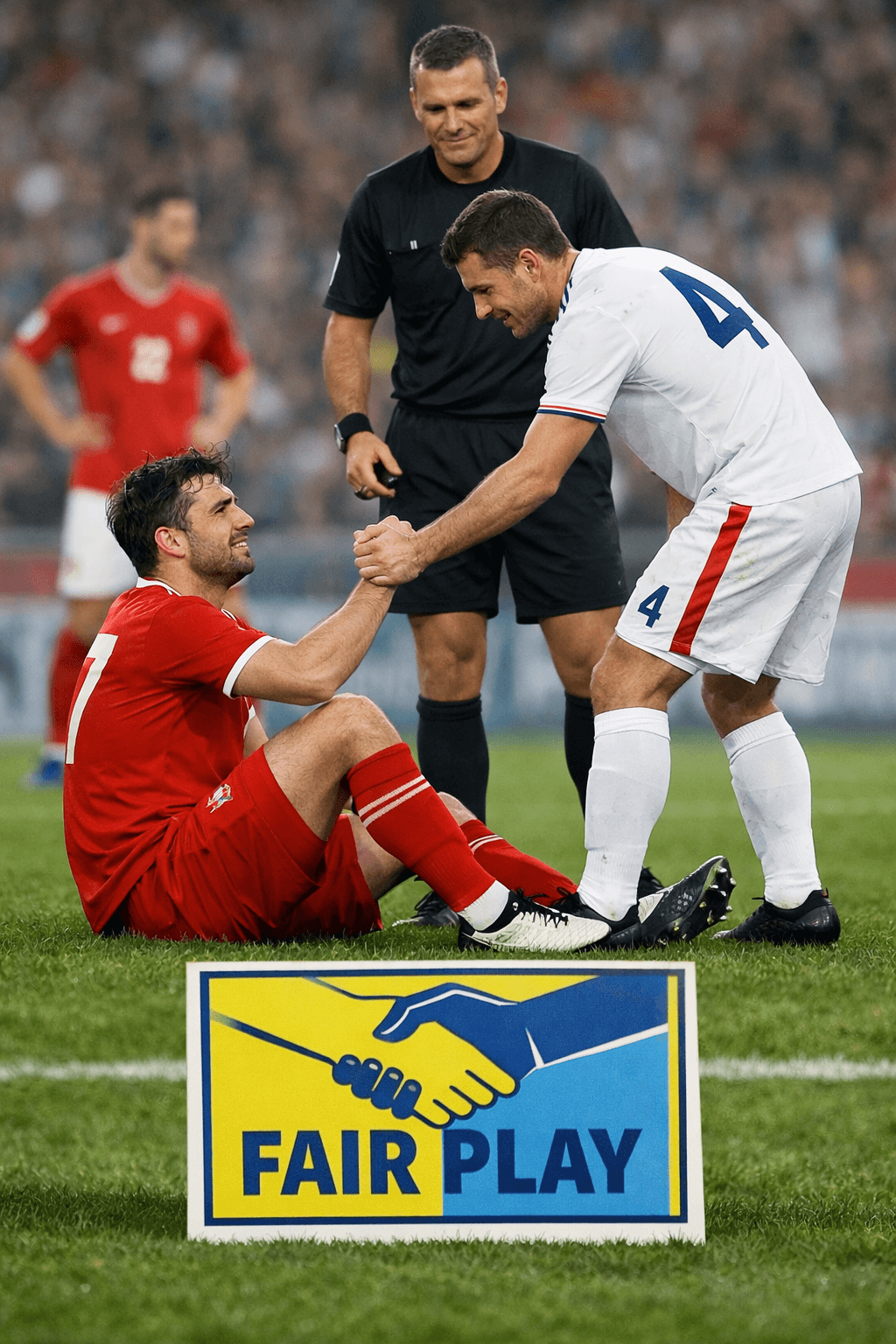
Example of Fair Play (generated by artificial intelligence)
Avoiding behaviors that endanger the safety of opponents and refraining from intentional fouls or deceptive actions are addressed within the framework of Fair Play. Such behaviors are viewed as ethical expectations aimed at ensuring that sport is conducted under fair and equal conditions.
The concept of Fair Play also encompasses the processes before and after competition. The attitudes displayed by athletes and coaching staff before and after matches demonstrate that Fair Play represents a continuous ethical approach. In this regard, Fair Play offers a behavioral model that extends across the entirety of sporting activity.
Fair Play does not eliminate competition, which is one of the fundamental elements of sport; rather, it aims to ensure that competition remains within ethical boundaries. While the desire to achieve success is accepted as a natural impulse, Fair Play fundamentally expects this desire not to undermine principles of honesty and justice.
In this context, the opponent is not viewed as something to be defeated but as a fundamental component that makes the game possible. Respect for the opponent is regarded as an essential ethical element for the sustainability of sport.
In Türkiye, the concept of Fair Play is addressed in accordance with ethical principles adopted by sports institutions. The Turkish Football Federation considers Fair Play one of the fundamental principles promoting sportsmanship and honesty in football activities. This approach anticipates that sport should be evaluated not only by sporting success but also by the behavior exhibited【4】 .
At the institutional level, Fair Play provides a framework that defines the ethical responsibilities of sports organizations. This framework seeks to strengthen the sense of justice in the sporting environment and reduce ethical violations.
Fair Play is closely linked to the educational function of sport. Values such as honesty, discipline, and respect, imparted to individuals through sport, are systematically transmitted through the concept of Fair Play. This transforms Fair Play from merely a sporting principle into an educational tool.
Especially for young athletes, Fair Play assumes a guiding role in preserving ethical boundaries within competitive environments. In this sense, Fair Play is regarded as a set of values that contribute to individual character development.
Fair Play is directly related to the social impact of sport. Courteous behaviors displayed in sporting events contribute to strengthening values such as tolerance, justice, and mutual respect in society. In this context, Fair Play is regarded as a factor that supports the social function of sport.
Fair Play is regarded as one of the concepts forming the ethical foundation of sports culture. The understanding that sport is not merely a competitive and outcome-oriented activity but also a value-creating domain is concretized through the concept of Fair Play【5】 .
Karabük Üniversitesi Certificate Programs. "Fair Play Nedir? Sporda Centilmenlik ve Dürüstlük." Accessed January 1, 2026.https://sertifika.karabuk.edu.tr/fair-play-nedir-sporda-centilmenlik-ve-durustluk-blog
Türkiye Futbol Federation. "Fair Play ve Sosyal Sorumluluk." Accessed January 1, 2026.https://www.tff.org/default.aspx?pageID=228&ftxtID=15815
Türkiye Milli Olimpiyat Komitesi. "Fair Play." Accessed January 1, 2026.https://olimpiyat.org.tr/Faaliyet-Detay/fair-play/16
Türkiye Milli Paralimpik Komitesi. "Fair Play Nedir?" Milliyet, October 27, 2007. Accessed January 1, 2026.https://www.tmpk.org.tr/yazarimizdan/fair-play-nedir-milliyet-27-10-2007/
[1]
Türkiye Milli Olimpiyat Komitesi. “Fair Play.” Erişim tarihi: 1 Ocak 2026. https://olimpiyat.org.tr/Faaliyet-Detay/fair-play/16
[2]
Karabük Üniversitesi Sertifika Programları. “Fair Play Nedir? Sporda Centilmenlik ve Dürüstlük.” Erişim tarihi: 1 Ocak 2026. https://sertifika.karabuk.edu.tr/fair-play-nedir-sporda-centilmenlik-ve-durustluk-blog
[3]
Türkiye Milli Paralimpik Komitesi. “Fair Play Nedir?” Milliyet, 27 Ekim 2007. Erişim tarihi: 1 Ocak 2026. https://www.tmpk.org.tr/yazarimizdan/fair-play-nedir-milliyet-27-10-2007/
[4]
Türkiye Futbol Federasyonu. “Fair Play ve Sosyal Sorumluluk.” Erişim tarihi: 1 Ocak 2026. https://www.tff.org/default.aspx?pageID=228&ftxtID=15815
[5]
Karabük Üniversitesi Sertifika Programları. “Fair Play Nedir? Sporda Centilmenlik ve Dürüstlük.” Erişim tarihi: 1 Ocak 2026. https://sertifika.karabuk.edu.tr/fair-play-nedir-sporda-centilmenlik-ve-durustluk-blog

Type | Sports ethics and behavioral principles | ||||||||
|---|---|---|---|---|---|---|---|---|---|
Scope | Behavior of spectators in sports environments Behavior of athletes during and outside competitions | ||||||||
Basic Principles | Honesty Adherence to rules Mutual respect Justice Respect for opponents and the game | ||||||||
Ethical Foundations
Normative Structure and Codes of Conduct
Regulation of Sports Behavior
In-Competition Practices
Pre- and Post-Competition Behavior
Ethical Limitation of Competition
Institutional and Governance Approaches
Institutional Responsibility and Regulatory Role
Educational Function and Value Transmission
Social Dimension
Position within Sports Culture