This article was automatically translated from the original Turkish version.
Celebration Start Year | From 2008 onwards | ||||||||
|---|---|---|---|---|---|---|---|---|---|
Relevant Institution | Public Officials Ethics Board | ||||||||
Legal Basis | Law No. 5176 adopted by the Grand National Assembly of Türkiye on 25 May 2004 | ||||||||
Ethics Week Date | The period between 25 and 31 May including 25 May | ||||||||
Ethics Day Date | On 25 May of each year | ||||||||
In Türkiye, May 25 is observed annually as Ethics Day, and the week encompassing this date is celebrated as Ethics Week. Law No. 5176, which served as the foundation for the establishment of the Public Officials Ethics Board, was adopted by the Grand National Assembly of Türkiye on May 25, 2004. The Board decided in 2008 to commemorate these dates nationwide each year to establish an ethical culture in public service, increase ethical awareness, and monitor ethical practices.【1】

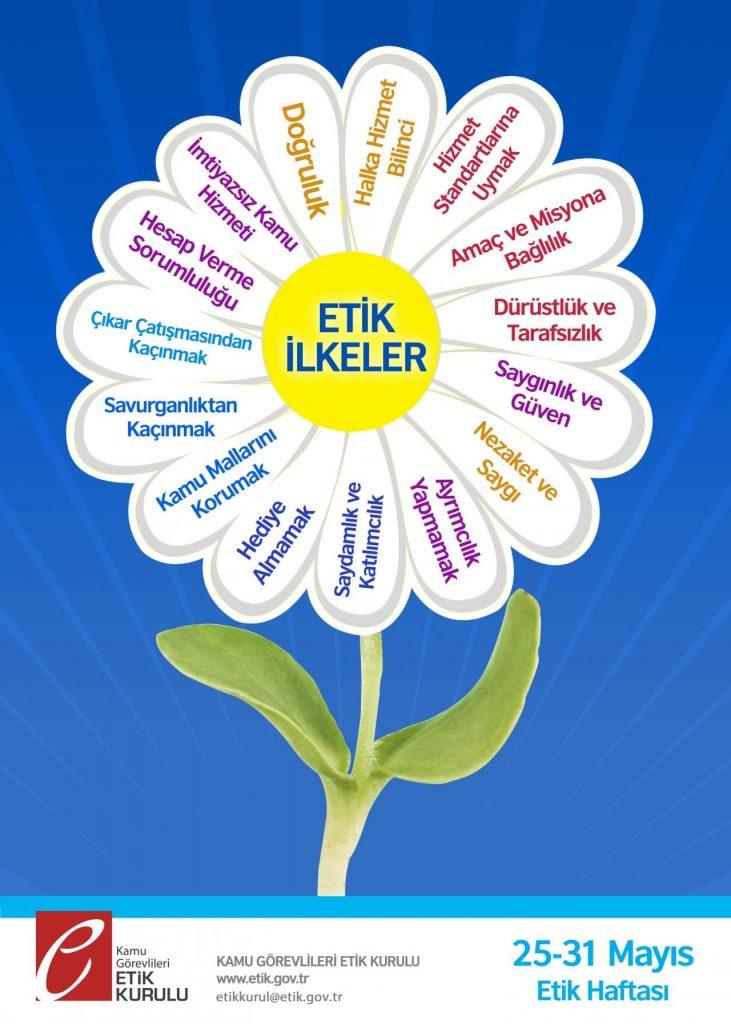
Ethical Values Poster (Republic of Türkiye Gazipaşa District Governorship)
The term ethics derives from the Greek word "ethos" (custom), and its original Greek usage is "Ethika". As one of the four main branches of philosophy, ethics provides concrete and empirical knowledge about human behavior patterns. Ethics seeks to understand the nature of morality in order to distinguish right from wrong, and is defined as a discipline that interprets rules logically and engages in reflective thinking about morality.【2】
Morality refers to the sum of values and beliefs accepted as correct by the majority within a given society, often without explicit justification. While morality as a discipline focuses on judgments that vary from society to society, the field of ethics aims to understand the nature of morality through universal and logical principles.【3】
Systematic ethical practices can be traced to the Ahi Organization, which operated within the Anatolian Seljuk Civilization in the 13th century and represented the unity of Turkish artisans and tradespeople. As a multifaceted Turkish socio-economic institution, Ahi established clear moral and professional codes that members were required to follow, with severe penalties imposed for violations. While philosophers throughout human history avoided prescribing concrete behavioral models in their discussions of good and evil, prophets contributed to the development of ethical systems by offering exemplary models of conduct to their communities.【4】
Honesty, solidarity, trust, transparency, and accountability constitute the fundamental ethical values of social life. In public administration, these values are concretized through principles such as truthfulness, public service orientation, adherence to service standards, commitment to purpose and mission, integrity and impartiality, credibility and trust, courtesy and respect. Additionally, public officials are required to adhere to key ethical behavioral principles including avoiding discrimination, refusing gifts, safeguarding public property, avoiding extravagance, steering clear of conflicts of interest, fulfilling accountability obligations, and providing impartial public service without privileges.【5】
The Public Officials Ethics Board prepares various scholarly publications—including professional ethics guides, academic theses, articles, books, and conference presentations—to promote an ethical culture. As part of public awareness initiatives, the Board produces ethical cartoons, posters, educational videos, and storybooks for children. At the institutional level, activities include training for ethics committee chairs and members, conferences directed at public institutions, ethics educator training, and the establishment of ethical guidelines for public officials’ use of social media.【6】
Ethics and Reputation Association. "Ethics Day." Accessed March 24, 2026. https://teid.org/etik-gunu/#:~:text=Kamuda%20Etik%20k%C3%BClt%C3%BCr%C3%BCn%C3%BC%20yerle%C5%9Ftirmek%20ve%20etik%20uygulamalar%C4%B1,%C4%B0tibar%20Etik%20ve%20%C4%B0tibar%2025%20May%C4%B1s%202008
Ministry of Interior of the Republic of Turkey. "Ethics Day and Ethics Week (May 25–31, 2024)." Accessed March 24, 2026. https://www.icisleri.gov.tr/personel/etik-gunu-ve-etik-haftasi-25-31-mayis-2024#:
T.C. Orman Genel Müdürlüğü. "2025 Yılı Etik Günü ve Etik Haftası." Accessed March 24, 2026. https://www.ogm.gov.tr/batikaradeniz/duyurular/2025-yili-etik-gunu-ve-etik-haftasi
T.C.Gazipaşa Belediyesi. "ETİK GÜNÜ VE HAFTASI (25 - 31 MAYIS)." Accessed March 24, 2026. https://www.gazipasa.gov.tr/etik-gunu-ve-haftasi-25---31-mayis-
[1]
Etik ve İtibar Derneği. "Etik Günü." Erişim Tarihi 24 Mart 2026. https://teid.org/etik-gunu/#:~:text=Kamuda%20Etik%20k%C3%BClt%C3%BCr%C3%BCn%C3%BC%20yerle%C5%9Ftirmek%20ve%20etik%20uygulamalar%C4%B1,%C4%B0tibar%20Etik%20ve%20%C4%B0tibar%2025%20May%C4%B1s%202008
[2]
T.C. Gazipaşa Kaymakamlığı. "ETİK GÜNÜ VE HAFTASI ( 25 - 31 MAYIS )." Erişim Tarihi 24 Mart 2026. https://www.gazipasa.gov.tr/etik-gunu-ve-haftasi-25---31-mayis-
[3]
T.C. Gazipaşa Kaymakamlığı. "ETİK GÜNÜ VE HAFTASI ( 25 - 31 MAYIS )." Erişim Tarihi 24 Mart 2026. https://www.gazipasa.gov.tr/etik-gunu-ve-haftasi-25---31-mayis-
[4]
T.C. Gazipaşa Kaymakamlığı. "ETİK GÜNÜ VE HAFTASI ( 25 - 31 MAYIS )." Erişim Tarihi 24 Mart 2026. https://www.gazipasa.gov.tr/etik-gunu-ve-haftasi-25---31-mayis-
[5]
T.C. Gazipaşa Kaymakamlığı. "ETİK GÜNÜ VE HAFTASI ( 25 - 31 MAYIS )." Erişim Tarihi 24 Mart 2026. https://www.gazipasa.gov.tr/etik-gunu-ve-haftasi-25---31-mayis-
[6]
T.C. İçişleri Bakanlığı. "Etik Günü ve Etik Haftası (25-31 Mayıs 2024." Erişim Tarihi 24 Mart 2026. https://www.icisleri.gov.tr/personel/etik-gunu-ve-etik-haftasi-25-31-mayis-2024#:~:text=Kamu%20G%C3%B6revlileri%20Etik%20Kurulunca%202008%20y%C4%B1l%C4%B1ndan%20itibaren,ilkelerinin%20tan%C4%B1t%C4%B1ld%C4%B1%C4%9F%C4%B1%20afi%C5%9F%20ve%20posterlere%20https://www.etik.gov.tr/yayinlar/afisler%2Dposterler/%20ula%C5%9Fabilirsiniz.

Celebration Start Year | From 2008 onwards | ||||||||
|---|---|---|---|---|---|---|---|---|---|
Relevant Institution | Public Officials Ethics Board | ||||||||
Legal Basis | Law No. 5176 adopted by the Grand National Assembly of Türkiye on 25 May 2004 | ||||||||
Ethics Week Date | The period between 25 and 31 May including 25 May | ||||||||
Ethics Day Date | On 25 May of each year | ||||||||
No Discussion Added Yet
Start discussion for "Ethics Day and Week" article
Etymological Foundations
Conceptual Differences Between Ethics and Morality
Historical Development of Ethical Practices
Core Ethical Values and Principles of Public Administration
Education and Awareness Activities