This article was automatically translated from the original Turkish version.
State | Ottoman Empire | ||||||||
|---|---|---|---|---|---|---|---|---|---|
Shipyard | Tersâne-i Âmire, İstanbul | ||||||||
Construction Start | 1854 | ||||||||
Launch | 1863 | ||||||||
Commissioning | 1864 | ||||||||
Type | Wood-hulled, wooden-hulled frigate | ||||||||
Length | 76 m | ||||||||
Width | 18 m | ||||||||
Weight (Tonnage) | 2,344 tons | ||||||||
Armament | Approximately 40 guns | ||||||||
Crew Capacity | 600+ personnel | ||||||||
Voyage Start | 14 July 1889, İstanbul | ||||||||
Commander | Miralay (Pasha) Osman Bey | ||||||||
Mission Purpose | To present the letter of honor and gifts from Sultan Abdülhamid II to Emperor Meiji of Japan, conduct a practical training voyage for students of the Naval Academy, and initiate Ottoman-Japanese diplomatic relations | ||||||||
Port of Call | Suez, Aden, Bombay, Colombo, Singapore, Hong Kong, Nagasaki, Kobe | ||||||||
Arrival | 7 June 1890, Yokohama | ||||||||
Return | 15 September 1890, departure from Yokohama | ||||||||
Accident Date | 16 Eylül 1890 | ||||||||
Accident Location | Wakayama Prefecture, Kushimoto waters, Kashinozaki cliffs | ||||||||
Cause of Accident | Typhoon and the ship's deteriorated structure | ||||||||
Rescue | The people of Kushimoto rescued the survivors despite the storm and provided food and shelter | ||||||||
Return Mission | The rescued ships, Hiei and Kongō, were delivered to Istanbul in 1891 | ||||||||
Monument | A monument was erected for the fallen in Kuşimoto in 1891 and restored by Türkiye in 1937 | ||||||||
Museum | The Turkish Museum in Kuşimoto was opened in 1974 | ||||||||
Commemoration | Ceremonies are held every year on September 16 in Türkiye and Japan | ||||||||
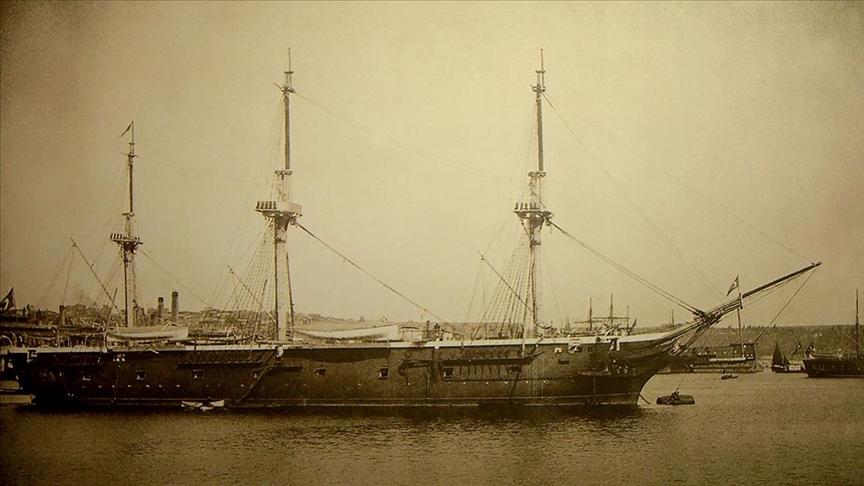
Ertuğrul Frigate, is a wooden-hulled, sail-steam hybrid (screw-propelled) warship of the Ottoman Navy. During its 1889–1890 voyage, it established direct diplomatic contact between the Ottoman State and Japan, and its sinking after striking rocks during a typhoon off the coast of Wakayama/Kushimoto on 16 September 1890 became a defining moment in Turkish-Japanese relations.
Ertuğrul Frigate (Anadolu Ajansı)
Ertuğrul was ordered from Tersane-i Âmire in 1854 and laid down in 1855; launched in 1863 and commissioned in 1864 after undergoing sea trials. That same year, it was sent to London for installation of its machinery and boilers, and upon return resumed active service. In 1885, it underwent extensive modernization and was reclassified as a “training ship” in 1888. Before its Japan voyage, it was rearmed and departed Istanbul on 14 July 1889; it sank during a typhoon on its return journey on 16 September 1890. This service trajectory reflects the typical transition of Ottoman naval forces from oar-and-sail traditions to steam-sail hybrid propulsion.
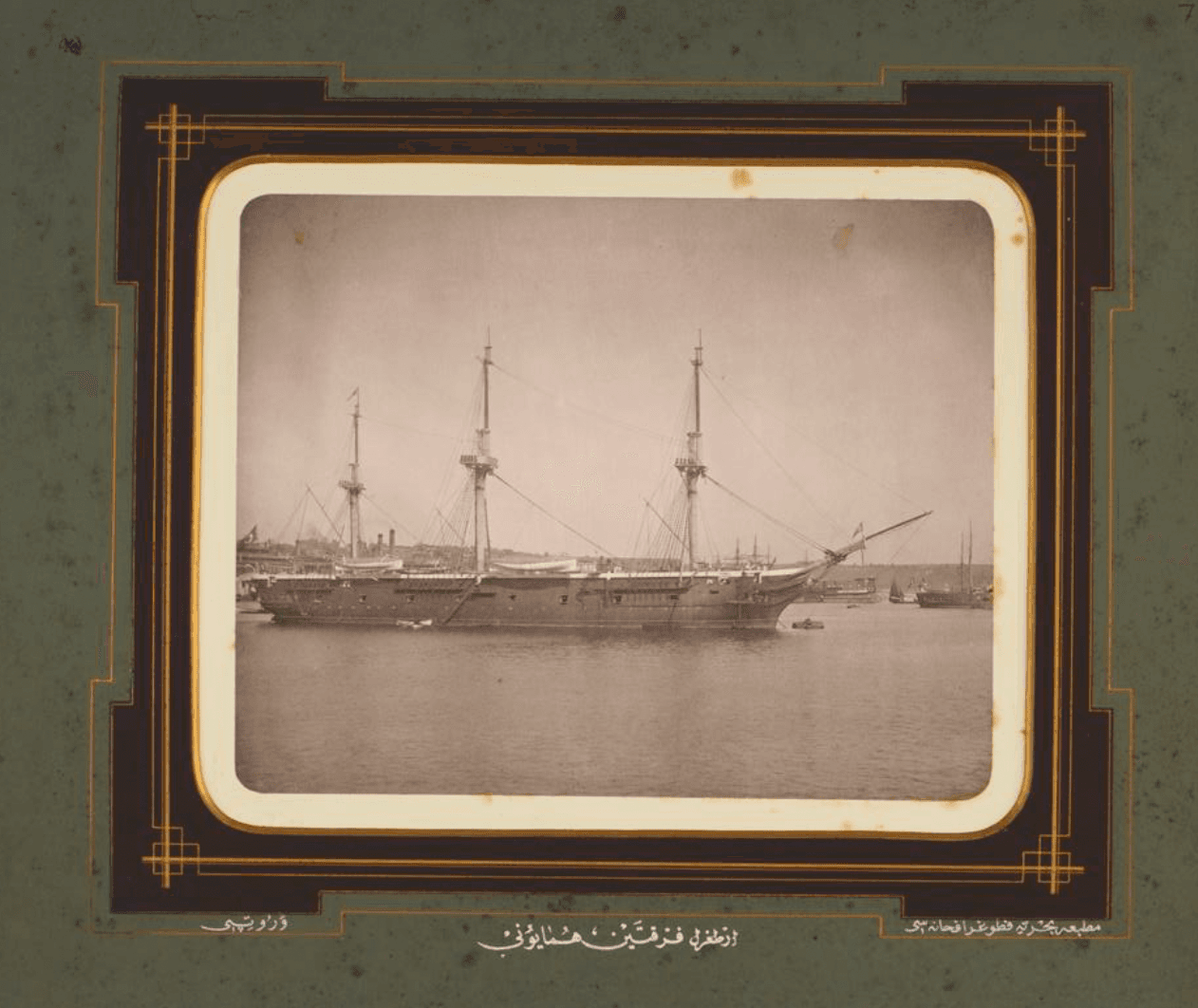
Ertuğrul Firkateyn-i Hümâyûnu (Meral Şahin)
Following the Meiji Restoration, modernizing Japan established indirect and direct contacts with the Ottoman Empire from the 1870s onward. The Iwakura Mission, which surveyed the West in 1871, included stops at Ottoman exhibitions. In 1878, the Japanese warship Seiki visited Istanbul. Sultan Abdülhamid II expressed his desire during this period to send an official naval delegation to reciprocate imperial greetings. In 1880, a Japanese delegation led by Foreign Affairs Adviser Yoshida Masaharu was received in Istanbul; political and commercial frameworks were discussed. Prince Komatsu’s visit to Istanbul in autumn 1887 generated expectations of an official Ottoman response.
The voyage was designed to combine diplomatic objectives with practical training for graduates of the Naval Academy. Under the command of Miralay (later Pasha) Osman Bey, the frigate departed the Haliç on 14 July 1889 with over 600 personnel. The departure drew large crowds along the Istanbul shoreline; military bands played marches and state officials were present at the ceremony.
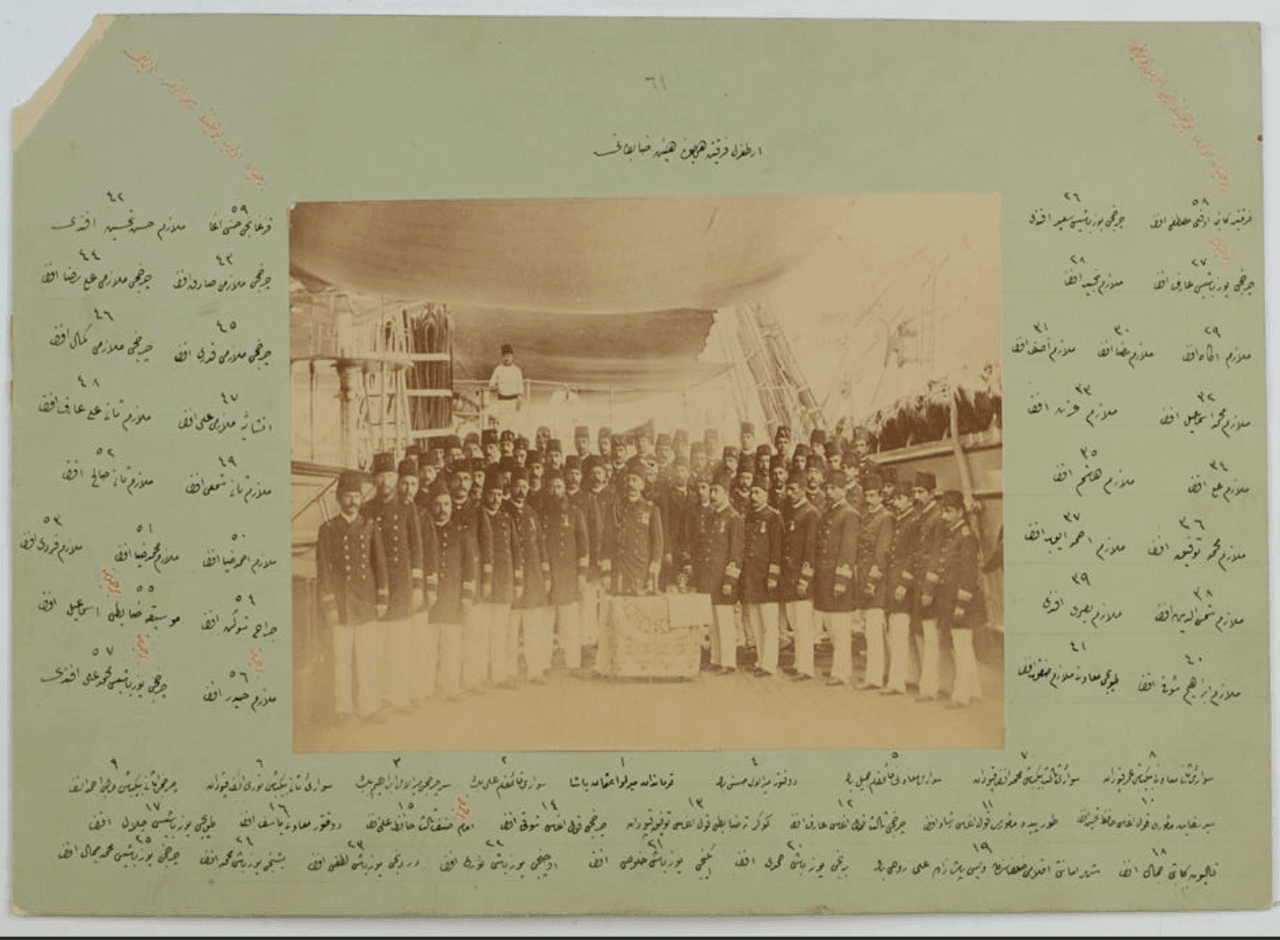
Ertuğrul Frigate Officer Corps (Meral Şahin)
Ertuğrul followed the route: Suez–Aden–Bombay–Colombo–Singapore–Saigon–Hong Kong–Nagasaki–Kobe. A prolonged repair period was required after damage sustained at Suez. In Bombay, a massive influx of visitors turned the ship into a “voyage fair”; in Singapore, the extended stay was decisive both due to the hospitality of the local Muslim community and logistical resupply. During Ramadan in Hong Kong, religious services were conducted aboard with the crew. Observations on Japanese urban fabric and commercial life were recorded during stops in Nagasaki and Kobe.
The frigate arrived in Yokohama on 7 June 1890. Head of the delegation, Osman Paşa, presented Emperor Meiji with a letter from Sultan Abdülhamid II, along with medals and gifts. The banquet hosted under court protocol served as an example of “state hospitality,” showcasing traditional Japanese table arrangements and serving customs.
The Japanese government advised extending the stay to allow for maintenance and repairs, citing the ship’s wooden hull and the imminent typhoon season in September. Concerned that delay might be interpreted as political weakness, the delegation departed Yokohama on 15 September 1890 as originally planned.
One day after departure, the ship was caught in a violent typhoon near Shionomisaki Cape and Kii Ōshima, driven onto the Kashinozaki rocks, and shattered. Over 500 Ottoman sailors lost their lives; 69 survived. Some survivors climbed steep cliffs guided by the light of the Kashinozaki Lighthouse to seek help.
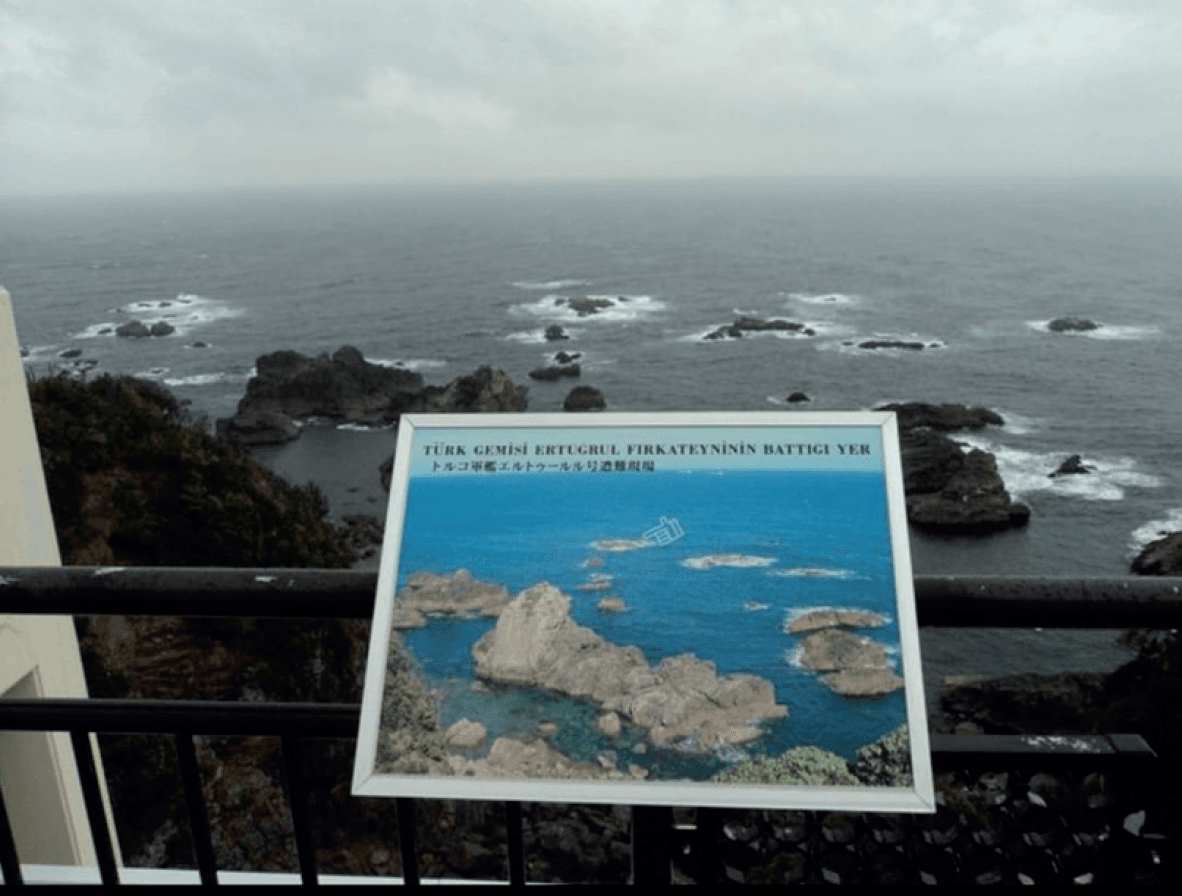
Coastline Where Ertuğrul Frigate Sank (Kushimoto/Wakayama) – (Fahrettin Tepealtı)
Residents of Kii Ōshima island risked their lives in storm conditions to rescue survivors from the rocks and provided them with food and shelter despite scarce supplies. Injured sailors were transported to Kobe for treatment; Emperor Meiji assigned imperial physicians and empress-appointed nurses to their care. Letters from local physicians stating “we will not charge fees” stand as documentary testimony of humanitarian aid.
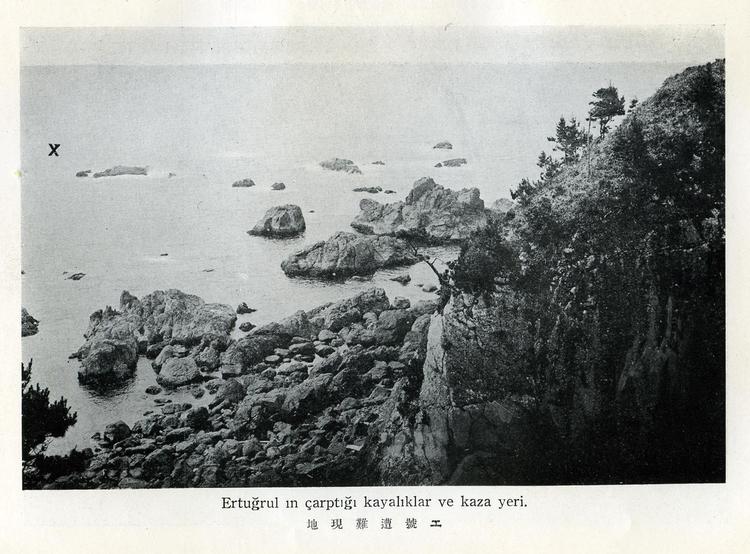
Site of the Ertuğrul Frigate Disaster (Anadolu Ajansı)
On 10 October 1890, the Japanese government dispatched the warships Hiei and Kongō to repatriate the survivors. Due to the Bosporus regime restrictions, the Japanese vessels could not enter Istanbul directly; the survivors were transferred to the Ottoman warship Talia at Çanakkale. The Japanese ships, granted special permission, entered Istanbul in January 1891 and were hosted for approximately one month before departing in February.
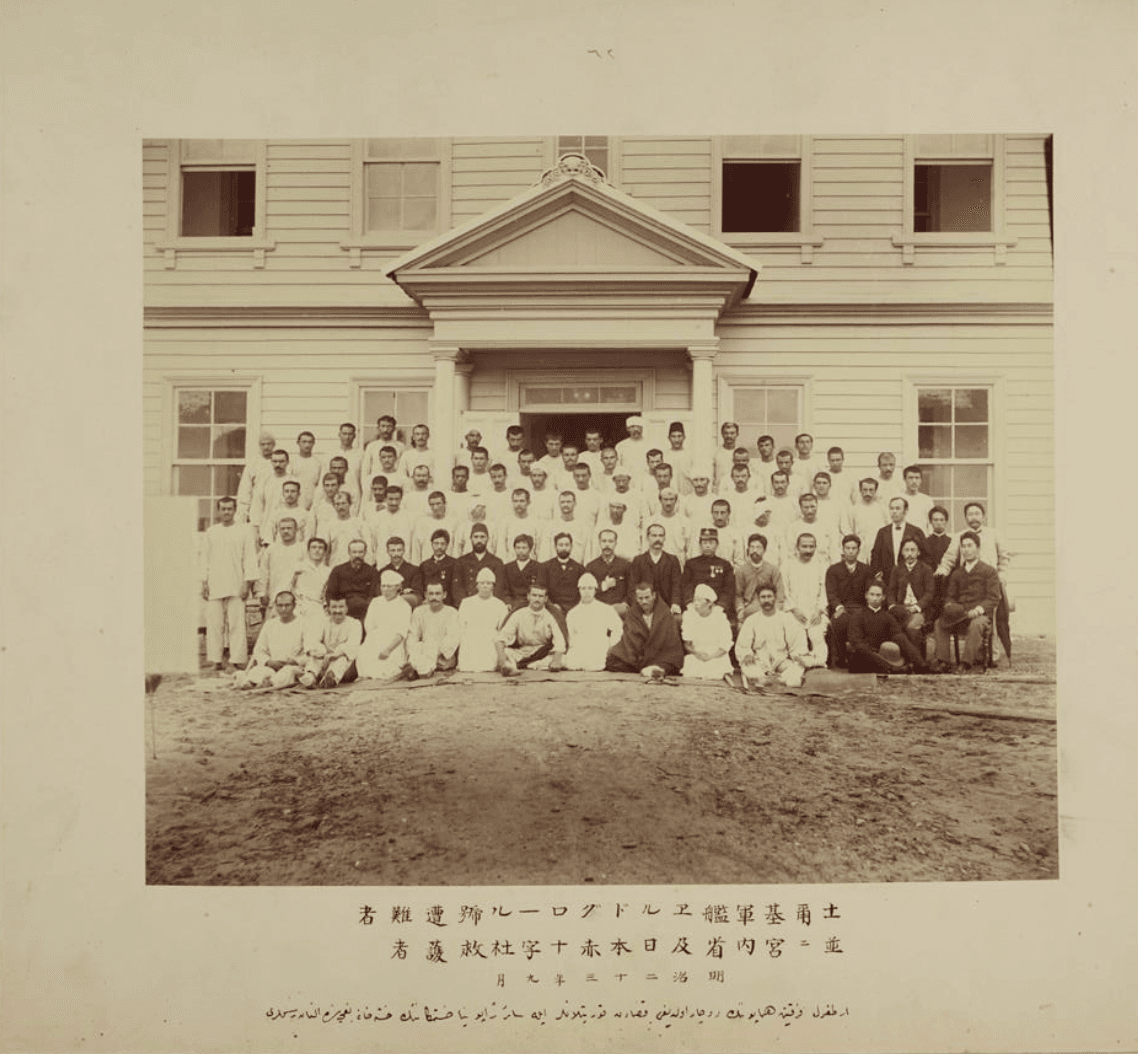
Japan: Photographs of Ertuğrul Frigate Survivors in a Japanese Hospital (Meral Şahin)
A communal cemetery was established on a hill overlooking the disaster site for the fallen crew, and a memorial was erected in 1891. Turkey restored the memorial in 1937; a Turkish Museum opened in the region in 1974. Today, commemorative ceremonies are held every five years in Kushimoto. The Kashinozaki Lighthouse, operational since 1870, is among Japan’s earliest stone-built, rotating lantern lighthouses; its design bears the signature of Richard Brunton.
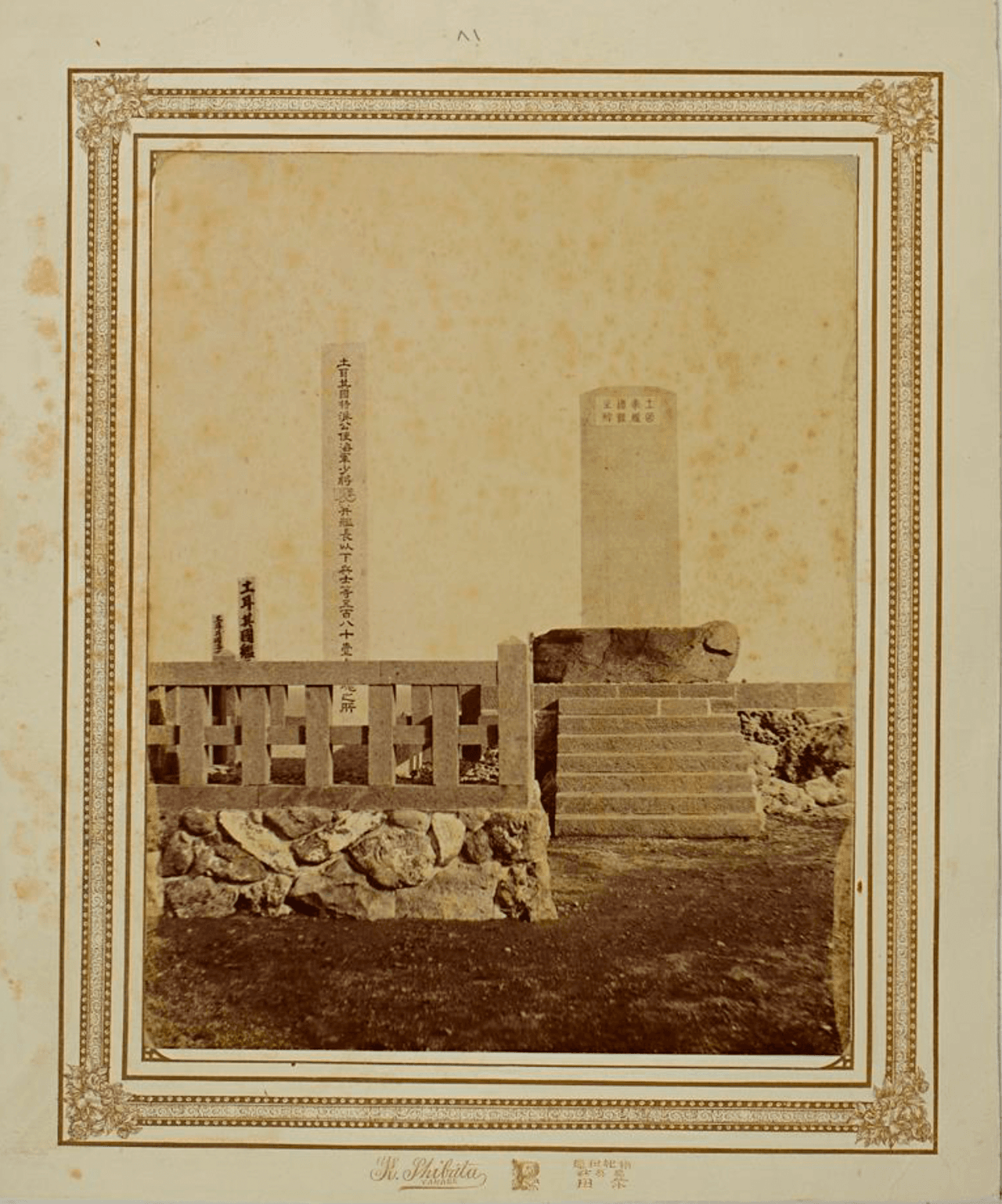
Ertuğrul Martyrs’ Memorial in Japan (Meral Şahin)
As part of archaeological efforts initiated in 2007, over a thousand artifacts were recovered from the seabed in 2008. That same year, the President of the Republic of Turkey made the first official visit to the Kushimoto memorial; commemorative and scientific activities were jointly conducted with institutions from both countries.
Survivor Çarkçı Yüzbaşı Mehmed Ali (Balkır) meticulously documented the voyage from Istanbul to Yokohama, including the imperial audience, the disaster, and his days on Kii Ōshima and in Kobe. His memoirs include social and cultural observations such as the prolonged stop in Singapore, the canal repair in Suez, the massive crowds in Bombay and Singapore, and Ramadan observances in Hong Kong. It is noted that Mehmed Ali Bey had a stove machine he saw in Japan manufactured in Istanbul and tested before the palace in 1892, illustrating the voyage’s technical and technological impact.
The Ertuğrul incident, as the first organized diplomatic mission from the Islamic world to Japan, forged a lasting memory of solidarity between the two societies. This chain of remembrance found a modern link in 1985, when Japanese citizens stranded in Tehran during the Iran–Iraq War were evacuated by Turkish Airlines—an act widely interpreted as a “95-year repayment” of the humanitarian aid offered in Kushimoto.
The story of Ertuğrul has been adapted into novels, documentaries, and films. The 2015 co-production film “Ertuğrul 1890/Kaian 1890” linked the 1890 disaster and the 1985 Tehran evacuation in two episodes, narratively connecting mutual aid in the collective memory of both nations. Museum exhibitions, scale models, photographs, and rituals around the memorial form the spatial foundations of popular memory.
Port visits commemorating Ertuğrul’s voyage continued with TCG Turgutreis in 1990 and 2000, TCG Gemlik in 2011, and TCG Gediz in 2015. On the centenary of Turkish–Japanese diplomatic relations, TCG Kınalıada undertook commemorative and friendship missions along the Kushimoto–Tokyo–Hiroshima route in 2024. In August 2024, Japanese Maritime Self-Defense Force training vessels Kashima and Shimakaze anchored at Istanbul’s Sarayburnu. Commemorative events held in 2025, marking the 135th anniversary, received public attention; in the same year, an agreement on a youth exchange program focused on disaster awareness was signed between the Turkish–Japanese Foundation and the Wakayama Prefecture in Ankara.
AA (Anadolu Ajansı). "Wakayama Valisi Miyazaki: Ertuğrul Firkateyni kazasının Türk-Japon dostluğunun temelini attığını söyledi." Anadolu Ajansı. Accessed September 15, 2025.https://www.aa.com.tr/tr/gundem/wakayama-valisi-miyazaki-ertugrul-firkateyni-kazasinin-turk-japon-dostlugunun-temelini-attigini-soyledi/3650795.
AA (Anadolu Ajansı). *Türkiye-Japon Diplomasisinin Miladı: Ertuğrul Fırkateyni.* Anadolu Ajansı. Accessed September 15, 2025.https://www.aa.com.tr/tr/gundem/turk-japon-diplomasisinin-miladi-ertugrul-firkateyni/2992545.
AA (Anadolu Ajansı). *Türkiye-Japonya ilişkilerinin başlangıcı Ertuğrul firkateyninin üzerinden 135 yıl geçti.* Anadolu Ajansı. Accessed September 15, 2025.https://www.aa.com.tr/tr/gundem/turkiye-japonya-iliskilerinin-baslangici-ertugrul-firkateyninin-uzerinden-135-yil-gecti/3687667.
Akiba, Jun. "Ertuğrul Fırkateyni ile Japonya’ya Ulema Gönderme Girişimi." Annals of Japan Association for Middle East Studies 29, no. 1 (2013): 129–143.
Nippon.com. "トルコの悲劇“エルトゥールル号”に命を救われた日本人漁師たちの恩返し." Accessed September 15, 2025.https://www.nippon.com/ja/behind/l00127/?pnum=1
Nippon.com. "トルコの悲劇“エルトゥールル号”に命を救われた日本人漁師たちの恩返し." Accessed September 15, 2025.https://www.nippon.com/ja/behind/l00127/?pnum=2
Sürmeli, Serpil. “Ertuğrul Faciasından Kurtulan Çarkçı Yüzbaşı Mehmed Ali (Balkır)’ın Hatıraları.” *History Studies* 15, no. 2 (May 2023): 171–196. Accessed September 15, 2025.https://dergipark.org.tr/tr/pub/historystudies/issue/77900/1311787
Tepealtı, Fahrettin. “Türkiye-Japonya ilişkileri: yüz yıllık bir değerlendirme.” *International Journal of Geography and Geography Education* 53 (September 2024): 136–156. Accessed September 15, 2025.https://dergipark.org.tr/tr/pub/igge/issue/87394/1500261.
Tokyo Büyükelçiliği (Republic of Turkey Ministry of Foreign Affairs). "Ertuğrul Fırkateyni Tragedy." Republic of Turkey Ministry of Foreign Affairs, Tokyo Embassy, July 4, 2017. Accessed September 15, 2025.https://tokyo-be.mfa.gov.tr/Mission/ShowInfoNote/133573
Çırpan, Mustafa. “Osmanlı Devleti’nde Gemi Tipleri ve Gemi Kazaları ile İlgili Değerlendirmeler.” *GİDB Dergi* 19 (2020): 41–58. Accessed September 15, 2025.https://dergipark.org.tr/tr/pub/gidb/issue/60341/880818
Şahin, Meral. “II. Abdülhamit Devrinde Osmanlı-Japonya ilişkileri bağlamında Ertuğrul Firkateyni’nin batışı ve H.1308/M. 1891 yılında Almanya ve Japonya’dan gelen resmi görevlilere yapılan harcamalar.” *Nevşehir Hacı Bektaş Veli Üniversitesi SBE Dergisi* 14 (Türkiye-Japonya İlişkileri 100. Yıl Özel Sayısı) (2024): 123–149. Accessed September 15, 2025.https://dergipark.org.tr/tr/pub/nevsosbilen/issue/84207/1522516

State | Ottoman Empire | ||||||||
|---|---|---|---|---|---|---|---|---|---|
Shipyard | Tersâne-i Âmire, İstanbul | ||||||||
Construction Start | 1854 | ||||||||
Launch | 1863 | ||||||||
Commissioning | 1864 | ||||||||
Type | Wood-hulled, wooden-hulled frigate | ||||||||
Length | 76 m | ||||||||
Width | 18 m | ||||||||
Weight (Tonnage) | 2,344 tons | ||||||||
Armament | Approximately 40 guns | ||||||||
Crew Capacity | 600+ personnel | ||||||||
Voyage Start | 14 July 1889, İstanbul | ||||||||
Commander | Miralay (Pasha) Osman Bey | ||||||||
Mission Purpose | To present the letter of honor and gifts from Sultan Abdülhamid II to Emperor Meiji of Japan, conduct a practical training voyage for students of the Naval Academy, and initiate Ottoman-Japanese diplomatic relations | ||||||||
Port of Call | Suez, Aden, Bombay, Colombo, Singapore, Hong Kong, Nagasaki, Kobe | ||||||||
Arrival | 7 June 1890, Yokohama | ||||||||
Return | 15 September 1890, departure from Yokohama | ||||||||
Accident Date | 16 Eylül 1890 | ||||||||
Accident Location | Wakayama Prefecture, Kushimoto waters, Kashinozaki cliffs | ||||||||
Cause of Accident | Typhoon and the ship's deteriorated structure | ||||||||
Rescue | The people of Kushimoto rescued the survivors despite the storm and provided food and shelter | ||||||||
Return Mission | The rescued ships, Hiei and Kongō, were delivered to Istanbul in 1891 | ||||||||
Monument | A monument was erected for the fallen in Kuşimoto in 1891 and restored by Türkiye in 1937 | ||||||||
Museum | The Turkish Museum in Kuşimoto was opened in 1974 | ||||||||
Commemoration | Ceremonies are held every year on September 16 in Türkiye and Japan | ||||||||
Construction, Armament, and Service History
Background of Ottoman–Japanese Relations (1870s–1889)
Organization and Command of the Voyage
Route and Port Calls
Arrival in Yokohama and Imperial Audience
Return Warnings and Seasonal Conditions
Disaster: Off Kushimoto/Kii Ōshima (16 September 1890)
Rescue, First Aid, and Medical Intervention
Repatriation of Survivors: Hiei and Kongō
Burial, Memorial, and Museumization
Underwater Investigations and Artifacts
Testimonies and Voyage Logs
Symbolic Impact on Ottoman–Japanese Relations
Cultural Productions and Popular Memory
Military Visits and Contemporary Reflections (1990s–2025)