This article was automatically translated from the original Turkish version.
+1 More
Erasmus
Name | Erasmus Program | ||||||||
|---|---|---|---|---|---|---|---|---|---|
Year of Liberation | 1987 | ||||||||
Executive Body | European Commission | ||||||||
Scope | Vocational education Higher education Youth Adult education | ||||||||
Participating Countries | EU member countries + program and partner countries | ||||||||
Program Type | Education and Mobility Program | ||||||||
Category | European Union Education Program | ||||||||
Center | Brussels-Belgium | ||||||||
Erasmus Program, Europe Union’s mobility program, launched in 1987 to provide international exchange opportunities for higher education students and staff. Named after the 15th-century humanist philosopher and theologian Desiderius Erasmus, the program aims to promote intercultural understanding, strengthen European identity, and support individuals’ personal, academic and professional development. Over time, the Erasmus Program has expanded beyond student exchange to include youth, sports, adult education and vocational training among other fields.

Portrait of Desiderius Erasmus painted by Hans Holbein between 1500 and 1525 (not to be confused with the younger Hans Holbein). Currently exhibited at the Louvre Museum. (World History Encyclopedia)
The Erasmus Program was developed as part of the social and cultural dimensions of European integration. It began in 1987 with participation from 11 European countries. Türkiye did not participate in the early years but gained full participant status as a “program country” in 2004.
In 2007, Erasmus and several other EU education programs were restructured under the umbrella of the “Lifelong Learning Programme” (LLP). This structure was replaced in 2014 by the “Erasmus+” program. The latest Erasmus+ period, covering 2021–2027, has further expanded and been redefined around themes of green transition, digitalisation, inclusion and participatory citizenship.
The core objectives of the Erasmus Program are:
• To enable students to gain intercultural experiences through study abroad,
• To improve foreign language proficiency,
• To support academic cooperation at the European level,
• To enhance awareness of European citizenship among young people and educators,
• To foster partnerships and networks among educational institutions.
The program embraces the principles of equal participation and equal opportunity. Various financial support mechanisms and special arrangements have been developed to ensure access for socio-economically disadvantaged groups.
The Erasmus+ program encompasses a wide range of activities, which can be grouped under four main headings:
• Study and internship opportunities for undergraduate, master’s and doctoral students abroad,
• Mobility of academics and administrative staff for teaching and training purposes,
• Opportunities for dual degrees and joint program development.
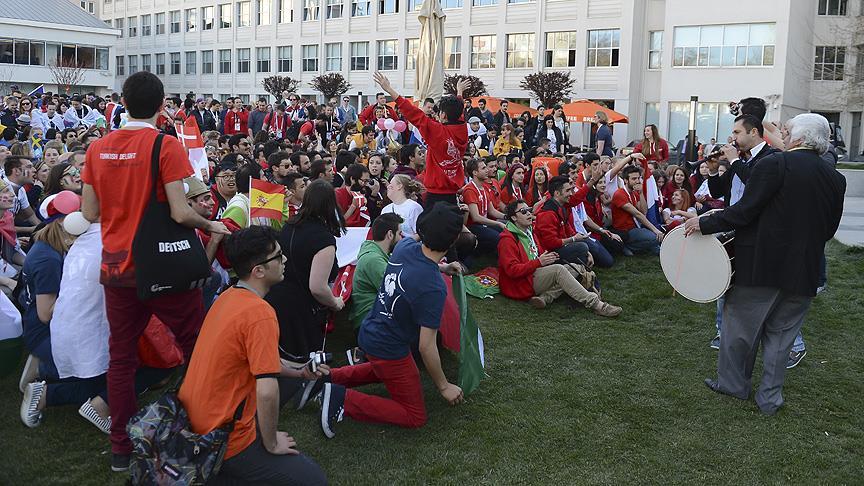
Erasmus students (Anadolu Ajansı)
• Vocational high school students and teachers undertaking internships in Europe,
• Development of training modules and cross-sector partnerships.
• Youth exchanges,
• Volunteering projects (formerly European Voluntary Service – EVS),
• Training and capacity-building projects for youth workers.
• Harmonisation of education, training and youth policies at the EU level,
• Dissemination of innovative practices,
• Strategic partnerships between universities, NGOs and the private sector.
The Erasmus+ Program is not limited to European Union member states. The following country groups may participate:
•Program Countries: The 27 EU member states plus Iceland, Norway, Liechtenstein, Türkiye, North Macedonia and Serbia
•Partner Countries: Non-European countries that can participate in specific projects (e.g. Japan, USA, South Korea, etc.)
The program is implemented under the coordination of the European Commission through National Agencies. In Türkiye, this responsibility is carried out by the Türkiye National Agency.
Türkiye became a full participant in the Erasmus Program in 2004. Since then, thousands of students, academics, youth workers and civil society representatives have participated in Erasmus exchanges, either traveling to European countries or hosting participants from abroad in Türkiye.
Turkish universities participating in the Erasmus Program publish student and staff exchange plans at the beginning of each academic year. These institutions are actively supported by their Erasmus Coordination Offices. Türkiye also plays an active role in youth initiatives, particularly in volunteering and youth exchange projects.
Although generally viewed positively, the Erasmus Program has faced some criticism. For example:
• It has often been noted that students from economically disadvantaged backgrounds do not benefit sufficiently from the program.
• Recognition and credit transfer issues during mobility can lead to academic losses for some students.
• Complex application procedures and bureaucratic burden reduce the quality and reach of applications.
To address these issues, the European Commission has introduced various improvements during the 2021–2027 program period under headings such as digitalisation and process simplification, and this process continues.
The Erasmus Program has significant cultural and social impacts beyond its academic benefits. Participants gain exposure to different ways of life, develop intercultural understanding and build international friendships. The program’s widespread success has contributed to the emergence of a new generation in Europe known as the “Erasmus Generation.” This generation consists of pluralistic, open-minded individuals committed to European values.
Anadolu Ajansı. "Erasmus Öğrencileri Türkiye’de Yaşadıklarını Anlattı." Accessed April 16, 2025.https://www.aa.com.tr/tr/yasam/erasmus-ogrencileri-turkiyede-yasadiklarini-anlatti/586817.
European Commission. "Erasmus+ Programme." European Union Erasmus+ Official Website. Accessed April 16, 2025.https://erasmus-plus.ec.europa.eu.
Ministry of Foreign Affairs of the Republic of Türkiye, Directorate General for European Union. "Erasmus+ Program." European Union Directorate General Official Website. Accessed April 16, 2025.https://www.ab.gov.tr/erasmus-programi_53081.html.
Türkiye Ulusal Ajansı. "Erasmus+ Programı." Türkiye Ulusal Ajansı Resmî Web Sitesi. Accessed April 16, 2025.https://www.ua.gov.tr/programlar_/erasmus-programi/.
World History Encyclopedia. "Erasmus by Hans Holbein." World History Encyclopedia. Accessed April 18, 2025.https://www.worldhistory.org/image/13017/erasmus-by-hans-holbein/.

Erasmus
Name | Erasmus Program | ||||||||
|---|---|---|---|---|---|---|---|---|---|
Year of Liberation | 1987 | ||||||||
Executive Body | European Commission | ||||||||
Scope | Vocational education Higher education Youth Adult education | ||||||||
Participating Countries | EU member countries + program and partner countries | ||||||||
Program Type | Education and Mobility Program | ||||||||
Category | European Union Education Program | ||||||||
Center | Brussels-Belgium | ||||||||
Historical Development
Objectives and Principles
Scope and Activity Areas
Student and Staff Mobility
Vocational Education and Training
Youth Mobility and Youth Work
Policy Reform Support and Cooperation
Participating Countries and Structure
Erasmus Program in Türkiye
Criticism and Areas for Improvement
Cultural and Social Impact