


This article was automatically translated from the original Turkish version.
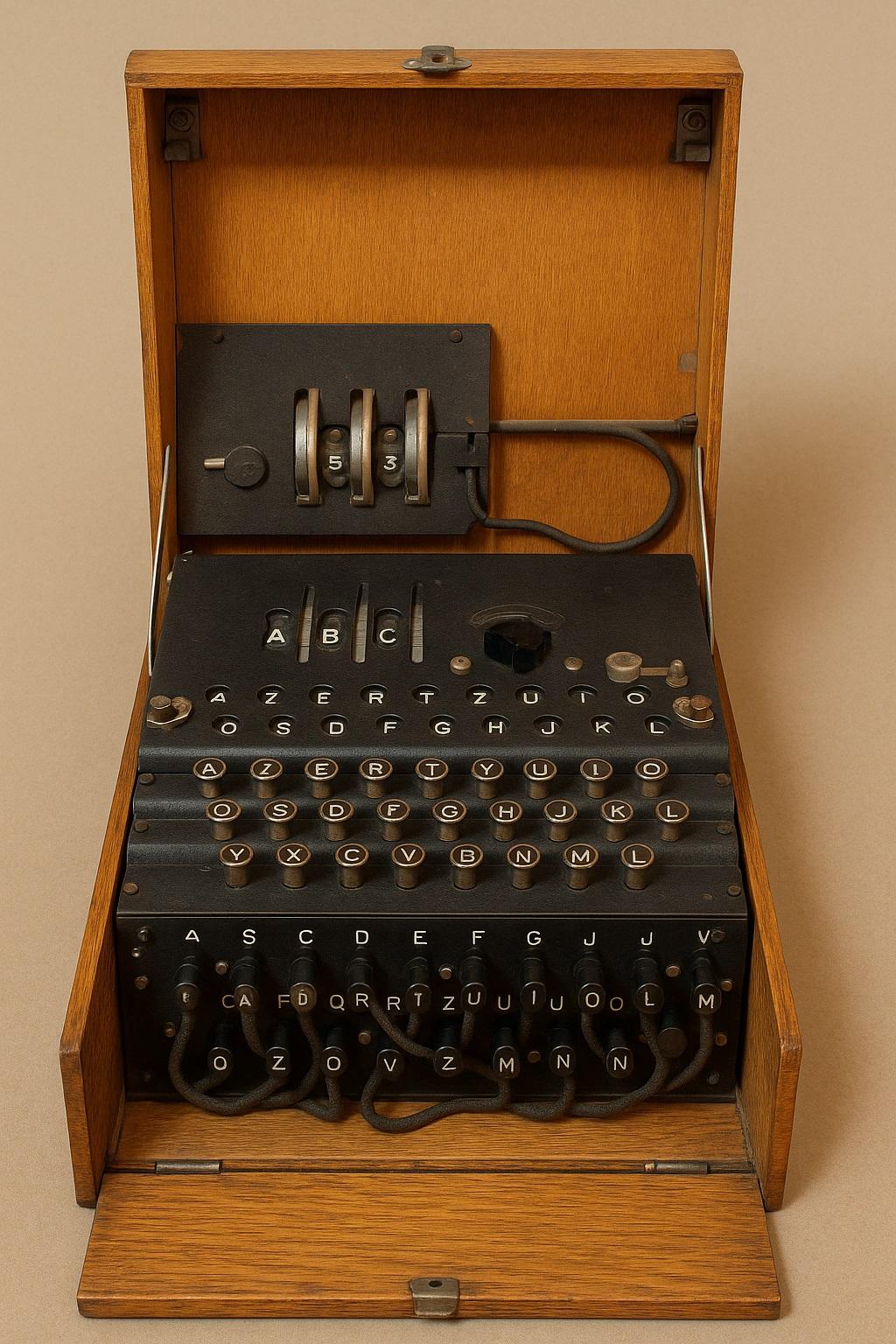
Enigma Machine
History of Invention | 1918-02-23 | ||||||||
|---|---|---|---|---|---|---|---|---|---|
Inventor | Arthur Scherbius | ||||||||
Purpose | Encrypted communication | ||||||||
Field of Use | Especially used by Nazi Germany during World War II | ||||||||
Enigma machine is an electromechanical encryption device invented in the early 20th century and primarily used by Nazi Germany during World War II. Due to its complex structure and interchangeable components, this device could generate hundreds of billions of combinationsand was regarded as the most secure communication tool of its time. However, the Allies deciphered the machine’s logic and significantly altered the course of the war.
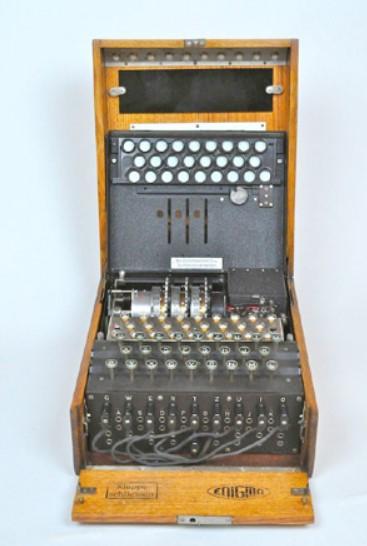
Enigma Makinesi (Enigma Museum)
The first version of Enigma was designed in 1918 by German engineer Arthur Scherbius and patented in 1919. Although initially produced for commercial purposes, it was acquired by the German militaryin the late 1920s and began to be used for military encryption. Throughout the 1930s, the German Air Force (Luftwaffe), Navy (Kriegsmarine), and Army (Heer) developed their own versions and employed the device for operational encryption.
The Enigma machine accepts letter input from the user and converts it into an encrypted letter through electromechanical means. The encryption process is carried out using the following key components:
Letters are entered via a QWERTZ layout keyboard.
Each rotor contains different internal wiring paths for the 26 letters. Each time a key is pressed, the rotors rotate, continuously changing the encryption combination. A typical Enigma machine uses three or four rotors.
The reflector redirects the encryption signal back through the rotors, enabling bidirectional encryption. This ensures that the same settings used for encryption can also be used for decryption.
In addition to the rotor encryption, the plugboard swaps letters in pairs, greatly increasing the number of possible combinations.
Indicates which letter the input letter has been encrypted into.
Thanks to this mechanism, the number of possible combinations generated by Enigma exceeds trillions. For example, in a three-rotor model, considering rotor order, initial positions and plugboard settings, approximately 150 quintillion different configurations are possible.
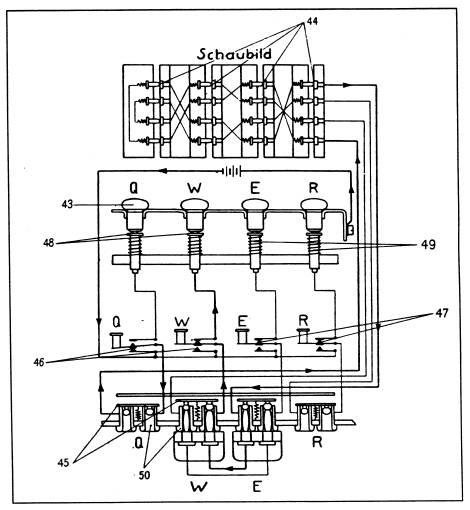
Enigma Makinesi Diyagramı (Enigma Museum)
(43) Light Bulbs – Lamps
(44) Rotor Contacts – Rotor Contacts
(45) Bypass Contacts for Unused Jack Panel Sockets – Bypass Contacts for Unused Jack Panel Sockets
(46) Key Contacts N. O. (Normally Open) – Normally Open Key Contacts
(47) Key Contacts N. C. (Normally Closed) – Normally Closed Key Contacts
(48) Lamp Contacts – Lamp Contact Points
(49) Lamp Contact Springs – Lamp Contact Springs
(50) Jacks in Patch Panel – Jacks in the Plugboard
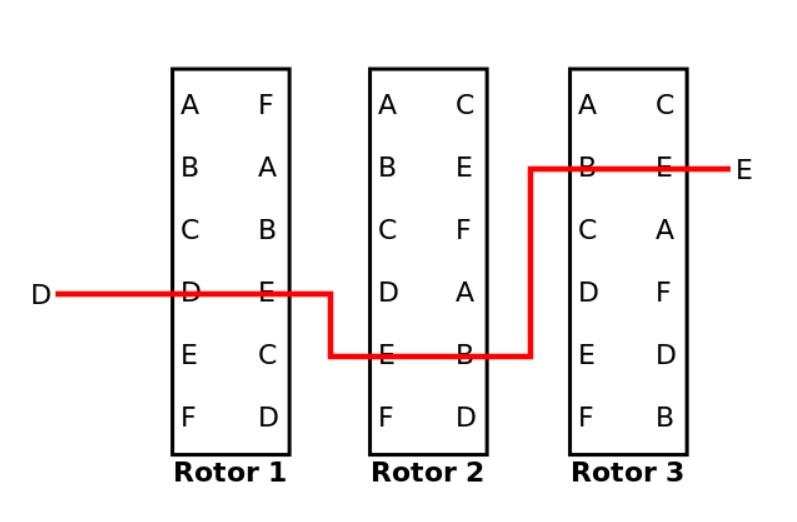
Basitleştirilmiş Enigma Modeli (USNA)
The decryption of Enigma was first achieved in the 1930s by Polish mathematicians, notably Marian Rejewski. Poland shared its intelligence breakthroughs with Britain and France, making a crucial contribution before the war.
Later, at Bletchley Park in England, Alan Turing, Gordon Welchman, and other cryptologists successfully broke Enigma codes systematically using electromechanical machines they called “Bombe.” This breakthrough gave the Allies a major intelligence advantage and is estimated to have shortened the war by approximately two years.
Today, the Enigma machine is regarded not only as an encryption device but also as the foundation of modern cryptography and computer science. Alan Turing’s contributions during this process influenced the emergence of modern computer concepts.
Chamberlain, Nathan. “Simple Model of the Enigma.” U.S. Naval Academy, IC211 Lab 4. Accessed May 14, 2025.https://www.usna.edu/Users/cs/nchamber/courses/ic211/s19/lab/l04/realenigma.html.
Cipher Machines and Cryptology. "Enigma." Accessed April 30, 2025.
Enigma Museum. "About Us." Accessed April 30, 2025.
Hodges, Andrew. Alan Turing: The Enigma. Princeton, NJ: Princeton University Press, 2014.
International Museum of World War II. “The Story of the First World War: Exhibit Guide.” International Museum of World War II. Accessed May 14, 2025.https://www.iwm.org.uk/collections/item/object/30005172.
Singh, Simon. The Code Book: The Science of Secrecy from Ancient Egypt to Quantum Cryptography. New York: Anchor Books, 2000.
Turing, Alan M. "Computing Machinery and Intelligence." Mind 59, no. 236 (1950): 433–460.

Enigma Machine
History of Invention | 1918-02-23 | ||||||||
|---|---|---|---|---|---|---|---|---|---|
Inventor | Arthur Scherbius | ||||||||
Purpose | Encrypted communication | ||||||||
Field of Use | Especially used by Nazi Germany during World War II | ||||||||
History
Technical Structure and Operating Principle
Enigma Machine Diagram
Breaking the Code
Modern Interpretation and Significance