This article was automatically translated from the original Turkish version.
Type of Geographical Indication | Signpost | ||||||||
|---|---|---|---|---|---|---|---|---|---|
Registration Number | 770 | ||||||||
Registration Date | 26.05.2021 | ||||||||
Product / Product Group(s) | Bakery and confectionery products sweets dough products | ||||||||
Province(s) | Afyonkarahisar | ||||||||
Applicant/Registrant(s) | Emirdağ Municipality | ||||||||
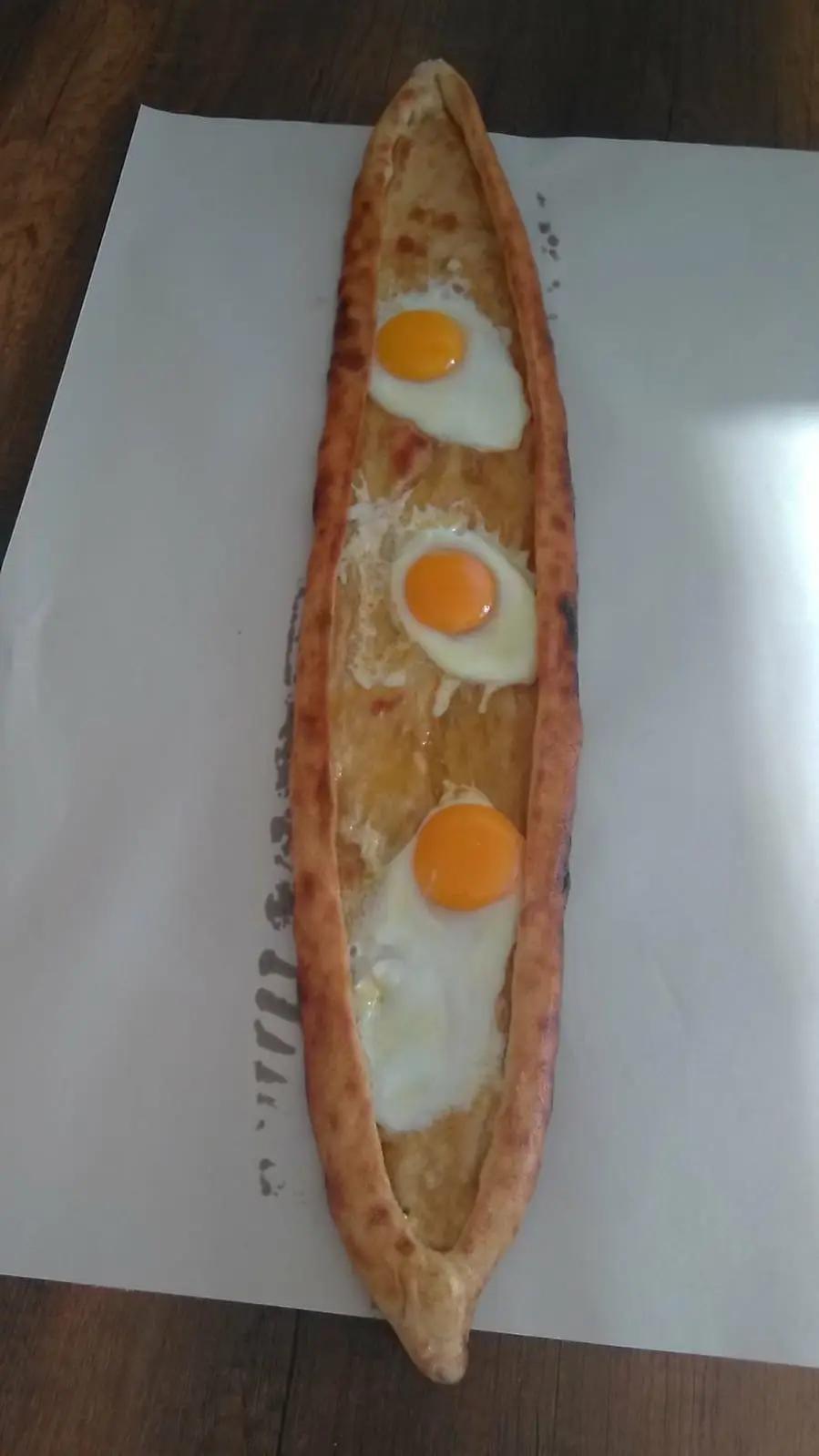
Emirdağ egg pide is a traditional bakery product unique to the Emirdağ district of Afyonkarahisar province, with a long historical tradition. Registered as a geographical indication on 26.05.2021, this pide is commonly consumed in daily meals and requires skilled craftsmanship, particularly in the preparation and baking of the dough. The product’s link to its geographical origin forms the basis for its registration.
The dough of Emirdağ egg pide is prepared using fresh yeast and salt, and rye bran is used during the rolling-out stage. The pide is shaped into an oval form approximately 80 cm in length and 15 cm in width. The edges are folded inward by about 2 cm to create a raised border. Before baking, butter is spread over the surface, and after the initial baking phase, one or more eggs are cracked directly onto the dough. The pide can be prepared either partially baked with runny yolk or fully baked, depending on the desired doneness of the egg. Partially baked egg pide is served without slicing. Approximately 350 g of dough is used for one portion, and 500 g for one and a half portions.
The production process of Emirdağ egg pide consists of the following steps:
The geographical boundary for Emirdağ egg pide is defined as the Emirdağ district of Afyonkarahisar province. All production processes—particularly those involving dough preparation, fermentation, and baking—must be carried out within this defined geographical area.
Monitoring of Emirdağ egg pide is conducted under the coordination of the Emirdağ Municipality. The monitoring body consists of a five-member committee comprising one expert each from the Emirdağ Municipality, Emirdağ Municipal Police Directorate, Emirdağ District Directorate of Agriculture and Forestry, Emirdağ Chamber of Tradesmen and Artisans, and Emirdağ Chamber of Commerce and Industry.
Monitoring inspections are carried out annually on a regular basis, and additional inspections may be conducted in response to complaints or as deemed necessary. The responsibilities of the monitoring body include verifying the compliance of ingredients, production methods (particularly dough preparation, fermentation, and baking), and the correct use of the designation “Emirdağ egg pide” and its registered geographical indication emblem. The registering institution, Emirdağ Municipality, is responsible for managing all legal procedures.
Turk Patent and Trademark Office. "Emirdağ Yumurtalı Pidesi Sicil Metni." *Geographical Indications Portal.* Accessed October 24, 2025. https://ci.turkpatent.gov.tr/Files/GeographicalSigns/31787cf7-67d2-4629-b40f-e13dd9d43ab.pdf
Turk Patent and Trademark Office. "Emirdağ Yumurtalı Pidesi." *Geographical Indications Portal.* Accessed October 24, 2025. https://ci.turkpatent.gov.tr/cografi-isaretler/detay/1825

Type of Geographical Indication | Signpost | ||||||||
|---|---|---|---|---|---|---|---|---|---|
Registration Number | 770 | ||||||||
Registration Date | 26.05.2021 | ||||||||
Product / Product Group(s) | Bakery and confectionery products sweets dough products | ||||||||
Province(s) | Afyonkarahisar | ||||||||
Applicant/Registrant(s) | Emirdağ Municipality | ||||||||
No Discussion Added Yet
Start discussion for "Emirdağ Yumurtalı Pidesi" article
Product Characteristics
Production Method
Geographical Boundary
Monitoring