


This article was automatically translated from the original Turkish version.
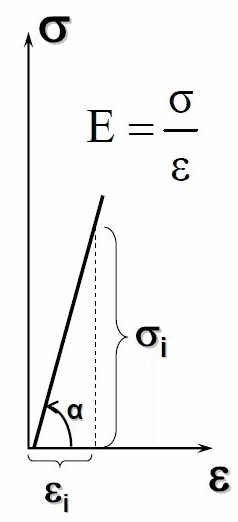
Graph | Stress-Strain Graph | ||||||||
|---|---|---|---|---|---|---|---|---|---|
The concept of the modulus of elasticity was first introduced by Thomas Young in 1807.
Also referred to as Young’s modulus in some sources, the modulus of elasticity (E) is a measure of a material’s resistance to deformation under a load.
This value (E) indicates how stiff or flexible a material is. A higher value means the material will deform less compared to one with a lower value.
This value is calculated from the stress-strain graph obtained after a stress-strain test. According to this, the slope of the linear region of the stress-strain curve is equal to the material’s modulus of elasticity. This relationship is known as Hooke’s Law.
Hooke’s Law is valid only within the linear region. Beyond this region, where the linear relationship breaks down, this law no longer applies. In nonlinear regions, where plastic deformation occurs, the modulus of elasticity varies with the applied load. The SI unit of the modulus of elasticity is the pascal (Pa).
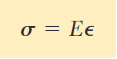
class=\
ESteel = 2×10¹¹ N/m2
EAluminum = 7×10¹⁰ N/m2
Beer, F. P., Johnston, E. R., Dewolf, J. T., and Mazurek, D. F. (Trans. A. Soyucok & O. Soyucok). (6th ed.)
Shackelford, James F. Mühendisler İçin Malzeme Bilimine Giriş. İstanbul: Literatür Yayıncılık, 2018.

Graph | Stress-Strain Graph | ||||||||
|---|---|---|---|---|---|---|---|---|---|
No Discussion Added Yet
Start discussion for "Elasticity (Young's) Modulus" article
Discovery
Definition
Determination and Base Unit
Example Materials