This article was automatically translated from the original Turkish version.
Eisenhower Matrix is an effective tool used for time management and prioritization. It is named after Dwight D. Eisenhower, the 34th President of the United States, who placed great importance on the efficient use of time. This matrix provides a method for prioritizing tasks.
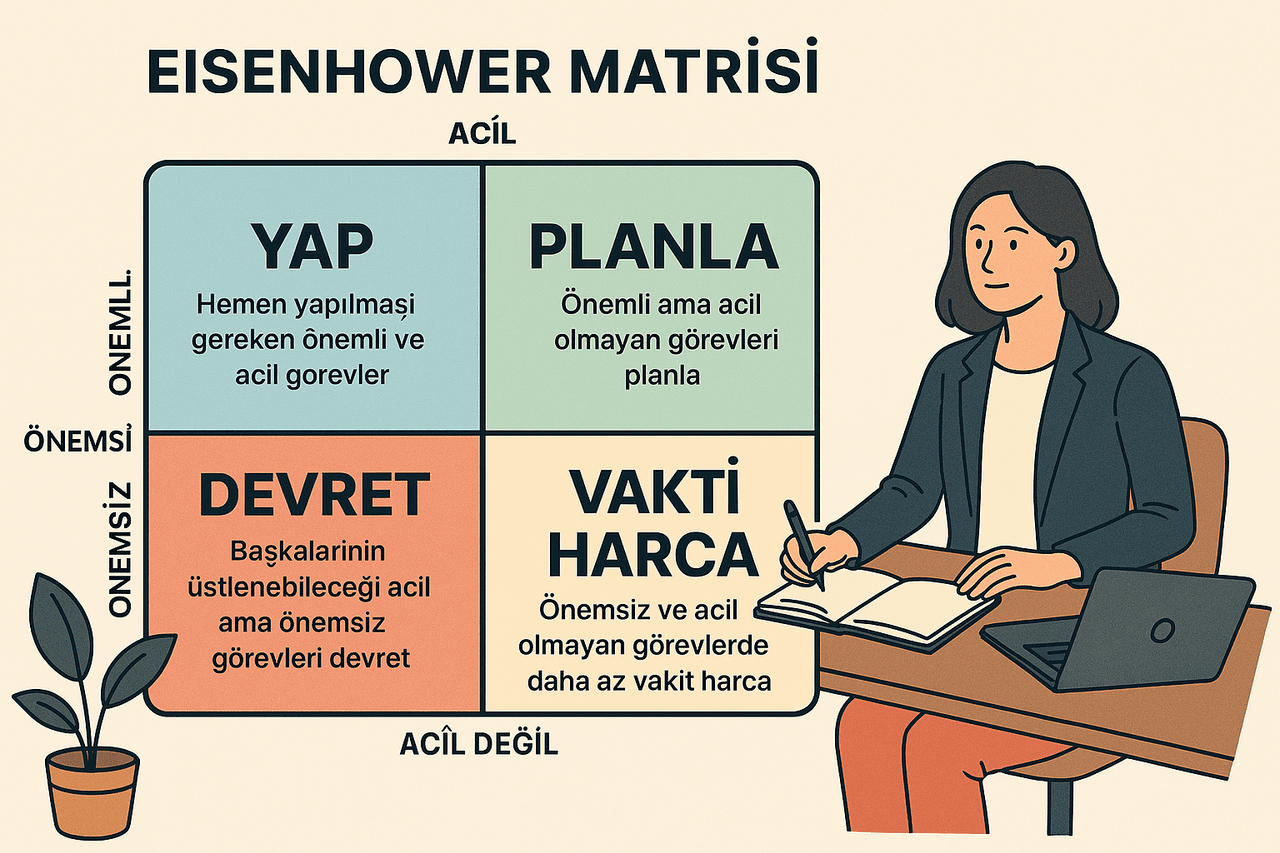
Visual of the Four Main Categories (Image Generated by Artificial Intelligence)
The Eisenhower Matrix holds critical importance for the efficient use of resources, particularly in contexts such as management, business economics, and politics.
The Eisenhower Matrix can be applied not only to time management but also to various other fields. It finds practical use in management and business strategies, decision-making processes, project management, and leadership. Businesses often adopt this matrix to manage daily operations efficiently, focus on priority tasks, and utilize resources more effectively. It can also be applied in politics, personal management, and crisis management.
Business Management: Company managers can use the Eisenhower Matrix to allocate resources more efficiently when prioritizing tasks. Distinguishing between high-priority strategic tasks and operational tasks ensures the organization operates effectively.
Personal Time Management: Individuals can use this matrix to plan daily routines more efficiently, reducing time wasted and improving progress toward personal goals.
Crisis Management: In crisis situations, where urgent and important decisions must be made quickly, the Eisenhower Matrix helps managers rapidly identify which actions require priority.
The Eisenhower Matrix is also an important tool in business economics. Given that businesses operate with limited resources and time, this matrix enables the proper allocation of those resources. Companies must make key decisions to manage their economic resources—such as labor, capital, and materials—and their time effectively. Using the matrix allows managers to focus on the most valuable and strategic tasks while offering alternatives such as delegating or postponing others.
Moreover, in organizational decision-making processes, the matrix helps managers identify which tasks contribute more to long-term success than to short-term gains. This makes it a vital decision-making tool aligned with sustainable growth objectives.
From a management perspective, the Eisenhower Matrix enhances the efficiency of decision-making processes. It does more than prioritize tasks—it provides managers with a strategic outlook. By distinguishing between urgent and important tasks, managers can concentrate on what truly matters and avoid wasting time on unnecessary or low-priority activities.
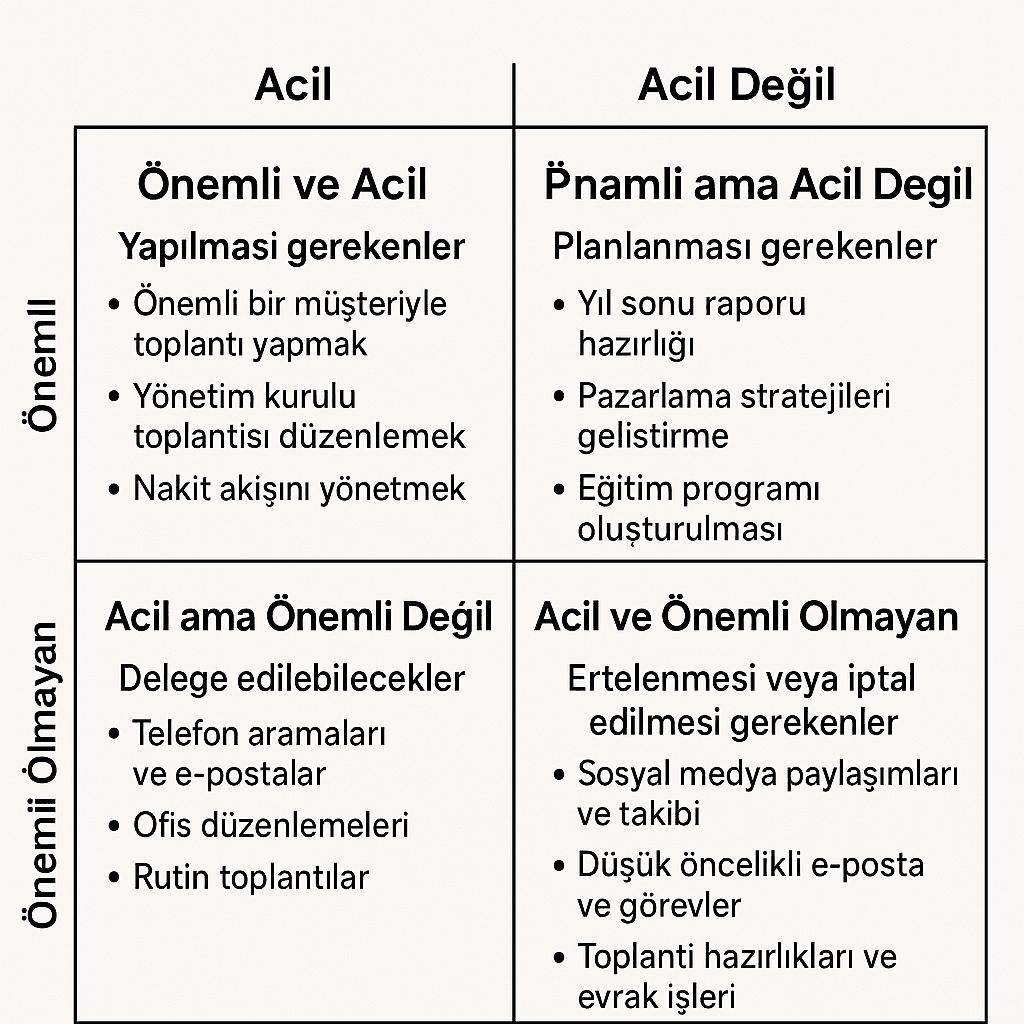
Example: Eisenhower Matrix Visual for Business Management and Daily Tasks (Image Generated by Artificial Intelligence)
The greatest strength of the Eisenhower Matrix is that it enables individuals and managers to visualize and understand their tasks. Especially in the business world, it is highly functional for avoiding being overwhelmed by constant demands and staying focused on long-term goals.
However, the method does have some limitations:
Nevertheless, this classification remains valuable at least for raising awareness. Spending just five minutes each morning planning the day using this matrix can open up significantly more mental space than expected.
The power of the Eisenhower Matrix lies not in managing time but in managing priorities. We do not need to do everything that is urgent. However, learning to allocate time to what is truly important may be the key to achieving balance between professional and personal life.
Aydemir, Sibel. “Çalışanlarda Erteleme Davranışı (İşyeri Prokrastinasyonu) Gelişiminde Zaman Tuzaklarının Etkisi.” *Anemon Muş Alparslan Üniversitesi Sosyal Bilimler Dergisi* 6, no. 6 (2018): 1031–1040. https://doi.org/10.18506/anemon.411753.
Ertem, Mehmet. “Zaman Yönetimi.” Bozok Üniversitesi. Accessed May 6, 2025. https://bozok.edu.tr/Dosya/3fd8c155-1.pdf.
Tekin, Zeliha, and Arzu Çotul. “Yönetimde Karar Verme ve Problem Çözme.” *İşletme, Ekonomi ve Siyaset Bağlamında YÖNETİM*, 79–93. Bursa: EKİN Yayıncılık, 2021. Accessed May 6, 2025. https://www.researchgate.net/publication/357900957_Isletme_Ekonomi_ve_Siyaset_Baglaminda_YONETIM.
Tüfekci, Ömer Kürşad. “Depremlerde Hazırbulunuşluk Senaryoları ve Hazırbulunuşluğa Yönelik Bir Model Önerisi.” *Kahramanmaraş Merkezli Depremler Sonrası İçin Akademik Öneriler*, 37–46. İstanbul: Özgür Yayın Dağıtım Ltd. Şti., 2023. Accessed May 6, 2025. https://www.ceeol.com/search/chapter-detail?id=1172092.
This Matrix Is Divided into Four Main Categories
Applications of the Eisenhower Matrix
Eisenhower Matrix and Business Economics
Assessment of the Eisenhower Matrix from a Management Perspective
Example: Eisenhower Matrix for Business Management and Daily Tasks
1. Urgent and Important (Must Be Done Immediately)
2. Important but Not Urgent (Requires Planning)
3. Urgent but Not Important (Can Be Delegated)
4. Neither Urgent nor Important (Should Be Delayed or Cancelled)