

+2 More

The Einstein ring is a special case of the gravitational lensing effect. It occurs when light from a more distant light source, aligned with a massive celestial object (such as a galaxy or a black hole), is bent by the gravitational influence of this object, resulting in the light appearing as a perfect ring in the observer's field of view. This phenomenon is one of the predictions of the theory of relativity and was first theoretically expressed by Albert Einstein in 1936.
Einstein rings are related to the perfectly symmetric case of the gravitational lensing phenomenon, which arises as a consequence of the general theory of relativity. If:
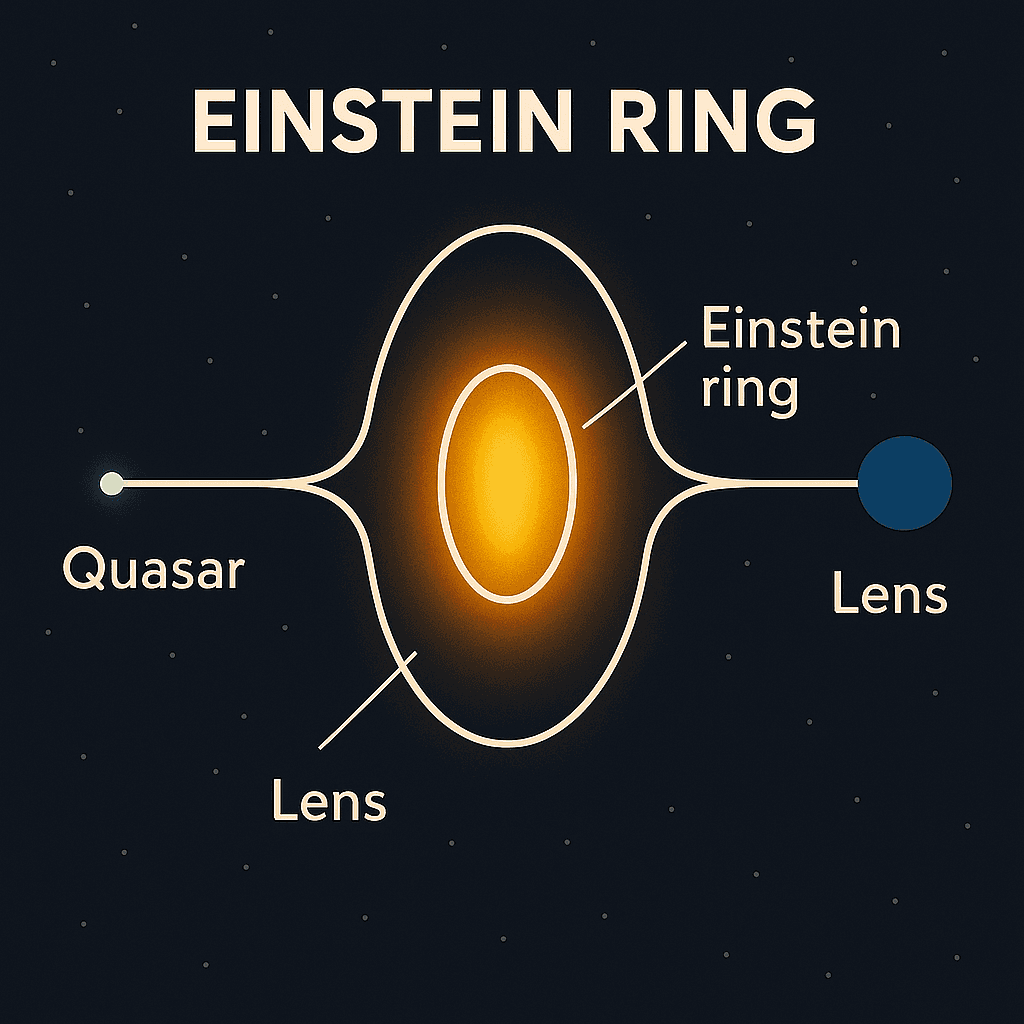
Einstein Ring (Generated by Artificial Intelligence)
The angular radius of the Einstein ring can be calculated based on the following factors:
Where:
This formula shows how the observed bending angle in gravitational lensing depends on physical parameters.
Einstein rings provide important information for astronomical observations. Specifically:
can be measured through a detailed analysis of these rings. Radio telescopes and space telescopes (especially the Hubble Space Telescope) have been able to observe Einstein rings with high resolution. Some rings may not be perfectly circular but fragmented or elliptical; this is due to imperfect alignment or irregularities in the lens mass.
Schneider, Peter, et al. Gravitational Lensing: Strong, Weak and Micro. Springer, 2006. Accessed July 13, 2025. https://www.researchgate.net/publication/321614698_Gravitational_Lensing_Strong_Weak_and_Micro.
Narayan, Ramesh. and Matthias Bartelmann. “Lectures on Gravitational Lensing.” arXiv preprint astro-ph/9606001 (1996). Accessed July 13, 2025. https://arxiv.org/abs/astro-ph/9606001.
Courbin, Frederic. and Dante Minniti. Gravitational Lensing: An Astrophysical Tool. Springer, 2002. AccessedJuly 13, 2025. https://www.researchgate.net/publication/321619939_Gravitational_Lensing_An_Astrophysical_Tool.
Treu, Tommaso. “Strong Lensing by Galaxies.” Annual Review of Astronomy and Astrophysics 48 (2010): 87–125. Accessed July 13, 2025. https://www.researchgate.net/publication/45908954_Strong_Lensing_by_Galaxies.

Physical Basis
Mathematical Description
Observability and Applications
This article was created with the support of artificial intelligence.