


This article was automatically translated from the original Turkish version.
The Selfish Gene, a theoretical approach in evolutionary biology that takes the gene rather than the individual or species as the fundamental unit of natural selection and argues that adaptation occurs at the genetic level. This concept, first popularized by Richard Dawkins in 1976, posits that organisms are programmed “survival machines” or vehicles designed to preserve and propagate their genes, with genes themselves being the ultimate beneficiaries and enduring units of evolutionary processes.

Richard Dawkins’ ‘Survival Machine’ Analogy: A Depiction of Biological Machinery Governed by Genes (Generated by Artificial Intelligence)
The selfish gene theory defines biological “selfishness” and “altruism” at a behavioral level. In this context, “selfishness” is not a subjective emotional state or intention but a technical definition: an organism increases its own chances of survival (fitness) at the expense of another’s. According to Dawkins, genes can be modeled as agents that “strive” to maximize the representation of their copies in future generations. However, genes possess no consciousness, emotions, or computational abilities; the term “selfishness” is an analogy used to explain the mechanics of natural selection. For example, a mature oak tree producing fewer leaves to avoid shading neighboring saplings may be described as biologically altruistic, but this does not imply any emotional intent on the part of the tree.
Natural selection does not directly “see” genes; it operates through phenotypes (organisms). Yet when organisms die, genes persist through their copies. Therefore, organisms are regarded as temporary vehicles that facilitate the spread of genes.
The selfish gene theory is closely related to Hamilton’s theory of “inclusive fitness.” Unlike the view that adaptation occurs at the level of the individual organism, this theory asserts that adaptation occurs at the genetic level. Mathematical models show that genes behave as if they are “fitness-maximizing agents.” Under this approach, when social interactions occur between genes, what a gene seeks to maximize is not individual fitness but inclusive fitness.
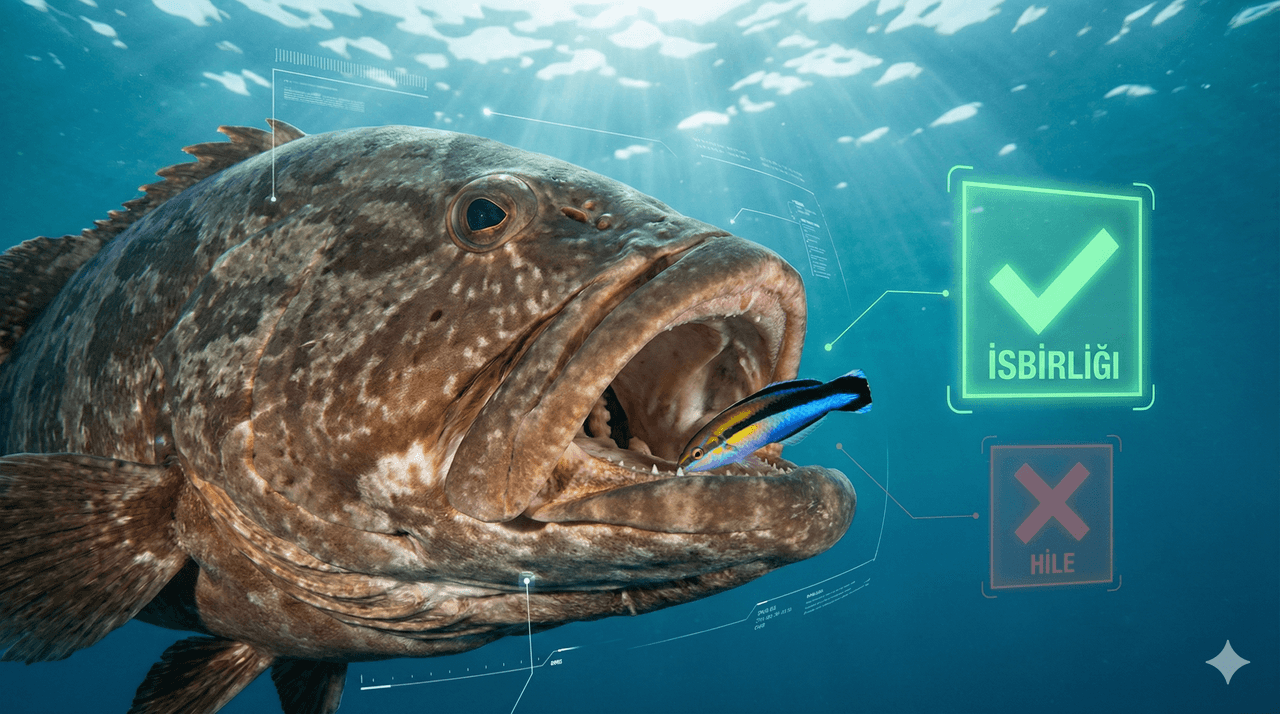
Game Theory and Reciprocal Altruism: Cooperation Matrix Between Cleaner Fish and Large Fish (Generated by Artificial Intelligence)
Game theory forms a crucial component of this approach. Models based on strategies such as “Cheater,” “Sucker,” and “Grudger” explain how reciprocal altruism can evolve without conscious calculation. Trivers’ theory of reciprocal altruism can also function with a functional equivalent of memory—such as nest fidelity—without requiring conscious recall or computation.
The predictions of the selfish gene theory are supported by studies on animal behavior and human family structures, particularly regarding resource allocation. The hypothesis that genetic relatedness is the primary determinant of parental investment has been tested by comparing stepfamilies and biological families.
Research conducted in the United States and South Africa has shown that households headed by non-biological mothers—stepmothers, adoptive mothers, or foster mothers—systematically spend less on food.
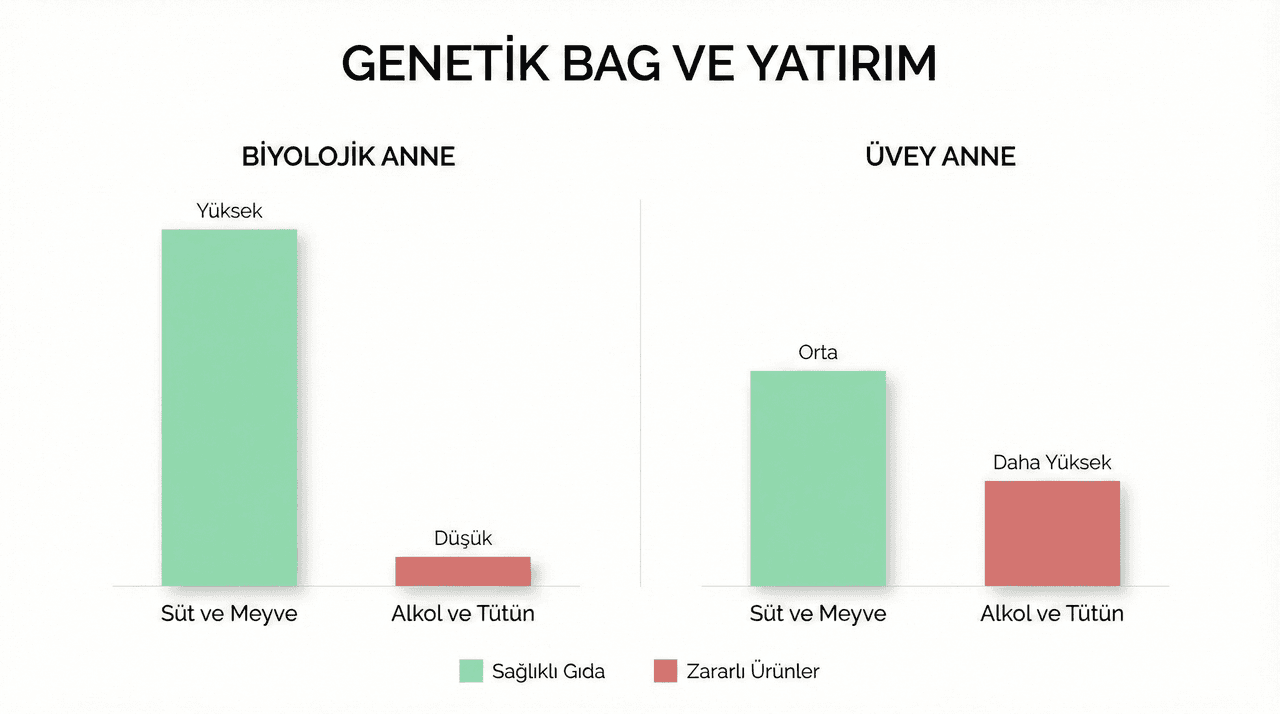
Household Expenditure Data: Comparison of Resource Allocation Between Biological and Stepmothers (Generated by Artificial Intelligence)
South African data reveal that when the biological mother is the head of household or spouse, spending on healthy foods such as milk, fruit, and vegetables increases, while expenditures on tobacco and alcohol decrease. This pattern suggests that genetic relatedness shapes investment not based on expectations of future economic return but rather on the drive to preserve genetic material—in alignment with the selfish gene hypothesis.
Step-parents tend to invest less in children than biological parents, or in extreme cases, pose a higher risk of harm—this is explained by genetic conflict of interest. Biological mothers, particularly during the most vulnerable early stages of childhood, are inclined to increase nutritional investment to ensure genetic continuity.
Since its introduction, the selfish gene theory has faced various philosophical and biological criticisms.
Philosophers such as Mary Midgley have criticized the attribution of human emotions like “selfishness” to genes and the portrayal of genes as calculating entities. In response, Dawkins emphasizes that the language used is metaphorical, that the “as if” mode of description is standard in biology, and that definitions are behavioral rather than psychological.
The central dogma of molecular biology (DNA → RNA → Protein) places DNA at the top of the hierarchy but has been criticized for neglecting the role of metabolism. Victor de Lorenzo argues that DNA is merely an information repository and that the true evolutionary driver is the expansion of metabolic networks and the conquest of new chemical landscapes. Under this view, particularly in processes such as pathogenicity and biodegradation, the metaphor of “selfish metabolism” may be more explanatory than “selfish gene,” since metabolic needs and thermodynamic constraints can limit or direct the implementation of genetic instructions.
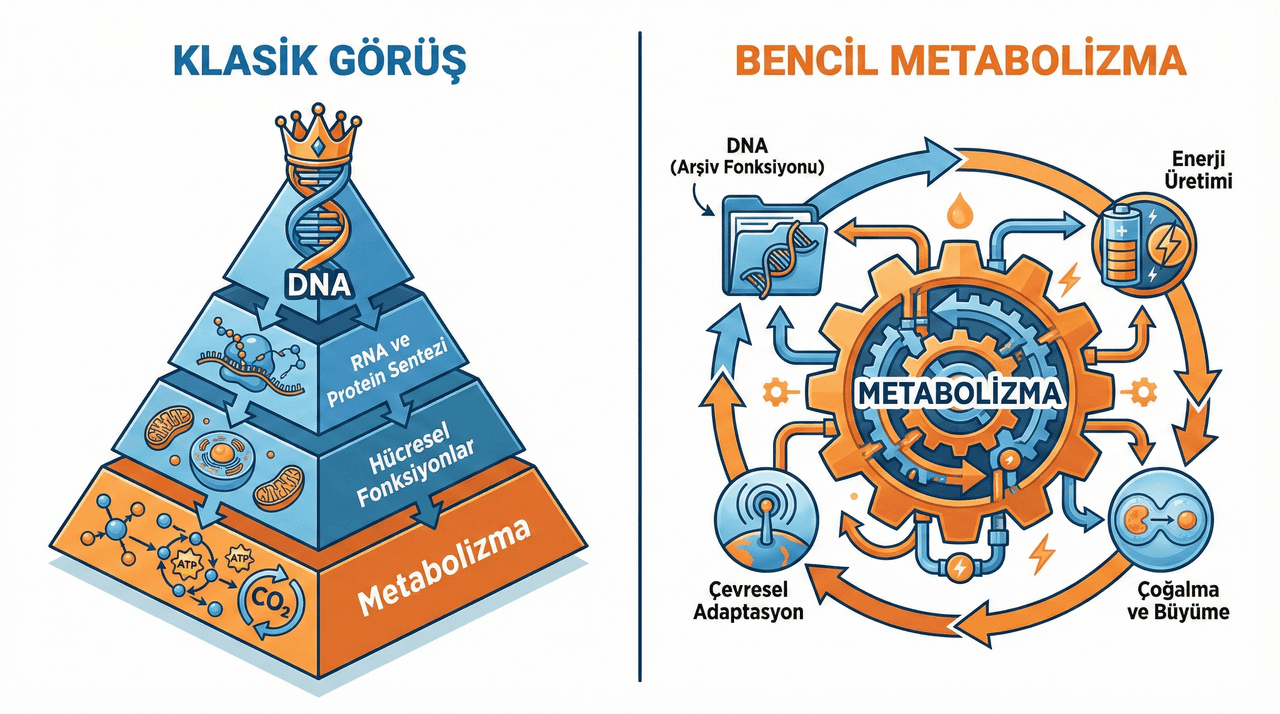
Comparison of the Central Dogma and the Selfish Metabolism Hypothesis in Terms of Information Flow (Generated by Artificial Intelligence)
Uncertainties regarding the precise definition of a gene—whether it is a single nucleotide or a sequence—and the complexity of genetic interactions (epistasis), which challenge the notion of the gene as an independent unit, remain contentious points. Formal theories argue that treating the gene as a “fitness-maximizing agent,” despite excluding factors such as genetic drift and mutation, remains a valid method for explaining adaptation.
Case, A., I.-Fen. Lin, and S. McLanahan. “How Hungry Is the Selfish Gene?” *The Economic Journal* 110, no. 466 (2000): 781–804. Accessed December 28, 2025.https://doi.org/10.1111/1468-0297.00565
Dawkins, Richard. “In Defence of Selfish Genes.” *Philosophy* 56, no. 218 (1981): 556–573. Accessed December 28, 2025.https://doi.org/10.1017/S0031819100050580
Gardner, Andy, and John J. Welch. "A Formal Theory of the Selfish Gene." Journal of Evolutionary Biology 24, no. 8 (2011): 1801–1813. Accessed December 28, 2025.
de Lorenzo, Victor. "From the Selfish Gene to Selfish Metabolism: Revisiting the Central Dogma." BioEssays 36, no. 3 (2014): 226–235. Accessed December 28, 2025.

Conceptual Framework and Definition
Theoretical Foundations and Formalization
Biological and Economic Evidence
Food Expenditure and Genetic Relatedness
Investment Motivation
The Cinderella Effect
Criticisms and Alternative Views
Anthropomorphism and Intention Critique
The Selfish Metabolism Hypothesis
Definition and Integrity of the Gene