


This article was automatically translated from the original Turkish version.
Edinburgh
Country | Scotland | ||||||||
|---|---|---|---|---|---|---|---|---|---|
Population | 554.000 | ||||||||
Area | 264 km² | ||||||||
Climate | Oceanic climate | ||||||||
Important Structure | Edinburgh Castle Scott Monument St. Giles Cathedral Holyrood Palace | ||||||||
Area Code(s) | +44 131 | ||||||||
Edinburgh, the capital and second-largest city of Scotland, one of the four countries of the United Kingdom. Covering an area of 264 km², the city is located on the eastern coast of Scotland, near the North Sea. Situated east of Glasgow, Edinburgh is renowned for its historical and cultural richness.
The city is distinguished by its Old and New Town areas, both listed on the UNESCO World Heritage List. Edinburgh Castle, the Royal Mile, Holyrood Palace and Arthur’s Seat are among its important tourist attractions. Additionally, the Edinburgh Festival and the Edinburgh Fringe Festival, among the world’s largest art festivals, welcome millions of visitors annually.
Edinburgh’s economy is based on finance, tourism, education and technology sectors and it is one of the United Kingdom’s most important financial centers. The city is also home to the prestigious University of Edinburgh, with a long academic tradition. The currency is the British Pound (GBP), as part of the United Kingdom.
The ethnic composition is diverse, with Scots forming the majority of the population, alongside English, Irish and communities from other European countries.
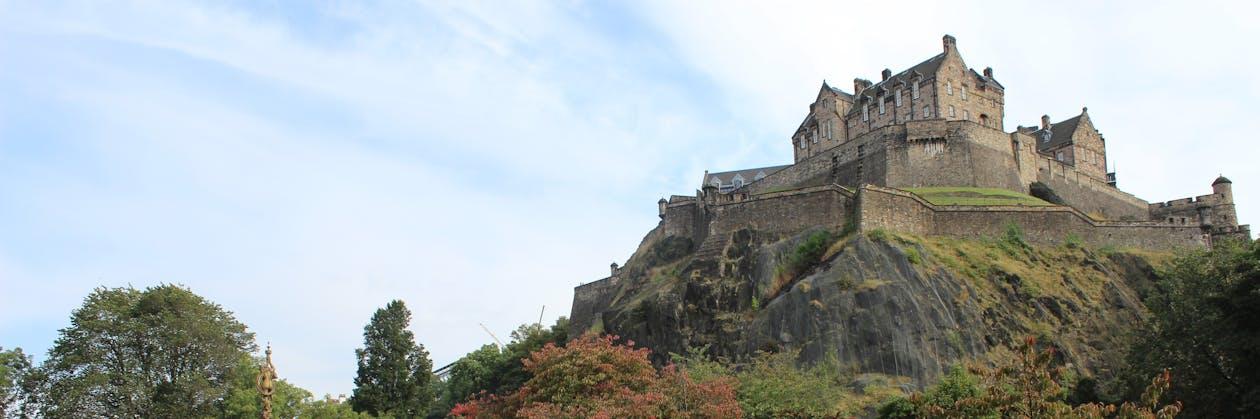
Edinburgh Castle
During the Middle Ages, a small fortress known as Dun Eiden stood on Castle Rock, originally built by the Gododdin people, though its exact location remains uncertain. In the 7th century, the Angles attacked the Gododdin and captured the fortress, combining “Eiden” with the Old English word “burh” to form the name Edinburgh. The Scots regained control of the fortress only in 1018.
The exact date of construction of the royal castle is unknown, but it is believed to have been built before or during the 12th century, likely during the reign of King David I. During this period, a settlement developed east of the castle, and both Edinburgh and Canongate gained royal burgh status, granting them rights to engage in foreign trade.
In the Middle Ages, monks differed from hermits by serving society and leaving monasteries. In Edinburgh, black-robed Dominican monks and grey-robed Augustinian monks lived. By the 14th century, as trade expanded, Edinburgh became a significant city exporting wool and leather goods from Port Leith. Cattle were sold at Cowgate, while grain and hay were traded at Grassmarket.
Despite ongoing wars with the English (the castle was captured between 1296 and 1322 and the Cathedral and Town Hall were burned in 1385), Edinburgh grew wealthier and expanded. In the 15th century, it was declared the capital of Scotland, and between 1671 and 1678, Holyrood Palace was built for King Charles II.
In the 1500s, approximately 12,000 people lived in Edinburgh. The population rapidly increased, reaching 15,000 within half a century. After the Battle of Flodden in 1513, the citizens of Edinburgh built the Flodden Wall to defend against the English. However, this wall proved insufficient, and the English repeatedly attacked the city.
Due to the city walls, the growing population led to the construction of multi-storey stone buildings as a solution. The first tall structures rose along the Royal Mile, some reaching up to twelve storeys. When space became scarce, wooden floors were added on top of stone houses to expand living areas.
Edinburgh became a dirty city plagued by frequent outbreaks of plague, disease and fire. By the end of the 17th century, the city’s population had reached 50,000.
In the 17th century, English writer Daniel Defoe remarked on Edinburgh:
"There is no other city in the world where so many people live in so narrow a space as in Edinburgh."
Diseases such as plague, typhus and cholera were part of daily life. Residents would shout “Gardyloo!” before throwing waste water from their windows into the streets. Waste and refuse were dumped into the Nor Loch (now Princes Street Gardens), which served as the city’s drinking water source. As a result, Edinburgh was known as one of Europe’s unhealthiest cities.
In 1752, plans were proposed to expand Edinburgh, and in 1767, young architect James Craig designed the New Town. Craig’s plan featured wide parallel streets, squares and gardens. After the 1707 union of Scotland and England, defensive walls were no longer needed. However, due to prolonged political differences, institutions such as the Bank of Scotland and the Scottish Parliament at Holyrood continued to operate separately.
In the 19th century, Glasgow surpassed Edinburgh in industrial development. In Edinburgh, the main industries were brewing and printing. Bankers and lawyers began settling in Glasgow. With the completion of the New Town, Edinburgh received immigration from Ireland, and its population reached 170,000 by 1850. During this period, Calton Hill, the National Gallery of Scotland, the Scott Monument and other significant structures were built. In the 20th century, more museums, shopping centers and tourist attractions were constructed, transforming the city into a major tourist destination by the century’s end. On 1 July 1999, the Scottish Parliament was officially opened by the Queen, resuming operations after 292 years. Scots gained the right to make their own laws on issues such as health, education and social services. The new parliament building opened in 2004.
Edinburgh is a city on the eastern coast of Scotland, facing the North Sea, located between 55° 57′ north latitude and 3° 11′ west longitude. Positioned on Scotland’s eastern coastline, Edinburgh shares land borders with East Lothian to the east, West Lothian to the west and Midlothian to the south. This strategic location has made Edinburgh an important center for both trade and culture.
Geographically, Edinburgh is built on hilly terrain shaped by volcanic formations. The city is surrounded by natural elevations such as the Pentland Hills to the south and Arthur’s Seat to the north. Arthur’s Seat, at 251 meters, is one of Edinburgh’s most prominent geographical features, dominating the cityscape. The Pentland Hills stretch to the south, forming one of Edinburgh’s natural boundaries.
Edinburgh has an oceanic climate characterized by mild temperatures throughout the year. Summers are cool, while winters are cold but not extreme. Average summer temperatures hover around 19°C, while winter temperatures can drop to 1°C. Rainfall is consistent year-round, with the highest levels recorded in autumn and winter. Proximity to the North Sea directly influences the climate, resulting in high humidity and frequent windy days.
The city also has abundant water resources. The Water of Leith river flows through the city center from the west and empties into the Firth of Forth. This river has historically served as both a water source and an industrial asset. The Firth of Forth estuary played a vital role in Edinburgh’s maritime trade and remains a strategic area for port activities today.
Edinburgh’s road network has developed in harmony with its geography. The city is connected to Glasgow via the M8 motorway and to England via the A1. Urban transportation is supported by roads and tram lines that preserve both the modern and historic fabric of the city.
Edinburgh, with its geographical features, is a significant center both locally and internationally, offering great potential in tourism, education and culture due to its natural beauty.
Edinburgh, the capital of Scotland, is a city notable for its historical and demographic structure. Covering an area of 264 km², Edinburgh had a population of 526,470 as of 2021. Of this, 252,325 (47.9%) were male and 274,145 (52.1%) were female. The higher proportion of women reflects a balanced demographic structure in Edinburgh.
Edinburgh’s population varies across its central and surrounding areas. Although it is Scotland’s second-largest settlement, its status as the capital makes it a major destination for migration. The majority of the population is concentrated in the city center and surrounding suburbs, where high living standards have been a key driver of population growth.
As Scotland’s second-largest city, Edinburgh houses approximately 9.6% of the country’s total population of 5.5 million. This demographic profile is directly linked not only to its status as the capital but also to the opportunities it offers in finance, education and tourism. Moreover, as one of Europe’s leading cultural centers, Edinburgh has a cosmopolitan structure that hosts people from diverse nationalities.
Edinburgh’s geography and climate have influenced the distribution of its population density. Surrounded by natural hills and uneven terrain, settlement has concentrated in specific areas. Edinburgh is divided into 17 districts, including the city center as well as important neighborhoods such as Leith, New Town, Old Town, Stockbridge, Morningside and Portobello. Leith, the city’s port area, stands out for maritime trade and industry, while New Town and Old Town are densely populated areas renowned for their historical and cultural heritage.
Edinburgh’s administrative structure has undergone significant changes throughout the 20th century. In 1975, Edinburgh became part of the Lothian Region, and in 1996, following local government reforms in Scotland, it became an independent council area. These administrative adjustments enabled more effective governance and contributed to the modernization of municipal services.
The 2014 Scottish independence referendum became a major topic of debate in Edinburgh’s demographic and political atmosphere, sparking widespread public discussion. Although the referendum resulted in Scotland remaining part of the United Kingdom, Edinburgh’s position as a strong cultural and economic center was confirmed.
Edinburgh continues to be one of Europe’s major capitals, thanks to its historical heritage, cultural activities and academic institutions. The city, visited annually by millions of tourists, experiences significant economic dynamism through the Edinburgh Festival and other artistic events. Its educational institutions and research centers contribute to the growth of both local and international populations, establishing Edinburgh as one of Scotland’s leading demographic and economic hubs.
As the capital of Scotland and with its economic diversity, Edinburgh stands out as one of the country’s most important centers for finance, tourism, education and technology. The city has a dynamic economic structure due to its strong service sector, advanced financial infrastructure and cultural activities.
One of the largest components of Edinburgh’s economy is the finance sector. The city is recognized as the United Kingdom’s second-largest financial center after London. Major financial institutions operating in Edinburgh include Royal Bank of Scotland (RBS), Standard Life and abrdn. Numerous institutions active in insurance, asset management and banking are fundamental pillars strengthening the city’s economic structure.
The tourism sector is also a vital part of Edinburgh’s economy. The city attracts millions of tourists annually through its historic areas listed on the UNESCO World Heritage List, cultural events and festivals. Particularly the Edinburgh Festival and Hogmanay (New Year) celebrations significantly boost tourism revenue. The tourism industry provides employment for thousands in accommodation, restaurants, entertainment and retail.
The education and research sector holds a significant place in the city’s economic structure. International academic institutions such as the University of Edinburgh, Heriot-Watt University and Napier University attract large numbers of students and academics, contributing to economic growth. The education sector, combined with investments in innovation and technology, accelerates the city’s development.
Technology and innovation are among Edinburgh’s rapidly growing sectors. The city has a rapidly expanding ecosystem in software development, artificial intelligence and data analytics. Edinburgh is regarded as one of Europe’s fastest-growing technology hubs, hosting numerous start-ups and entrepreneurs.
Edinburgh’s port and logistics sectors also play a significant role in the city’s economic activities. Leith Port, strategically located, contributes to maritime transport and import-export activities. The port also serves commercial operations linked to the North Sea oil and natural gas industries.
Overall, Edinburgh continues to be one of the most important economic centers in Scotland and the United Kingdom, thanks to its strong finance sector, advanced education system, tourism potential and rapidly growing technology industries. The city’s economic structure demonstrates steady growth, making it an attractive destination for both local and international investors.
Edinburgh makes a major contribution to tourism through its historic structures, festivals, natural areas and cultural heritage, attracting both domestic and international visitors. One of Edinburgh’s most important tourist sites is Edinburgh Castle, built in the 12th century and now a symbol of the city. The castle, with its historical and strategic significance, is one of the city’s most visited landmarks. Other key cultural heritage sites include Holyrood Palace, St. Giles Cathedral, the Scott Monument and the Royal Mile.
Cultural events play a major role in Edinburgh’s tourism. The city attracts a global audience annually through events such as the Edinburgh International Festival, the Edinburgh Fringe Festival and the Edinburgh Book Festival. These festivals offer significant cultural interactions in areas such as art, theater, music and literature. Additionally, Hogmanay, the New Year celebrations, is one of the city’s largest tourist events, drawing visitors from around the world.
In terms of nature tourism, Edinburgh stands out with natural attractions such as Arthur’s Seat, Holyrood Park and Calton Hill. These areas are popular destinations for walking, nature photography and outdoor activities. Easily accessible from the city center, these natural spaces combine with Edinburgh’s historic fabric to offer a unique tourist experience.
Edinburgh’s traditional cuisine is also a significant tourist attraction. Must-try traditional Scottish dishes for visitors include haggis, neeps and tatties, Scotch pie and shortbread. In addition, the city’s world-famous whiskies and traditional pub culture are other key draws for tourists.
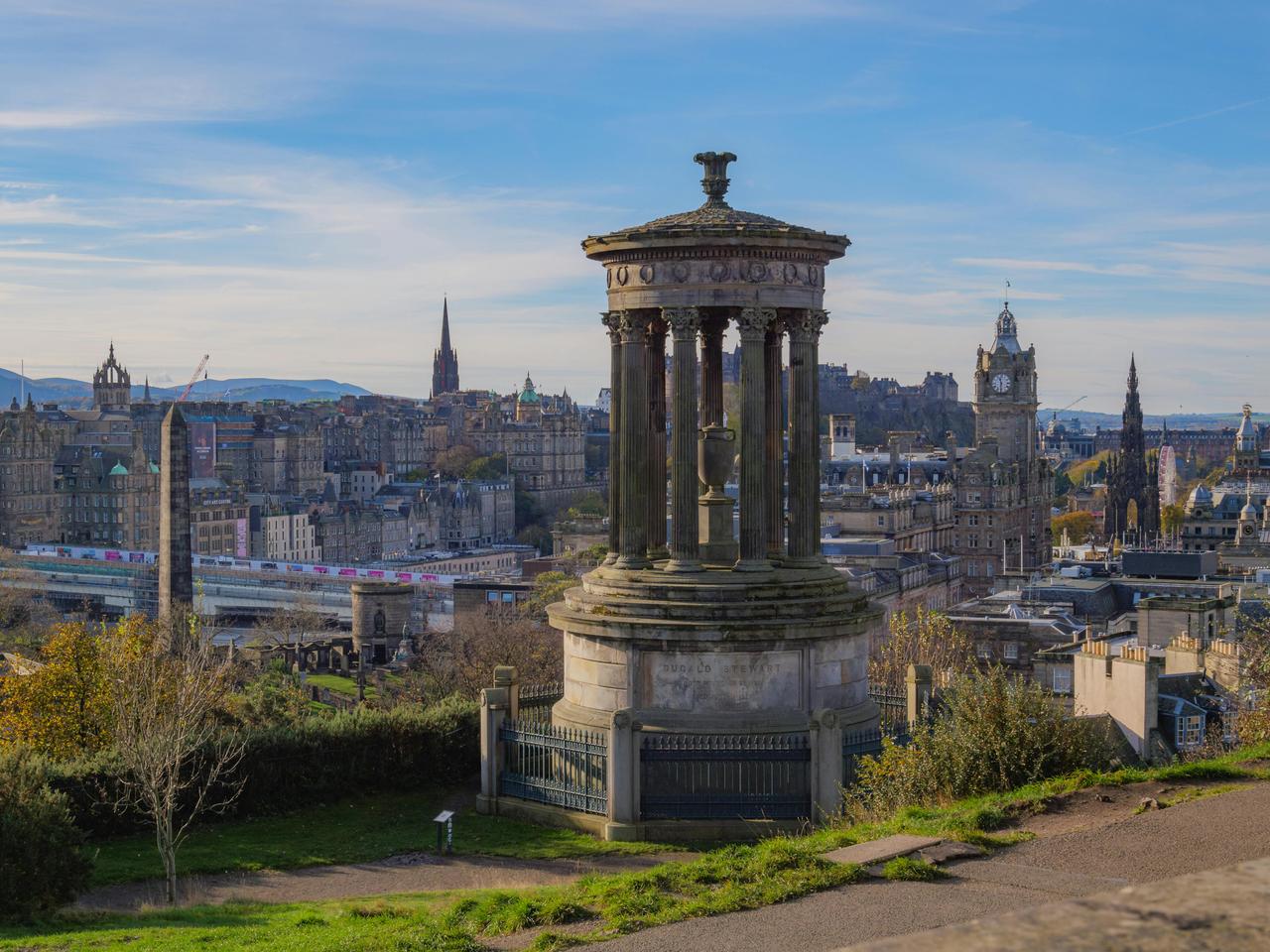
Calton Hill (Source:Piotr Wojnowski)
Edinburgh’s cultural identity has been shaped by its historical fabric stretching from the Middle Ages to the present, royal influences and its academic and artistic heritage. The city has carried traces of many civilizations throughout history, enriching its cultural heritage with traditional arts and literary traditions.
Edinburgh, particularly due to its deep literary roots, was one of the first cities to be designated by UNESCO as a “City of Literature.” The city has inspired world-renowned writers such as Robert Burns, Sir Walter Scott, Robert Louis Stevenson and J.K. Rowling. The Scott Monument and the Writers’ Museum in Edinburgh are important cultural sites reflecting the city’s literary heritage. Additionally, the annual Edinburgh Book Festival, one of the world’s largest literary events, brings together authors and readers.
In the field of art, Edinburgh is internationally renowned for events such as the Edinburgh International Festival and the Edinburgh Fringe Festival. The Edinburgh Fringe Festival, the world’s largest arts festival, is a major event bringing together theater, music, dance, comedy and street art. Moreover, the National Gallery of Scotland and the Edinburgh Modern Art Gallery house extensive collections of Scottish art history.
With a rich culture in music and theater, Edinburgh features traditional Scottish music and instruments, particularly the bagpipes, as an integral part of its cultural identity. Key venues for music and stage arts include the Usher Hall, Edinburgh Playhouse and Royal Lyceum Theatre.
Edinburgh’s cultural heritage is also evident in traditional crafts. Scottish tartan and kilt are among the city’s cultural symbols, directly linked to Scottish clan culture. Additionally, Scottish whisky holds an important place in the city’s gastronomic culture, with numerous whisky-tasting events held throughout the year.
Edinburgh has been one of Scotland’s most important cultural and commercial centers throughout history. Among its best-known structures are Edinburgh Castle, Holyrood Palace, St. Giles Cathedral and the Scott Monument. Edinburgh Castle, one of the city’s most iconic symbols, has held significant military and royal importance throughout history. Built on a high volcanic rock, it dominates the cityscape and has witnessed some of the most important events in Scottish history.
Holyrood Palace, the official residence of the Scottish royal family, is an important structure both for its architecture and for hosting significant historical events. The palace is particularly known as the residence of Queen Mary Stuart and is still used today by the British Queen for official ceremonies.
St. Giles Cathedral is one of the most important examples of Edinburgh’s religious and architectural heritage. Built in the 12th century, this cathedral became the center of the Scottish Reformation and hosted key figures such as John Knox. Its Gothic architecture and the famous Thistle Chapel make it an attractive destination for tourists and history enthusiasts.
Edinburgh’s cultural heritage also includes structures built to honor literary figures. The Scott Monument was erected to honor the famous Scottish writer Sir Walter Scott and is considered one of the world’s largest author monuments. Similarly, the Writers’ Museum in the city preserves the legacy of important Scottish writers such as Robert Burns, Robert Louis Stevenson and Sir Walter Scott.
Edinburgh is known for its traditional Scottish crafts and rich artistic heritage. The city has a long history in weaving and textile arts. Scotland’s world-famous tartan has been produced in Edinburgh and its surroundings for centuries and is one of the most important symbols of traditional Scottish culture. These patterned fabrics, closely associated with clan emblems, are still used today in traditional kilts and shawls.
In addition, Edinburgh’s richness in art and crafts is evident in stone carving, wood carving and jewelry making. Numerous art galleries and workshops in the city continue production by blending traditional Scottish crafts with modern designs. Particularly silver and gold jewelry adorned with Celtic designs are among the most original examples of Scottish craftsmanship.
Edinburgh is also significant in music and performing arts. Traditional Scottish music, performed on instruments such as the bagpipes, is frequently heard at festivals. Folk music, a centuries-old tradition, is enriched by ballads that tell Scottish history and legends. In addition, traditional folk dances, especially ceilidh, are kept alive in the city. These dances are performed with great enthusiasm at weddings and festivals.
One of Edinburgh’s greatest contributions to the arts is in theater and literature. The city hosts major events such as the Edinburgh International Festival and the Edinburgh Fringe Festival, bringing together international artists and art lovers across all artistic disciplines. At the same time, important literary figures such as Sir Walter Scott, Robert Louis Stevenson and J.K. Rowling stand out as integral parts of Edinburgh’s artistic and cultural heritage.
Edinburgh, alongside its traditional cultural heritage, is also a city that stands out through modern art and contemporary cultural events. The city strengthens its position as Scotland’s cultural capital by hosting countless events across all areas of art.
One of the city’s most important cultural centers is the Scottish National Gallery of Modern Art, which exhibits modern and contemporary works by both Scottish and international artists. Additionally, venues such as the City Art Centre and Collective Gallery host exhibitions focused on contemporary art.
Edinburgh’s cultural events are highly active throughout the year, featuring festivals in art, music, theater and literature. The most famous are the Edinburgh International Festival and the Edinburgh Fringe Festival, which rank among the world’s largest arts and theater events. The Fringe Festival provides a platform for independent artists and theater groups, reflecting the city’s innovative and free-spirited artistic character. In addition, the Edinburgh Book Festival is a major event that connects literature lovers with internationally renowned authors.
Music and performing arts also hold an important place in Edinburgh’s cultural life. The Usher Hall, The Queen’s Hall and Edinburgh Playhouse are venues where internationally renowned concerts and theater performances take place. Prestigious arts groups such as the Royal Scottish National Orchestra and Scottish Ballet regularly perform in the city.
In addition, independent cinemas such as Filmhouse and Cameo Cinema bring the finest examples of world cinema to Edinburgh’s art lovers, while the city also holds a significant place in the global film scene through the Edinburgh International Film Festival.
Enriched by modern art and cultural events, Edinburgh continues to be an important meeting point for local and international artists by blending its historical heritage with contemporary artistic sensibilities.
As the capital of Scotland, Edinburgh has a developed transportation infrastructure with a comprehensive network for both intra-city and inter-city travel. As a major tourist and economic center with its historic and natural features, the city offers strong connections via road, rail, sea and air transport.
Edinburgh is one of Scotland’s most important cities in terms of road transport. Major road connections such as the A1, M8, M9 and M90 integrate the city with other major Scottish cities and England. The A1 motorway directly links Edinburgh to London, while the M8 connects it to Glasgow. The M90 motorway links the city to the north, connecting it to other major Scottish cities such as Perth and Inverness.
Edinburgh’s inner-city roads, due to the need to preserve its historic fabric, can be narrow and winding. As a result, bicycle lanes and pedestrian areas are widely used. Limited parking spaces encourage the use of public transportation.
Edinburgh has one of Scotland’s busiest rail networks. The city’s main railway station, Edinburgh Waverley, offers frequent train services to major destinations such as London, Glasgow, Aberdeen and Inverness. The London–Edinburgh route is one of the busiest rail lines in England, operated by LNER (London North Eastern Railway). This line provides a journey of approximately four hours from Edinburgh to London.
Other important but smaller stations in the city include Haymarket Station. Commuter trains provide fast and comfortable access to surrounding settlements.
Edinburgh’s maritime transport is facilitated through Leith Port and the Rosyth Ferry Terminal. Leith Port, once a major commercial hub, now primarily serves cruise ships and yachts. Cruises departing from here regularly travel to the Baltic and Northern Europe.
The Rosyth Ferry Terminal, located west of Edinburgh, is an important port for cargo transport to various parts of Europe. Edinburgh’s connection by sea holds significant importance for both commercial and tourism purposes.
Edinburgh Airport is one of Scotland’s busiest airports and holds major importance for both domestic and international flights. The airport offers direct flights to many major European cities and also accommodates transatlantic flights.
Located approximately 12 kilometers from the city center, the airport is easily accessible by tram, bus and taxi. Direct flights from Edinburgh Airport connect to London, Amsterdam, Paris, New York and many other major cities.
Edinburgh’s urban transport system is well-developed. The most commonly used public transport options are:
Edinburgh Tram Line: The tram line, launched in 2014, connects the city center with Edinburgh Airport, with future expansion plans underway.
Edinburgh Tram Line: The tram line, launched in 2014, connects the city center with Edinburgh Airport, with future expansion plans underway.
To preserve its historic fabric, vehicle traffic in the city center is restricted, with priority given to public transport and pedestrian pathways. Thanks to its advanced transportation infrastructure, Edinburgh offers a comfortable travel experience for both residents and visitors.
As the capital of Scotland, Edinburgh has a well-developed infrastructure in health and education. The city provides high-quality services to both local residents and international students through modern hospitals, research centers and established educational institutions.
In terms of healthcare infrastructure, Edinburgh offers a wide range of services under NHS Scotland (National Health Service Scotland). The city has both public hospitals and private healthcare facilities.
Some of the most important healthcare centers in the city include:
Edinburgh is also an important center for medical research. The University of Edinburgh Medical School is one of Scotland’s most prestigious medical faculties and has led many medical innovations. Medical research in the city spans a broad spectrum from genetics to neurology.
Edinburgh is also a significant center for health tourism. Private clinics and rehabilitation centers in the city provide services to international patients in areas such as aesthetic surgery, dental treatments and psychological counseling. Many patients benefit from the advanced medical facilities in Edinburgh, particularly in eye surgery and dental aesthetics.
Edinburgh plays a major role in education by hosting some of the world’s most prestigious universities. The city’s education system offers high-quality educational opportunities from primary to higher education.
Scotland’s education system follows a framework called Curriculum for Excellence, distinct from England’s. Edinburgh has both state and private schools. Important secondary education institutions in the city include:
Edinburgh is renowned for its world-famous universities and serves as a major academic center for international students. The main higher education institutions are:
Edinburgh is also a major center for academic research and innovation. Research centers within the University of Edinburgh host significant work in biotechnology, artificial intelligence, genetics and environmental sciences. The Roslin Institute, in particular, gained worldwide recognition for its work on Dolly the Sheep, the first cloned mammal.
Continuous improvements are being made to Edinburgh’s educational infrastructure. New educational projects in the city focus on expanding STEM (Science, Technology, Engineering, Mathematics) education and providing students with greater research opportunities.
The city also attracts attention through international student exchange programs. Erasmus+ and various joint postgraduate programs enable students to receive a global education.
As the capital of Scotland, Edinburgh offers a wide range of accommodation and social life options. The city provides a dynamic social atmosphere and comfortable accommodation choices for both tourists and residents, blending its historic fabric with modern living.
Due to year-round tourist influx, Edinburgh offers a wide variety of accommodation options. From luxury hotels to boutique guesthouses, from Airbnb options to student dormitories, a broad spectrum is available. In the surrounding areas of Edinburgh, various country houses and luxury glamping (luxury camping) options are available for those seeking a nature-immersive experience.
Edinburgh has a rich social life, combining its historical heritage with modern cultural events. The city offers social venues catering to diverse tastes through its festival culture, vibrant music scene, theaters, museums and gastronomy.
Edinburgh is recognized as one of the world’s festival capitals. Festivals held throughout the year bring together local and international visitors.
Edinburgh has a rich food and drink culture offering both traditional Scottish cuisine and international options.
Edinburgh places great importance on sports and outdoor activities in its social life.
As the capital of Scotland, Edinburgh holds a significant position in both local and central governance. Due to hosting the Scottish Parliament, it plays a central role in Scotland’s political decision-making processes, while also being administered by its city council at the local level.
Edinburgh’s local government is managed by the City of Edinburgh Council.
Edinburgh’s local government works closely with the Scottish Government to implement development projects for the city.
Edinburgh hosts the Scottish Parliament, opened in 1999.
Edinburgh is also represented in the United Kingdom Parliament. Westminster has dedicated MPs for Scotland, ensuring Edinburgh’s political representation at the UK level.
Edinburgh is one of the centers of the Scottish legal system and hosts various legal and judicial institutions.
Edinburgh has established twin city agreements with many cities internationally. These include:
Through these partnerships, the city builds strong international ties in cultural and economic fields.
City of Edinburgh Council. "Home." Accessed February 25, 2025.https://www.edinburgh.gov.uk/.
Edinburgh World Heritage. "The UNESCO World Heritage Site." Accessed February 25, 2025.https://ewh.org.uk/the-unesco-world-heritage-site/
Introducing Edinburgh. "History." Accessed February 25, 2025.https://www.introducingedinburgh.com/history.
Scottish Government. "Home." Accessed February 25, 2025.https://www.gov.scot/
Edinburgh
Country | Scotland | ||||||||
|---|---|---|---|---|---|---|---|---|---|
Population | 554.000 | ||||||||
Area | 264 km² | ||||||||
Climate | Oceanic climate | ||||||||
Important Structure | Edinburgh Castle Scott Monument St. Giles Cathedral Holyrood Palace | ||||||||
Area Code(s) | +44 131 | ||||||||
Middle Ages
16th and 17th Centuries – Dark and Overcrowded Edinburgh
18th Century – The New Town
19th and 20th Centuries
Geography
Demographics
Economy
Tourism
Culture and Art
Cultural Heritage and Structures
Art and Crafts
Modern Art and Cultural Events
Infrastructure and Transportation
Road Transport
Rail Transport
Sea Transport
Air Transport
Urban Transport
Health and Education
Health Services
Health Tourism
Education System
Primary and Secondary Education
Higher Education
Academic Research and Scientific Advancements
Education Development and Investments
Accommodation and Social Life
Accommodation Options
Social Life and Entertainment
Festival Culture
Gastronomy and Café Culture
Sports and Outdoor Activities
Governance
Local Government
Central Government and the Scottish Parliament
Judiciary and Legal Administration
International Relations and Twin Cities