


This article was automatically translated from the original Turkish version.
Edge AI (Uç Yapay Zeka) or Edge Intelligence (Uç Zeka - EI) refers to the practice of running artificial intelligence (AI) computations and algorithms on devices located at the network’s edge—close to where data is generated or users are present—rather than in centralized data centers.
This approach aims to integrate AI capabilities into mobile devices, Internet of Things (IoT) sensors, smart cameras, robots like real world devices. Fundamentally, it seeks to create distributed and autonomous intelligence capabilities closer to the data source by combining edge computing paradigms with AI techniques.
Although narrowly defined as running AI on edge devices, from a broader perspective it can also be viewed as a paradigm that fully leverages hierarchical collaboration between edge devices, edge servers, and the cloud to optimize AI model training and inference. The level of this collaboration may vary depending on how much data is transferred and how far it is sent.
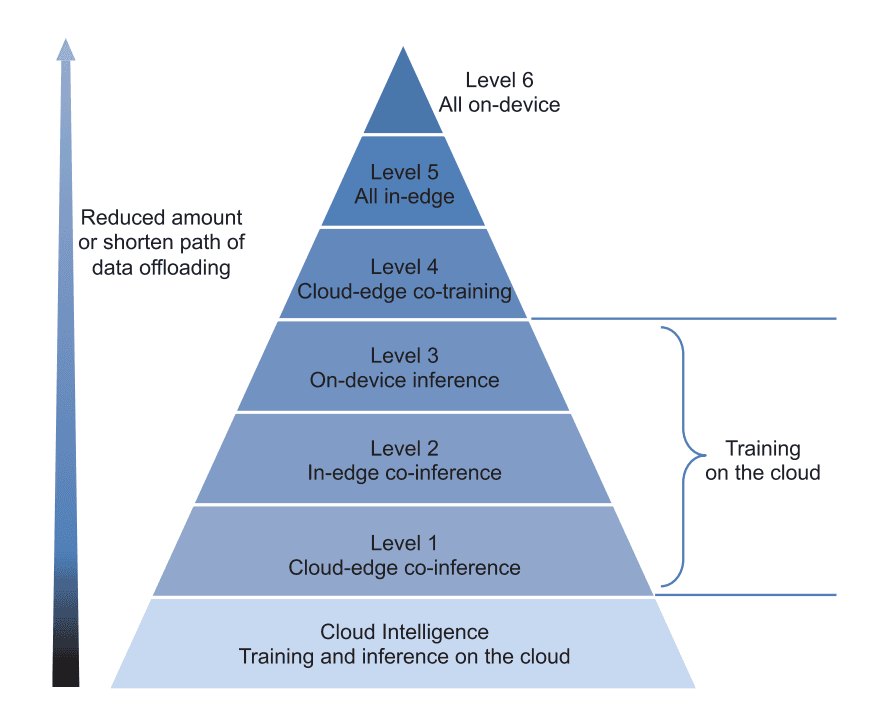
Six Levels of Edge Intelligence (Zhou et al.: Edge Intelligence: Paving the Last Mile of Artificial Intelligence With Edge Computing)
The origins of Edge AI can be traced back to the 1990s with the emergence of content delivery networks (CDNs) that hosted web and game videos on servers close to users. However, the development of Edge AI in its modern sense is closely tied to the evolution of computing models: the transition from centralized mainframe systems to personal computers, client-server (C/S) and browser-server (B/S) architectures, and subsequently to cloud computing.
Although the proliferation of cloud computing in the 2000s provided massive processing power and storage capacity in centralized data centers, challenges such as high latency, bandwidth bottlenecks, and data privacy concerns—especially due to the explosion of mobile devices and IoT—necessitated new approaches. In response, edge computing paradigms were developed to move computational power closer to the network’s edge:
The emergence of Edge AI became possible through the development of these edge computing infrastructures, combined with increased efficiency in artificial intelligence algorithms—particularly deep learning—and the widespread adoption of IoT devices. It began to gain prominence in technology reports such as Gartner’s Hype Cycle around 2018 and has since attracted rapid interest in both academic and industrial domains. Today, Edge AI is recognized as a critical technology that delivers AI’s “last mile” to the network’s edge.
The rise of Edge AI stems from various technological and application-driven needs:
1. Low Latency: Bringing AI computations closer to where data is generated or to the user eliminates the delay of sending data to the cloud and waiting for results, enabling millisecond-level response times critical for time-sensitive applications such as autonomous vehicles, real-time video analysis, industrial control, and AR/VR.
2. Bandwidth and Cost Savings: Processing large volumes of raw data—especially video—at the edge instead of transmitting it to the cloud significantly reduces network traffic and associated communication costs. Only meaningful results or model updates may need to be sent to the cloud.
3. Privacy and Security: Processing sensitive data—such as health records, personal images, or industrial secrets—locally on devices or trusted edge servers minimizes the risk of data exposure during transmission and centralized storage, thereby enhancing privacy and data security. Techniques like Federated Learning provide additional safeguards.
4. Reliability and Accessibility: Edge devices can execute AI tasks locally even when network connectivity is intermittent or absent, ensuring operational continuity especially for critical infrastructure and industrial applications.
5. Unlocking Edge Data Potential: The massive volume of data generated by billions of IoT and mobile devices is predominantly produced at the network’s edge. Edge AI is an essential tool for extracting real-time insights and meaningful information from this data.
6. New Applications and Capabilities: Edge AI enables numerous new application scenarios previously impossible or impractical: advanced automation, smarter devices, personalized experiences, and context awareness are among them.
7. Scalability and Distribution: By distributing AI workloads from centralized cloud systems to distributed edge devices, overall system scalability can be improved and congestion at a single central point reduced.
For these reasons, the market size of Edge AI is expected to grow exponentially in the coming years.
Edge AI systems typically operate within a hierarchical structure comprising edge devices (data-collecting sensors, cameras, mobile phones, etc.), edge servers (more powerful computational units connected to access points, base stations, or local network gateways), and the cloud (for centralized storage, intensive model training, and global coordination). Within this architecture, AI model training and inference can be distributed in various ways:
Recently, a vision has emerged to make Edge AI systems autonomous using Large Language Models (LLMs, e.g., GPT). In this approach, the LLM acts as a controller in the cloud, understanding user requests in natural language, evaluating the capabilities of existing AI models, decomposing tasks into subtasks, selecting and coordinating appropriate models, and even automatically generating code for Federated Learning.
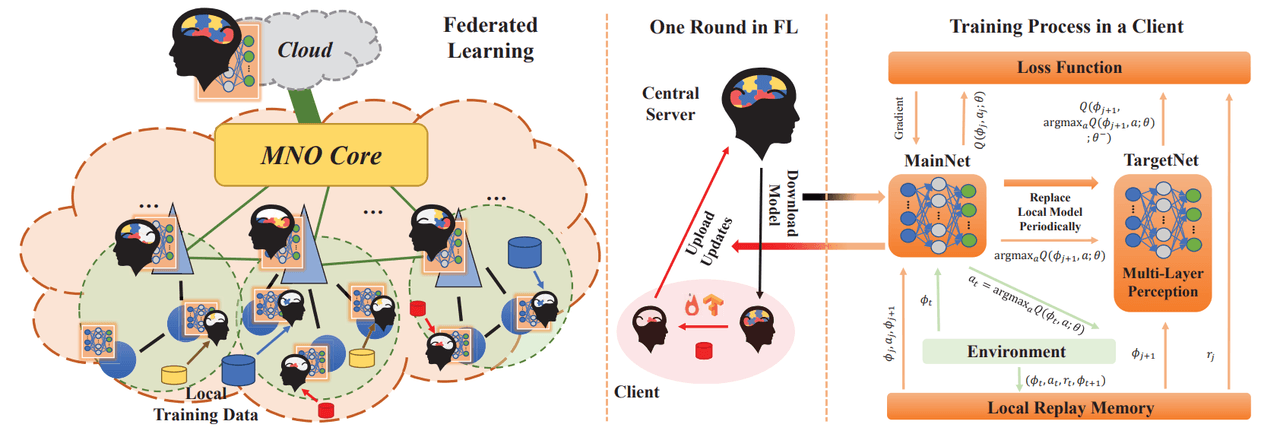
Federated Learning Process (Source: Wang et al. 2019, In-Edge AI: Intelligentizing Mobile Edge Computing, Caching and Communication by Federated Learning)
Edge AI has application potential across nearly every industry. Key application areas include:
The implementation of Edge AI is made possible by various technological advancements in hardware and software:
Although Edge AI is a rapidly evolving field, significant challenges remain to be addressed, along with promising promises for future research directions:
Shen, Yilun, Jingwei Shao, Xiaoyu Zhang, Zhenyu Lin, and Hongyang Pan. “Large Language Models Empowered Autonomous Edge AI for Connected Intelligence.” *IEEE Communications Magazine* 61, no. 12 (2023): 24–30.https://arxiv.org/abs/2307.02779.
Wang, Xiong, Yonggang Han, Chenyang Wang, and Qiang Zhao. "In-Edge AI: Intelligentizing Mobile Edge Computing, Caching and Communication by Federated Learning." IEEE Network 33, no. 3 (2019): 156–165.
Wang, Xiong, Yonggang Han, and Dusit Niyato. *Edge AI: Convergence of Edge Computing and Artificial Intelligence*. Singapore: Springer, 2020.https://link.springer.com/book/10.1007/978-981-15-6186-3
Zhou, Zhi, Xu Chen, Enliang Li, Liekang Zeng, Ke Luo, and Junshan Zhang. "Edge Intelligence: Paving the Last Mile of Artificial Intelligence With Edge Computing." Proceedings of the IEEE 107, no. 8 (2019): 1738–1762.

No Discussion Added Yet
Start discussion for "Edge AI (Edge Artificial Intelligence)" article
History and Development
Importance and Motivation
Working Principles and Architectures
Model Training
Model Inference
Autonomous Edge AI
Application Areas
Enabling Technologies
Challenges and Future Directions