


This article was automatically translated from the original Turkish version.
+2 More
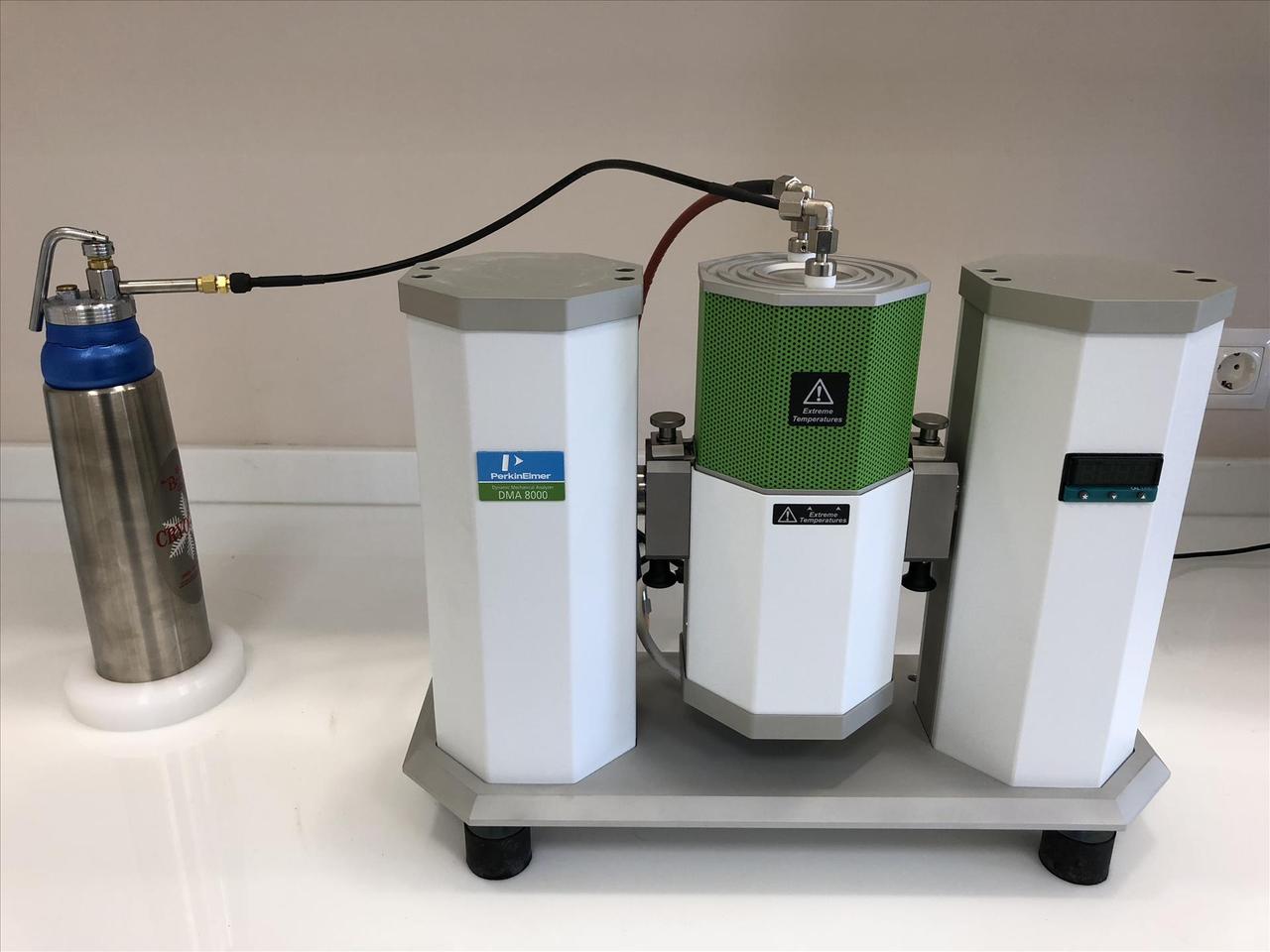
https://arum.ogu.edu.tr/Sayfa/Index/68/dinamik-mekanik-analizor-dma
DMA
Elastic Modulus (E′) | It is a measure of the reversible deformation a material exhibits in response to applied stress. | ||||||||
|---|---|---|---|---|---|---|---|---|---|
Viscous Modulus (E″) | It represents the material's capacity to dissipate energy, namely internal friction. | ||||||||
Glass Transition Temperature (Tg) | It is the temperature at which amorphous polymers transition from the rubbery phase to the glassy phase. | ||||||||
Applications | Thermomechanical property determination in polymer films, elastomers, and engineering plastics; analysis of filler effects and temperature resistance in composite materials; aging, UV, and chemical resistance tests. | ||||||||
Advantage(s) | Measurement of E′ with a sensitivity of ±0.1 MPa and shear. bending compression tension double beam capability to test in multiple modes including single beam accuracy up to 95% at the glass transition temperature detection of tan δ with a resolution of ±0.001 | ||||||||
The Dynamic Mechanical Analyzer (DMA) is a widely used thermomechanical analysis instrument for characterizing the viscoelastic properties of materials such as polymers, composites, elastomers, and some metals. This method, preferred in approximately 60% of polymer analyses, offers high precision in determining the glass transition temperature (Tg), elasticity, and damping characteristics. In Türkiye, it is actively employed at centers such as EGEMATAL at Ege University, ARUM at Eskişehir Osmangazi University, and KİTAM at Ondokuz Mayıs University, playing a key role in the detailed characterization of composite, elastomer, and polymer-based materials.
DMA applies a sinusoidal mechanical stress to the sample and measures the resulting deformation. From these measurements, three fundamental viscoelastic parameters are obtained:
As the stress frequency increases (for example from 1 Hz to 10 Hz), the E′ value may increase by 10–15%; this reflects the material’s frequency sensitivity. Particularly in elastomers, a stiffer behavior is observed at higher frequencies.
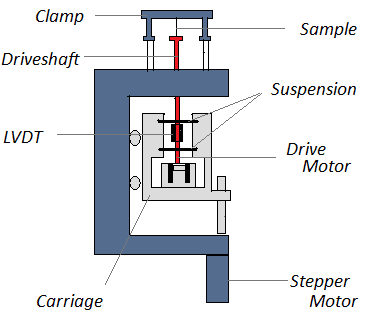
General Schematic of a DMA Analyzer.(1)
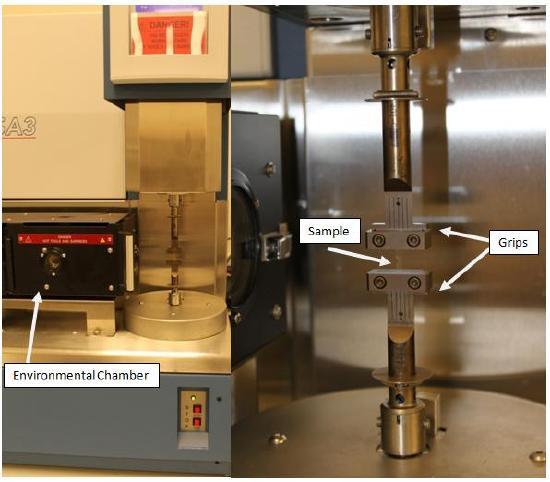
Axial Analyzer with DMA Instrument (left) and Axial Analyzer with Tensile/Stretch Geometry (right).(2)
DMA instruments support various loading modes, each suited to different sample types and analysis objectives:
Preparing samples with precise dimensions is critical for analysis quality. For example, in flexural tests, sample thickness is typically 2 mm; length and width must be fixed according to manufacturer recommendations.
DMA analyses can be performed over a wide range of temperatures and frequencies:
These ranges enable analysis of material behavior at both low and high temperatures. For instance, the glass transition temperature (Tg) of polystyrene is approximately 100 °C and can be identified as the peak of the tan δ curve. Additionally, when measurements are conducted at higher frequencies (e.g., 10 Hz), the E′ value may increase by up to 15%, indicating that the material’s stiffness varies with frequency.
Interpretation of parameters obtained from DMA provides important insights into material performance:
A high tan δ value indicates a more viscous material with high damping capacity, while a low value suggests a more elastic structure.
DMA is preferred in numerous industries for the following applications:
In Türkiye, EGEMATAL (Ege University) conducts composite material testing; ARUM (Eskişehir Osmangazi University) performs elastomer characterization; and KİTAM (Ondokuz Mayıs University) carries out applications on polymer films and biomaterials.
ARUM, Eskişehir Osmangazi Üniversitesi. “Dinamik Mekanik Analizör (DMA).” Accessed July 7, 2025. https://arum.ogu.edu.tr/Sayfa/Index/68/dinamik-mekanik-analizor-dma.
ASTM International. *Standard Test Method for Glass Transition Temperature*, ASTM D7028-07(2015). Accessed July 7, 2025. https://store.astm.org/d7028-07r15.html.
Barron, Andrew R. *Physical Methods in Chemistry and Nano Science*. "2.10: Dynamic Mechanical Analysis." Chem LibreTexts. Last updated: October 2, 2013. Accessed July 7, 2025. https://chem.libretexts.org/Bookshelves/Analytical_Chemistry/Physical_Methods_in_Chemistry_and_Nano_Science_(Barron)/02%3A_Physical_and_Thermal_Analysis/2.10%3A_Dynamic_Mechanical_Analysis.
Chem LibreTexts. "2.10: Dynamic Mechanical Analysis." Accessed July 7, 2025. https://chem.libretexts.org/Bookshelves/Analytical_Chemistry/Physical_Methods_in_Chemistry_and_Nano_Science_(Barron)/02%3A_Physical_and_Thermal_Analysis/2.10%3A_Dynamic_Mechanical_Analysis.
Ege Üniversitesi. "DMA." Accessed July 7, 2025. https://egematal.ege.edu.tr/files/egematal/icerik/DMA.pdf.
Hubtuam, Hittite University. “Dinamik Mekanik Analiz Cihazı (DMA).” Accessed July 7, 2025. https://hubtuam.hitit.edu.tr/tr/detay/dinamik-mekanik-analiz-cihazi-dma.
ILTAM,Pamukkale Üniversitesi. "DMA Cihazı." Accessed July 7, 2025. http://iltam.pau.edu.tr/cihazlar/dma.html.
KİTAM, Ondokuz Mayıs Üniversitesi. "DMA Test Sayfası." Accessed July 7, 2025. https://kitam.omu.edu.tr/test-sayfasi-4/.
Merlab, Middle East Technical University. "Dinamik Mekanik Analiz Cihazı (DMA)." Accessed July 7, 2025. http://merlab.metu.edu.tr/tr/dinamik-mekanik-analiz-cihazi-dma.
Ondokuz Mayıs Üniversitesi. "Dinamik Mekanik Analiz (DMA)." Accessed July 7, 2025. https://kitam.omu.edu.tr/2020/04/30/dinamik-mekanik-analiz-dma/.
Thermal Engineering. "DMA Nedir?" Accessed July 7, 2025. https://www.thermal-engineering.org/tr/dinamik-mekanik-analiz-dma-nedir/.
https://arum.ogu.edu.tr/Sayfa/Index/68/dinamik-mekanik-analizor-dma
DMA
Elastic Modulus (E′) | It is a measure of the reversible deformation a material exhibits in response to applied stress. | ||||||||
|---|---|---|---|---|---|---|---|---|---|
Viscous Modulus (E″) | It represents the material's capacity to dissipate energy, namely internal friction. | ||||||||
Glass Transition Temperature (Tg) | It is the temperature at which amorphous polymers transition from the rubbery phase to the glassy phase. | ||||||||
Applications | Thermomechanical property determination in polymer films, elastomers, and engineering plastics; analysis of filler effects and temperature resistance in composite materials; aging, UV, and chemical resistance tests. | ||||||||
Advantage(s) | Measurement of E′ with a sensitivity of ±0.1 MPa and shear. bending compression tension double beam capability to test in multiple modes including single beam accuracy up to 95% at the glass transition temperature detection of tan δ with a resolution of ±0.001 | ||||||||
No Discussion Added Yet
Start discussion for "Dynamic Mechanical Analyzer (DMA)" article
Basic Principles
Application Modes and Sample Types
Temperature and Frequency Ranges
Interpretation of Measured Parameters
Applications