


This article was automatically translated from the original Turkish version.
Dropout is a regularization method developed to prevent overfittingin deep learning models and is now widely used. It was first proposed byGeoffrey Hintonand colleagues in 2012 and later thoroughly analyzed in 2014 under the leadership of Nitish Srivastava.
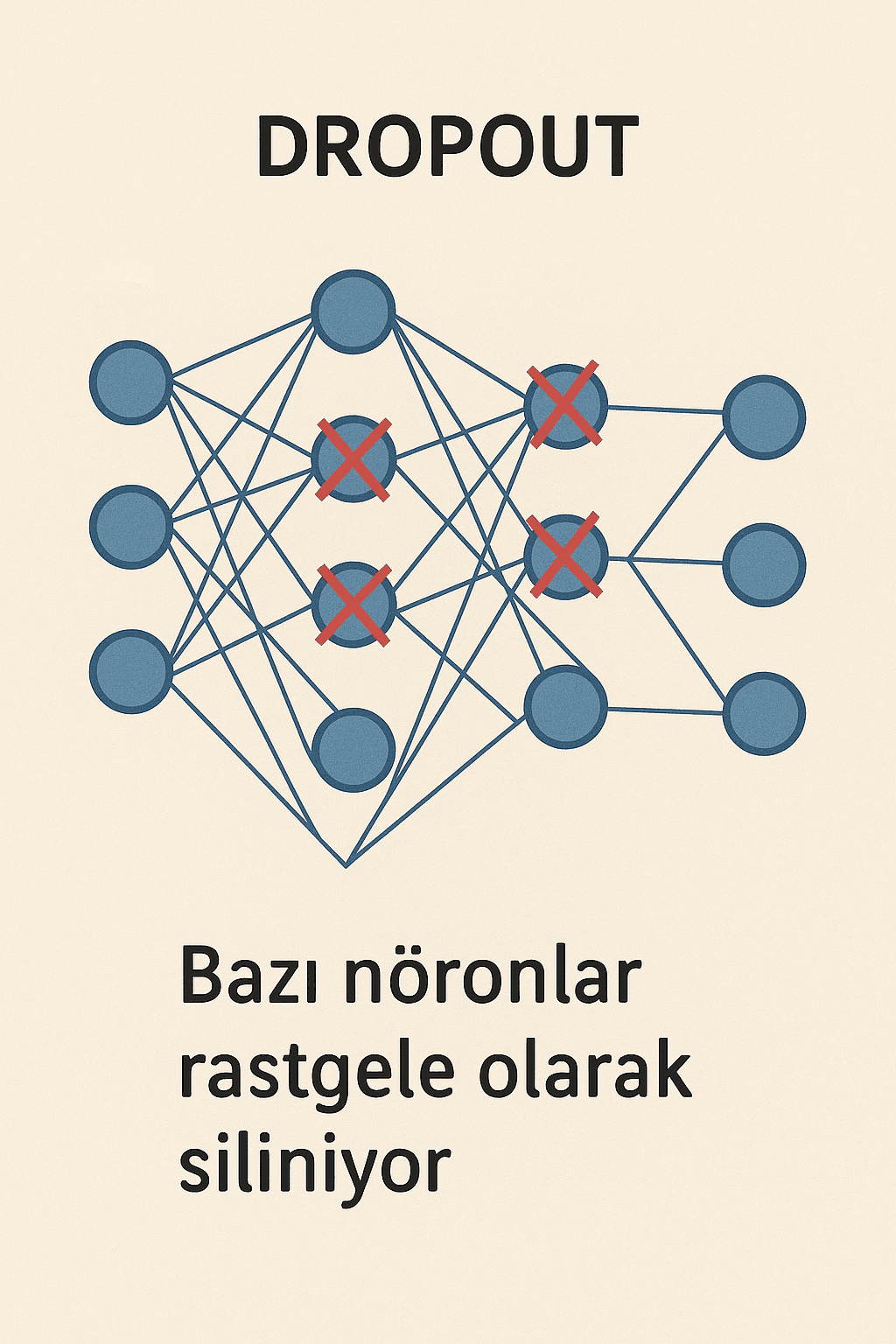
Dropout çalışma prensibi tasviri (Yapay Zekâ ile oluşturulmuştur)
Dropout is a regularization technique designed to prevent overfitting in deep neural networks. During training, a random subset of neurons in hidden layers is deactivated according to a specified dropout rate p. These neurons are not used in either the forward or backpropagation passes of that iteration. As a result, the network is forced to operate on different “thinned subnetworks” in each training iteration, which:
After training, to ensure consistent outputs when all neurons are activated, neuron outputs are typically scaled by . This preserves the average effect observed in the thinned networks during training.
Mathematically:
= ⊙
Where:
Dropout enables learning across multiple “thinned” networks during training. This creates an ensemble-like effect, where the single model behaves as if it is averaging predictions from multiple distinct configurations. Consequently, overfitting is significantly reduced and test performance improves.
Popular libraries (Keras, TensorFlow, PyTorch) provide built-in Dropout layers.
Standard Dropout: Typically deactivates 50% of neurons in hidden layers and 10%–20% in input layers. During testing, all neurons are active and outputs are scaled accordingly.
DropConnect: Randomly deactivates connections instead of neurons.
SpatialDropout, DropBlock, MC Dropout (Dropout used during testing for uncertainty estimation in Bayesian approaches)
Monte Carlo Dropout: Multiple masked forward passes during testing are used to estimate model uncertainty.
Early/Late Dropout: Dropout is activated at the beginning or end of training to optimize the model’s learning dynamics.
Dropout is widely used in convolutional neural networks (CNNs), fully connected deep networks (DNNs), and recurrent networks (RNNs). It also provides a flexible framework for Bayesian uncertainty modeling and facilitates the generation of reliable results.
DatabaseCamp. "What is the Dropout Layer?"Accessed Adresi.
GeeksforGeeks. "Dropout in Neural Networks." 2022.Accessed Adresi.
Hinton, Geoffrey E., Nitish Srivastava, Alex Krizhevsky, Ilya Sutskever, and Ruslan R. Salakhutdinov. "Improving neural networks by preventing co-adaptation of feature detectors." *arXiv preprint arXiv:1207.0580* (2012).Accessed Adresi.
Marimuthu, Parthiban. "Dropout Regularization in Deep Learning". 2024.Accessed Adresi.
MathWorks. "Dropout Layer." MATLAB & Simulink Documentation. Accessed May 2, 2025.Accessed Adresi.
Srivastava, Nitish, Geoffrey Hinton, Alex Krizhevsky, Ilya Sutskever, and Ruslan Salakhutdinov. "Dropout: a simple way to prevent neural networks from overfitting." *The journal of machine learning research* 15, no. 1 (2014): 1929-1958.Accessed Adresi.
[1]
Hinton, Geoffrey E., Nitish Srivastava, Alex Krizhevsky, Ilya Sutskever, and Ruslan R. Salakhutdinov. "Improving neural networks by preventing co-adaptation of feature detectors." arXiv preprint arXiv:1207.0580 (2012). Erişim Adresi.
[2]
Srivastava, Nitish, Geoffrey Hinton, Alex Krizhevsky, Ilya Sutskever, and Ruslan Salakhutdinov. "Dropout: a simple way to prevent neural networks from overfitting." The journal of machine learning research 15, no. 1 (2014): 1929-1958. Erişim Adresi.

Mechanism of Operation
History
Usage and Parameters
Advantages and Disadvantages
Advantages
Disadvantages
Advanced Variants
Orientation and Application Areas