


This article was automatically translated from the original Turkish version.
+1 More
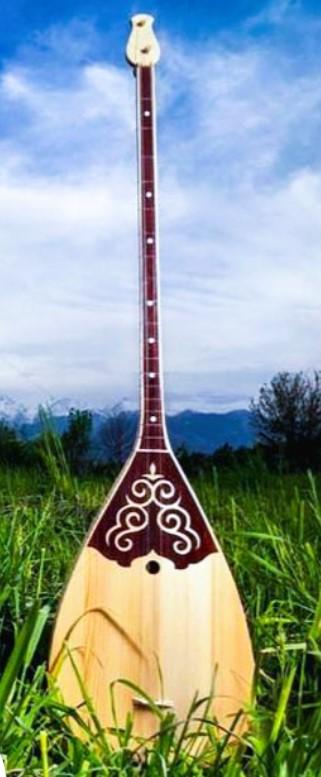
Dombra
Instrument Type | Telli, folk instrument | ||||||||
|---|---|---|---|---|---|---|---|---|---|
Origin | Kyrgyzstan Uzbekistan Central Asia – Kazakhstan | ||||||||
Structure | Long neck Hollow body Two strings | ||||||||
Strings | Monofilament or metal (in the past, strings were made from intestines) | ||||||||
Number of Strings | Usually 2 (it has also been reported that there were six strings in the past) | ||||||||
Playing Technique | With fingers, using the shelpa technique | ||||||||
Sound Usage | Solo and accompaniment | ||||||||
Dombra is a traditional Turkic string instrument with a long neck and typically two strings, widely used among Turkic peoples of Central Asia, especially in Kazakhstan. The dombra is used both as a solo and accompanying instrument and is regarded by many peoples, particularly the Kazakh Turks, as an instrument of identity and cultural memory. The Kazakh dombra music, inscribed by UNESCO on the Intangible Cultural Heritage of Humanity list, has elevated the instrument’s significance to an international level.
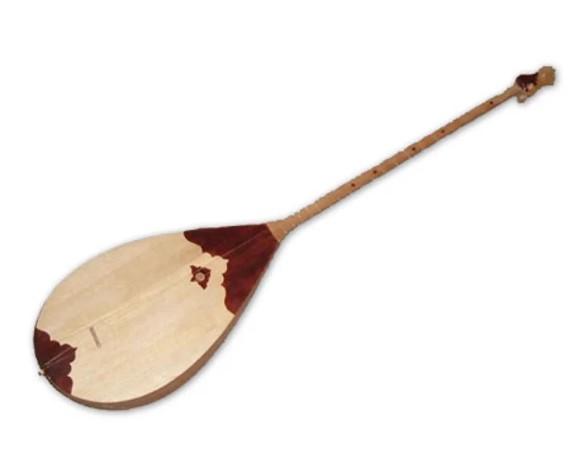
Dombra (Tüdev)
The dombra is one of the oldest Turkic instruments, with origins traced back to the 5th–7th centuries. An artifact discovered in 2008 in the Cargalant-Kayırhan region of Mongolia, inside a cave known as Nuhen Had, and identified as an Old Turkic dombra, sheds light on the instrument’s historical past.
The word “dombra” derives from the Turkic root morpheme dop-//dom-, meaning “round, swollen object.” Although it has evolved into various forms across different regions, the dombra remains one of the few instruments to have maintained continuity in the musical memory of Central Asia.
Kazakh oral culture contains several legends about the origins of the dombra. One such tale recounts how Kerbuğa-küyşi, a messenger, used music to inform Joşı Han, son of Genghis Khan, of his son’s death. Kerbuğa played the Aksak Ceylan (Lame Gazelle) küy on the dombra to convey the news. Upon the Khan’s order, lead was poured not onto Kerbuğa himself but onto the body of the dombra, causing its strings to snap. Thus, the six-stringed dombra transformed into the two-stringed form known today.
Another legend tells of twin infants who, tied to a tree, sustained life with their tears. A woman, inspired by their story, felled the tree and fashioned an instrument from the fibers that emerged. The sound produced by the instrument resembled the heartbeat of the children.
Aksak ceylan kuyu (Grup orhun)
The dombra is a long-necked, hollow-bodied instrument, typically with two strings. Its body is carved from a single piece of wood and covered with a thin wooden soundboard. In the past, the strings were made from animal intestines or sinew; today, they are commonly made of monofilament nylon or copper wire.
The playing technique of the dombra is generally performed without a plectrum, using the fingertips in a method known as “şelpe.” This technique bears resemblance to the plucked styles of the bağlama.
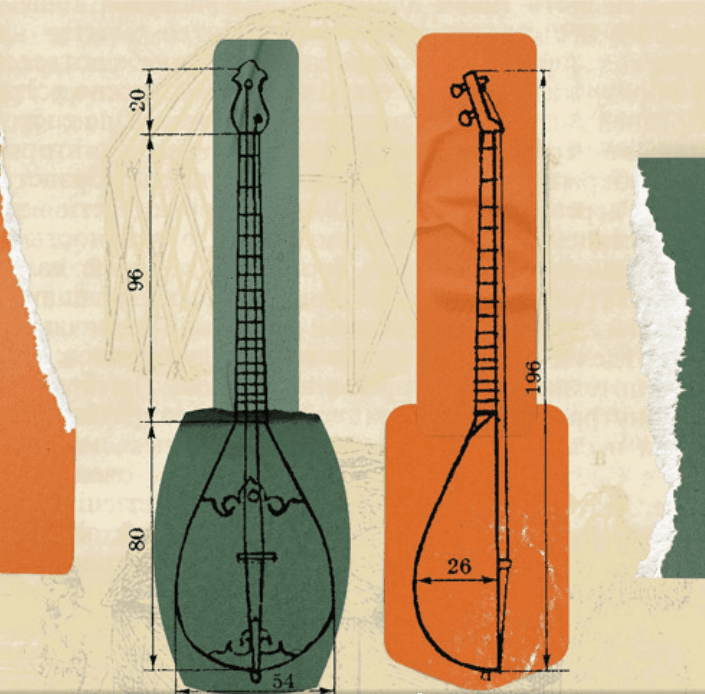
Physical form and features (Rengarenk dergisi)
In the dombra playing tradition, küy—wordless musical forms—are prevalent. Each küy serves as an evocation of an event, emotion, or natural phenomenon. A dombra master’s ability to imitate the sound of a horse’s hooves on the instrument is considered a key indicator of mastery.
Küy are not merely musical expressions but also function as historical narratives. It is possible to play the dombra without formal musical notation, making it an accessible instrument among the people. However, mastery and artistry require specific training and technical proficiency.
Dombra kuy (UNESCO)
In Kazakh culture, the dombra is not merely a musical instrument but is regarded as a symbol of national identity. It is commonly hung in the most honored corner of homes and frequently played at weddings, ceremonies, and in daily life, reflecting this symbolic role.
In Kazakhstan, the first Sunday of July is officially designated as National Dombra Day. On this day, thousands of people play the dombra simultaneously to strengthen a sense of social unity and identity. Even during the Soviet era, when Kazakh identity was suppressed, the dombra remained a vital medium for expressing the people’s emotions.
The art of performing küy exclusively on the dombra was inscribed on UNESCO’s Intangible Cultural Heritage of Humanity list in 2014. This recognition affirms that the dombra carries a cultural value that transcends its local origins and holds universal significance.
The dombra became known in Türkiye beginning in 1997 with the composition of the piece “Dombıra” by Arslanbek Sultanbekov. The piece was performed by various political adaptations and music groups and gained widespread public attention in 2014 and 2015.
The use of the dombra in the music of the Turkish television series Diriliş: Ertuğrul, broadcast on TRT1, has increased the instrument’s visibility in Türkiye. Additionally, Turkish audiences familiar with the şelpe technique on the bağlama are not unfamiliar with the tonal qualities of the dombra.
Numerous institutions in Türkiye, including the Kazakh Turks Education and Research Association, the East Turkestan Emigrants Association, and Erzincan University, have established dombra courses, a practice that continues as of 2019.
Arslanbek Sultanbekov dombıra (Arslanbek Sultanbekov)
Müziki Dergisi. "Dombra: Türk Halk Müziğinde Köklü Bir Enstrüman." Accessed May 16, 2025.http://www.musikidergisi.net/?p=872.
Rengarenk Dergisi. 2024. “Geçmişten Günümüze Dombra.” Rengarenk Dergisi. Accessed May 16, 2025.https://rengarenkdergisi.com/2024/10/17/gecmisten-gunumuze-dombra.
TÜDEV. "Dombra: Eski Türk Çalgısı." Türkiye Denizcilik Federasyonu. Accessed May 16, 2025.https://www.tudev.org.tr/dombra-eski-turk-calgisi/.
Türk Dil Kurumu. “Dombra.” Türk Dil Kurumu Sözlükleri. Accessed May 16, 2025.https://sozluk.gov.tr/.
UNESCO. “Kazakh Traditional Art of Dombra Kuy.” Intangible Cultural Heritage, 2014. Accessed May 16, 2025.https://ich.unesco.org/en/RL/kazakh-traditional-art-of-dombra-kuy-00996.
YouTube. "Dombra - Korkut Ata Destanı Türk Dünyası Versiyonu." Accessed May 16, 2025.https://www.youtube.com/watch?v=-o68Za69bCc
YouTube. "Kazakh Dombra Performance." YouTube. Accessed May 16, 2025.https://www.youtube.com/watch?v=f4AAkHMNBhw&t=1s.
YouTube. "Türk Dünyasında Dombra Geleneği." YouTube video. Accessed May 16, 2025.https://www.youtube.com/watch?v=SfGQWyEd08o&t=58s
Çetin, Nagihan. 2019. “Türkiye’de Dombranın Popülerleşmesi ve Bir Dombra Ustası: Sedat Solakoğlu.” *Erzincan Üniversitesi Sosyal Bilimler Enstitüsü Dergisi* 12 (2). Accessed May 16, 2025.https://dergipark.org.tr/tr/download/article-file/730880
Dombra
Instrument Type | Telli, folk instrument | ||||||||
|---|---|---|---|---|---|---|---|---|---|
Origin | Kyrgyzstan Uzbekistan Central Asia – Kazakhstan | ||||||||
Structure | Long neck Hollow body Two strings | ||||||||
Strings | Monofilament or metal (in the past, strings were made from intestines) | ||||||||
Number of Strings | Usually 2 (it has also been reported that there were six strings in the past) | ||||||||
Playing Technique | With fingers, using the shelpa technique | ||||||||
Sound Usage | Solo and accompaniment | ||||||||
History and Origins
Legends and Oral Narratives
Structure and Technical Features
Playing Techniques and Küy Tradition
Cultural Significance and Social Role
UNESCO List and International Recognition
Dombra in Türkiye