


This article was automatically translated from the original Turkish version.
Dogfight, a high-dynamic interaction field in which two or more aircraft simultaneously manage geometry, energy, and perception dimensions over very short time scales to gain mutual advantage. Geometry encompasses relative position, orientation, and angular variables; energy includes speed, altitude, and total energy state; perception covers situational awareness and sensor/weapon sight data. Within this framework, the primary objective of dogfight is for the attacker to generate a firing solution that simultaneously satisfies the range, angle, and timing requirements of the weapon-sight-target triad; for the defender, it is to prevent those conditions from arising. Success depends on balancing these two objectives within a single decision process.
The defining characteristic of the WVR (within visual range) environment is the high decision rhythm and command frequency. In BVR (beyond visual range) engagements, outcomes are largely shaped by sensor ranges, network-centric information flow, and long-range missile envelopes; in WVR, visual and short-range perception dominate. This manifests concretely in how the line-of-sight (LOS) direction and LOS velocity (the angular rate relative to the target) directly determine the firing window. For sight systems to operate reliably, it is not sufficient for the target to enter range; the LOS velocity must also be sufficiently reduced to allow the sight to maintain stable tracking on the target. Therefore, dogfight is not merely an optimization of spatial position but a problem of managing the “angular meaning” that the spatial state imposes on the target. This approach, known in the literature as the “space–angle game,” entails combining spatial decisions—such as turn plane, altitude layer, and distance—with angular decisions—such as AOT (angle-off-tail), lead/pure/lag tracking angles, and HOBS (high off-boresight)—and proper timing. In other words, advantage often arises from the combination of selecting the correct plane, maintaining the correct speed band, and sustaining LOS velocity within the sight’s required range.
The physical conditions of a firing solution are defined by kinematic and energy constraints. Idealized, the relationship between turn radius and angular turn rate is
,
where V is flight speed and g represents the effective centripetal acceleration demand. As speed decreases and effective g increases, grows, meaning angular generation accelerates; however, energy consumption simultaneously increases and sustainability decreases. Therefore, instantaneous maximum turn capability must be distinguished from sustained turn capability; the former is evaluated for short-term angular gain, the latter for tracking and position maintenance. In energy–maneuverability theory, specific excess power quantifies this balance: positive enables pre-firing stabilization and post-firing escape, while low or negative limits the continuity of aggressive maneuvers. Selecting the speed band near the “corner speed” provides a practical compromise between sustained angular generation and energy conservation for most platforms.
Weapon–sight integration is tightly bound to this kinematic foundation. In gun firing, projectile flight time and predicted impact point relative to the target require low LOS velocity and stable application of lead angle corrections. In short-range infrared-guided missiles, reliable seeker lock within the no-escape zone (NEZ) is essential; this necessitates simultaneous satisfaction of both range and angular constraints at the moment of firing. Although helmet-mounted sights and HOBS capabilities expand the firing envelope, if LOS velocity and tracking quality are insufficient, the practical firing window narrows. Thus, the firing solution is not merely a matter of entering range but a stabilization problem requiring “temporal continuity.”
For the defender, the goal is to disrupt the firing solution along all three axes (geometry, energy, and perception). Geometric disruption is achieved through high-g turns that increase LOS velocity and challenge sight stabilization, out-of-plane components that break plane alignment, and close-range closure management to induce overshoot. On the energy axis, unloaded extension and rapid “reset” maneuvers, combined with spiral or OOP combinations, help distance the opponent from the corner region while replenishing one’s own budget. On the perception and guidance axis, countermeasures such as flares or chaff, combined with aggressive plane-breaking maneuvers, saturate the seeker or degrade visual/tracking quality to shorten the firing window; even against HOBS, rapid directional changes can reduce helmet cueing opportunities. These actions do not rigidly separate attack from defense; many maneuvers can produce both production (offensive) and denial (defensive) effects depending on context.
Execution relies on a continuous decision loop. In the perception phase, LOS direction and velocity, AOT/aspect, closure, and differential are evaluated; these data form the basis for selecting the appropriate turn plane (one-circle, two-circle, or OOP) and speed band. In the application phase, the attacker enters a plane that reduces LOS velocity, remains near the corner band, and seeks to open the lead/pure window; the defender increases LOS velocity, breaks plane alignment, and performs an energy reset. In the evaluation phase, the continuity of the window, proximity to g/AOA/structural limits, and remaining budget for post-firing escape are reassessed. Thus, the definition (multi-target maneuver game), distinction (WVR focus on LOS and tempo), and objective (generate–deny firing solution) converge into a single technical framework.
This unity repositions dogfight not as a mere pursuit of “getting behind” but as an interdisciplinary problem requiring the integrated management of energy, geometry, and perception. From an objective performance perspective, what determines success is not the repertoire of individual maneuvers but the capacity to maintain LOS velocity within the desired range through correct plane–speed–time selection, sustain continuity without violating the budget, and simultaneously satisfy sight–weapon requirements. This is a common metric applicable to both human pilots and autonomous systems.
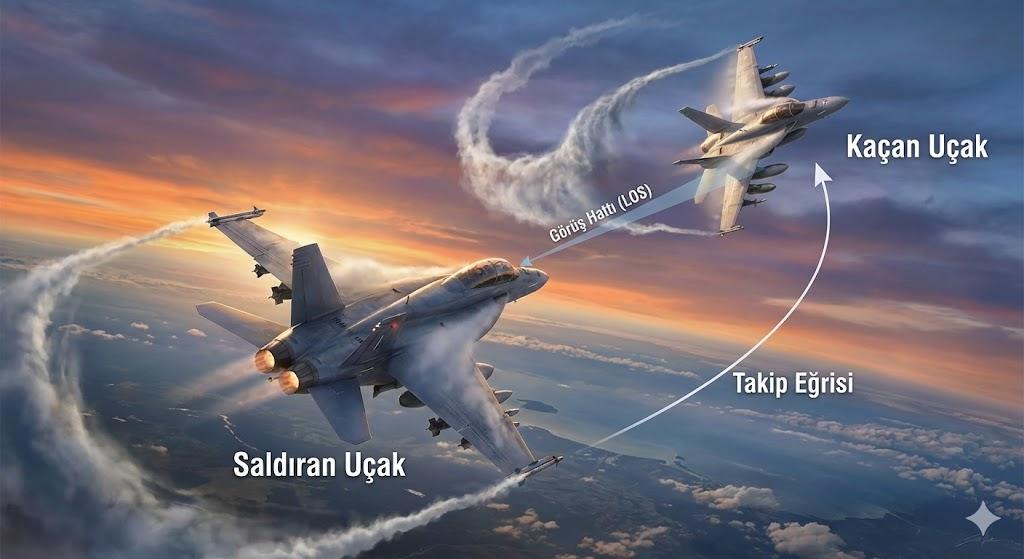
İt Dalaşı Temsili Gösterimi (Yapay Zeka İle Oluşturulmuştur.)
The historical evolution of dogfight has been shaped by technological advances as much as aviation itself, undergoing gradual yet radical transformations in doctrine and tactical priorities. During World War I, air combat was primarily based on basic directional capability and the pilot’s visual tracking. Aircraft of the era had low speeds and limited altitude performance; engagements therefore mostly consisted of tight circular maneuvers, particularly continuous horizontal turns at low speed, establishing a linear geometry paradigm where “the one who gets behind wins.” This phase laid the groundwork for the embryonic forms of later BFM (Basic Fighter Maneuvers) maneuvers such as lead–lag–pure pursuit, yo-yo variants, and scissors. The transition from piston-engine to turbojet eras dramatically increased speed and climb rates; however, these new performance levels fundamentally altered maneuver dynamics. Continuous horizontal turning became increasingly impossible due to structural limits and high speeds, directing pilots toward energy-conserving vertical or semi-vertical maneuvers. Thus, dogfight ceased to be merely an art of “geometric positioning” and became simultaneously a problem of “energy management.”
One critical breakthrough enabling this transformation was the introduction of fly-by-wire (FBW) technology. NASA’s digital FBW test program on the F-8 Crusader replaced traditional mechanical flight controls with digital computer-based control laws, redefining the relationship between pilot inputs and aerodynamic response. This system allowed aircraft to be controlled without relying on natural aerodynamic stability, making it possible to safely execute critical maneuvers even at AOA (angle of attack) values far beyond what a pilot could normally manage. FBW did not merely ease control; it introduced a layer of envelope protection that automatically safeguarded against structural g-limits, AOA exceedance, or critical speed thresholds. This development reshaped classical dogfight geometry intuitions by reframing the question as “how critically can the aircraft be maneuvered safely?” The FBW era also marked the foundational period for the conceptual shift toward “the pilot flying the tactic, not the aircraft.”
Fourth- and fifth-generation fighter aircraft have reshaped dogfight doctrine not only through aerodynamic and energy capacity but also through perceptual dominance elements. While “energy advantage” remains a critical parameter, in modern engagements “perceptual advantage” has become an equally decisive factor. Sensor fusion capabilities, IRST (Infrared Search and Track), helmet-mounted sight systems (HMD/HOBS), AESA radar architectures, and network-centric data sharing have enabled pilots or autonomous systems to evaluate not only the immediate environmental state but also potential tactical outcomes in advance. In this context, dogfight today is not merely a physical maneuver contest but also a struggle for perceptual and cognitive temporal advantage. On modern platforms, a maneuver is executed not only to alter geometry but to delay the opponent’s decision cycle; this represents an elevation of the classical “maneuver game” to a higher level.
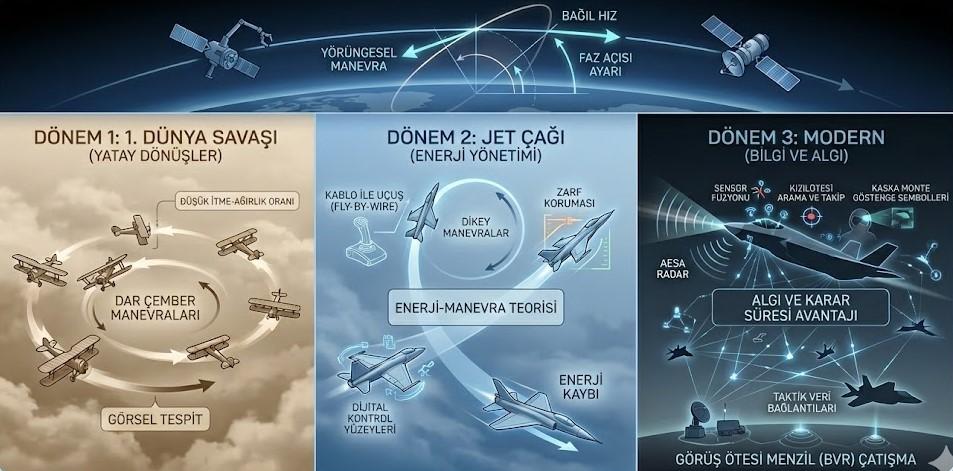
İt Dalaşı Doktrin Evrimi Şeması (Yapay Zeka İle Oluşturulmuştur.)
This transformation also demonstrates that dogfight doctrine is not confined to the atmosphere. With the emergence of satellite-to-satellite engagement possibilities in space—particularly in low Earth orbit—the concept of “space dogfighting” has entered the literature at a theoretical level. In this above-atmosphere scenario, the primary determinants are not lift generation and aerodynamic drag but orbital phase relationships, apsidal precession, relative velocity differences, and Keplerian dynamics. Pilot commands are replaced by phase synchronization and timing strategies; the classical turn radius relationship is superseded by relative position and time coordination dictated by orbital mechanics. In this context, space dogfighting is not a complete departure from traditional dogfight but can be viewed as a natural extension of the “space–angle game” approach: the medium differs, but advantage is still determined by the synthesis of positional and temporal superiority.
The physical foundations of dogfight require an understanding of fundamental aerodynamic forces and their effects on aircraft control axes. An aircraft’s maneuverability depends on the continuous realignment of lift, weight, thrust, and drag. The aircraft controls this force balance along three primary axes (pitch, roll, and yaw) through control surfaces and flight control systems. During maneuvers, particularly in the pitch axis, acceleration generates positive g-loads. These accelerations are constrained by the pilot’s physiological tolerance and structural limits. The Maneuvering egg diagram is a practical representation illustrating how these limits vary with speed–g-load relationships; at low speeds, the aircraft cannot generate high g, and at high speeds, structural limits impose similar constraints. This model shows the aircraft’s capability to maneuver within a specific instantaneous maneuvering band.
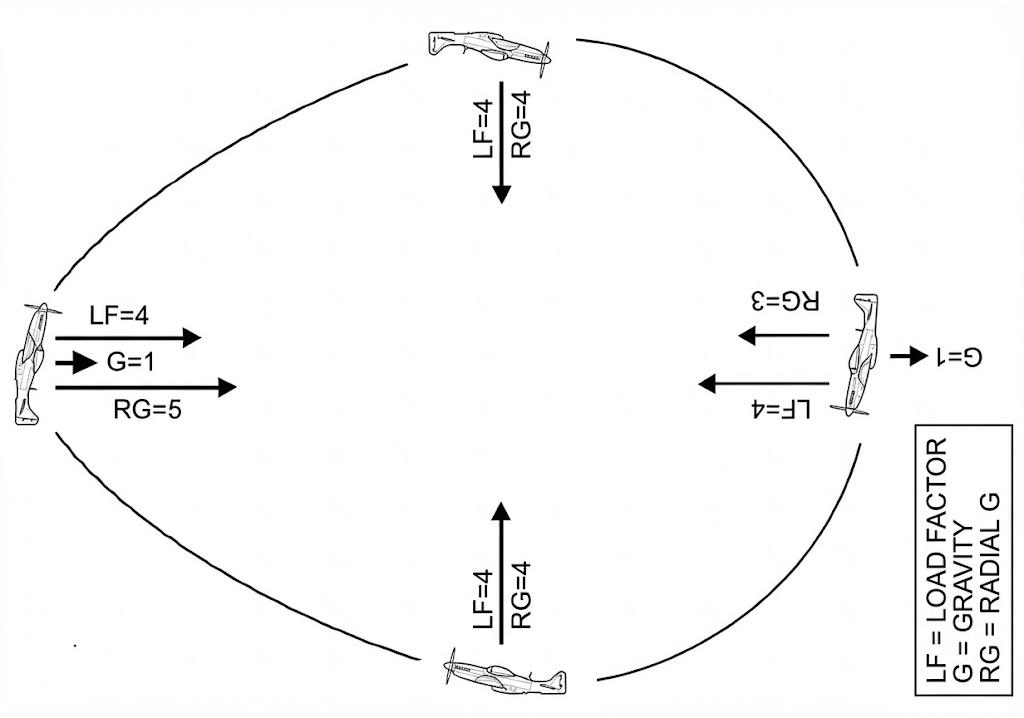
Maneuvering Egg Diyagramı (Yapay Zeka İle Oluşturulmuştur.)
Factors determining an aircraft’s maneuverability include both fixed and variable elements. Structural load limits (e.g., +9g limit), maximum AOA (angle of attack) values, and flight control algorithm constraints are immutable physical limits. Wing loading (weight per unit wing area) and thrust-to-weight ratio are fundamental flight characteristics that directly determine performance; vertical energy retention capacity depends on thrust-to-weight ratio, while horizontal turning performance depends on wing loading. The relationship between these parameters is depicted in the V–n diagram. This diagram, with speed on the horizontal axis and g-load on the vertical axis, shows at which speeds the aircraft can generate what g-load and at which speeds structural limit exceedance risks occur. The speed band known as “corner speed” is a critical breakpoint on this diagram: at this point, the aircraft achieves its maximum instantaneous turn rate, or highest angular velocity generation capability. However, the sustainability of the corner region depends on the engine’s ability to overcome drag, along with factors such as engine cooling and fuel consumption.
When analyzing turn performance, two key quantities emerge: turn radius and angular turn rate. In an idealized state, turn radius and angular rate can be expressed as:
Here, is flight speed and is effective centripetal acceleration. These relationships show that low speed and high g enable high angular turn rates, while high speed increases turn radius. However, the distinction between instantaneous and sustained performance becomes evident here. Instantaneous maneuvers generate sudden angular gains through short-duration high AOA and g values, while sustained maneuvers provide longer-term tracking and positional advantage by conserving energy. The difference is fundamentally determined by energy parameters such as engine thrust, drag curve, and fuel efficiency.
In this context, energy–maneuverability theory (EM) transforms the physical nature of dogfight from a purely geometric problem into an energy-based model. In this approach, an aircraft’s total mechanical energy at any moment is divided into kinetic energy and potential energy , and their rates of change are analyzed. Specific excess power is defined as the rate of change of total energy relative to weight:
Here, T is thrust, D is drag, W is weight, and V is speed. When , the aircraft is gaining energy; when , it is losing energy. This value guides critical decisions during both attack and defense: positive is required for pre-firing stabilization and post-firing escape; negative leads to rapid degradation of maneuverability. Thus, the pilot or autonomous system must strive not only for the correct angle but also the correct energy state; for example, high or low yo-yo maneuvers consciously trade speed and altitude to optimize either instantaneous angular generation or sustained tracking.
Geometry and basic maneuvers are concrete tools directly linked to the ultimate goals of dogfight: achieving a firing solution and preventing the opponent from achieving one. Thus, maneuver selection depends not on aesthetic advantage but on a combination of relative speed, turning capability, load factor, and weapon/sensor constraints. The mathematical basis of geometric concepts can be summarized by centripetal acceleration and load factor relationships; during a turn, centripetal acceleration relates to load factor via , so turn radius and angular turn rate can be expressed as:
These relationships directly show how maneuver choice is constrained by speed and achievable limits; low speed and high increase instantaneous angular generation but negatively impact sustainability and energy cost.
The concepts of one-circle and two-circle describe the macro-geometry of turn patterns between two platforms. In one-circle interactions, both parties’ turn centers lie approximately on a common circular path; in this case, the relative position between tracker and target is resolved along a single circular track. In two-circle situations, each party’s turns occur with different centers and radii, producing more complex outcomes in terms of expected intersection points and waiting times. Which geometry emerges depends on factors such as the platforms’ entry speeds, angular gain capacity (turn rate), and initial closure rate. Practical tactical selection is evaluated based on how the chosen plane alters LOS angular velocity and generates the necessary weapon windows.
The use of out-of-plane (OOP) maneuvers provides various tactical advantages compared to planar (single-plane) interactions. Adding an OOP component disrupts the opponent’s expectation of a horizontal plane turn match, generating unexpected 3D geometry that can reduce LOS angular velocity and temporarily challenge seeker/sight configurations. OOP preferences can be energetically costly, as out-of-plane maneuvers typically require speed–altitude trade-offs or high load factors. Therefore, OOP is only selected when energy budget and structural limits permit, specifically to achieve unexpected geometric disruption.
Among attack maneuvers, the lead/pure/lag pursuit categories determine which target point is aimed at. Lead pursuit involves aiming at the target’s predicted future position to compensate for missile or projectile flight time; this is especially critical in gun firing. Pure pursuit directs the weapon line toward the target’s current direction and can be used for short-duration shots; lag pursuit is typically chosen for closure control and energy gain, later transitioning to lead to create a firing window. Yo-yo maneuvers (high and low yo-yo) are applications of these pursuit strategies along the energy–geometry axis: in a high yo-yo, the attacker adds a vertical component to generate lead angle while sacrificing speed; in a low yo-yo, speed is preserved to enable more aggressive directional changes at shorter range. Both variants offer a deliberate trade-off between lead angle and speed–altitude exchange.
Tactics such as scissors and barrel-roll attacks aim to disrupt line-of-sight at close range or increase the opponent’s likelihood of overshoot. Scissors tactics involve reciprocal short turns and directional changes to cause the opponent to lose alignment, over-manoeuvre, and thereby narrow the firing window. Barrel-roll attacks and displacement roll maneuvers are used to shift the attacker’s sight alignment and achieve an unexpected angular position to create a firing window; displacement roll is particularly effective for rapidly changing aspect angle.
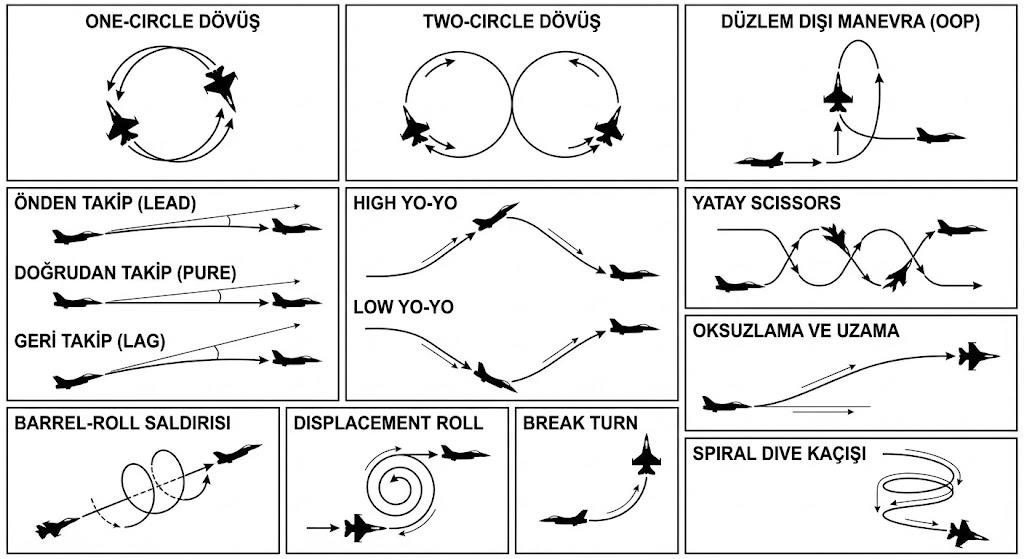
Temel Manevralar (Yapay Zeka İle Oluşturulmuştur.)
Defensive maneuvers typically focus on geometric disruption and energy reset. The break turn, an instantaneous maximum- turn, is a classic method to disrupt the attacker’s sight stabilization; this maneuver rapidly increases LOS angular velocity and can temporarily invalidate the attacker’s sight. Unloaded extension (throttle-off and extension) is a strategy to gain speed, increase distance, and replenish energy; its aim is to escape the missile threat envelope while rebuilding the budget (specific excess power) for the next engagement. Horizontal-plane defensive variants such as flat scissors are preferred under low-altitude and limited vertical space conditions; spiral dive escapes, though risky, are used to confuse missile seekers or disrupt the attacker’s tracking path.
Energy and weapon integration constitute a high-level coordination principle determining BFM effectiveness. Different weapon types impose distinct kinematic and angular requirements: gun firing requires projectile flight time, sight stabilization, and lead calculation; thus, gun firing demands very low LOS velocity within short, stable windows. Short-range guided missiles involve constraints represented by concepts such as seeker cone angle and no-escape zone (NEZ); reaching these requires a specific immediate-target geometry and closure profile. High-off-bore-sight (HOBS) capability and helmet-mounted sight systems (HMD) expand the firing envelope by allowing the pilot to fire at high off-axis angles using head gaze; however, HOBS’s practical benefit is limited by seeker and control delays in relation to LOS velocity. Therefore, tactically, a platform must consciously balance its ability to rapidly place the target within the NEZ against the budget it retains for post-firing escape.
Missile threat emerges as a factor that fundamentally alters engagement dynamics in dogfight; the presence of a missile threat in close combat directly affects both tactical choices and energy/performance management. Air-to-air missiles generally operate on a two-phase guidance logic (cruise + terminal); in the terminal phase, seeker data and guidance laws determine target acquisition. This section provides a brief technical summary of missile kinematics and guidance principles, then evaluates evasion strategies from an energy–tactic dilemma perspective, and finally examines the role of countermeasures and mission context.
One of the most common modeling approaches for missile kinematics and guidance is the proportional navigation (PN) law. According to this principle, the commanded lateral acceleration of the missile is proportional to the angular rate of the line-of-sight (LOS) to the target. A simple PN formulation is expressed as:
where is the missile’s commanded lateral acceleration, is the navigation constant, is the closing velocity, and is the LOS angular rate. PN effectiveness is tightly dependent on the dynamic limits of the target and missile and the seeker’s measurement accuracy; modern systems enhance PN with augmentations (e.g., augmented PN or nonlinear PN variants) that account for seeker noise, delays, and aerodynamic limits. The missile’s own maneuver limits—determined by thrust capacity and maximum effective lateral acceleration from control surfaces—define the boundaries of this guidance; thus, a target’s evasion success fundamentally depends on this force–acceleration balance.
Evasion principles are applied against this guidance logic. Since PN-based guidance seeks to suppress LOS angular rate, the most effective evasion maneuver for the target is typically to increase LOS velocity or reduce closing velocity. Sudden angular maneuvers in horizontal or vertical planes, maneuvers adding OOP components, and rapid unloaded extensions alter LOS dynamics and reduce PN command effectiveness. However, evasion maneuvers incur energy costs: high lateral acceleration demands accelerate energy (specific excess power ) consumption and may approach structural or pilot tolerance limits. From the missile’s perspective, another critical concept is the no-escape zone (NEZ), defined as the region where any maneuver the target can execute with its current performance cannot defeat the missile’s intercept capability, making escape impossible. NEZs are calculated using the missile’s maximum lateral acceleration, closing velocity profile, and seeker capabilities and serve as a critical operational threshold in engagement decisions.
Decisions under missile threat become a multi-objective optimization problem: on one hand, survivability is paramount; on the other, mission objectives—maintaining positional advantage and tactical superiority over the opponent—persist. These two goals often conflict; for example, an evasion maneuver may increase survivability but sacrifice tactical position, or an aggressive maneuver may close the firing window. Modern analytical approaches address this conflict within the framework of a Pareto-optimal solution set. Using multi-objective evolutionary algorithms (e.g., MOEA/D), nondominated (Pareto) strategy sets can be generated for different survivability/tactic weightings; operational selection involves choosing an appropriate point from this set based on mission context and decision-maker risk preferences. Thus, the pilot or autonomous agent is presented not with a single “best” maneuver but with a spectrum of strategies showing the trade-offs between competing objectives.
Countermeasures operate effectively on both kinetic and electronic/perceptual levels. Thermal seekers are countered by flares, which physically create heat sources; radar-guided threats are countered by chaff (radar-reflective particles) and electronic countermeasures (ECM), which disrupt seeker detection. These tools are effective only when used with correct timing and appropriate maneuvers; for example, flare deployment may temporarily confuse the missile’s guidance, but failure to follow up with a high-g maneuver or OOP component can allow the missile to reacquire. Additionally, helmet-mounted sights and warning systems (helmet-mounted displays, missile-approach warning systems) assist the pilot in optimizing timing, thereby enhancing countermeasure effectiveness. Mission context is decisive: a platform on escort duty prioritizes evasion and protection, while an attacker may accept the risk of entering the NEZ with more aggressive tactics; maneuver choices vary depending on munition type, team procedures, and command-and-control structures.
Human factors, safety, and training are directly linked to operational success in dogfight and require careful design of procedures and training to manage both the pilot’s physiological limits and strategies to overcome them. The high-g maneuvers characteristic of close air combat induce hemodynamic changes in the pilot; the most critical consequence is visual impairment and loss of consciousness (g-induced loss of consciousness, G-LOC). Technically, the centripetal acceleration experienced during a turn relates to speed and turn radius as , and load factor relates to . Therefore, a specific turn profile applied by the aircraft directly determines the g-load experienced by the pilot; training and operational limits are defined based on this physical relationship. Pilot g-tolerance varies individually; training, physical conditioning, and application of anti-g techniques (e.g., breathing and muscle contraction maneuvers) are the main factors influencing this tolerance. In this context, safety procedures must be designed to encompass not only technical limits of the aircraft envelope but also human physiological limits.
The lookout doctrine and loss-of-visual-contact rules provide a cognitive and tactical framework in close combat. Loss of visual contact or loss-of-visual situations require standardized procedures for both safety and conflict deconfliction; the primary aim of these procedures is to reduce uncertainty in the environment, separate flight corridors, and define appropriate steps for reacquisition of visual or relational contact. Training documents implement specific checklists and routines to help pilots automate these rules; these cover both individual pilot behavior (e.g., executing a safe escape maneuver in critical situations) and team procedures (e.g., wingman position and communication). In loss-of-visual incidents, measures such as radio communication, pre-briefed separation profiles, and visual reacquisition points help ensure the situation is resolved in a controlled manner.
The training architecture must be designed as a multilayered structure integrating human factors and technical competence. An effective training system typically combines theoretical foundation (ground school), simulation-based practice (synthetic trainer), and actual flight application. Ground school provides foundational conceptual knowledge and interdisciplinary understanding such as energy–maneuverability theory and BFM repertoire; simulation environments allow safe repetition of high-risk maneuvers, testing of emergency procedures, and evaluation of human–system interaction. The final phase, flight-based training, validates simulated skills under real flight dynamics and physical stress. This tripartite approach must be designed to progressively develop the student’s cognitive models, motor skills, and decision-making under stress.
The effectiveness of training programs must be evaluated not only through individual performance metrics but also through team performance, safety culture indicators, and analysis of incident/infraction records. Simulation-based assessments provide valuable data, particularly in reproducing G-LOC scenarios, sensor blind spots, and loss-of-visual conditions; this data quantitatively reveals individual pilot reaction time, situational awareness level, and procedural compliance. Training strategies must also include physiological preparation; for example, g-tolerance techniques, rest/acclimatization principles, and appropriate physical conditioning requirements must be integral components of training packages.
Numerical modeling and 6-DOF simulation are essential components in dogfight research, providing both physical realism and tactical accuracy. The modeling level used must be selected according to the intended purpose; for high-level tactical analysis, 3-DOF approaches may suffice, but for controller design, sensor–effector interactions, and real-world counterparts of pilot/autonomous agent behavior, 6-DOF models are required.
Three degrees of freedom (3-DOF) models typically simulate the position and planar velocity changes of a body, i.e., linear motion, without including orientation and angular dynamics. Such models provide computational efficiency for range–time analysis, rapid scanning of high-level tactical policies, and large-scale Monte Carlo experiments. In contrast, six degrees of freedom (6-DOF) models simultaneously solve for the three-dimensional position and three-dimensional angular state of the body. Within the rigid-body dynamics framework, 6-DOF equations take the following fundamental form:
,
where is mass, is velocity vector, is inertia tensor, is angular velocity, and are aerodynamic force and moment terms, are thrust forces, and represent moments from control surfaces. Aerodynamic terms are typically functionally dependent on velocity, angular velocity, AOA (angle of attack), sideslip, and control surface positions; environmental variables such as atmospheric density, temperature, and wind turbulence directly affect aerodynamic models. Therefore, 6-DOF simulations integrate atmospheric models (national standard atmosphere, local wind/turbulence models) to achieve better real-world congruence.
Control laws and effector constraints form the engineering backbone of the simulation. Low-level control is typically addressed through four-channel (pitch, roll, yaw, speed/altitude) configurations or similar reconfigured control laws; however, this abstraction must be fed with real-world actuator limits, bandwidth, delays, and saturation effects. In modeling control laws, delay and bandwidth parameters can be decisive for performance; for example, increased total latency from actuator and sensor delays negatively impacts closed-loop stability and tracking error. Therefore, controller design in simulations must be tested with as realistic effector models as possible rather than idealized behavior.
Maneuver libraries provide the executable action set for high-level decision layers. These libraries parametrically define fundamental BFM maneuvers (lead/pure/lag pursuit, yo-yo variants, break, unloaded extension, scissors, etc.) and report each maneuver’s inputs and expected outputs (e.g., angular velocity profile, expected energy change). A high-level decision maker selects from this library; the selected maneuver is then safely and performance-conformingly executed by low-level controllers. This two-tiered structure ensures both the engineering feasibility of decisions and accelerates learning by constraining the action space for complex learning or optimization algorithms (e.g., DRL).
Scenario and opponent modeling determine the simulation’s tactical accuracy. Approaches used to model adversary behavior offer varying levels of generalization and predictive capability. Deterministic decision trees and finite-state machines provide interpretable and engineer-controllable behavior sets; these are easily tested and debugged but have limited adaptability. Learning agents and self-play approaches enable behavioral evolution; self-play, in particular, is a powerful method for adaptation to opponent strategies and emergence of new tactics. However, for self-play-derived policies to be reliable in the real world, sim-to-real transfer issues (model mismatch, sensor noise, transmission delays) must be carefully addressed. In this context, hybrid approaches—using decision trees to guarantee baseline behaviors while optimizing parameters through learning—are frequently preferred for practical acceptability.
Validation and verification determine the reliability and scientific value of simulation studies. In experimental design, metrics must include both operational success (e.g., kill ratio, first-shot success, time-to-shot) and performance margins (e.g., energy error, number of NEZ violations, maximum g values). For example, statistical distributions of closing velocity, average firing window durations, and distributions of remaining specific excess power provide both tactical and engineering perspectives. Quantitative metrics can be formulated as: closing velocity , time-to-shot , miss distance . Studies typically derive distributions of these metrics through multiple repetitions (Monte Carlo) and evaluate significant differences using hypothesis testing, confidence intervals, or non-parametric statistical methods. Additionally, ablation studies can isolate the contribution of a control policy or sensor module; for example, a drop in kill ratio or change in energy consumption after removing a component quantitatively demonstrates that component’s impact.
To strengthen model reliability, simulation results must be cross-validated against physical tests or higher-fidelity reference models. Sensitivity analyses reveal how parameter uncertainties affect performance; robust optimization and conservative design principles help ensure safety under uncertainty. Result evaluation must consider not only averages but also tail behaviors of distributions (e.g., worst-case 5% scenarios); in military operations, the impact of extreme scenarios is often more critical than average performance.
AI-based maneuver decision and autonomous dogfight systems have transformed close air combat from a classical control problem into an AI design challenge integrating decision-making, learning, and perceptual integration under a single framework. Approaches developed in this field broadly advance along three axes: human imitation (imitative learning), tactic–policy discovery (reinforcement learning), and sensor-fusion-based perceptual integration. Advanced systems combine these three axes to simultaneously optimize mission objectives along with safety and energy constraints.
Imitative learning (behavior cloning / imitation learning) has been widely applied, particularly in Pursuit–Lock–Launch type missions, by directly learning from behavioral traces of human or expert agents. In this approach, the agent learns the policy function by observing actions corresponding to environmental observations; for example, it can learn lead/pure/lag preferences using AOT, LOS velocity, and relative energy variables as inputs. This method offers rapid convergence but is only as good as the accuracy of the expert policy and can internalize flawed strategies at the same speed.
Visual perception-based drone-vs-drone scenarios diverge from classical geometry-based observation formats. In CVPR-level studies, neural network models have been used to real-time estimate from camera images whether a target poses a threat, whether to continue tracking or evade. In this approach, neural networks simultaneously classify, predict motion direction, velocity, and threat level. Such perception systems form the input layer for autonomous maneuver algorithms; before transitioning to a sensor-fused decision loop, the target can be labeled as “drone” or “high-threat angle.”
Early AI agent architectures were built on decision structures based on specific state–action tables, differing from today’s learning-based policies. In these systems, maneuvers are selected based on predefined condition blocks; for example, “if AOT > 45°, initiate OOP maneuver.” These architectures are highly favorable for interpretability and safety and form the basis of hybrid systems designed to safeguard learning-based methods.
Overall, the evolution of AI-based maneuver decision-making is progressing not merely toward “generating maneuvers” but toward “managing them in conjunction with energy, perception, and safety constraints.” Future systems will likely not rely solely on a single DRL or imitative model; instead, human-simulated strategies, dense sensor fusion, temporal representations, and context-optimized hybrid decision structures will work together. Thus, AI autonomy continues to develop as a multidisciplinary field requiring coordinated attention to technical, cognitive, and engineering layers in the context of dogfight.
The historical and technical framework of dogfight is only complete when evaluated not only through aerodynamic and avionics parameters but also through the influence of human factors on decision-making. Pilot behavior is determined not only by physiological capacity but also by cognitive models, situational awareness (SA), and decision cycle speed. Therefore, modern approaches have developed human-centered mathematical models capable of numerically representing not only physical flight dynamics but also human decision-making mechanisms.
One method used to model pilot behavior is three-dimensional fuzzy logic-based performance modeling. In this approach, pilot decisions are not deterministic but represented as probabilistic behavior sets with varying “confidence levels.” Three-dimensional fuzzy systems are typically constructed along axes of decision speed (reaction time), perceptual latency (sensory latency), and error tolerance (error margin). Membership functions are defined for each axis; for example, linguistic labels such as “fast reaction,” “uncertain,” and “weak energy calculation” are expressed as numerical fuzzy sets. The decision output is then generated as a continuous value (e.g., maneuver aggressiveness coefficient) based on combinations of these sets. This structure allows simulation of human performance fluctuations and testing of autonomous systems against such variations.
Cognitive decision tree approaches elevate this representation to a strategic level, aiming to reproduce human pilot decisions at a higher level of abstraction. Unlike classical rule-based “if–then” architectures, modern cognitive decision trees are hybrid structures shaped by uncertain conditions and scenario layers. For example, decision branches enabling the pilot to shift between an “aggressive risk-taking mode” and a “defensive energy-focused mode” are determined by mutually dependent factors such as perceived threat level (e.g., target aspect angle or missile threat) and energy reserve (e.g., specific excess power, ). Such decision structures, when combined with DRL or imitative learning models, enable the creation of both intuitive and explainable autonomous decision architectures. Imitating the human decision pathway is considered critical, particularly in flight test certification processes, for preserving “safe behavioral templates.”
Andriambololona, M., & Lefeuvre, P. "Implementing a dogfight artificial pilot". (2003). Research Report DKS03–07/ICE 07, Data and Knowledge Systems Group, Faculty of Information Technology and Systems Delft University of Technology. Accessed October 24, 2025.
Ashraf, M. W., Sultani, W., & Shah, M. "Dogfight: Detecting drones from drones videos". (2021). In Proceedings of the IEEE/CVF Conference on Computer Vision and Pattern Recognition (pp. 7067-7076). Accessed October 24, 2025.
Ghasemi, R., Nikravesh, S. K. Y., Menhaj, M. B., & Akbari, S. "A 3-D Fuzzy Modeling of Pilot's Performance in the Dogfight". Accessed October 24, 2025.
Han, H., Cheng, J., & Lv, M. "Interpretable DRL-Based Maneuver Decision of UCAV Dogfight". (2024, October). In 2024 IEEE International Conference on Systems, Man, and Cybernetics (SMC) (pp. 109-114). IEEE. Accessed October 24, 2025.
Hanlon, E., & Yakimenko, O. "Introduction to space dogfighting-what matters in space engagements". (2019, March). In 2019 IEEE Aerospace Conference (pp. 1-19). IEEE. Accessed October 24, 2025.
Inman, O. L., Anderson, T. R., & Harmon, R. R. "Predicting US jet fighter aircraft introductions from 1944 to 1982: A dogfight between regression and TFDEA". (2006). Technological Forecasting and Social Change, 73(9), 1178-1187. Accessed October 24, 2025.
Li, S., Zuo, R., Liu, B., He, Y., Liu, P., & Zhao, Y. "An Imitative Reinforcement Learning Framework for Pursuit-Lock-Launch Missions". ACM Transactions on Autonomous and Adaptive Systems. Accessed October 24, 2025.
Ruan, W., Duan, H., & Deng, Y. "Autonomous maneuver decisions via transfer learning pigeon-inspired optimization for UCAVs in dogfight engagements". (2022). IEEE/CAA Journal of Automatica Sinica, 9(9), 1639-1657. Accessed October 24, 2025.
Seong, H., & Shim, D. H. "TempFuser: Learning Agile, Tactical, and Acrobatic Flight Maneuvers Using a Long Short-Term Temporal Fusion Transformer". (2024). IEEE Robotics and Automation Letters. Accessed October 24, 2025.
Shaw, R. L. "Fighter combat. Tactics and maneuvering". (1985). 62-97. Accessed October 24, 2025.
United States Naval Air Training Command. "Air Combat Maneuvering Flight Procedures - Flight Support Lecture Guide". (1998). Nas Corpus Christi, Texas. Accessed October 24, 2025.
Zhenyang, D., Weirenkong, H., Zhang, K., & Zhao, Y. "Nondominated Maneuver Strategy Set With Tactical Requirements for a Fighter Against Missiles in a Dogfight". 2020. IEEE Acess PP(99):1-1. Accessed October 24, 2025.

History and Evolution of Doctrine
Kinematic and Aerodynamic Foundations
Geometry and Basic Maneuvers (BFM)
Dogfight Under Missile Threat
Human Factors, Safety, and Training
From Numerical Modeling to 6-DOF Simulation
Artificial Intelligence for Maneuver Decision and Autonomy
Human-Centered Modeling and Cognitive Dimensions