This article was automatically translated from the original Turkish version.
+1 More
Origin(s) | Diyarbakır Türkiye | ||||||||
|---|---|---|---|---|---|---|---|---|---|
Registration Type | Mahreç İşareti | ||||||||
Registration Number | 916 | ||||||||
Registration Date | 11 October 2021 | ||||||||
Applicant/Registrant(s) | Diyarbakır Chamber of Commerce and Industry | ||||||||
Basic Materials | Yogurt, Durum Wheat (Dövme), Chickpea, Yarpuz | ||||||||
Service Method | Hot Service | ||||||||
Diyarbakır lebenisi is a traditional soup unique to Diyarbakır province, prepared with fundamental ingredients such as yogurt, dövme (Durum wheat), chickpeas, and yarpuz. The composition and production method of this dish reflect a historical continuity within the region’s local food culture.
Diyarbakır lebenisi is an original dish made from yogurt, dövme (Durum wheat), chickpeas, and yarpuz. Its distinctive feature lies in the use of dövme derived from Durum wheat grown locally and yarpuz, a plant that grows naturally along waterways. These unique ingredients impart a flavor and aroma specific to the region. All production stages of Diyarbakır lebenisi must be carried out within the geographical boundaries of Diyarbakır province.
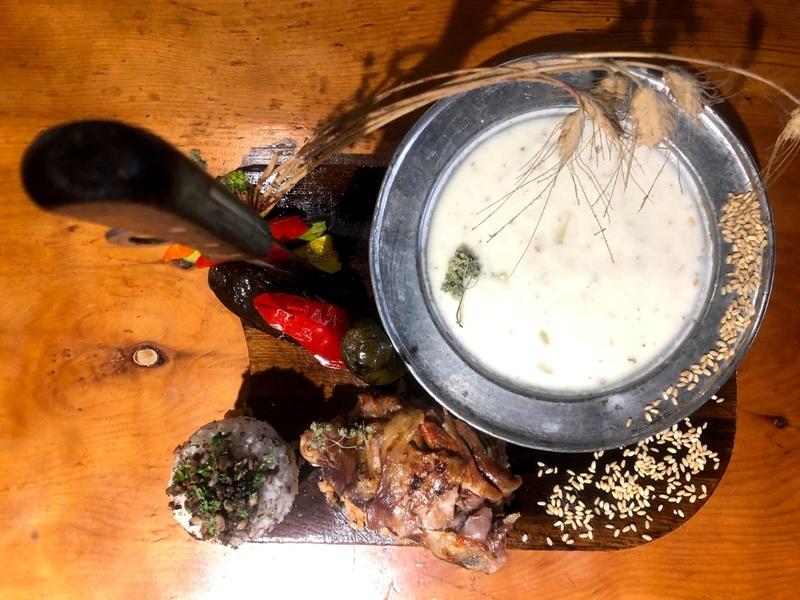
Diyarbakır Lebenisi (Diyarbakır Governorate)
The Durum wheat is thoroughly washed and soaked. Water is added to the yogurt in a one-to-one ratio to achieve the consistency of ayran. The soaked dövme is then mixed with the ayran in the same pot and cooked together. Once boiling begins, the boiled chickpeas are added. Near the end of cooking, the cleaned leaves of yarpuz are introduced and the mixture is simmered further to allow the yarpuz aroma to infuse into the dish. Diyarbakır lebenisi is served hot.
Diyarbakır lebenisi was officially registered as a geographical indication on 11 October 2021 under number 916. The application for registration was submitted by the Diyarbakır Chamber of Commerce and Industry, and the geographical boundary of the product is limited to Diyarbakır province. The yogurt and Durum wheat used in production are preferably sourced from within this geographical boundary. Sheep’s milk is typically used for yogurt production. The yarpuz plant imparts the characteristic flavor and aroma to the dish. Local practices in the production method distinguish Diyarbakır lebenisi from similar soup varieties.
Monitoring is conducted by a control board consisting of at least three members, coordinated by the Diyarbakır Chamber of Commerce and Industry and with participation from the Diyarbakır Provincial Directorate of Agriculture and Forestry. Monitoring is carried out at least once per year. Additional inspections may be conducted upon complaint or when deemed necessary. During inspections, the ingredients, production method, and compliance with the geographical indication label are evaluated. Expert assistance from specialized individuals or institutions may be obtained when required.
Diyarbakır Kent Tanıtım Portalı. "Diyarbakır Lebenisi." Accessed July 7, 2025. https://diyarbakir.org.tr/diyarbakir-lebenisi/.
Diyarbakır Valiliği. "Diyarbakır Lebenisi." Accessed July 7, 2025. http://www.diyarbakir.gov.tr/diyarbakir-lebenisi.
Turk Patent and Trademark Office. "Diyarbakır Lebenisi - Coğrafi İşaret Bilgisi." Accessed July 7, 2025. https://ci.turkpatent.gov.tr/cografi-isaretler/detay/2475.
Turk Patent and Trademark Office. "Diyarbakır Lebenisi - Tescil Belgesi (PDF)." Accessed July 7, 2025. https://ci.turkpatent.gov.tr/Files/GeographicalSigns/b3e379f6-8fcf-4ddf-b6a5-517a9a9817be.pdf.

Origin(s) | Diyarbakır Türkiye | ||||||||
|---|---|---|---|---|---|---|---|---|---|
Registration Type | Mahreç İşareti | ||||||||
Registration Number | 916 | ||||||||
Registration Date | 11 October 2021 | ||||||||
Applicant/Registrant(s) | Diyarbakır Chamber of Commerce and Industry | ||||||||
Basic Materials | Yogurt, Durum Wheat (Dövme), Chickpea, Yarpuz | ||||||||
Service Method | Hot Service | ||||||||
Distinctive Characteristics
Production Method
Ingredients (for 6 servings)
Preparation
Geographical Indication Information
Monitoring