This article was automatically translated from the original Turkish version.
Type of Geographical İndication | Mahreç Sign | ||||||||
|---|---|---|---|---|---|---|---|---|---|
Registration Number | 856 | ||||||||
Registration Date | 20.08.2021 | ||||||||
Product / Product Group(s) | Meals and soups | ||||||||
Province(s) | Diyarbakır | ||||||||
Applicant/Registrant(s) | Diyarbakır Chamber of Commerce and Industry | ||||||||
Diyarbakır içli köftesi is a traditional dish unique to the city of Diyarbakır in Türkiye’s Southeastern Anatolia Region, officially registered with a geographical indication. This product was registered on 20 August 2021 under Law No. 6769 on Industrial Property and is one of the defining elements of Diyarbakır cuisine.
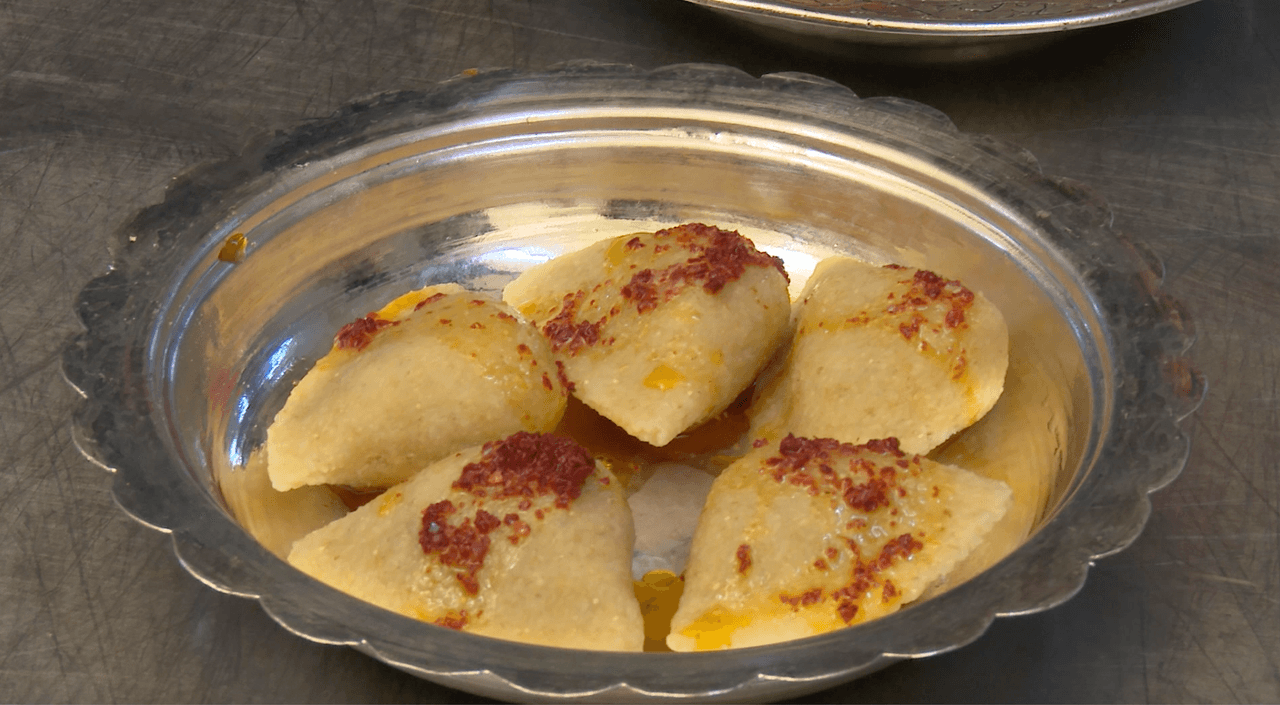
Diyarbakır içli köftesi is prepared using fine bulgur made from durum wheat, Diyarbakır-specific dövme ufağı (simindirik), meat from one-year-old lambs of the Karakaş breed, and various spices. The use of anise in the outer casing is a distinctive feature that sets this köfte apart from other types of içli köfte. The köfte is cooked by boiling and served hot; it can be accompanied by yogurt and topped with butter infused with tomato paste or red pepper flakes, according to preference.
The main ingredients—fine bulgur, lamb meat, and pepper paste—are sourced within the boundaries of Diyarbakır province. The dövme ufağı is produced by boiling and drying durum wheat grown in Diyarbakır, followed by pounding to separate the husk and grinding it into fine particles.
The outer casing is made by mixing fine bulgur and dövme ufağı with cumin, red pepper flakes, anise, and salt, then moistening the mixture with water at approximately 30°C. The mixture is kneaded until it softens into a dough-like consistency and left to rest.
The filling begins with browning medium-fat lamb mince. Then, clarified butter and finely chopped onions are added and the browning process continues. It is completed with the addition of pepper paste, black pepper, salt, and finely chopped parsley.
The köfte is shaped using the palm and thumb: a walnut-sized piece of outer casing is hollowed inward, filled with the preparation, and sealed so that the top is flat and the bottom is rounded. To prevent splitting during boiling and to enhance shine, the köftes are cooked in water with added salt and lemon juice. The köftes are considered cooked when they rise to the surface of the water.
The reputation of Diyarbakır içli köftesi is directly tied to Diyarbakır province. All stages of production must take place within this geographical boundary to preserve the product’s cultural and technical uniqueness.
To ensure the protection of the product under the geographical indication system and compliance with established standards, monitoring is carried out under the coordination of the Diyarbakır Chamber of Commerce and Industry. The monitoring body consists of representatives from the Diyarbakır Provincial Directorate of Agriculture and Forestry, Dicle University, Diyarbakır Metropolitan Municipality, and Diyarbakır Chamber of Commerce. Monitoring is conducted at least once a year and may be carried out at any time upon complaint or need. During the monitoring process, checks are performed on ingredient suitability, adherence to production methods, and proper use of the indication.
Turk Patent and Trademark Office. "Diyarbakır İçli Köftesi." Geographical Indications Portal. Accessed October 23, 2025. https://ci.turkpatent.gov.tr/cografi-isaretler/detay/2472.
Turkish Patent and Trademark Office. *Diyarbakır İçli Köftesi Geographical Indication Registration Certificate, No: 856*. August 20, 2021. Accessed October 23, 2025. https://ci.turkpatent.gov.tr/Files/GeographicalSigns/05ba5c93-10c4-46a6-9f04-5fac9ad5f46c.pdf.

Type of Geographical İndication | Mahreç Sign | ||||||||
|---|---|---|---|---|---|---|---|---|---|
Registration Number | 856 | ||||||||
Registration Date | 20.08.2021 | ||||||||
Product / Product Group(s) | Meals and soups | ||||||||
Province(s) | Diyarbakır | ||||||||
Applicant/Registrant(s) | Diyarbakır Chamber of Commerce and Industry | ||||||||
No Discussion Added Yet
Start discussion for "Diyarbakır İçli Köftesi" article
Definition and Distinctive Characteristics
Production Method
Geographical Link and Production Boundary
Monitoring Mechanism