


This article was automatically translated from the original Turkish version.
Divide and Conquer algorithms are an approach that solves a large problem by breaking it down into smaller smaller subproblems. These algorithms typically consist of three stages:
This method is effectively used in many computer science problems such as sorting, searching, matrix multiplication, and optimal route calculations like.
The most basic method for finding the largest element in an array is a double-loop comparison with O(n²) complexity. However, using the Divide and Conquer algorithm, this operation can be performed with O(n log n) or even O(log n) time complexity.
Finding the maximum element using two nested loops requires comparing each element with all others:
This method is inefficient because each element is unnecessarily compared multiple times.
The core idea of finding the maximum element using the Divide and Conquer algorithm is to recursively divide the array into halves to determine the largest element. This method is expressed by the recurrence relation T(n) = 2T(n/2) + O(1) and has O(n) time complexity.
A similar algorithm can be used to find the minimum element. In this case, the minimum element from each subarray is returned instead of the maximum to reach the final result.
The Merge Sort Algorithm is a stable and efficient sorting algorithm that uses the Divide and Conquer strategy. The fundamental working principle of the algorithm is as follows:
This process continues until the array is broken down into single-element subarrays, after which the subarrays are sorted and merged.
The Merge Sort Algorithm follows these steps:
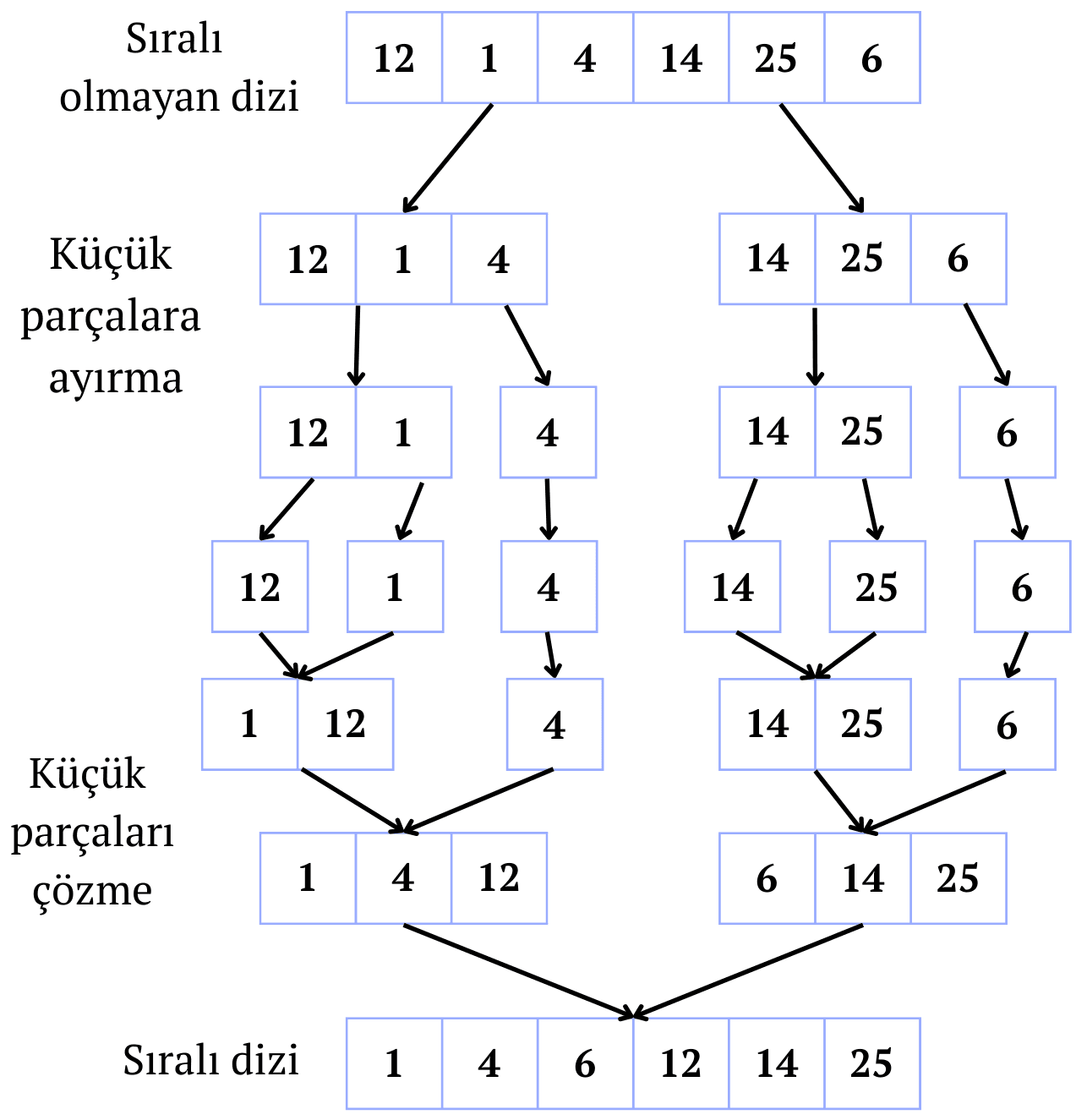
Example of Merge Sort Algorithm steps
One of the most important features of the Merge Sort Algorithm is that it has O(n log n) time complexity in all cases.
The space complexity is O(n), as it requires additional memory during the merge phase. Therefore, Merge Sort is generally suitable for large data sets where in-place sorting is not required.
Merge Sort is a sorting algorithm that operates on the Divide and Conquer principle. To understand its time complexity, two key stages must be examined.
The Merge Sort Algorithm divides the array into two halves at each step.
This process continues until only single elements remain. When an array is repeatedly halved, this process reaches a depth of log N.
For example:
If the array has 8 elements, the division steps are as follows:
Therefore, the divide phase takes O(log N) time.
After the division is complete, each subarray is sorted and merged.
A total of O(N) operations are performed at every level.
Merge Sort is widely used in applications requiring large data sets and stable sorting:
C++ Reference. (n.d.). *std::vector*. Accessedhttps://cplusplus.com/reference/vector(Vektör kütüphanesi fonksiyonları ve kullanımı)
Cormen, T. H., Leiserson, C. E., Rivest, R. L., and Stein, C. (2009). Introduction to Algorithms (3rd ed.). The MIT Press. pp. 30-39
Dasgupta, S., Papadimitriou, C. H., and Vazirani, U. (2006). Algorithms. McGraw-Hill. pp. 54-57
GeeksforGeeks. (n.d.). Introduction to Divide and Conquer Algorithm.Accessed
GeeksforGeeks. (n.d.). Merge Sort Algorithm. Accessed.https://www.geeksforgeeks.org/merge-sort/
Sedgewick, R., and Wayne, K. (2011). Algorithms (4th ed.). Addison-Wesley. pp. 270-280
Stanford University Lecture Notes. (n.d.). *Sorting and Divide & Conquer Algorithms.* pp. 20–70.

No Discussion Added Yet
Start discussion for "Divide and Conquer Algorithm: Merge Sort" article
Finding the Maximum Element Using the Divide and Conquer Algorithm
Classic Method: O(n²) Complexity
Finding the Maximum Using the Divide and Conquer Algorithm: O(n) Complexity
Merge Sort Algorithm
Working Principle of the Merge Sort Algorithm
Merge Sort Algorithm in C++
Time and Space Complexity of the Merge Sort Algorithm
Why Is the Time Complexity of Merge Sort O(N log N)?
1. Divide Phase (Divide) - O(log N)
2. Merge Phase (Merge) - O(N)
Advantages and Disadvantages of Merge Sort
Advantages
Disadvantages
Applications of Merge Sort