This article was automatically translated from the original Turkish version.
+1 More
Geographical Boundary | Burdur Province | ||||||||
|---|---|---|---|---|---|---|---|---|---|
Type of Geographical Indication | Mahreç Sign | ||||||||
Registration Date | 30.10.2020 | ||||||||
Application Date | 03.10.2019 | ||||||||
Registration Number | 585 | ||||||||
Product / Product Group(s) | Other products | ||||||||
Applicant/Registrant(s) | Altınyayla Subprovince | ||||||||
Dirmil Sipsisi is a traditional wind instrument unique to the Altınyayla district of Burdur, made from reeds known locally as "demir kargı". This instrument has distinctive features including a mouthpiece made of a thinner reed, with five holes on the top and one on the bottom. The mouthpiece section is also locally referred to as "cukcuk".
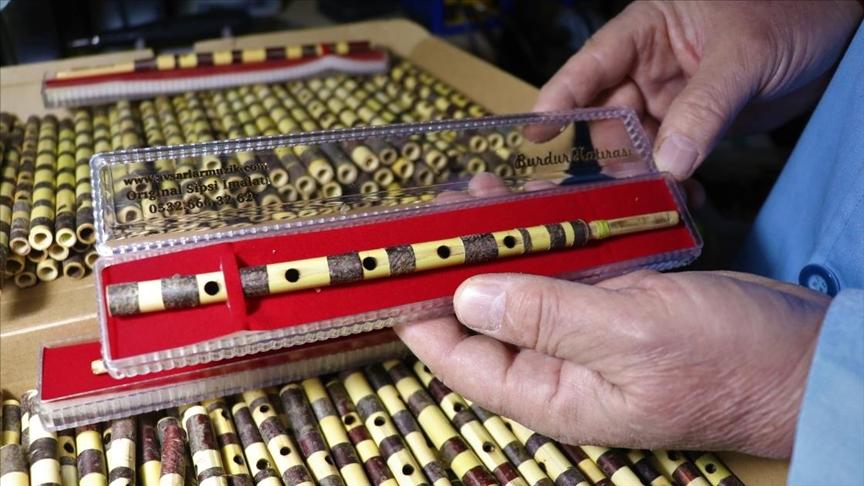
Image of Dirmil Sipsisi (Anadolu Agency)
Owing to its physical structure, the Dirmil Sipsisi can produce eight distinct tones in sequence. Depending on the skill of the craftsman and the pressure applied, this number can increase up to twelve tones. Local folk songs are typically performed using the Dirmil Sipsisi. Another important feature of the instrument is the ring used both to add decorative patterns and to prevent the reed from cracking, which is made from the bark of the "ala eğri ağacı" tree native to the region.
The main materials used in the production of the Dirmil Sipsisi are as follows:
The production process begins by cutting a reed to approximately 17 cm in length. Using a heated iron rod, the first hole is drilled 3 cm below the top end, followed by four additional holes spaced 2.5 cm apart. The bottom hole is drilled 2 cm above the tip using the same method. After drilling, the interior of the reed is cleaned with the cleaning rod.
Next, rings made from ala eğri ağacı bark are inserted: two at a distance of 2.5 cm between the first and second holes, two at 2 cm intervals between the remaining holes, and one at 3 cm between the fifth hole and the end of the instrument. These rings serve both to decorate the instrument and to prevent the reed from cracking.
The mouthpiece is approximately 4 cm long and has a diameter of 0.3–0.5 mm. It is cut horizontally to a length of 3 cm at the top to enable sound production through vibration. After cleaning, the mouthpiece is fitted into the main body and wrapped at its base with durable cotton thread. This process secures the tuning and prevents the vibrating section from breaking.

Image of Dirmil Sipsisi (Anadolu Agency)
The Dirmil Sipsisi was registered as a geographical indication on 30 October 2020 under Law No. 6769 on Industrial Property. The application date was 3 October 2019, and the registration number is 585. The registering authority is the Altınyayla District Governorship. The geographical boundary of the product is limited to the Altınyayla district of Burdur Province. The Dirmil Sipsisi has been produced for many years by local artisans and is closely associated with the region. Therefore, all stages of production must take place within the Altınyayla district of Burdur Province.
Monitoring of the Dirmil Sipsisi is carried out by a three-member oversight body composed of one representative each from the Altınyayla District Governorship, the Altınyayla Craftsmen and Artisans Chamber, and the Altınyayla Public Education Center, coordinated by the Altınyayla District Governorship. The oversight body verifies the distinguishing features of the produced Dirmil Sipsisi instruments, the materials used in production, and the production stages.
Inspections are conducted annually or as needed, and may be carried out at any time in response to complaints. Reports on inspections are regularly submitted to the Turkish Patent and Trademark Office. The oversight body may consult expert individuals or legal entities or procure services during inspections. The registering authority is responsible for managing legal procedures.
Anadolu Ajansı. "Yörük Çalgısı Sipsi Coğrafi İşaret Aldı." Accessed July 15, 2025. https://www.aa.com.tr/tr/kultur-sanat/yoruk-calgisi-sipsi-cografi-isaret-aldi/2062707
Anadolu Ajansı. “Yöresel Çalgı Sipsi ile Düğün, Şenlik ve Festivallerde Sahne Alıyor.” Accessed July 15, 2025. https://www.aa.com.tr/tr/yasam/yoresel-calgi-sipsi-ile-dugun-senlik-ve-festivallerde-sahne-aliyor/3295284
Turk Patent and Trademark Office. "Sipsi Sicil Belgesi." Coğrafi İşaretler Portalı. Accessed July 15, 2025. https://ci.turkpatent.gov.tr/Files/GeographicalSigns/59eb8116-dd89-4842-8a04-fa3764738ddc.pdf
Turkish Patent and Trademark Office. "Sipsi." *Geographical Indications Portal*. Accessed July 15, 2025. https://ci.turkpatent.gov.tr/cografi-isaretler/detay/1062

Geographical Boundary | Burdur Province | ||||||||
|---|---|---|---|---|---|---|---|---|---|
Type of Geographical Indication | Mahreç Sign | ||||||||
Registration Date | 30.10.2020 | ||||||||
Application Date | 03.10.2019 | ||||||||
Registration Number | 585 | ||||||||
Product / Product Group(s) | Other products | ||||||||
Applicant/Registrant(s) | Altınyayla Subprovince | ||||||||
Distinguishing Features
Production Method
Geographical Indication Registration
Monitoring