This article was automatically translated from the original Turkish version.
+2 More
Excavation Methodology | Horizontal/planimetric excavation system | ||||||||
|---|---|---|---|---|---|---|---|---|---|
Period(s) | Epipaleolithic Period | ||||||||
Cave Structure | 13 meters wide, 15 meters high, an oval entrance | ||||||||
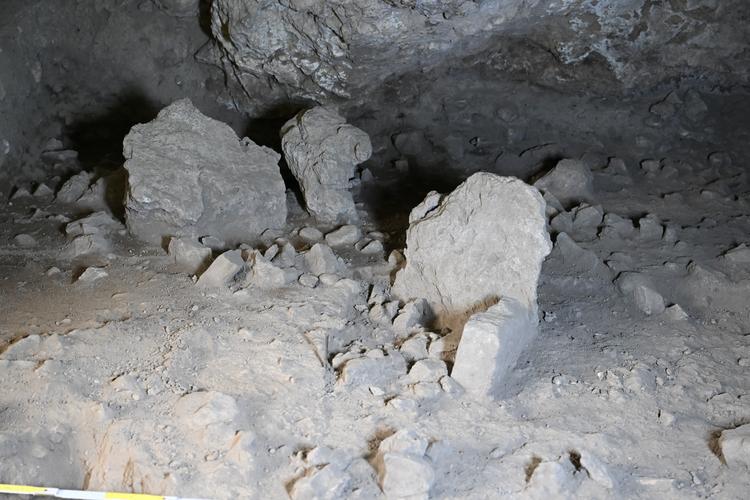
Direkli Cave is an archaeological site located in the Döngel Village of the Onikişubat District in Kahramanmaraş. The cave, which consists of a single chamber, is situated at an elevation of 1510 metres above sea level in a narrow valley on the southern slope of Delihöbek Mountain. It has an oval entrance measuring 13 metres in width and 15 metres in height, facing south.【1】
The cave was first introduced to the scientific community in 1959 through drilling studies conducted by Professor Dr. İsmail Kılıç Kökten. Revisited in 2006 as part of surface surveys in the region, systematic excavations were initiated in 2007 under the direction of the Kahramanmaraş Museum Directorate due to the rich surface finds. Since 2010, excavations have continued uninterrupted under the authority of a Council of Ministers decision, and since 2018, they have been conducted under the status of a Presidential Decree.
In Direkli Cave, a method known as the “horizontal/planimetric excavation system” is applied. In this method, each 10 cm archaeological layer is excavated in 3-3-4 cm strata within a one square metre area. The coordinates of all finds are recorded, and the sediments obtained are subjected to wet sieving through sieves of varying mesh sizes to perform micro-removal.
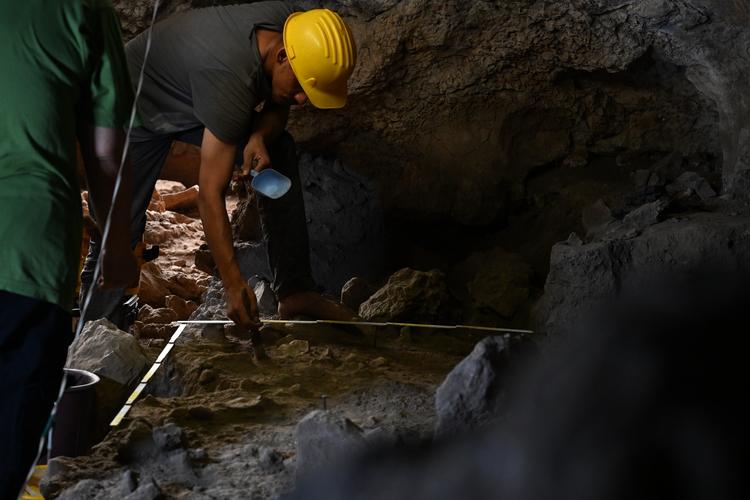
Excavation Work at Direkli Cave (Anadolu Agency)
The excavations at Direkli Cave are of great importance for understanding the cultural structure and lifestyle of the Epipaleolithic period. In the cave, beads made of stone, bone and marine shells have been uncovered, demonstrating that the people of this era placed importance not only on hunting and subsistence but also on personal adornment.
To date, numerous artifacts have been discovered, including remains from the Paleolithic period, a major goddess figure, agricultural tools, burials, and 13,000-year-old bone needles. Recently, a fifth burial in a rectangular shape was uncovered during excavations. Wild goat bones and horns found at the site indicate that the inhabitants of Direkli Cave had direct connections between the Caucasus and Anatolia.
Evidence has been found regarding the spatial organization of life by Epipaleolithic people. Within the cave, hearths, burials and circular structure traces have been identified. In excavations carried out between 2019 and 2020, a human jawbone was also discovered.
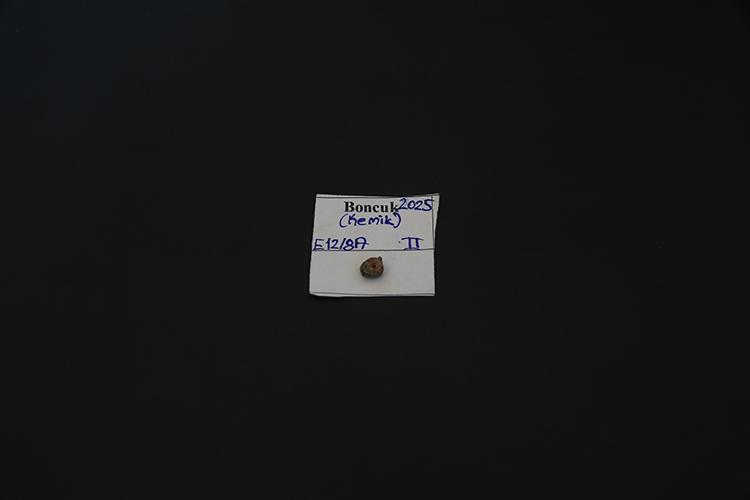
Wild Goat Bones and Beads Found During Excavations (Anadolu Agency)
Anadolu Ajansı. "Direkli Mağarası'nda Epipaleolitik Dönem'e ait süs boncukları bulundu." Accessed September 26, 2025. https://www.aa.com.tr/tr/kultur/direkli-magarasinda-epipaleolitik-doneme-ait-sus-boncuklari-bulundu/3698492
Anadolu Ajansı. "Kahramanmaraş'ta Direkli Mağarası'ndaki kazılarda 5. mezara ulaşıldı." Accessed September 26, 2025. https://www.aa.com.tr/tr/kultur/kahramanmarasta-direkli-magarasindaki-kazilarda-5-mezara-ulasildi/3663280
Erek, Cevdet Merih, Iraz Aslı Yaman, and Umutcan Doğan. "Direkli Mağarası Kazıları 2019-2020." ResearchGate. Accessed September 26, 2025. https://www.researchgate.net/publication/366877875_Direkli_Magarasi_Kazilari_2019-2020
Erek, Cevdet Merih. “Direkli Mağarası Epi-paleolitik Dönem Yaşamsal Alan Düzenlemeleri Üzerine Bir Değerlendirme”. Seleucia, no. 7 (January 2017): 367–396. Accessed September 26, 2025. https://dergipark.org.tr/tr/pub/seleucia/issue/54869/751484
[1]
Erek, Cevdet Merih, Iraz Aslı Yaman, ve Umutcan Doğan, "Direkli Mağarası Kazıları 2019-2020." ResearchGate. syf 6. Erişim 26 Eylül 2025. https://www.researchgate.net/publication/366877875_Direkli_Magarasi_Kazilari_2019-2020

Excavation Methodology | Horizontal/planimetric excavation system | ||||||||
|---|---|---|---|---|---|---|---|---|---|
Period(s) | Epipaleolithic Period | ||||||||
Cave Structure | 13 meters wide, 15 meters high, an oval entrance | ||||||||
History and Methodology of Excavations
Excavation Finds and Cultural Evaluation