


This article was automatically translated from the original Turkish version.
Henry Kissinger’s book Diplomacy is a comprehensive work that sheds light on the history of international relations. Kissinger approaches diplomacy from a historical perspective, examining the struggle for power among states, conflicts of interest, and the pursuit of international balance. By integrating his own experiences with historical events, he provides readers with both theoretical and practical understanding. While explaining the historical origins of diplomacy and its impact on modern international relations, the book serves as a fundamental source capable of offering profound insight into global policy.
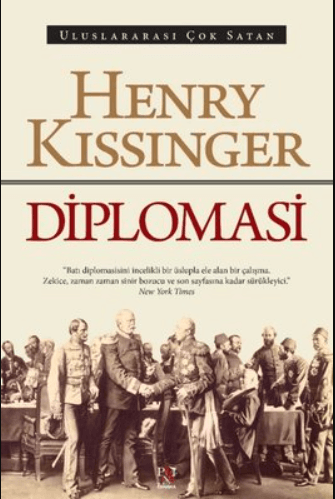
Diplomacy
Kissinger provides a comprehensive framework for understanding the dynamics of international relations by thoroughly examining the historical foundations of diplomacy. The author marks the Peace of Westphalia (1648) as the beginning of modern diplomacy and explains how the concept of the balance of power evolved during this period. He analyzes the principles underlying relations between states since antiquity and the different approaches various cultures took toward diplomacy. According to Kissinger, diplomacy is not merely a tool for achieving peace but also a fundamental instrument for safeguarding state interests.
One of the book’s central themes is the pivotal role of the balance of power theory in international relations. Kissinger supports this with historical examples, demonstrating how the balance of power effectively maintained international peace and stability. He elaborates on the Realpolitik approach that formed the foundation of 19th century European diplomacy. Realpolitik refers to a political strategy in which states prioritize national interests over ideological values, adopting a power-centered approach. Kissinger thoroughly discusses both the positive and negative effects of this perspective on the international system.
Kissinger views the Cold War era as a critical turning point in international relations. During this period, the ideological conflict between the United States and the Soviet Union, along with their strategic pursuit of balance, increased the complexity of diplomacy. Kissinger examines in detail détente policies, nuclear deterrence strategies, and relations between the blocs. He also highlights how this era laid the groundwork for the transition to a multipolar world order.
The book examines how modern diplomacy has transformed alongside globalization. The development of global trade, technology, and communication tools has reshaped the way nation-states understand diplomacy. Kissinger emphasizes how growing economic interdependence has made international cooperation a necessity. He also discusses how modern diplomacy must adapt to address new threats such as terrorism, climate change, and cyber security.
Kissinger analyzes diplomacy both within a historical context and a theoretical framework, offering readers a deep analysis. He emphasizes that diplomacy is not only a means of resolving conflicts of interest but also a tool for achieving international peace. The book also addresses the ethical dimensions of diplomacy, questioning the balance between power and moral values.
Henry Kissinger’s book Diplomacy is a work that offers a broad perspective on international relations and diplomacy. This book, which analyzes historical events and provides insights capable of shaping future policies, can be regarded as a foundational source in the field of diplomacy. Kissinger draws lessons from past mistakes and underscores the importance of charting a new course for international relations.
Kissinger, Henry. Diplomasi. Translated by Elif Berktaş, Panama Yayıncılık, 2022.

Content of the Book
The Historical Development of Diplomacy
Balance of Power and Realpolitik
The Cold War and Bloc Diplomacy
Globalization and the Transformation of Modern Diplomacy
A Theoretical and Practical Approach to Diplomacy