


This article was automatically translated from the original Turkish version.
+1 More
Dejavu , a French-origin term (French: déjà vu) meaning “already seen.” It is characterized by the individual’s feeling that a current experience has been lived before, although this feeling is not based on any actual past experience. Dejavu is a subjective recognition phenomenon that includes the sense of familiarity with the experience, the awareness that this familiarity is logically incorrect, and the inability to clearly recall a prior memory. According to V. M. Neppe’s 1983 definition, dejavu is described as “the subjective impression of familiarity of a current experience with an indistinct past.” The phrase “subjectively inappropriate” in this definition emphasizes the unusual and logically inexplicable nature of the experience.
Dejavu is not limited to visual perception; it is a holistic experience encompassing thoughts, emotions, perceptions, and cognitive processes. Phenomena that may be confused with dejavu include jamais vu (an inappropriate sense of unfamiliarity toward a previously experienced situation), flashbacks, depersonalization, and misreported everyday dejavu experiences. In some individuals, dejavu occurs as a brief and self-limiting phenomenon, while in others it may appear more intensely and recurrently in association with neurological or psychiatric conditions.
Dejavu-Themed Illustration (Generated by Artificial Intelligence).
Dejavu has been described and interpreted in various ways throughout history. Around 400 AD, St. Augustine referred to it as “falsae memoriae”. Its first recognition in modern psychiatry occurred in 1844 when Arthur Ladbroke Wigan described it as the “sense of having previously experienced” something. The term dejavu was introduced into the literature in 1896 by F. L. Arnaud. The phenomenon also appears in literature and poetry; authors such as Sir Walter Scott, Charles Dickens, Leo Tolstoy, Marcel Proust, Thomas Hardy, and Joseph Heller have depicted dejavu experiences in their works, using the phenomenon to reflect characters’ psychological states.
The temporal lobe plays a key role in memory and sensory processing. In particular, the medial temporal lobe (MTL), which includes the hippocampus, parahippocampal gyrus, and rhinal cortex (entorhinal and perirhinal cortex), is critical for memory formation and retrieval. The parahippocampal gyrus and rhinal cortex are involved in generating the sense of familiarity, while the hippocampus is associated with the recall of contextual details. Electrical stimulation studies in patients with temporal lobe epilepsy (TLE) have shown that stimulation of the rhinal cortex can trigger dejavu experiences. These findings suggest that transient and mild neural activity fluctuations in healthy individuals may also produce dejavu.

Human Brain (Anadolu Ajansı)
Dejavu has been linked to a disruption in the coordination between familiarity and recall processes. When the parahippocampal cortex generates a sense of familiarity but the hippocampus fails to retrieve contextual details, the individual perceives the current situation as familiar yet cannot recall any prior experience. This phenomenon is commonly observed as a pre-ictal aura in patients with TLE.
Recognition memory consists of two distinct processes: familiarity and recollection. Dejavu arises when the synchronization between these processes is temporarily disrupted. The individual experiences a sense of familiarity without being able to recall contextual details. This model explains dejavu as a transient mismatch between familiarity and contextual recollection.
An individual may experience dejavu when a current environment resembles a past experience, even if the past experience is not consciously remembered; this is known as gestalt familiarity. The parahippocampal gyrus plays a critical role in processing spatial and contextual information. Virtual reality experiments have shown that scenes with similar spatial arrangements increase reports of dejavu. Unconscious memory activation may also contribute to dejavu; elements of previously experienced but forgotten events can overlap with the current situation, triggering a sense of familiarity.
Proposed by Akira O’Connor, this theory suggests that the medial prefrontal cortex detects a conflict between the familiarity signal from the temporal lobe and the absence of a corresponding real memory. This conflict gives rise to the dejavu experience.
Brief lapses in attention or delayed processing of sensory information may cause the same experience to be perceived twice, creating the sensation of having already experienced it. This phenomenon is explained by perceptual doubling or divided perception theories.
Sigmund Freud interpreted dejavu as the resurgence of repressed fantasies, linking it to the individual’s desire to improve their current situation. Oberndorf viewed dejavu as a psychological defense mechanism providing reassurance from past experiences. Some psychoanalysts define dejavu as a waking dream or a daytime dream residue.
Studies by Penfield and Halgren demonstrated that electrical stimulation of the temporal lobe and limbic structures can induce a “dreamy state” similar to dejavu. Bancaud and colleagues proposed a tripartite model in which the hippocampus and amygdala play primary roles, while the temporal neocortex plays a secondary role. Gloor emphasized that the limbic system and parallel cortical networks encode experiences, highlighting the importance of the spatial pattern of activation.【1】
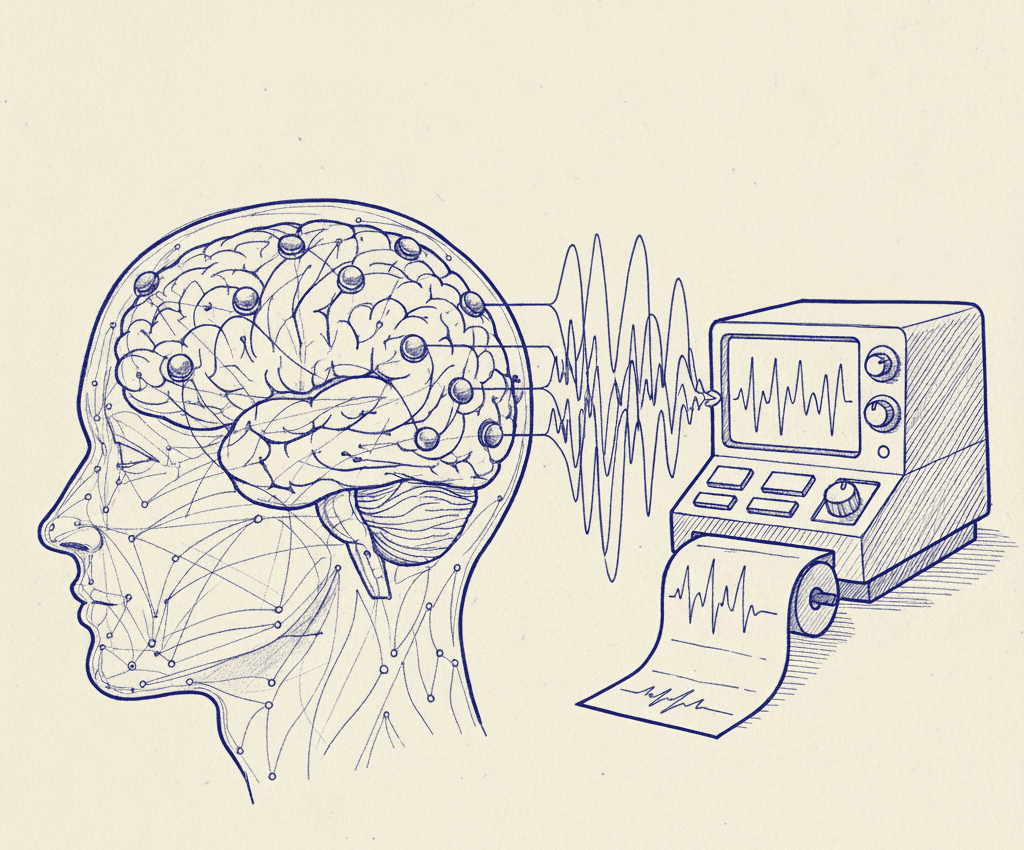
Visualization of EEG (Generated by Artificial Intelligence).
Positron emission tomography studies have shown reduced glucose metabolism in the medial temporal and parietal cortices during dejavu episodes in patients with temporal lobe epilepsy. Temporal lobe dysfunction is necessary but not sufficient to explain dejavu, and lateralization has limited diagnostic value.【2】
Autosomal Dominant Lateral Temporal Epilepsy (ADLTE) is a focal epilepsy syndrome associated with mutations in the LGI1 gene. In ADLTE patients, dejavu may occur as a pre-ictal or isolated seizure symptom. The LGI1 gene plays a role in brain development and function but is not specific to dejavu. Genetic studies offer potential insights into the neurochemical basis of dejavu.
Dejavu is a common phenomenon in the general population and can occur both in association with neurological and psychiatric conditions and as part of normal neuropsychiatric functioning. Research indicates that between 31% and 96% of healthy individuals have experienced dejavu. Younger age, higher education level, and certain socioeconomic factors may increase the frequency of dejavu, while no significant association has been found with gender or race. Dejavu alone does not indicate pathology; the non-pathological form is brief, rapidly onset, and accompanied by full awareness. The pathological form is prolonged, slowly onset, and associated with impaired awareness. It may be linked to temporal lobe epilepsy or certain psychiatric disorders.【3】
Anadolu Ajansı. "Psikiyatrik Tedavide 'Beyin Check-up'ı Dönemi." Accessed November 14, 2025.https://www.aa.com.tr/tr/saglik/psikiyatrik-tedavide-beyin-check-upi-donemi/677687
Cleary, Anne M., Anthony J. Ryals, and Jason S. Nomi. "Can Déjà vu Result from Similarity to a Prior Experience? Support for The Similarity Hypothesis of Déjà vu." *Psychonomic Bulletin & Review* 16, no. 6 (2009): 1082-1088. Accessed November 14, 2025.https://link.springer.com/article/10.3758/PBR.16.6.1082
Wild, Edward. "Deja vu in Neurology." *Journal of Neurology* 252, no. 1 (2005): 1–7. Accessed November 14, 2025.https://link.springer.com/article/10.1007/s00415-005-0677-3
Xu, Ziqin. "Exploring the Mechanisms of Déjà Vu: Neurological and Psychological Perspectives." *Transactions on Materials, Biotechnology and Life Sciences* 8. (2025): 149-154. Accessed November 14, 2025.https://tmbls.org/index.php/ojs/article/view/27
[1]
Wild, Edward. "Deja vu in Neurology." Journal of Neurology 252, no. 1. (2005): 3. Erişim 14 Kasım 2025. https://link.springer.com/article/10.1007/s00415-005-0677-3
[2]
Wild, Edward. "Deja vu in Neurology." Journal of Neurology 252, no. 1. (2005): 4. Erişim 14 Kasım 2025. https://link.springer.com/article/10.1007/s00415-005-0677-3
[3]
Wild, Edward. "Deja vu in Neurology." Journal of Neurology 252, no. 1. (2005): 5. Erişim 14 Kasım 2025. https://link.springer.com/article/10.1007/s00415-005-0677-3

History
Neurobiological Foundations
Temporal Lobe and Memory Functions
Parahippocampal Cortex Dysfunction
Psychological Theories
Dual-Process Recognition Model
Gestalt Familiarity and Unconscious Memory Activation
Memory Monitoring Theory
Attentional Disturbance and Perceptual Doubling
Psychodynamic Approaches
Neuroanatomy and Experimental Findings
Electrical Stimulation and Electroencephalography (EEG) Studies
Functional Imaging
Molecular Genetics
Clinical Significance