


This article was automatically translated from the original Turkish version.
Deconstructivism is an architectural style that emerged in the last quarter of the 20th century and introduced a critical approach to traditional design principles in architecture. This perspective rejects regular, symmetrical and predictable structural compositions, instead embracing fragmented, asymmetrical, discontinuous and contradictory forms. Rooted philosophically in the French thinker Jacques Derrida’s theory of “deconstruction”, deconstructivist architecture aims to deconstruct and reinterpret buildings at both formal and semantic levels.
Drawing on the formal diversity of postmodern architecture, this approach challenges the rigid rules and singular truth claims of modernism. Concepts such as chaos, fragmentation, void, tension and ephemerality come to the fore in architectural design. Architects such as Peter Eisenman, Bernard Tschumi, Zaha Hadid, Daniel Libeskind and Frank Gehry are among the leading representatives of deconstructivist thinking. This style is regarded not only as a formal innovation but also as a design practice that expresses critical thought within architecture.
The intellectual foundation of deconstructivist architecture rests on Derrida’s theory of deconstruction. This theory seeks to dismantle texts in order to reveal the underlying layers of meaning, and in architecture it similarly assumes that buildings possess a multilayered, analyzable meaning. Buildings are understood not to produce singular or fixed meanings but rather multiple and dynamic layers of interpretation.
This multilayered structure can also be compared to musical techniques such as counterpoint and fugue. In these musical forms, distinct themes intersect and overlap while simultaneously maintaining their independence, mirroring the chaotic yet organized compositions found in deconstructivist architecture. In this context, deconstructivism represents an approach that unites aesthetic experience with the analytical deconstruction of structure.
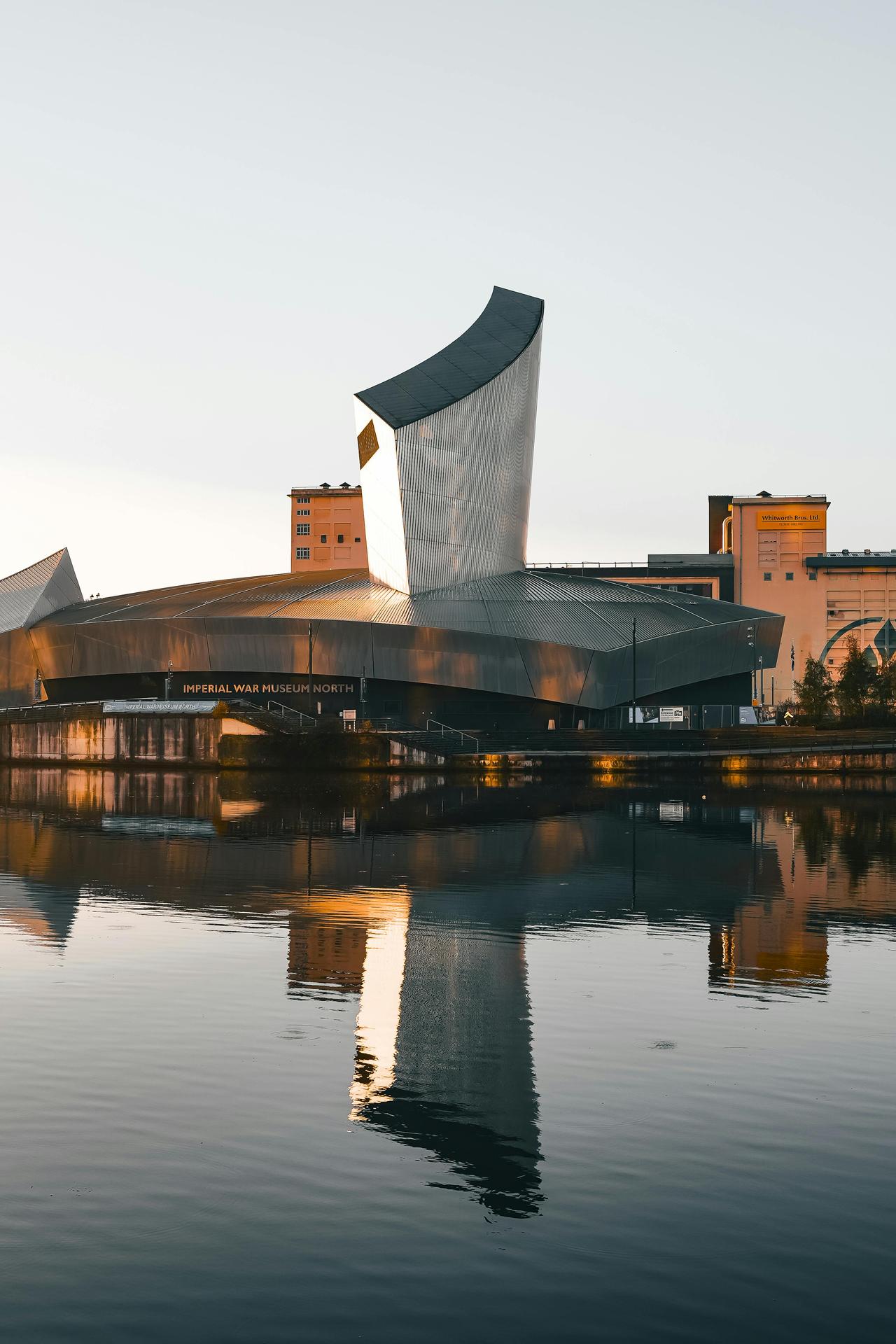
Imperial War Museum North Binası, Manchester, İngiltere (Pexels, Nathan J Hilton)
In deconstructivist buildings, geometric unity is deliberately disrupted. Straight lines, right angles, and vertical-horizontal distinctions give way to angular breaks, sharp turns, and non-organic forms that appear random. In structures such as Frank Gehry’s Vitra Design Museum and the Weisman Art Museum, architectural elements are arranged according to a kind of “collage” logic. Instead of architectural coherence, a deliberate sense of disarray and fragmentation dominates. This approach is not merely a visual preference but a method intended to deconstruct and reconstruct architectural narrative. Fragmented structural compositions are often analyzed through analogy with polyphonic and multilayered musical structures.
In deconstructivist architecture, the structural system is not treated merely as a technical solution but as an active element of design. Structural components are sometimes made visible or reinterpreted beyond conventional logic to assume a decisive role in the building’s visual and spatial expression. Cantilever elements are frequently employed to emphasize specific parts of the structure, construct without altering the topography, or establish a relationship with the landscape. High-strength and highly formable materials such as steel are preferred to meet the complex formal demands of deconstructivist buildings.
Deconstructivist architecture is open to various interpretations beyond its formal solutions, particularly within an interdisciplinary context. One such interpretation draws parallels between architectural design and musical techniques such as fugue and counterpoint. In fugue and counterpoint, independent melodic lines develop simultaneously while forming a coherent whole. Similarly, in deconstructivist buildings, architectural elements such as plan, section and elevation are designed on different planes and in independent forms, yet they still achieve a balanced and structured spatial unity. This approach demonstrates that behind architectural chaos lies a deliberate composition and internal order.
One example of this approach is found in Frank Gehry’s designs. In Gehry’s projects, alternative formal solutions are developed in opposition to traditional concepts of mass and facade. Particularly the Guggenheim Museum Bilbao stands out as one of the leading examples of this approach, distinguished by its fragmented surfaces, metallic exterior, and complex spatial organization.
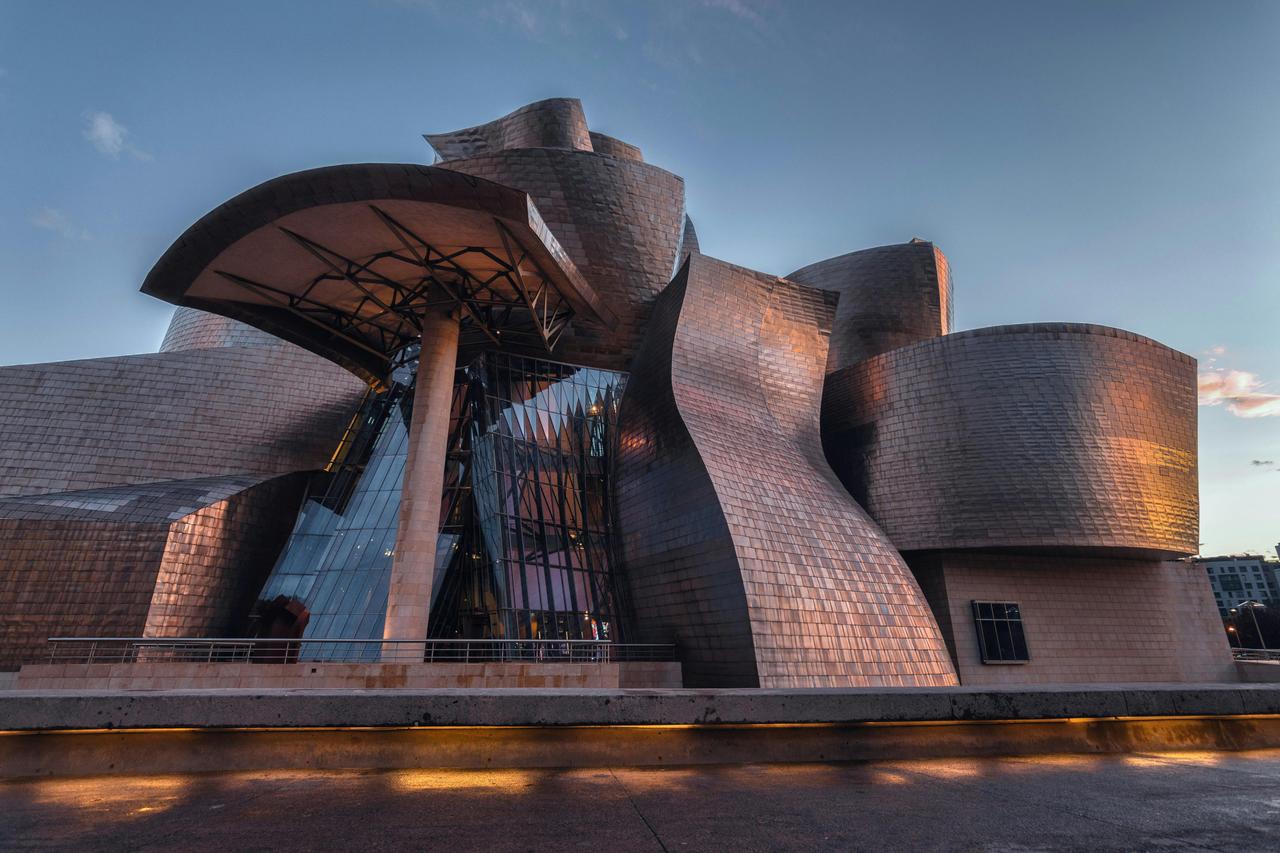
Guggenheim Bilbao Müzesi, Bilbao, İspanya (Pexels, Jesús Esteban San José)
While functionality is considered in Gehry’s designs, formal transformation takes precedence; the classical understanding of structural systems becomes an active component of visual and spatial expression. At the same time, Gehry’s cautious stance regarding direct association with the deconstructivist movement has provided a basis for discussion on the relationship between architectural movements and individual design practices.
Despite its emphasis on technical skill and formal creativity, deconstructivist architecture has faced various criticisms. Chief among these are accusations of disconnection from context, the marginalization of user experience, and the creation of radical ruptures with the surrounding environment. As exemplified by Gehry’s work, some buildings aim not to integrate with their surroundings but to generate new focal points and transform the context. Additionally, it is often noted that such buildings frequently encounter engineering challenges and make cost control difficult. Nevertheless, deconstructivism continues to represent the critical and experimental dimension of contemporary architectural discourse.
Gökşen, Fulya, Asena Soyluk, and İdil Ayçam. “Mimarlıkta Konsol Strüktürel Davranışın High-Tech ve Dekonstrüktivizm Akımlarında Yorumlanması.” *Middle East International Conference on Contemporary Scientific Studies-V*, Vol. III (March 2021): 93–96. Accessed May 31, 2025.https://atlasjournal.net/index.php/atlas/article/view/51/48
Mert, Beyza Nur. "Karmaşadaki Uyum: Mimarlıkta Dekonstrüktivist Yaklaşımın Müzikteki Kontrpuan & Füg Bağlamı Üzerinden İncelenmesi." Master's thesis, Mimar Sinan Güzel Sanatlar Üniversitesi, 2024. Accessed May 31, 2025.https://acikerisim.msgsu.edu.tr/xmlui/bitstream/handle/20.500.14124/7005/882474.pdf?sequence=1&isAllowed=y
Pexels. "Salford Rıhtımları Imperial War Museum at Sunset JPG." Accessed May 31, 2025.https://www.pexels.com/tr-tr/fotograf/salford-rihtimlari-imparatorluk-savas-muzesi-gun-batiminda-30675759/
Pexels. “Bilbao, Spain JPG.” Accessed May 31, 2025.https://www.pexels.com/tr-tr/fotograf/kent-sehir-kent-simgesi-gorulecek-yer-14638004/
Soyluk, Asena, and İzzettin Kutlu. “Dekonstrüktivizm Akımının Frank Gehry Örneklemi Üzerinden Mimarlar Üzerine Etkilerinin İncelenmesi.” *Atlas International Referred Journal on Social Sciences* 4, no. 8 (May 2018): 215–226. Accessed May 31, 2025.https://avesis.gazi.edu.tr/yayin/a25ed350-873b-499d-81fc-ee083c7ac802/mimarlikta-konsol-strukturel-davranisin-high-tech-ve-dekonstruktivizm-akimlarinda-yorumlanmasi

Theoretical Foundations and Conceptual Background
Formal Fragmentation and Spatial Composition
Structure and Material Use
Formal Fragmentation, Deconstruction and Interdisciplinary Interpretations
Contemporary Interpretations and Critiques