
This article was automatically translated from the original Turkish version.
Why Do We Always Get Fixated on Trivial Things?
Have you ever found yourself in this situation: a group of people gathers to make an important decision. For example, the company is switching to a new software system. Millions of dollars are at stake. Presentations are given, graphs and tables displayed... yet no one speaks up. Then someone suddenly says:
“By the way, should the system’s theme be blue or orange?”
And instantly the atmosphere comes alive. Everyone has an opinion. One person says blue feels calming, another says orange is energetic. The debate drags on and on.
It’s as if we’re choosing paint colors rather than software.
This seemingly absurd yet deeply human phenomenon has a name: Cubic Relationship or, more playfully, Bikeshedding.
The origin of this term is quite charming. The British writer Parkinson gives this example: A committee votes on a highly expensive and technical nuclear reactor project. Nobody says anything about the reactor itself because it is too complex. But then the project includes a bicycle shed.
Immediately everyone starts talking:
“Should the roof be green or blue?”
“How many bikes will it hold?”
“Isn’t this price too high?”
So the multi-million-dollar reactor goes unchallenged, while the $300 bicycle shed is debated for hours. Hence the name bikeshedding.
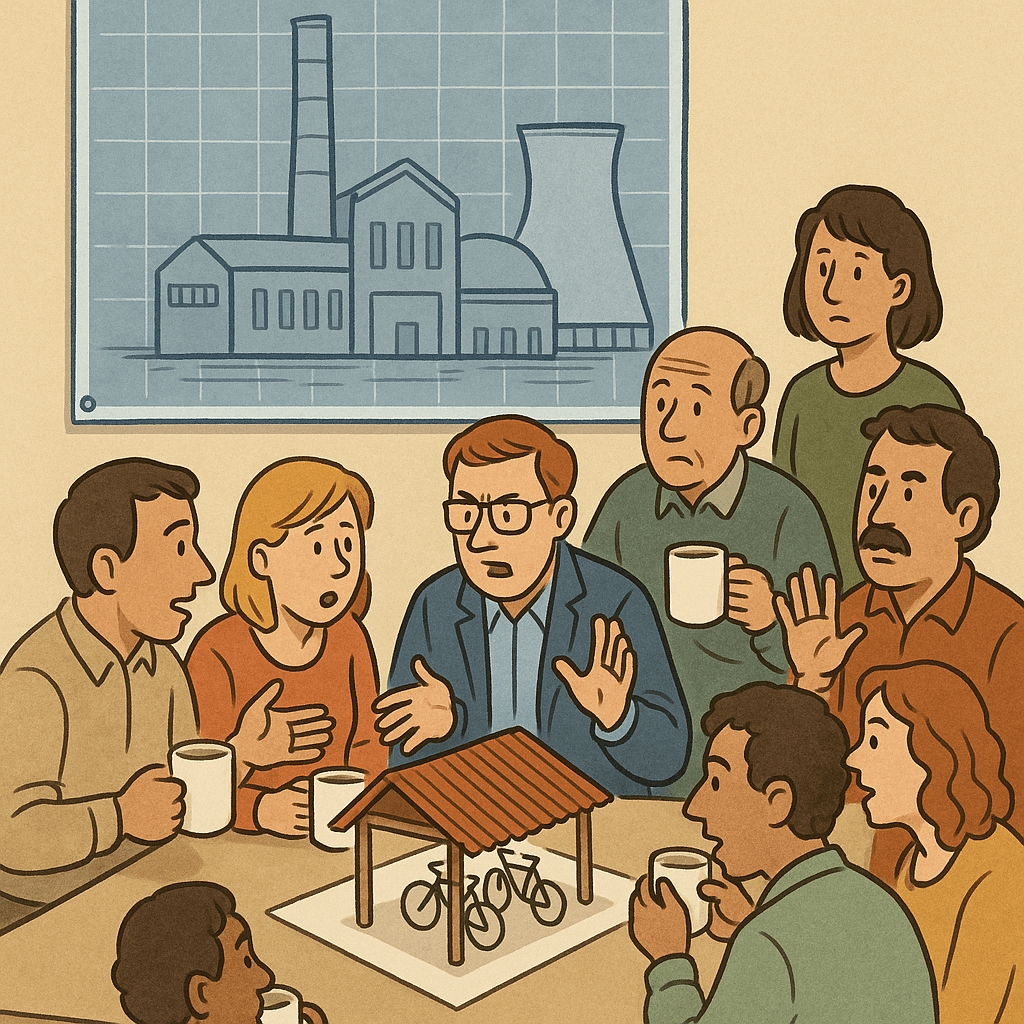
Bikeshedding (generated by Artificial Intelligence.)
Let’s turn inward for a moment. Why do we behave this way?
Faced with complex issues, we feel helpless. We fear saying something wrong. But when a small, simple detail is involved, it feels easier to voice an opinion.
Not everyone has an opinion on nuclear reactors. But “Should this coffee machine be filter-based or capsule-based?”? Everyone has something to say about that!
In meetings or group decisions, people want to participate. No one wants to appear passive. So they join the discussion on a point they understand and feel confident about.
Major decisions are stressful. Small details, however, are safe. Choosing a color, debating a font... these are comforting.
A management meeting discusses transitioning to a new digital infrastructure. Everyone is silent on technical matters. But if someone says the new system’s logo looks too bold... suddenly everyone’s eyes light up. “I noticed that too—it’s too italic.”
The meeting stretches on endlessly.
The family is moving to a new house. Rent, transportation, and schools are quietly overlooked. But a heated debate erupts over the carpet color. “Cream or beige? Patterned or plain?”
A graduation project is being prepared. The topic is difficult and everyone is stressed. But when it comes to “Which template should we use for the presentation?”, the room suddenly comes alive. Theme, transition effects, font...
A vacation is being planned. Hotel or guesthouse? Fine. Plane or bus? Okay.
But where will breakfast be served? Now everyone slams their fist on the table.
Consider this:
We have critical decisions ahead of us, yet we spend our energy, attention, and time on trivial details. This leads to several consequences:
So no matter how perfect the coffee machine is chosen, if the company’s infrastructure is collapsing, it hardly matters.
Cubic Relationship is something present in all of us. Seeking refuge in familiar, safe, simple things is a very human behavior.
But we must not forget:
Life is not just about choosing wall paint color or presentation themes. Real decisions can be difficult, complex, and even frightening. But if we avoid them, we only survive the day—not the future.
Build the building first. Then, if you wish, spend hours debating the roof.
Parkinson, C. Northcote. Parkinson's Law: The Pursuit of Progress. London: John Murray, 1958.
Where Does This Term Come From?
Why Does This Happen?
Need for Control
Accessibility
Desire to Contribute
Comfort and Safety
Where Do We Encounter This?
In the Workplace
In Family Decisions
In School and Project Groups
In Friend Groups
Why Is This a Problem?