


This article was automatically translated from the original Turkish version.
Combinatorics
Area | Mathematics | ||||||||
|---|---|---|---|---|---|---|---|---|---|
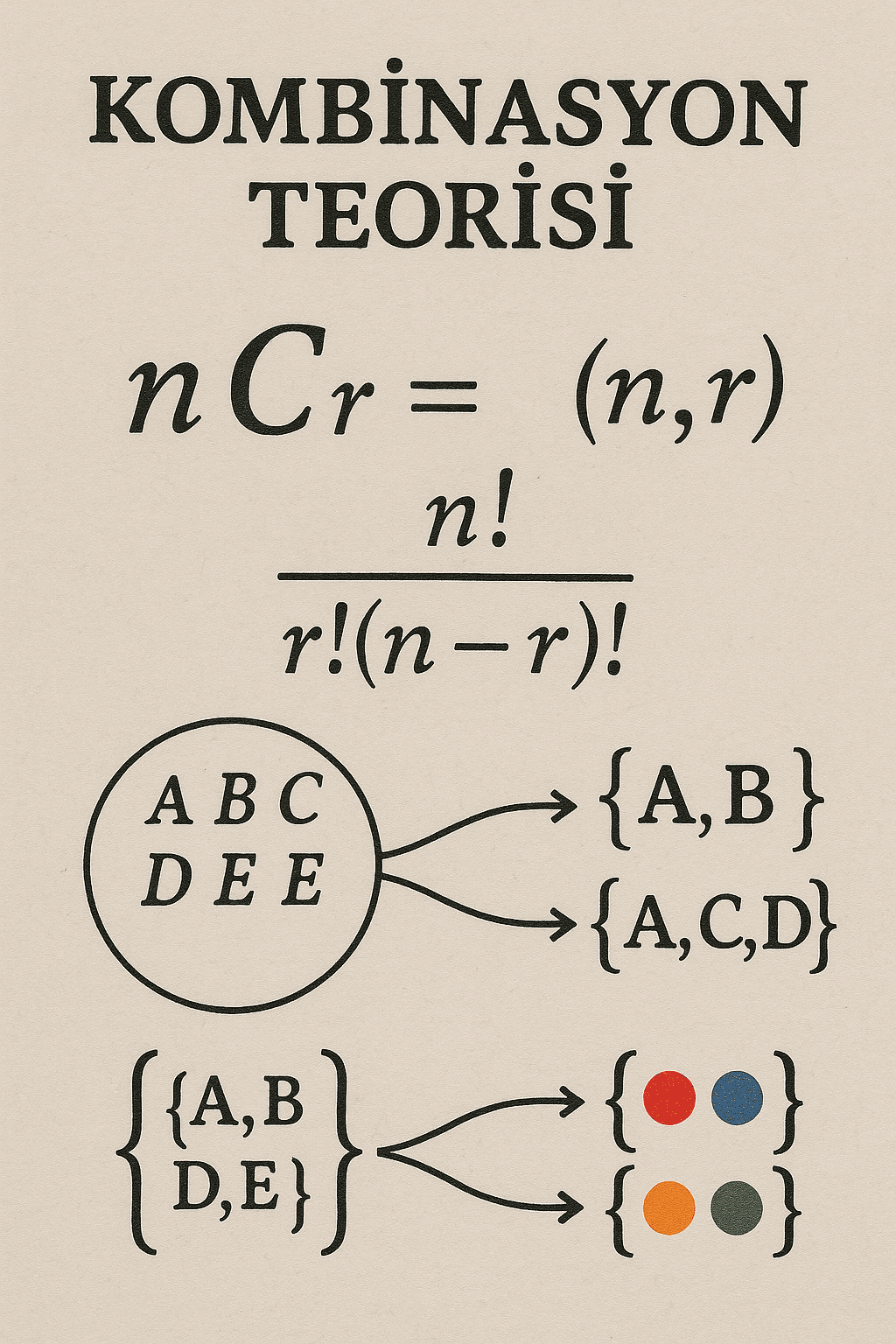
Formula | C(n r) = n! / [(n - r)! * r!] | ||||||||
Usage | Gives the number of unordered groups of r elements from n elements. | ||||||||
Variables | R: Number of selected elements N: Total number of elements | ||||||||
Combinations are a mathematical concept used to calculate the number of ways to select unordered elements from a given set. Combination theory is a fundamental branch of enumerative combinatorics and is closely related to mathematical tools such as binomial coefficients, Pascal’s Triangle, and generating functions gibi. These theories are applied in biology, computer science, statistics, and many other disciplines.
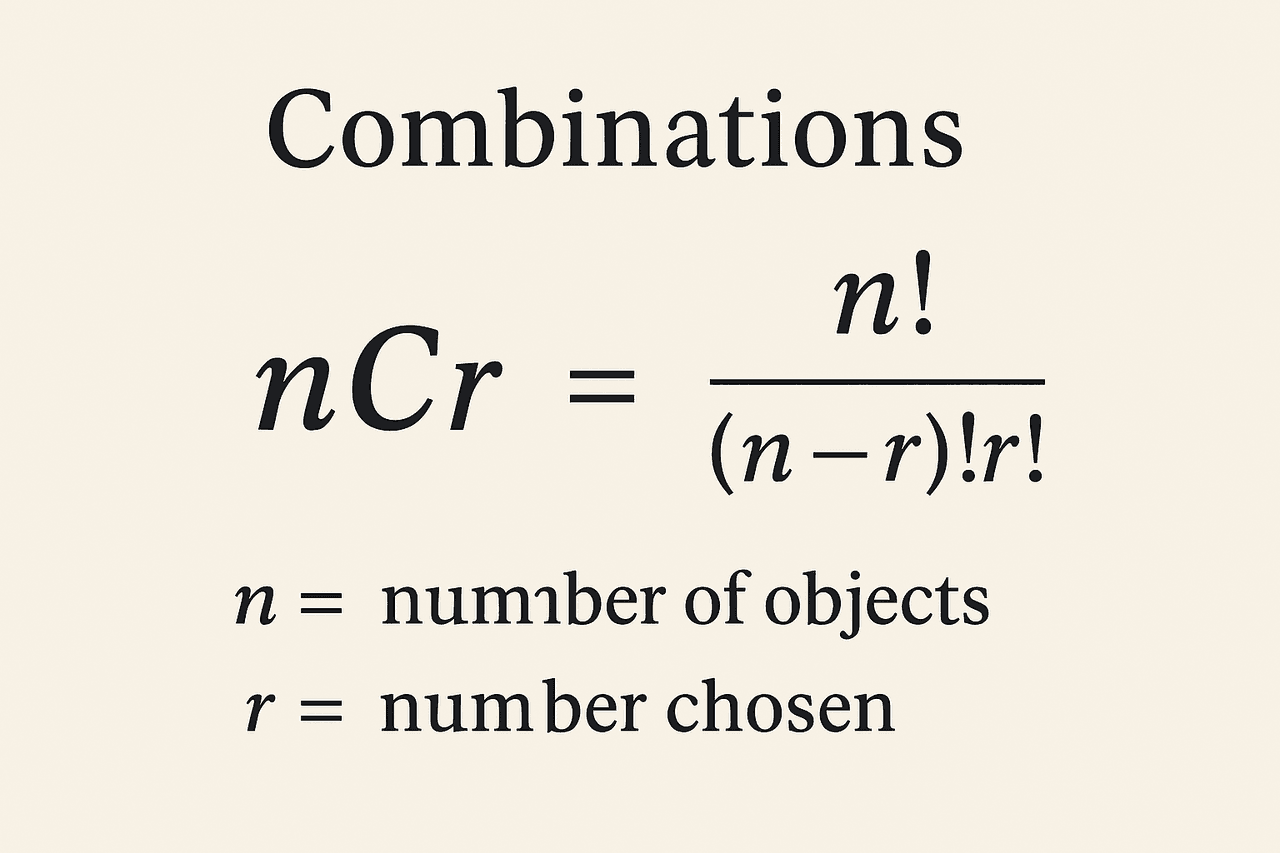
Combination Theory (generated by artificial intelligence).
The core problem in combination theory is selecting k elements from a set of n elements. Mathematically, this is expressed by the binomial coefficient formula:
Here, n! (n factorial) denotes the product of all positive integers from n down to 1. This formula is related to many topics in probability theory, such as the binomial distribution. Binomial coefficients are used to compute probabilities among unordered selections.
Pascal’s Triangle provides a visual representation of these coefficients and is an essential tool for combination calculations. In Pascal’s Triangle, each number is equal to the sum of the two numbers directly above it. This structure helps in understanding the relationships between binomial coefficients.
To delve deeper into combination theory, analytic combinatorial methods are frequently employed. Analytic combinatorics uses mathematical tools such as generating functions and complex analysis to estimate the number of specific combinatorial objects.
Generating functions are among the most powerful tools for solving counting problems. Functions representing the number of combinatorial objects are also used to understand the structure of these objects. For example, analyses of random structures and their asymptotic behavior rely on generating functions to estimate the number of large objects.
Combinations are used in numerous fields. One of the most common applications is in genetic engineering. In areas such as genetic diversity and plant breeding, combination calculations are used to select individuals with specific genetic traits, providing an effective way to achieve desired characteristics.
In addition, in fields such as computer science and cryptography, combinations are used in random number generation, algorithm analysis, and encryption techniques. In statistical modeling and data analysis, enumerative combinatorics helps understand data structures and predict future events. In particular, random processes such as Markov chains can be made more efficient through combinatorial analysis. The importance of analytic combinatorial methods for analyzing random structures is evident. Such analyses are applied in many areas including biological systems and financial modeling.
Question: There are 10 students in a class. We wish to select 3 of them. Since the order of selection is not important, this is a combination problem. In how many different ways can 3 students be selected?
Solution: This type of question falls under the problem of selecting k elements from n elements, and the formula is:
Where:
Apply the formula:
Substitute the factorial values:
Calculate:
Result: There are 120 different ways to select 3 students from 10. In this example, combinations are used because the selections are unordered.
Combination theory offers many interesting advanced applications. In particular, in areas such as random graph theory and Markov processes, combinatorial analysis facilitates the understanding of complex structures. In fields such as complex networks and distributed systems, combinations are used to model system behaviors.
Analytic combinatorics is concerned not only with counting but also with analyzing random structures. Such structures play a crucial role in applications such as random graph theory, data sets, and social networks.
Combination theory plays a central role in mathematical modeling and analysis, with tools such as binomial coefficients, Pascal’s Triangle, and generating functions being used to solve complex combinatorial problems. The analytic methods of combination theory have significant applications in biology, computer science, statistics, and many other fields. These theories, especially when combined with analyses of big data and random structures, clearly provide practical solutions to mathematical problems.
Flajolet, P., & Sedgewick, R. (2009). *Analytic Combinatorics*. Cambridge University Press. Accessed.https://archive.org/details/flajolet-sedgewick-analytic-combinatorics/page/6/mode/2up.
Wallis, W. D., & George, J. C. (2013). *Introduction to Combinatorics*. CRC Press.https://api.pageplace.de/preview/DT0400.9781439894996_A37928744/preview-9781439894996_A37928744.pdf
Weisstein, E. W. (n.d.). *Combinatorics*. From MathWorld—A Wolfram Web Resource. Accessedhttps://mathworld.wolfram.com/Combinatorics.html.

Combinatorics
Area | Mathematics | ||||||||
|---|---|---|---|---|---|---|---|---|---|
Formula | C(n r) = n! / [(n - r)! * r!] | ||||||||
Usage | Gives the number of unordered groups of r elements from n elements. | ||||||||
Variables | R: Number of selected elements N: Total number of elements | ||||||||
Combinations and Binomial Coefficients
C(n , k)=
Enumerative Combinatorics and Analytic Combinatorial Methods
Applications of Combinations
Combination Example
C(n ,k)=
C(10,3)= =
C(10,3)==
C(10,3)==120
Advanced Applications and Methods of Combinations