This article was automatically translated from the original Turkish version.
+1 More
Cloud seeding, is a weather modification technique aimed at increasing precipitation by injecting specific chemicals (such as silver iodide, dry ice, and hygroscopic salts) into clouds with suitable physical conditions. This method is applied to support agricultural production, enhance water resources, combat drought, or suppress harmful weather phenomena such as hail and fog.
The origins of modern cloud seeding stem from experiments conducted by Irving Langmuir and Vincent Schaefer during World War II to study ice crystal formation. Schaefer observed that dry ice caused moisture in the air to crystallize in a frozen environment. It was later discovered that silver iodide, due to its structural similarity to ice crystals, was even more effective. In 1947, Bernard Vonnegut demonstrated that silver iodide serves as an ideal nucleation agent for crystallization.
This technology was subsequently deployed in the field and widely adopted in countries such as the United States, China, and Russia. In Türkiye, the first application was carried out in 1990 by İSKİ in Istanbul, followed by short-term trials in Ankara and İzmir.
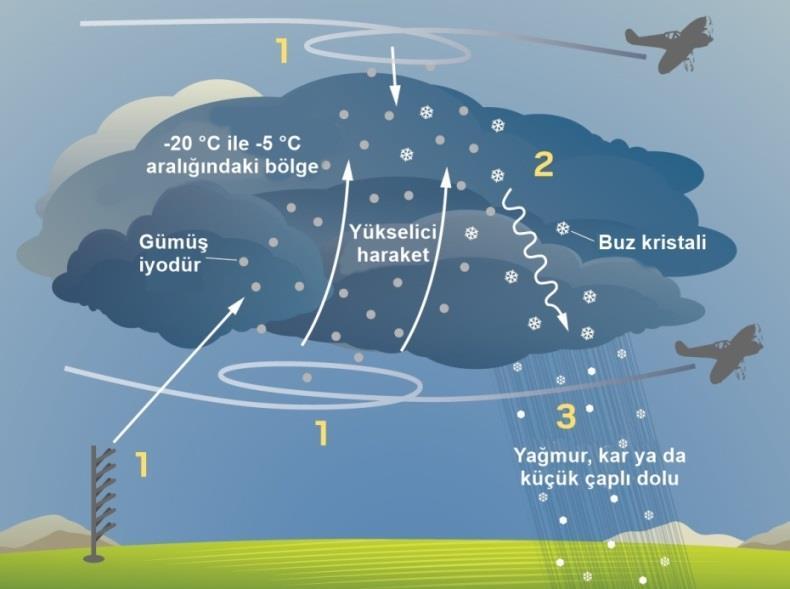
The process of cloud seeding is explained by the Bergeron-Findeisen theory. According to this theory, ice crystals act as nuclei that promote the condensation of supercooled water droplets within clouds. Since the vapor pressure over ice is lower than that over liquid water, at the same temperature, condensation begins on ice crystals while water droplets evaporate. This process leads to the growth of ice crystals and their eventual fall as precipitation.
During cloud seeding, substances are introduced to trigger crystallization on supercooled droplets. Silver iodide functions as an ice nucleus at temperatures between -5 °C and -20 °C, while dry ice promotes crystal formation by cooling the surrounding air. After crystallization, the resulting ice particles aggregate and either fall as snow or melt into rain.
The most commonly used chemical is silver iodide (AgI), which is the most effective seeding agent due to its structural similarity to ice crystals. Other substances used include:
Silver iodide produces fewer ice crystals at low temperatures and more at higher temperatures. For example, at -6 °C approximately 10 crystals are formed, while at +14 °C up to 10¹⁰ crystals have been observed.
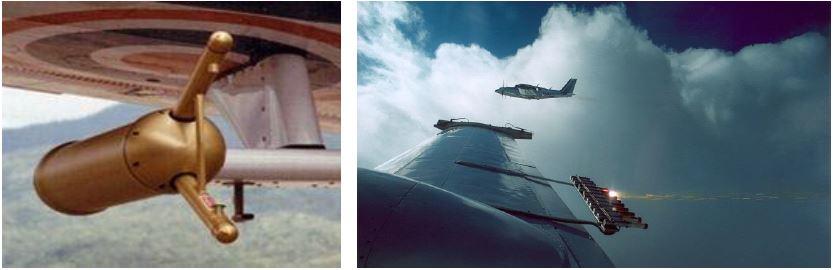
System measuring raindrop diameter and a cloud seeding operation conducted by releasing silver iodide smoke from an aircraft. (MGM)
For artificial precipitation to occur, clouds must already exist naturally; clouds cannot be created, only clouds with precipitation potential are enhanced. Suitable cloud types can be classified into three main categories:
Aircraft release seeding agents into clouds from above, directly through the cloud body, or via ascending air currents at the cloud base. In this process, burners mounted on aircraft wings emit silver iodide smoke. The silver iodide particles act as condensation nuclei within the cloud, promoting precipitation formation. Additionally, flare systems or spray mechanisms may be deployed from aircraft to deliver seeding materials into clouds.
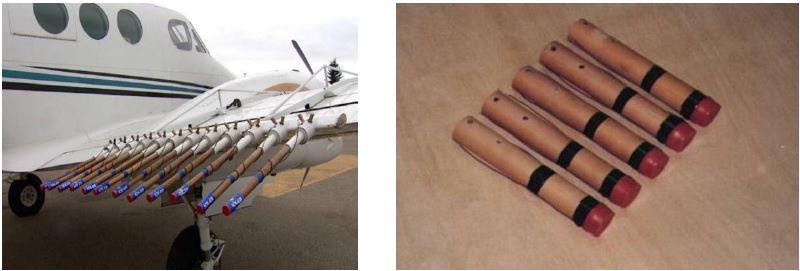
Cloud seeding flares mounted on an aircraft wing and flares containing 50 grams of silver iodide. (MGM)
Chemicals are released into the atmosphere via rockets or generators from the ground. Although rocket systems are preferred due to their high accuracy, they are costly. In China, 32,000 personnel and 26 control stations were involved in ground-based seeding operations, successfully altering rainfall patterns during the 2008 Olympics.
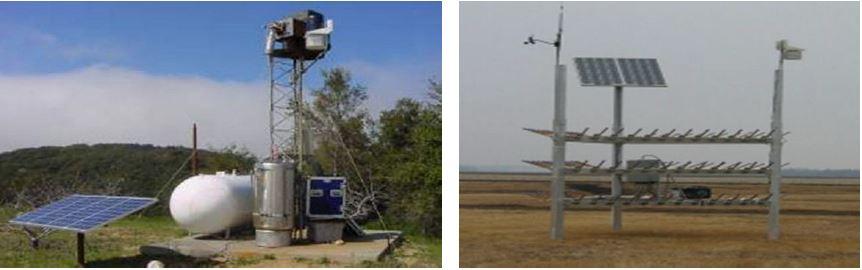
Ground-based seeding systems and ground-based silver iodide rocket systems. (MGM)
Cloud seeding can increase precipitation by 5% to 20%. However, its effectiveness depends on numerous factors including cloud structure, temperature, humidity levels, wind profiles, and timing. Moreover, it is not possible to precisely predict when or where precipitation will occur after seeding.
In some cases, seeding has been observed to increase the risk of hail or sudden downpours. Therefore, careful planning of operations is essential. Additionally, whether seeding causes reduced precipitation in other regions remains a subject of debate.
The environmental impacts of chemicals used in seeding, particularly silver iodide, must be closely monitored. Although silver iodide is insoluble in water, it may accumulate in soil and waterways over the long term. Lack of public awareness and potential legal issues are also among the social dimensions of cloud seeding.
Cloud seeding is a viable weather modification method for increasing precipitation when specific meteorological conditions are met. In arid regions where water management is critical, it is considered a low-cost alternative. However, due to its nature as an intervention in natural processes, it must be carefully implemented with scientific measurement, environmental analysis, economic feasibility, and legal regulations taken into account.
https://dergipark.org.tr/tr/download/article-file/89216
"Bulut Tohumlama: Yağmuru Tetikleme Sanatı." Tübitak, e-Dergi. Accessed May 16, 2025.
Cloud Seeding Program. "What Is Cloud Seeding?" Desert Research Institute. Accessed May 16, 2025.https://www.dri.edu/cloud-seeding-program/what-is-cloud-seeding/.
Koç, Büşra, and Öztürk, Turgut. "Hava Modifikasyon İşlemlerinde Yapay Yağış Tekniği." Iğdır Üniversitesi Fen Bilimleri Enstitüsü Dergisi 3, no. 1 (2013): 31–40.
Meteoroloji Genel Müdürlüğü. Yapay Yağış ve Yağış Artırma Çalışmaları. Ankara: Meteoroloji Genel Müdürlüğü, 2021.
Meteoroloji Genel Müdürlüğü. Yapay Yağış ve Yağış Artırma Çalışmaları. Ankara: Meteoroloji Genel Müdürlüğü, 2021.
Türk Meteoroloji Derneği. "Suni Yağış." Kuzey Kıbrıs Türk Cumhuriyeti Meteoroloji Dairesi. Accessed May 16, 2025.

History
Precipitation Formation Mechanism and Scientific Basis
Chemicals Used and Their Physical Effects
Suitable Cloud Types for Seeding
Application Methods
Aerial Seeding
Ground-Based Seeding
Application Outcomes and Scientific Evaluations
Environmental and Social Impacts