This article was automatically translated from the original Turkish version.
+2 More
Architectural Feature(s) | Rock-cut church space with an apse in the eastern section | ||||||||
|---|---|---|---|---|---|---|---|---|---|
Period(s) | Early Christian Period (4th–6th centuries) | ||||||||
Location | Göksu Valley Mut district Mersin | ||||||||
Archaeological Element | Rock-hewn sarcophagus | ||||||||
Decoration | Fresco and mosaic fragments | ||||||||
Building Type | Rock-cut cave church | ||||||||
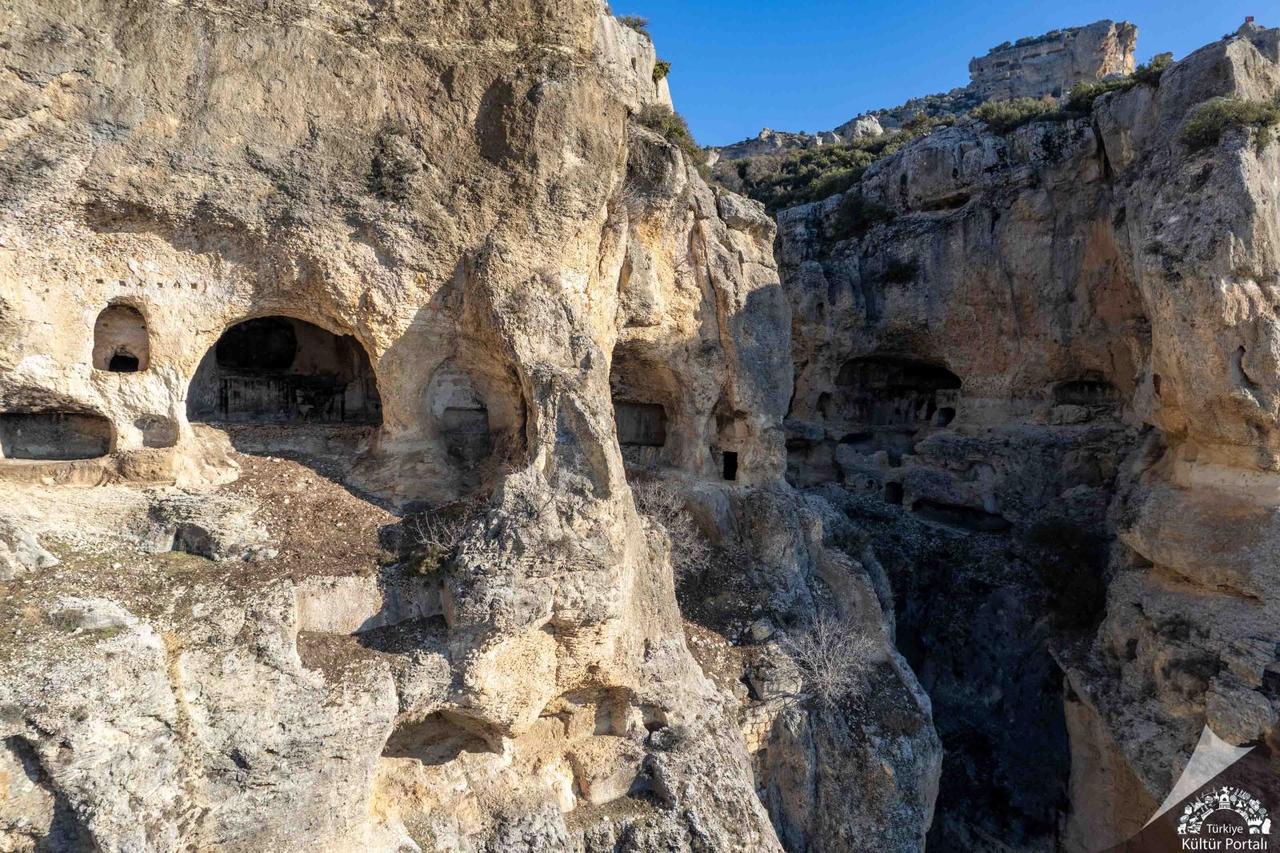
Al Oda Church (Al Oda Cave Church), a rock church carved into a natural cave, is located within the boundaries of the Mut district in Mersin Province, in Türkiye’s Mediterranean Region. Dating to the Early Christian period, the structure is situated among the steep cliffs surrounding the Göksu Valley and is assessed together with the nearby monastic settlement. The church, with its interior space carved into the rock and surviving fresco and mosaic fragments, is among the examples of early Christian architecture in the region.
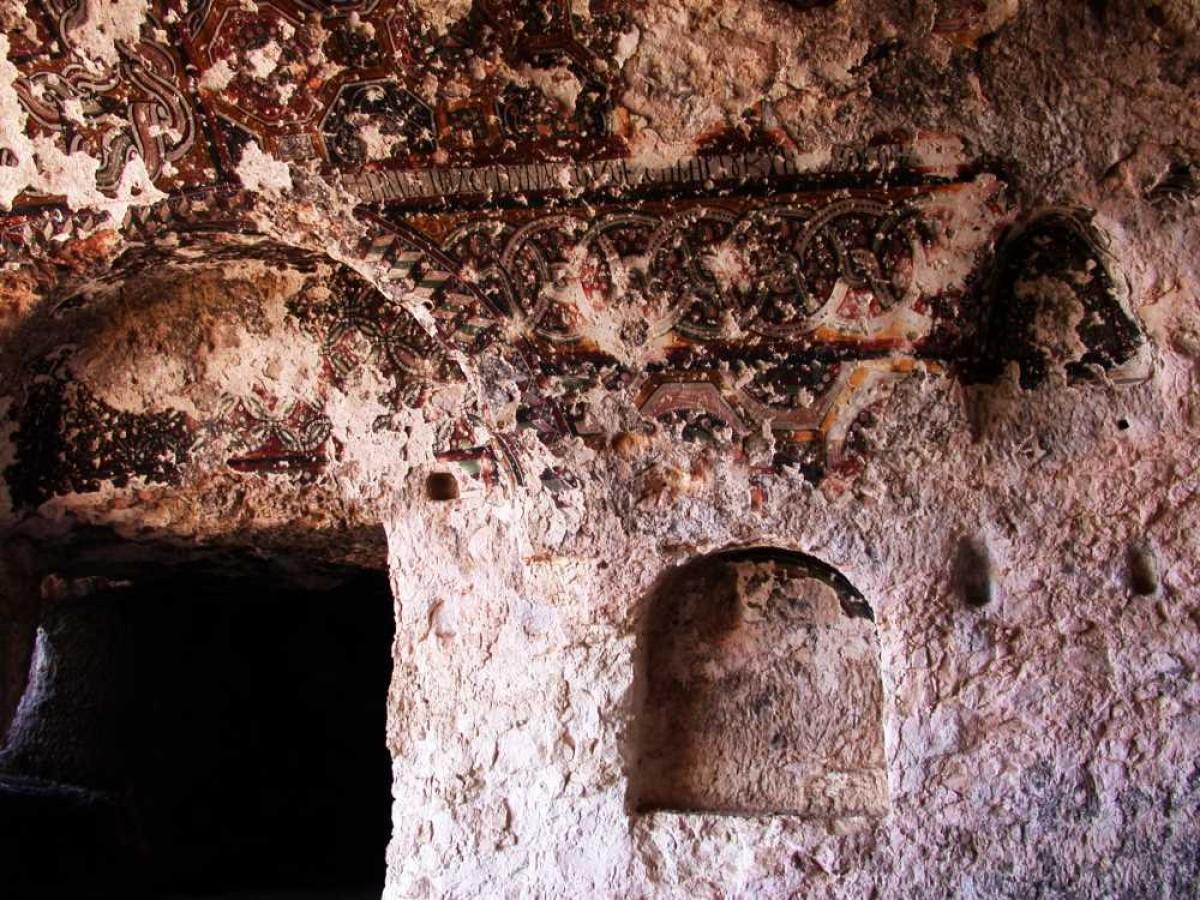
Alaoda Church (Mut Municipality)
Al Oda Church is situated on a steep slope facing the Göksu Valley, in the northwestern part of the Mut district of Mersin Province. The structure is accessible via a footpath branching off from the Mut–Karaman road, located in a rocky area. On both slopes of the valley in which the church stands, various spaces have been carved into the rock.
The region is characterized by a topography of deep valleys and vertical cliffs. The church’s location, commanding a view over the Göksu Valley, reflects a settlement pattern in direct relationship with the natural environment.
Al Oda Church was constructed during the Early Christian period, approximately between the 4th and 6th centuries. The structure shares the same topographic context as the nearby religious center, the Alahan Monastery.
The name of the church derives from the reddish hue of the rock surface on which it is carved. Due to this coloration, the space was locally known as “Al Oda” (red room), a name that gradually evolved into “Alaoda.”
Al Oda Church is a rock church formed by modifying the interior of a natural cave. The main chamber has a semi-circular plan, with the entrance located on the northeast side. Inside, niches and distinct spatial divisions have been carved directly into the rock.
The eastern section of the church contains an apse. It is noted that this area is situated close to the cliff edge, with traces indicating the former presence of a wall.【1】 On the western side of the cave, a separate room is present, featuring window openings and small niches. The ceiling of the main chamber is shaped as a barrel vault, while the ceiling of the western room is flat.
Within the church, a rock-carved khamasorion type sarcophagus is also present. This sarcophagus is believed to have belonged to an important religious figure.【2】
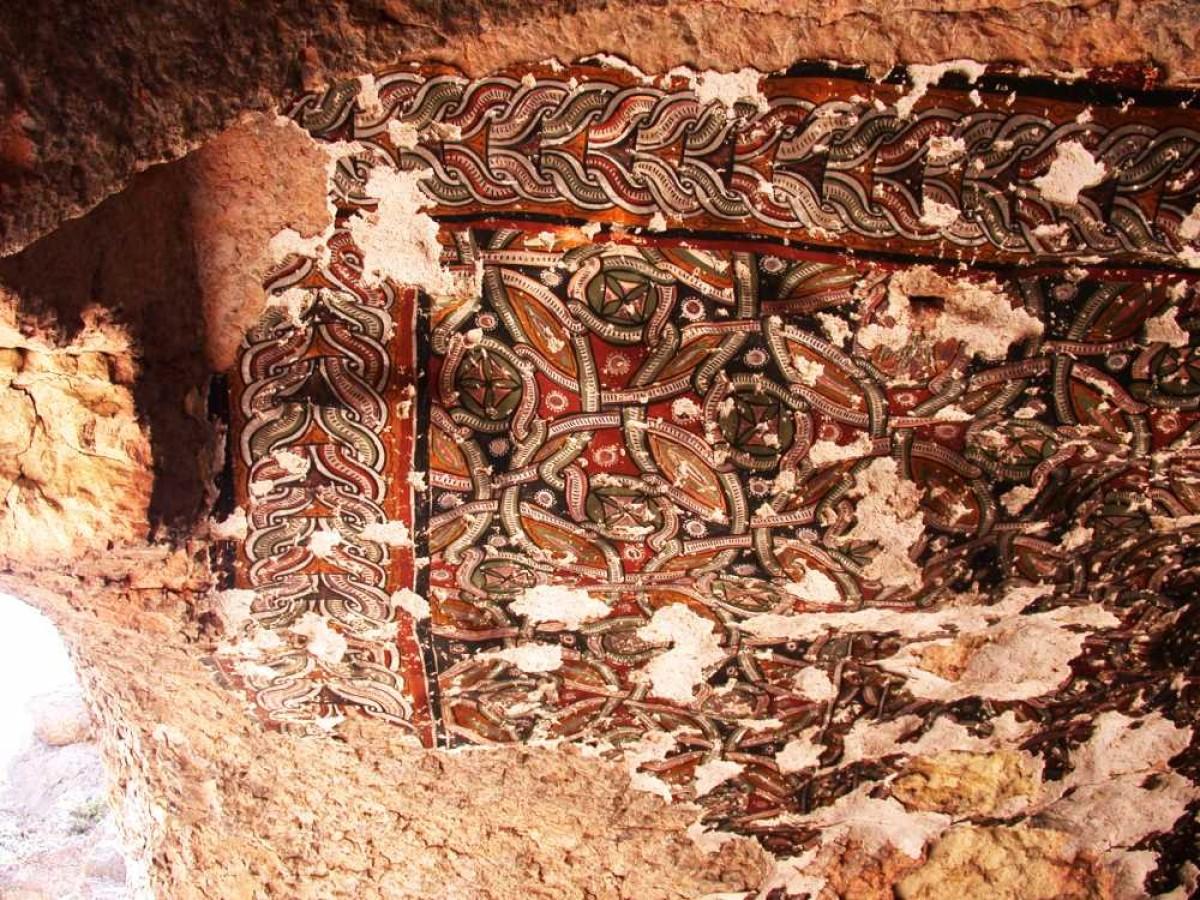
Alaoda Church Decorations (Mut Municipality)
Fresco and mosaic fragments have been found within the interior of Al Oda Church. The floor is described as having been decorated with mosaics and the walls with frescoes. However, much of this decoration has been lost over time, and only limited portions have survived to the present day.
Among the decorative motifs are bull and dove patterns, various cross compositions, braided designs, geometric shapes, and plant forms.
The area containing Al Oda Church is not limited to a single place of worship. A monastic settlement, believed to be associated with the church, is also located in the region. A deep ravine separates the monastic section from the church section. Various carved spaces are found on both slopes of the valley.
Today, Al Oda Church is recognized as an archaeological and cultural heritage site. Although much of its fresco and mosaic decoration has deteriorated over time, the rock-carved architecture and spatial layout remain largely intact.
The church is part of the historical and cultural sites of Mut district and represents one of the examples of Early Christian structures in the region.
Can, Cansen. “Aloda Kilisesi (Alaoda Mağara Kilisesi).” Türkiye Turizm Ansiklopedisi. Accessed March 8, 2026. https://turkiyeturizmansiklopedisi.com/aloda-kilisesi-alaoda-magara-kilisesi
Mersin Valiliği Mut Kaymakamlığı. "Mut İlçesi ve Tarihi Yerleri." Accessed March 8, 2026. https://www.mut.gov.tr/mut-ilcesi-ve-tarihi-yerleri
Mut Belediyesi. “Alaoda Kilisesi (Mağarası).” Accessed March 8, 2026. https://mut.bel.tr/tarihi-merkez/11
T.C. Ministry of Culture and Tourism. "Al Oda." Kültür Portalı. Accessed March 8, 2026. https://www.kulturportali.gov.tr/turkiye/mersin/gezilecekyer/al-oda
[1]
Ministry of Culture and Tourism of the Republic of Türkiye, “Al Oda,” Culture Portal, accessed 8 March 2026, https://www.kulturportali.gov.tr/turkiye/mersin/gezilecekyer/al-oda
[2]
Ministry of Culture and Tourism of the Republic of Türkiye, “Al Oda,” Culture Portal, accessed 8 March 2026, https://www.kulturportali.gov.tr/turkiye/mersin/gezilecekyer/al-oda

Architectural Feature(s) | Rock-cut church space with an apse in the eastern section | ||||||||
|---|---|---|---|---|---|---|---|---|---|
Period(s) | Early Christian Period (4th–6th centuries) | ||||||||
Location | Göksu Valley Mut district Mersin | ||||||||
Archaeological Element | Rock-hewn sarcophagus | ||||||||
Decoration | Fresco and mosaic fragments | ||||||||
Building Type | Rock-cut cave church | ||||||||
No Discussion Added Yet
Start discussion for "Church of the Cave (Grotto)" article
Location and Geographic Setting
History and Dating
Architectural Features
Decorative Program
Monastic Settlement and Surrounding Rock-Carved Spaces
Current Condition