


This article was automatically translated from the original Turkish version.
Saint Teresa Latin Catholic Church is a historic religious structure located in the Ulus neighborhood of Ankara, the capital of Türkiye, on Kardeşler Street. Church draws attention both for its architectural features and its historical past. The building’s origins date back to the early 20th century and it has evolved over time through various functions into its current form.
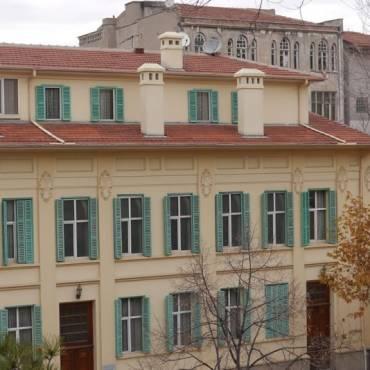
Saint Teresa Church (latinkatolikkilisesiistanbul)
The land on which the church stands was originally home to Saint Clement French College, managed by the Brothers of Christian Schools, since 1915. During this period, the area was also known for its proximity to the former Armenian quarter. However, in 1916 a major fire destroyed Saint Clement College and the surrounding neighborhood. Only the college’s outer wall remained after the fire. In honor of the French-speaking priests who worked in the area, the street was named Kardeşler Street.
In 1928, a new building was constructed on the site of the former college. The ground floor housed the Chancellery of the French Embassy, while the first floor contained the ambassador’s reception hall and within it a small chapel. In the early years, the French Consul resided there; later, until 1962, the building was allocated to a small French school. The building housing the chapel gradually became known as Saint Teresa Latin Catholic Church.
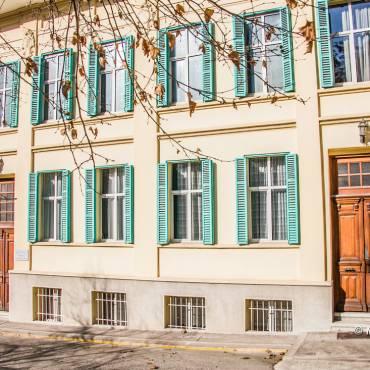
Saint Teresa Church (latinkatolikkilisesiistanbul)
The most important feature of Saint Teresa Church is the chapel on the first floor, which underwent comprehensive restoration in 2002. The chapel’s main mosaic was designed by French artist Hervé Vital, inspired by the churches of Cappadocia. On the right side of the mosaic, King David, from whose lineage the Messiah was promised, and King Solomon, who built the Holy Temple, are depicted. These two figures guide the viewer’s gaze toward Adam and Eve on the left, who are shown rising from their tombs toward the outstretched hand of Christ, illuminated by the light of His resurrection. On the left, the Holy Virgin holds the Child Jesus in her arms; on the right, Christ is portrayed holding a Gospel in one hand and blessing with the other. The soft color tones of the mosaics harmonize with the church’s bright interior. In front of each mosaic, fixed candlesticks hold small candles lit by the faithful to symbolize their prayers and hopes.
The chapel’s cross, designed by Madeleine Diener, represents the mystery of the Eucharist. The two open fingers signify the union of Christ’s divine and human natures, while the other three fingers represent the Holy Trinity. Inside the space, the capitals of the columns are adorned with four ram heads to recall the sacrifices of the Old Testament; the corners of the ceiling are decorated with wheat and grape clusters to symbolize the Eucharistic sacrifice of the New Testament.
The chapel’s lighting is provided by stained-glass windows on the sides of the columns. Six of these windows were made in Bordeaux in 1914 by D.P. Dagrant. These stained-glass windows originally belonged to the chapel of the former French College in İzmit and were preserved in Kadıköy after the school closed in 1920. They were transferred and installed in Saint Teresa Church in 1952. Four additional stained-glass windows in the same style were produced in Florence and installed in the church to complete the series.
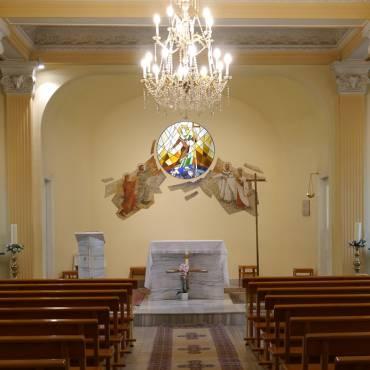
Saint Teresa Church (latinkatolikkilisesiistanbul)
The church is named after Saint Teresa of Lisieux. Living in the 19th century, Teresa is known for her simple life and her spiritual teaching, which she called the “Little Way.” The daughter of Louis and Zélie Martin, Teresa lost her mother at the age of four, an event that cast a shadow over her otherwise happy childhood. Under the guidance of her sister Pauline, Teresa’s faith deepened, and at the age of 14 she experienced a “conversion” that marked a turning point in her spiritual life. In 1888, despite her young age, she was accepted into the Carmelite Convent in Lisieux.
Teresa dreamed of missionary work and martyrdom for the faith, but realized that convent life did not allow her to pursue these goals. Instead, she developed the philosophy of the “Little Way,” focusing on expressing love through small daily acts. In 1897, Teresa contracted tuberculosis and died on 30 September of the same year. She was canonized in 1925 and is recognized as the patron saint of foreign missions, as well as of remote regions of France and Russia. Her feast day is 1 October.
Saint Teresa Latin Catholic Church is an important part of Ankara’s historical and cultural fabric. Through its architectural elements and the spiritual legacy of Saint Teresa, it offers visitors a rich experience. The artistic details of the chapel and its historical background have transformed the church into more than a place of worship—it is also a cultural treasure.
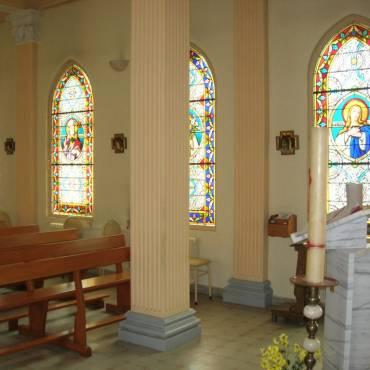
Saint Teresa Church (latinkatolikkilisesiistanbul)
Ankara Katolik Kilisesi. “Azize Terezanın Hayatı.” Accessed April 3, 2025.https://www.ankarakatolik.com/tr/azize-terezanin-hayati/.
Ankara Katolik Kilisesi. “Kilisemizin Tarihi.” Accessed April 3, 2025.https://www.ankarakatolik.com/tr/kilisemizin-tarihi/.
Latin Katolik Church Istanbul. "Azize TereziaKilisesi İstanbul Ankara." Accessed April 3, 2025.https://latinkatolikkilisesiistanbul.com/kiliselerimiz/ankara/azize-terezia-kilisesi-ankara/
Visit Ankara. "Place Index | Azize Terezia Kilisesi." Accessed April 3, 2025.https://visitankara-webui.dev.kultur.gov.tr/Place/Index/26.

No Discussion Added Yet
Start discussion for "Church of Saint Teresa" article
History
Architectural Features and Chapel
The Life of Saint Teresa