


This article was automatically translated from the original Turkish version.
+1 More
Location | Göreme Türkiye Nevşehir | ||||||||
|---|---|---|---|---|---|---|---|---|---|
Date(s) | 11th–13th centuries | ||||||||
Architectural Plan | Closed Greek cross, two-column, four-dome, three-apse | ||||||||
Construction Technique | Carved into natural rock | ||||||||
Çarıklı Kilise is a part of the monastic complex located within the boundaries of the Göreme Open Air Museum, approximately 10 kilometers from the city center of Nevşehir, near the district of Ürgüp in the Göreme Valley, Türkiye. The church is carved into the natural rock on the southern slope of the museum area and is accessed via a later-added iron staircase leading to an entrance situated about five meters above the monastic courtyard. It is believed to have been built under the patronage of the Melissenos family.

Çarıklı Kilise (Türkiye Culture Portal)
Çarıklı Kilise is a structure with two free-standing columns, four domes, three apses, and transverse vaults. Other supporting elements are shaped as corbels at the corners of the walls. In terms of plan type, it follows the closed Greek cross layout. The naos is irregularly shaped, excluding the western arm of the cross and the apses. The central space, supported by two columns, is an irregular square covered by a dome, while the eastern arm of the cross is covered by a slightly elliptical dome. The other arms of the cross are covered with barrel vaults, and the northeast and southeast corner spaces are closed with domes. The naos terminates in three semicircular apses on the eastern side, with the main apse being wider and taller than the side apses. The entrance is located on the northern wall of the naos and opens into the northern arm of the cross.
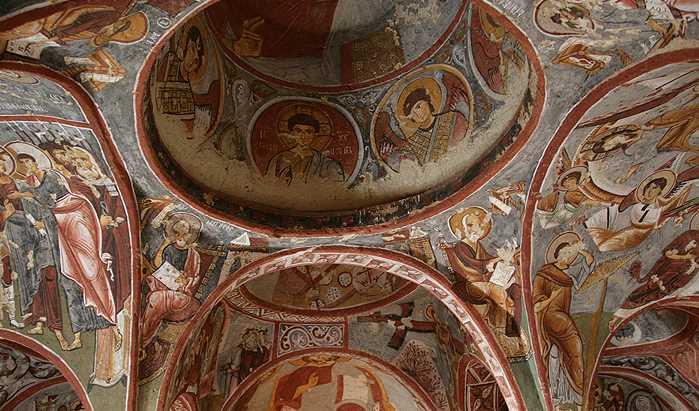
The church is notable for its figural wall paintings. The pictorial program includes scenes from the life and miracles of Christ, the Church Fathers, saints, female saints, archangels, Emperor Constantine and his mother Helena, as well as depictions of the donors. Scenes related to Christ include the Deesis, Nativity, Adoration of the Magi, Baptism, Raising of Lazarus, Transfiguration (Metamorphosis), Entry into Jerusalem, Betrayal, Christ on the Way to Golgotha, Crucifixion, Women at the Empty Tomb, Ascension, and Anastasis. In addition, the Old Testament theme of Abraham’s Hospitality (receiving the three angels at Mamre) is also depicted.
In the center of the main dome, within a medallion, Christ Pantokrator is depicted, surrounded by busts of angels—Michael, Uriel, Misael, Raphael, and Gabriel—on the surrounding surface. The four Evangelists are portrayed on the pendentives. The Deesis scene is located in the main apse, the Eleousa type of the Virgin and Child Christ in the northern apse, and the archangel Michael in the southern apse. The Nativity of Christ is depicted in the western arm of the cross; the Adoration of the Magi is on the northern half of the western vault; the Baptism is on the lunette of the northeast corner space; the Transfiguration is on the western vault of the western arm; the Entry into Jerusalem and the Betrayal are on the northern vault of the northern arm; the Crucifixion is on the northern lunette of the northern arm; the Anastasis is on the southern wall of the southeast corner space; and the Women at the Empty Tomb scene is on the eastern lunette of the same space. The Ascension is depicted on the southern vault of the southern arm.
Below the Deesis scene on the wall of the main apse, the following saints are arranged in sequence: Saint Hypatios, Saint Nicholas, John Chrysostom, Gregory of Nazianzus, Saint Blasius, and Saint Basil. On the southern wall of the western arm are Saint George and Saint Theodore; on the northern wall, Saint Procopius of Scythopolis; and on the lower part of the northern wall of the northeast corner space, the Christian physician saints Cosmas and Damian are depicted. On the arch surfaces of the same space are Saints Provos, Tarakhos, and Andronikos. Among the female saints, Saint Barbara and Saint Eudokia are on the western wall of the northern arm; an anonymous female saint and Saint Paraskeve are on the northern wall of the northern arm. On the western wall of the southern arm, Emperor Constantine the Great and his mother Helena are depicted.
The donors Theognostos, Leontos, and Mikhail are portrayed on the western wall of the western arm, beneath the Nativity scene, with their identities confirmed by accompanying inscriptions. These individuals are known to have belonged to the Melissenos family and supported the Phokas imperial dynasty.
Kaya, İlkgül. “Çarıklı Kilise,” *Türkiye Turizm Ansiklopedisi*, 2021. Accessed June 17, 2025. https://turkiyeturizmansiklopedisi.com/carikli-kilise
T.C. Kültür ve Turizm Bakanlığı. “Çarıklı Kilise,” Kapadokya Alan Başkanlığı. Accessed June 17, 2025.
Türkiye Kültür Portalı. "Çarıklı Kilise - Nevşehir." Accessed June 17, 2025. https://www.kulturportali.gov.tr/turkiye/nevsehir/gezilecekyer/carikli-kilise
Location | Göreme Türkiye Nevşehir | ||||||||
|---|---|---|---|---|---|---|---|---|---|
Date(s) | 11th–13th centuries | ||||||||
Architectural Plan | Closed Greek cross, two-column, four-dome, three-apse | ||||||||
Construction Technique | Carved into natural rock | ||||||||
Architectural Features
Fresco Program and Iconography
Fresco Placement
Saints and Donor Depictions