


This article was automatically translated from the original Turkish version.
+1 More
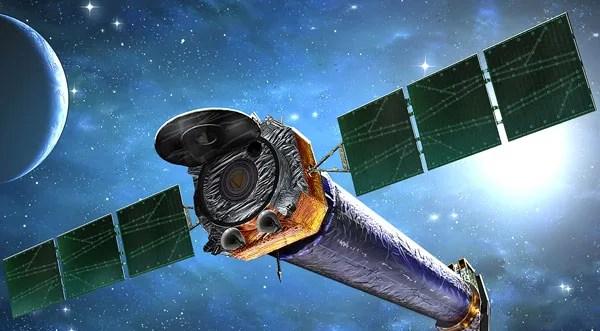
Chandra X-ray Observatory
Launch Date | 23 Temmuz 1999 | ||||||||
|---|---|---|---|---|---|---|---|---|---|
Cost | 1.65 billion USD | ||||||||
Launch Vehicle | Space Shuttle Columbia | ||||||||
Orbit | Perigee: ~16,000 km Orbital period: ~64 hours Apogee: ~133,000 km | ||||||||
Energy Range | 0.1 keV – 10 keV | ||||||||
Detector System | ACIS (Advanced CCD Imaging Spectrometer) HRC (High Resolution Camera) | ||||||||
Mission Duration | Planned Initial 5 Years | ||||||||
Current Mission Status | Active | ||||||||
In the field of high-energy astrophysics, observations in the X-ray region of the electromagnetic spectrum play a key role in understanding the most energetic and dynamic events in the universe. In this context, NASA’s Chandra X-Ray Observatory, launched in 1999, has been established as one of the most important instruments in modern astronomy.
The observatory provides critical insights into the structure and evolution of the universe by observing in detail high-energy astronomical structures such as black holes, neutron stars, supernova remnants, and galaxy clusters.
X-rays occupy the high-energy region of the electromagnetic spectrum and are characterized by short wavelengths and high frequencies. Due to these properties, they originate only from the hottest, densest, and most energetic celestial objects. Neutron stars, black holes, supernova remnants, and galaxy clusters are among the primary observation targets in X-ray astronomy.
Since the Earth atmosphere absorbs X-rays, direct observation of such emissions from the ground is impossible. Therefore, X-ray astronomical observations can only be conducted using telescopes placed in space.
In this regard, the Chandra X-Ray Observatory, placed in orbit by NASA in 1999, plays a vital role in studying high-energy astrophysical phenomena. Thanks to its high spatial resolution, Chandra provides detailed data on matter interactions around black holes, the distribution of hot gas in the intergalactic medium, and the dynamic structures of the universe, making significant contributions to contemporary astronomy research.
The Chandra X-Ray Observatory was developed as part of NASA’s Great Observatories Program. Under this program, the Hubble Space Telescope, the Compton Gamma Ray Observatory, and the Spitzer Space Telescope were previously launched.
Chandra, as the third major telescope in this series, was placed into orbit on 23 July 1999 aboard the Columbia space shuttle during the STS-93 mission. The observatory was named in honor of the Nobel Prize-winning Indian-American astrophysicist Subrahmanyan Chandrasekhar.
The development of Chandra was led by the Massachusetts Institute of Technology (MIT) and the Smithsonian Astrophysical Observatory (SAO), under the management of the Marshall Space Flight Center (MSFC). The observatory’s primary structural component, the high-resolution mirrors, was manufactured using one of NASA’s most advanced technological infrastructures.
Chandra is 10 meters long and weighs approximately 4.8 metric tons. It possesses a much higher angular resolution than other X-ray telescopes. With a resolution capacity of 0.5 arcseconds, it can pinpoint the positions of X-ray sources with extreme precision.
The observatory carries four primary scientific instruments:
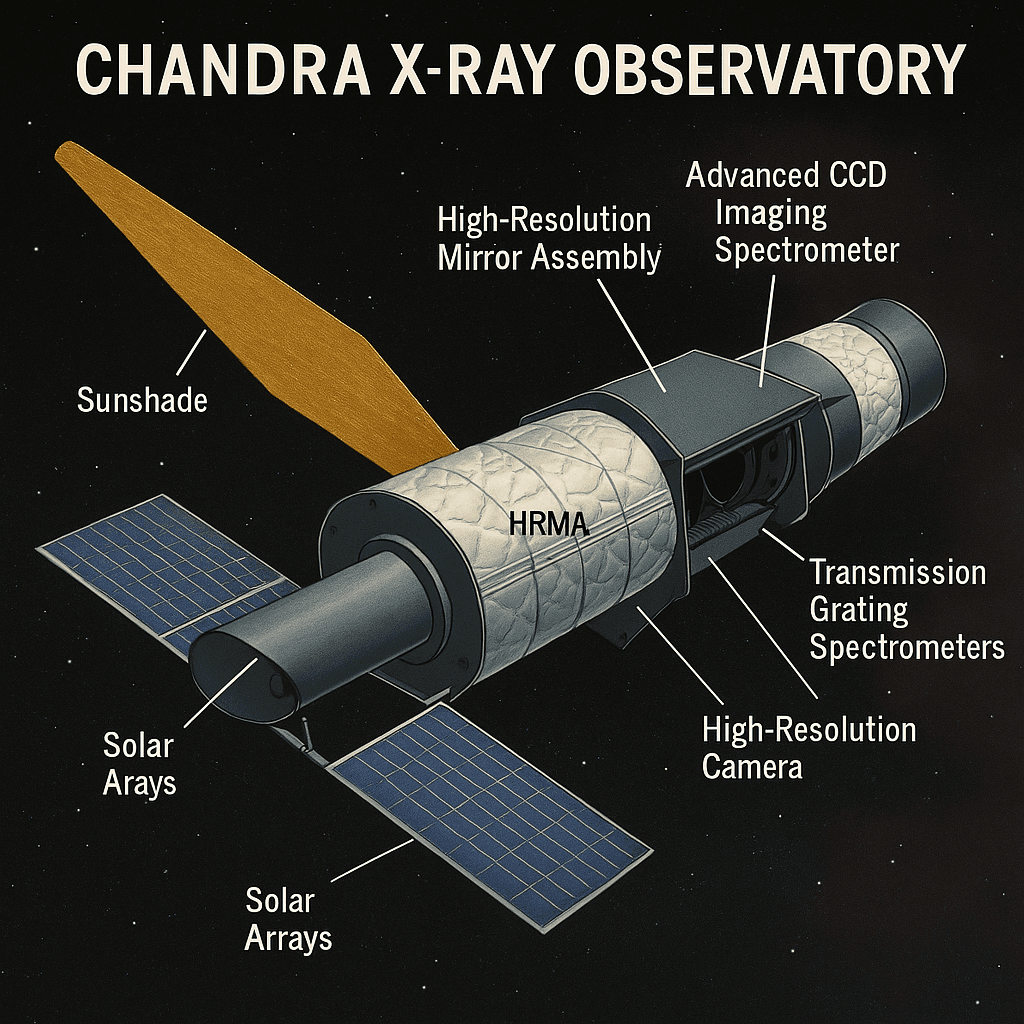
Artificial Intelligence Generated Technical Features of the Chandra X-Ray Observatory.
Chandra is placed in an elliptical orbit extending up to 133,000 kilometers from Earth. This high orbit enables long-duration observations without interference from the Earth’s atmosphere blocking X-rays.
Since its activation, Chandra has made numerous groundbreaking scientific discoveries. Among its key contributions are:

Artificial Intelligence Generated Discoveries of the Chandra X-Ray Observatory.
As of 2025, Chandra remains operational and continues its mission under an extended timeline approved by NASA. Although its technical lifespan was originally planned for five years, its durability and scientific value have led to multiple mission extensions. Next-generation X-ray telescopes, such as Athena (ESA) and Lynx (a proposed NASA mission), are being designed to build upon the data legacy established by Chandra. The Chandra X-Ray Observatory has been a revolutionary instrument in X-ray astronomy, offering a unique window into the observation of high-energy processes in the cosmos.
Thanks to Chandra, information has been gained about the most dynamic structures in the universe, ranging from black holes to galaxy clusters. Chandra is not merely a telescope; it is a turning point in the development of modern astrophysics.
Garmire, Gordon P., Mark W. Bautz, Paul G. Ford, Norbert S. Jernigan, and Leon Van Speybroeck. “Advanced CCD Imaging Spectrometer (ACIS) Instrument on the Chandra X-ray Observatory.” *X-Ray and Gamma-Ray Telescopes and Instruments for Astronomy*, Proceedings of SPIE Vol. 4851 (2003).https://doi.org/10.1117/12.461599. Accessed April 10, 2025.
NASA Chandra X-Ray Observatory. “Chandra X-ray Observatory.” NASA. Accessed April 10, 2025.
NASA. “Chandra X-ray Observatory – Science Mission Directorate.” Accessed April 10, 2025.
Smithsonian Astrophysical Observatory. “Chandra Science Center.” Accessed April 10, 2025.
Weisskopf, Martin C., Stephen L. O’Dell, George G. Pavlov, and Daniel A. Swartz. “An Overview of the Performance and Scientific Results from the Chandra X-ray Observatory.” *Publications of the Astronomical Society of the Pacific* 114, no. 791 (2002): 1–24.https://doi.org/10.1086/338108. Accessed April 10, 2025.

Chandra X-ray Observatory
Launch Date | 23 Temmuz 1999 | ||||||||
|---|---|---|---|---|---|---|---|---|---|
Cost | 1.65 billion USD | ||||||||
Launch Vehicle | Space Shuttle Columbia | ||||||||
Orbit | Perigee: ~16,000 km Orbital period: ~64 hours Apogee: ~133,000 km | ||||||||
Energy Range | 0.1 keV – 10 keV | ||||||||
Detector System | ACIS (Advanced CCD Imaging Spectrometer) HRC (High Resolution Camera) | ||||||||
Mission Duration | Planned Initial 5 Years | ||||||||
Current Mission Status | Active | ||||||||
No Discussion Added Yet
Start discussion for "Chandra X-ray Observatory" article
Chandra X-Ray Observatory and X-Rays
History and Development Process
Technical Features and Systems
Scientific Contributions
Current Status and Future Perspectives