


This article was automatically translated from the original Turkish version.
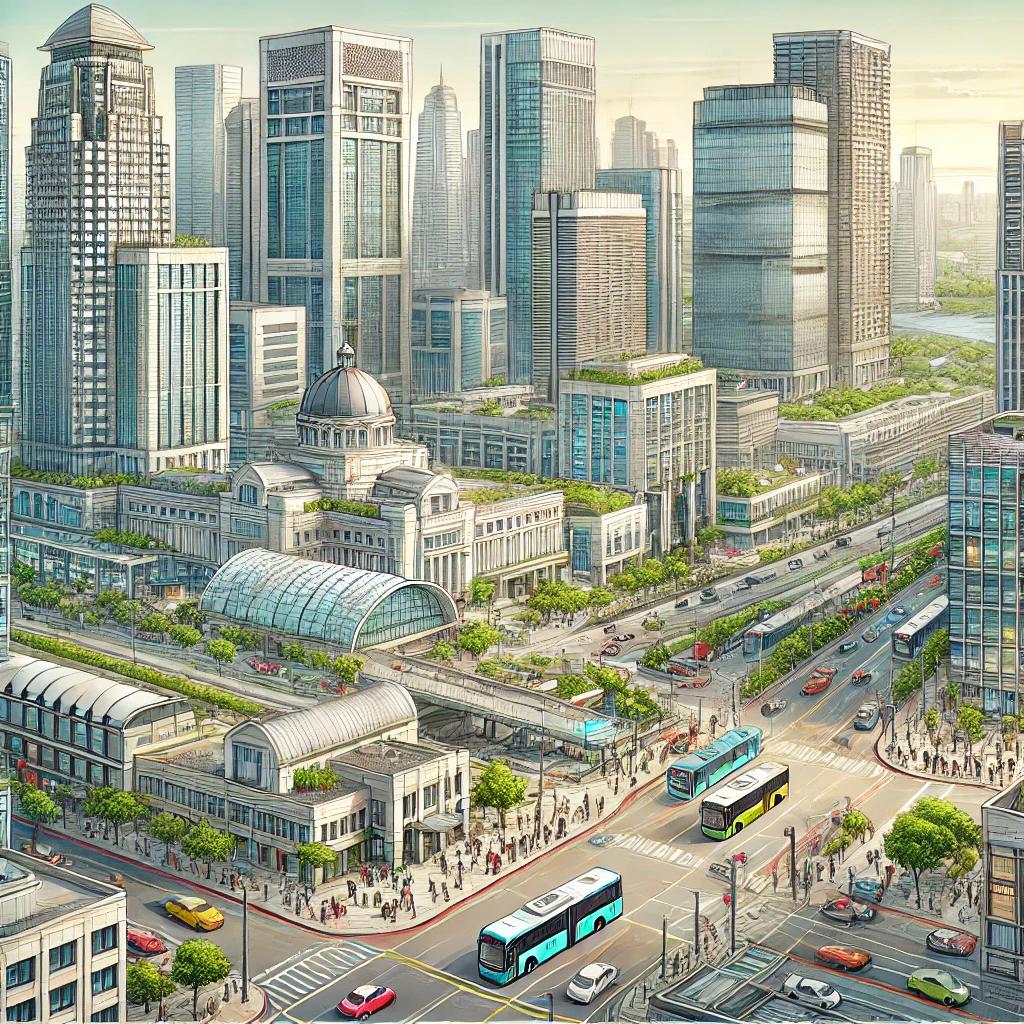
Central Business Areas
Description | A region where a city's economic, commercial, financial and administrative activities are concentrated, typically accessible in terms of transportation and characterized by dense development. Business districts house skyscrapers, offices, hotels, banks, shopping centers and public service buildings. | ||||||||
|---|---|---|---|---|---|---|---|---|---|
Characteristics of Central Work Areas | Digitalization and Technological Integration Daytime Population Density High Real Estate Values Concentration of Economic Activities Integration with Transportation Networks Density and Vertical Development | ||||||||
The Central Business District (CBD) is the area of a city where economic, commercial, financial and administrative activities are concentrated, typically characterized by high accessibility in terms of transportation and dense urban development. This area houses office buildings, skyscrapers, offices, hotels, banks, shopping centers and public service facilities. The CBD is one of the most valuable and competitive urban zones and one of the areas with the highest concentration of labor and capital.
The Central Business District plays a critical role in the economic and spatial development of cities. It emerged following the industrial revolution as large cities expanded and has undergone transformation over time in line with globalization and technological advancements. Today, CBDs have become one of the key important factors determining the economic competitiveness of global cities.
Central Business Districts function as the economic engines of cities. From an urban planning perspective, the sustainable, accessible and innovative development of CBDs importance supply is essential. In this context, transportation planning, reduction of environmental impacts and digitalization like factors must be considered in accordance with modern urbanism principles.
Brenner, N. New State Spaces: Urban Governance and the Rescaling of Statehood. Oxford University Press, 2004.
Castells, M. The Rise of the Network Society. Blackwell Publishers, 1996.
Florida, R. Cities and the Creative Class. Routledge, 2005.
Graham, S., and Marvin, S. Splintering Urbanism: Networked Infrastructures, Technological Mobilities and the Urban Condition. Routledge, 2001.
Hall, P. Cities of Tomorrow: An Intellectual History of Urban Planning and Design in the Twentieth Century. Blackwell Publishing, 2002.
Lynch, K. The Image of the City. MIT Press, 1960.
Sassen, S. The Global City: New York, London, Tokyo. Princeton University Press, 2001.

Central Business Areas
Description | A region where a city's economic, commercial, financial and administrative activities are concentrated, typically accessible in terms of transportation and characterized by dense development. Business districts house skyscrapers, offices, hotels, banks, shopping centers and public service buildings. | ||||||||
|---|---|---|---|---|---|---|---|---|---|
Characteristics of Central Work Areas | Digitalization and Technological Integration Daytime Population Density High Real Estate Values Concentration of Economic Activities Integration with Transportation Networks Density and Vertical Development | ||||||||
No Discussion Added Yet
Start discussion for "Central Business Areas" article
Characteristics of Central Business Districts
Example Cities
Advantages and Disadvantages of Central Business Districts
Advantages
Disadvantages