This article was automatically translated from the original Turkish version.
Physical and Climatic Conditions | Frequent Rainfall and Low Wind Circulation Deep and Narrow Valleys Steep Slopes Swamp-Like Soft Ground High Temperature-Humidity Combination Dense Vegetation (Visibility Range Often Only Several Meters) | ||||||||
|---|---|---|---|---|---|---|---|---|---|
Operational Effects | Physical Load Logistical Constraints Navigation Difficulties Restricted Visibility | ||||||||
Historical Example Wars | Vietnam War (1955–1975) Chaco War (1932–1935) 1995) 1981 Ecuador–Peru Conflicts (1941 Colombia–Peru War (1932–1933) Acre War (1902–1903) | ||||||||
Jungle warfare refers to military operations conducted in areas characterized by dense forests, thick vegetation, and tropical or subtropical climates. This form of warfare differs from conventional land combat due to challenging terrain conditions, high humidity, limited visibility, complex topography, and climatic hardships. In modern military literature, it is known as jungle warfare and has long been practiced by armed forces in regions such as South America, Southeast Asia, and the Indian-Pacific area.
Propaganda Video Compiled from American Troop Combat Footage During the Vietnam Jungle War (LegoGuy Productions)
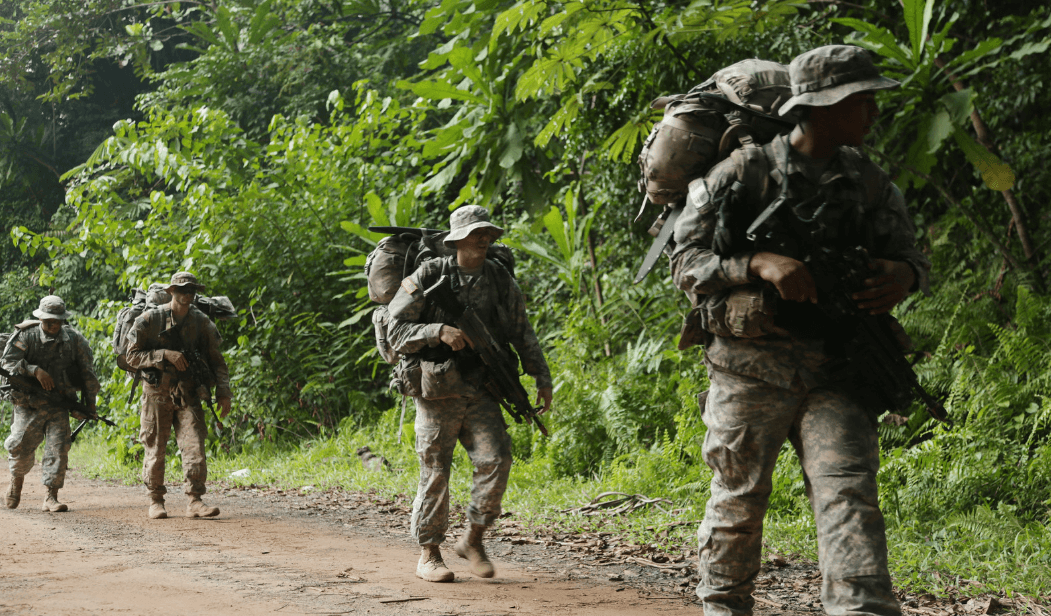
The jungle environment is defined by dense, layered vegetation, steep slopes, soft ground with swamp-like qualities, deep narrow valleys, and a year-round combination of high temperature and humidity. These natural conditions impose multifaceted constraints on military operations. The density of vegetation often restricts visibility to only a few meters, making target identification, visual communication between units, and coordination of fire support difficult. The terrain’s structure, lack of prominent reference points, and magnetic deviations complicate navigation, forcing units to rely on map-and-compass-based close-range orientation techniques. Swampy and rugged ground severely hampers the movement of heavy equipment and supply vehicles, resulting in logistics being largely sustained via air or river routes. The combination of high temperature and humidity, coupled with continuous physical exertion in the forest, strains soldiers’ endurance and increases the risk of heat-related illnesses and dehydration with electrolyte loss. Together, these factors transform the jungle into a theater of operations requiring high physical adaptation and specialized training.
Because jungle warfare is conducted in tropical regions dominated by dense vegetation, high humidity, limited visibility, and rugged topography, units must adapt to tactics, equipment, and operational needs distinct from conventional land combat. Due to severely restricted mobility, soldiers must master silent, controlled, and highly enduring movement techniques through thick vegetation. The terrain’s steep slopes, slippery soils, and deep valleys necessitate widespread use of mountaineering-derived methods such as rope systems, fixed lines, rappelling techniques, anchor points, and pulley systems that provide mechanical advantage. Visibility often reduced to just a few meters complicates command and control and shortens engagement distances. This makes small-unit tactics at the team and platoon level the fundamental combat model of jungle warfare. Due to limited radio range caused by dense vegetation and topography, units frequently operate with tactical independence.
Environmental conditions pose significant risks to soldier health. Malaria, dengue, Zika, leishmaniasis, and other tropical diseases, along with water- and food-borne infections, are widespread in jungle regions, making the use of antimalarial drugs, insect repellents, mosquito nets, antifungal creams, and sterile water purification systems mandatory. The combination of high temperature and humidity increases the risk of heatstroke, dehydration, and electrolyte loss, requiring continuous water supply and thermal management through specialized planning. Most water sources in forests are microbiologically contaminated, making portable water purifiers, boiling methods, and chemical purification tablets vital. Due to terrain constraints, logistical support is heavily restricted, leading to reliance on helicopter air resupply, river transport, and lightweight cargo systems instead of heavy supply convoys.
Specialized equipment is essential in jungle operations. This includes tropical climate-adapted uniforms, lightweight and quick-drying boots, machete-like brush-clearing tools, multi-purpose ropes, anchor gear, short-range radios, signal boosters, miniature reconnaissance UAVs, and electronic devices resistant to high humidity. Navigation is often conducted using map-and-compass methods due to frequent GPS signal degradation. Health and life-support equipment includes water filtration kits, high-calorie rations, and emergency medical supplies.
The use of conventional armored units and artillery in jungle warfare is severely limited. Tanks and armored vehicles cannot maneuver or lose basic mobility due to dense tree cover, swampy ground, and root systems. Artillery fire is constrained in target acquisition, accuracy, and ammunition effectiveness due to dense canopy cover. Consequently, jungle warfare relies primarily on light infantry, close air support, helicopter-delivered fire elements, and short-range fire support systems.
When considered together, jungle warfare emerges as a comprehensive operational form requiring high mobility, low visibility, small-unit tactics, advanced medical protection, flexible logistics planning, and specialized equipment. The physical and operational constraints imposed by the forest environment define these requirements as the fundamental determinants of jungle warfare.
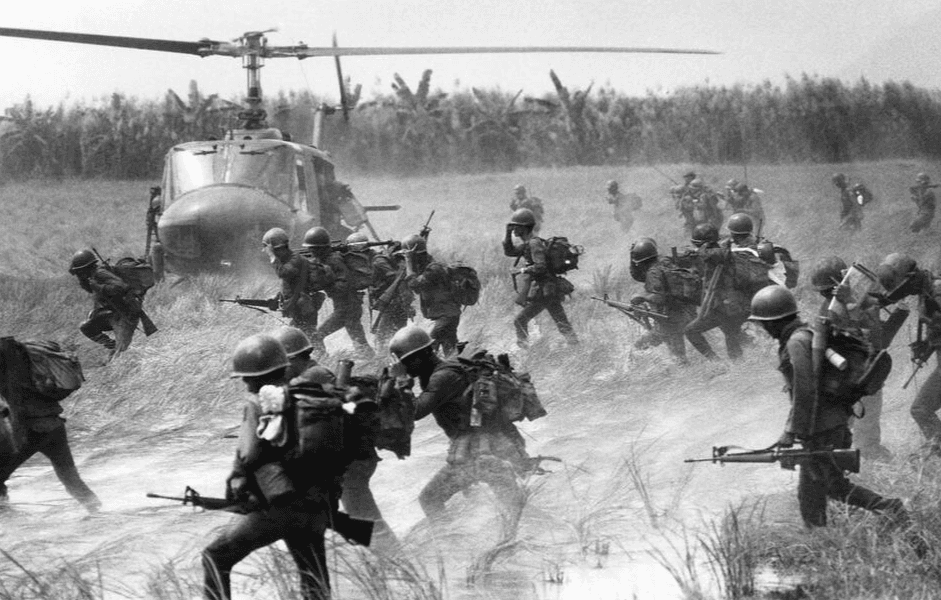
American Soldiers Landing in a Forested Area During the Vietnam War (flickr)
Historical conflicts in the Amazon basin and similar regions occurred within dense forest environments. Examples:
These conflicts demonstrate how forest conditions shaped military tactics and logistical capabilities.
The integration of modern systems into jungle warfare is increasingly prevalent. Unmanned aerial vehicles (UAVs) and unmanned ground vehicles (UGVs) partially overcome the reconnaissance and surveillance limitations imposed by dense vegetation, enabling short-range reconnaissance, route control, and contact detection. Laser designators and thermal imaging devices enhance target acquisition under conditions of low visibility and heavy shadowing. Robotic resupply systems facilitate material transport while reducing reliance on human labor in harsh terrain. Advanced camouflage solutions reduce both thermal signatures and visual silhouettes, minimizing visibility in the forest environment. Autonomous watercraft developed for river and swamp areas provide a critical alternative for logistics and reconnaissance missions. Countries in the Amazon basin, drawing on decades of operational experience, have accumulated extensive expertise in the use of UAVs and river-based reconnaissance platforms, and this experience is reflected in regional training and cooperation programs.
Army University Press. "Elevating Jungle Warfare with Mountain Techniques." NCO Journal, April 2025. Accessed December 3, 2025.
CSIS (Center for Strategic and International Studies). "Jungle Thunder: A Multinational Approach to Improving U.S. Capabilities in Jungle Warfare." 2025. Accessed December 3, 2025.
JudgeRock (Flickr Kullanıcısı. "U.S. Marines in Vietnam," Photograph, 2010. Accessed December 3, 2025. https://www.flickr.com/photos/judgerock/5230609656/
U.S. Army Africa. "[Fotoğraf Başlığı Belirtilmemiş]." Flickr. Accessed December 2, 2025. https://www.flickr.com/photos/usarmyafrica/27450537971/.

Physical and Climatic Conditions | Frequent Rainfall and Low Wind Circulation Deep and Narrow Valleys Steep Slopes Swamp-Like Soft Ground High Temperature-Humidity Combination Dense Vegetation (Visibility Range Often Only Several Meters) | ||||||||
|---|---|---|---|---|---|---|---|---|---|
Operational Effects | Physical Load Logistical Constraints Navigation Difficulties Restricted Visibility | ||||||||
Historical Example Wars | Vietnam War (1955–1975) Chaco War (1932–1935) 1995) 1981 Ecuador–Peru Conflicts (1941 Colombia–Peru War (1932–1933) Acre War (1902–1903) | ||||||||
Jungle Warfare Environment and Key Characteristics
Physical and Climatic Challenges
Military Requirements
Historical Jungle Warfare Conflicts
Technology Use in Jungle Warfare