


This article was automatically translated from the original Turkish version.
The popular culture train continued its full-throttle journey. Chuff-chuff and chuff! The carriages were packed to bursting. The train was nervous, fast, unstoppable. It roamed every corner of the country, never stopping, never refueling, simply moving forward. It cut through stones, pebbles, and branches without a second thought, slicing them apart and flinging them aside.
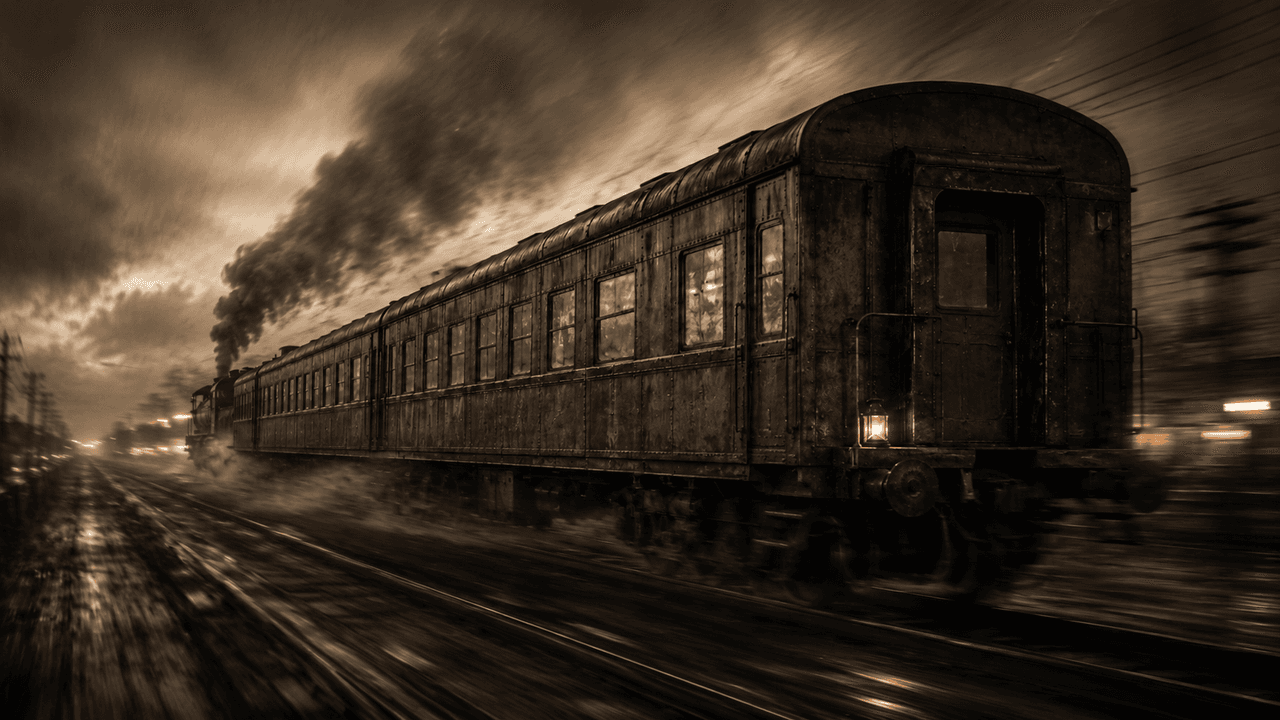
The train is still going at full speed. (I said it, and credit to the AI for creating it.)
All the carriages were full. Especially the social media carriage, where there was no room to breathe. Likes, emojis, comments, lynchings, memorized opinions, ready-made posts, and ownerless sentences piled up like sardines. Long ownerless sentences had spilled out of suitcases; some lynchings hung down from the overhead luggage racks; the bags of likes were tightly sealed. The carriage was so crammed that the conductor had given up even checking tickets—upon seeing the chaos inside, he decided not to enter at all.
The canon carriage was packed with big-mouthed opinionators who issued verdicts: “That’s how it should be, this is unacceptable,” “This is valuable, that is worthless.” They had taken the most beautiful, spacious, and comfortable carriage. The conductor always put on his white gloves before stepping into it.
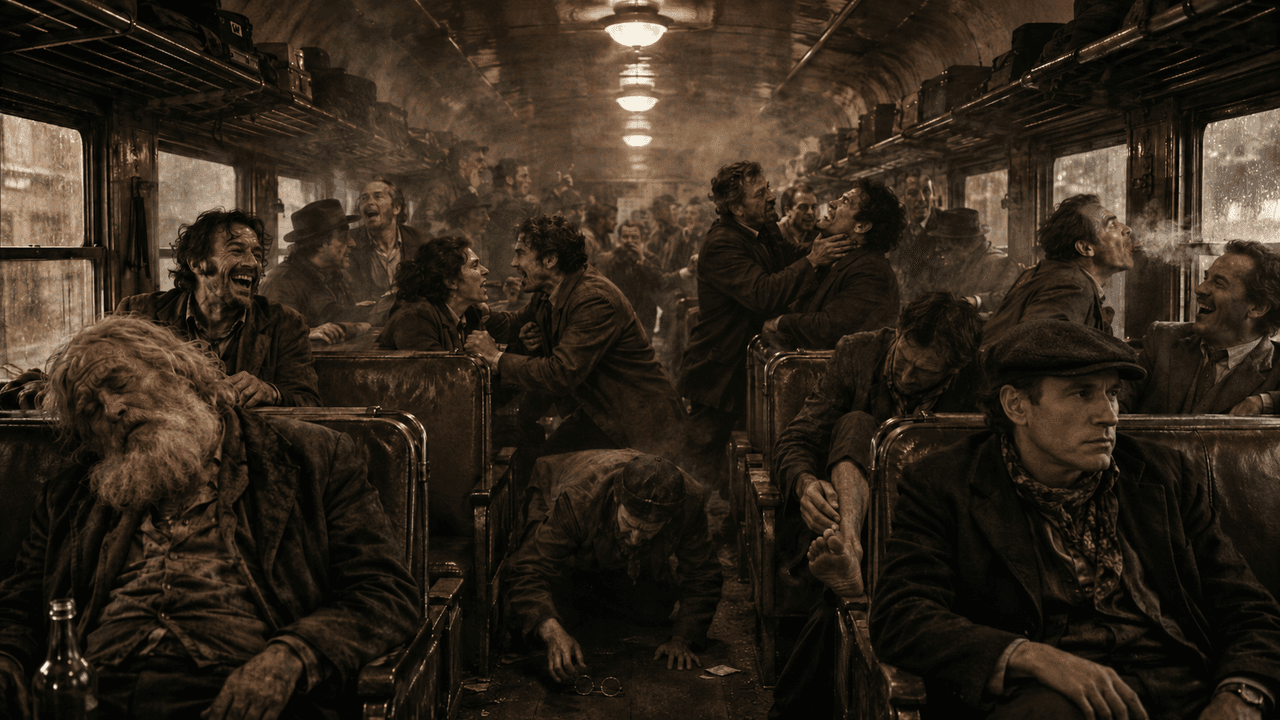
A complete mess in the writers’ carriage. (Yes, the AI created this too.)
There was also the writers’ carriage—don’t even ask, oh God, what a disaster. Those playing backgammon sat shoulder to shoulder with those slapping each other’s mouths with their pipes. The interior reeked of smoke and ash, floating like a funeral pyre. Oxygen had died of suffocation half an hour ago. Orhan Veli was wrestling with a callus. Necip was throttling Nazım while the conductor shouted, “Writers, sit properly with your literature!” Peyami had dropped his glasses somewhere near Tomris’s seat; he couldn’t see ahead but was too ashamed to ask for them. Ece Ayhan was there too, writing on the window: “Train = Hell.” Cemal smiled at him, then lit another cigarette, placed his hand on his head, and resumed staring into the distance. Can Yücel, still drowsy from the night before, dozed off in a corner despite all the commotion. Oğuz had fallen off the train while boarding, unable to grip the rails; Sabahattin had been laughing at this scene for forty-eight hours, tears streaming down his face. Attila sat at the very front, his charisma untouched, his scarf tied around his neck like a greasy rag. A complete mess reigned everywhere.
The train was racing ahead—from Edirne to Hakkari, from Sinop to Hatay. No village it had not passed, no district it had not reached. Its smoke enveloped every village, neighborhood, and city it passed, dictating to people what to like, what to hate.
The train’s chief grabbed his microphone and shouted from the pasha’s pavilion into the carriages: “Have you decided among yourselves? Have you chosen a driver? Who will take responsibility for all these carriages?” The chief had been frantic since the journey began, unable to find anyone for the driver’s seat. He needed to find one immediately—every second without a driver meant lost money, every second without one meant loss. Of course, finding one was no small feat; each carriage had its own demands, wishes, suggestions, and orders.
The social media carriage sent its conditions to the chief: We need someone who will get plenty of likes and comments, withstand lynchings, have high engagement, no age restrictions, who will share even phrases that don’t belong to them as if they were their own—yes, even write those phrases on coasters, under cups, and on posters, even if they aren’t theirs.
The canon carriage—the one with the big-mouths—sent their demands: The candidate must not belong to any single faction but represent every era and every side. He must constantly speak of love and women, be comprehensible, understand eroticism and write about it abundantly. No mockery, irony, noise, or spectacle should be missing. He must have no grand mission to save the world, be modern and urban, and have no understanding of greed, exploitation, or servitude.
And I haven’t even listed the other carriages yet. There are also carriages for publishing houses, editors, and advertisers. If I wrote about them too, you’d get a headache from this train. Don’t read them, ignore them. I read them once before—nothing changed. In fact, there was even a carriage for theorists—or rather, rule-makers. People who filled the train and left empty seats behind, useless fellows. They were just another dimension of the canon crowd. No need to write about them at all.
But it was the chief’s job. He was frantic—every second without a driver meant lost money, the train was wandering aimlessly across the land. He listened to each of the other carriages one by one, took their demands in his hands, put them in his pocket, went to his cabin to read them. He bent over them, sometimes erased, sometimes rewrote, mostly scribbled them out. He struggled to find someone. He had to find one as soon as possible—every second lost meant loss.
Then he went to the writers’ carriage. He tore through their conditions, page by page. I won’t rewrite them here—I already did above; the conditions were the same. Only one canon member added: “And he must drink alcohol.” The chief just said “Okay,” and moved on.
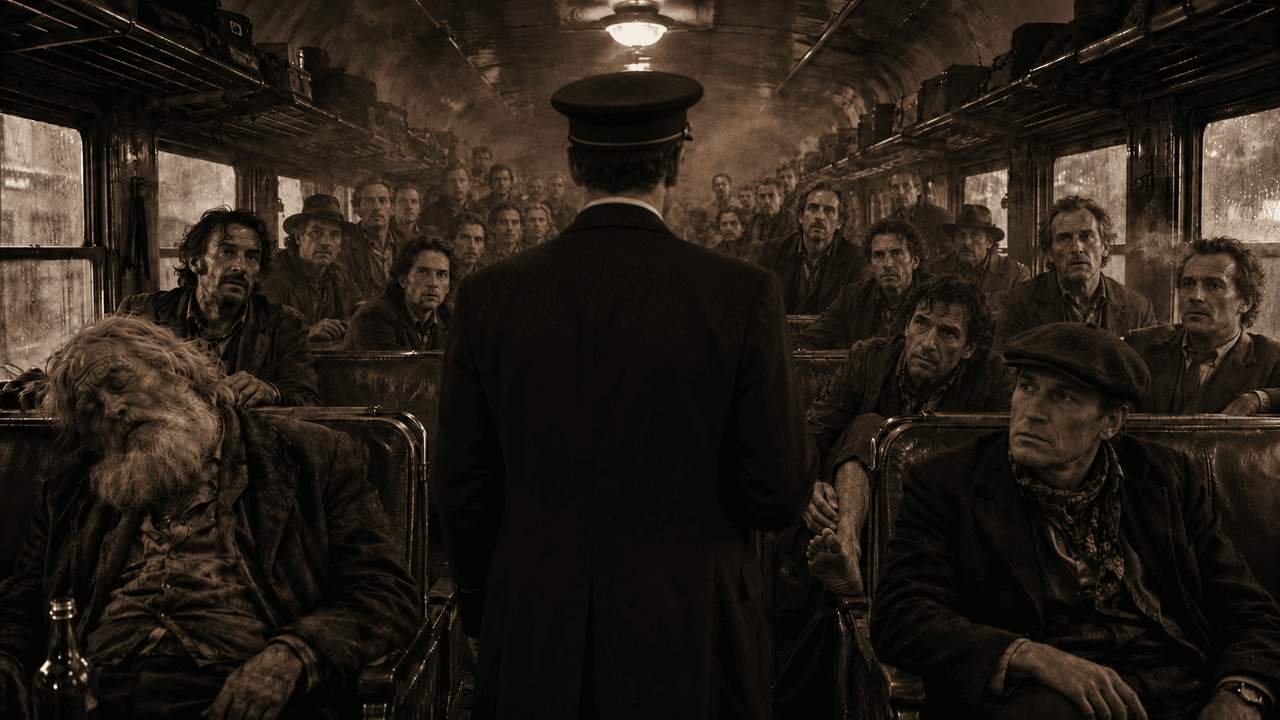
The chief in the writers’ carriage. (If I had the talent, I’d have drawn this, but the AI created it too.)
When the chief arrived, the writers fell silent. They listened, understood, and stopped talking. Now a decision had to be made. Someone from among the writers had to take the helm of this popular culture train. Oğuz immediately gave up: “I won’t do it.” Sabahattin laughed at him again: “You couldn’t hold on to this either.” Then he jumped in: “I can do it—I wrote Kürk Mantolu Madonna.” The chief replied: “You won’t do. You’re too entangled in politics. You and Necip, you’re both like that.” The chief glanced at Peyami and thought, “Maybe him?” But he didn’t want to dress this confused, East-West-torn man in the mantle of popular culture ambassador.
The writers began bickering and boasting again: “Me, me, my corpse is the best, no one can find better.” The chief eliminated Can Yücel: “He drinks, but this much is too much.” He looked at Orhan Veli and, for some reason, gave him up too. Ece Ayhan tried to appeal, but the chief said: “He doesn’t even understand his own writing—he calls the Sea of Marmara the Marble Sea.” He eliminated him. “Attila’s aura is unmatched—men will envy him,” so he passed him over too. Meanwhile, in the back, under a seat, he spotted Yaşar Kemal, hunched and hiding. The chief realized: Yaşar was a fare dodger. He threw him off the train onto the embrace of Çukurova.
His patience was gone. He had to hand over literature pages, advertisements, algorithms to someone—to attach a name to all these anonymous ashes. His eyes settled on a young man far away, smoking quietly, hand on his head: Cemal Süreya. He had all these qualities. Cemal was immortal. Since the 1950s, he had been on the market, saying “yes” to every anonymous phrase, the lover of young girls, the sole comfort of romantic youths.
Of course, who else could this train be entrusted to? Movement is in Cemal, engagement, likes, lynchings, comments, shares—you name it, it’s in Cemal. Say a sentence, write “Cemal” underneath, and it sticks. Who dares question it? Even the most ignorant fools who have never crossed the threshold of poetry know Cemal. He is a one-of-a-kind fabric. Go on, Cemal, sacrifice yourself to God.
Cemal, my Cemal, my elusive Cemal. If he weren’t the chief, he’d make mountains cry out “Evraka!” “Cemal,” the chief called out loudly. The carriage fell silent. “Cemal will drive,” he said, smiling beneath his mustache. He exited the carriage with a victor’s air. The writers first grumbled, then argued, then thought, and finally conceded—bitterly accepting that they themselves could not be the driver.
Cemal slowly rose from his seat. He exhaled the last puff of his cigarette into the air. Quietly, he walked toward the door. As he passed Tomris, a sharp “clack” sounded from the floor. Peyami shouted after him: “May God punish you—you broke my glasses.”

A plain glass, a lie. (I asked Cafer to draw it, he refused. The AI created this too.)
The train accelerated further. It surpassed the speed of light. The chief was happy. Now every passing second meant profit. Cemal sat down in his bewildered seat. The canon enforcers chuckled and scratched their bellies. The tightly sealed bags of likes were opened. Comments were pulled from suitcases. Seconds later, the first post from the social media carriage arrived:
“His smile opened the window of a long-locked room; for the first time, spring entered inside.” Cemal Süreya (you’re welcome…)
Akkaya, Yusuf Bilal. "Cemal Sürer Ya." Unpublished short story. Date Written: June 5, 2026.
