

This article was automatically translated from the original Turkish version.
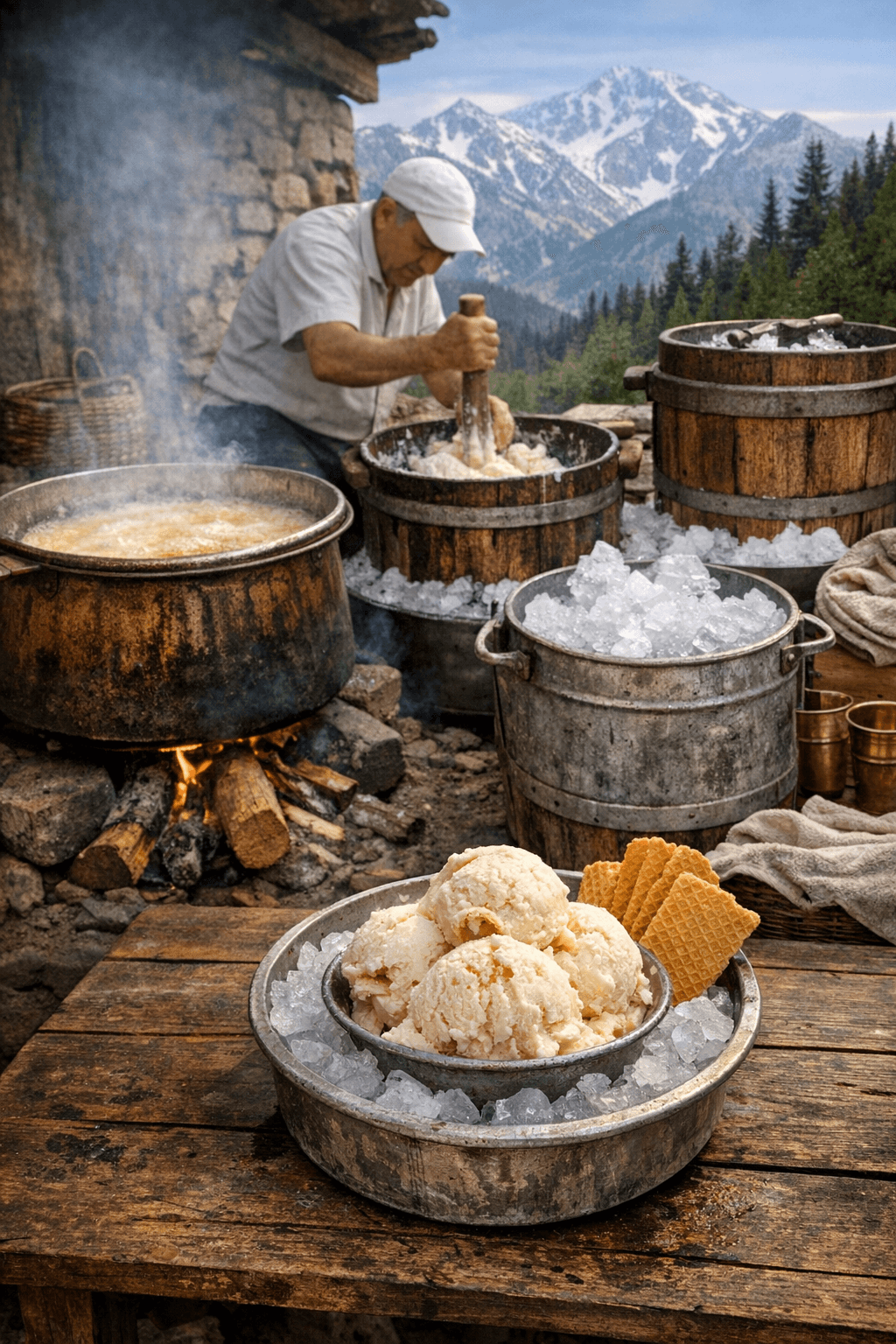
Yanıksı Dondurma (Yapay Zekâ ile Oluşturulmuştur.)
Type(s) | Traditional ice cream | ||||||||
|---|---|---|---|---|---|---|---|---|---|
Location | Elmalı) Antalya (Korkuteli | ||||||||
Contents | sugar salep Goat milk | ||||||||
Cultural Value | Local gastronomic product based on traditional production knowledge | ||||||||
Distinguishing Feature | Aroma formed by prolonged thermal treatment | ||||||||
Cultural Area | Intangible Cultural Heritage | ||||||||
Yanıksı dondurma is a traditional ice cream variety unique to Antalya province in Türkiye. The product is primarily made from goat’s milk and salep, and it is distinguished from other ice cream types by its characteristic burnt aroma, which results from a prolonged thermal treatment during production. Due to its production method based on local knowledge and craftsmanship, Yanıksı dondurma is recognized as a traditional food product within the framework of intangible cultural heritage.
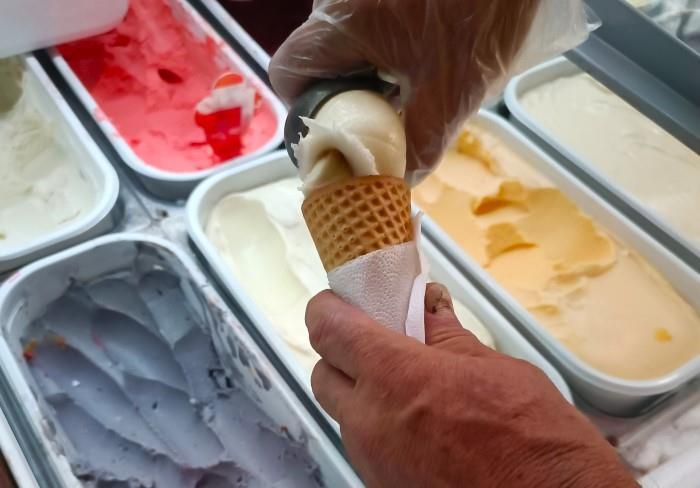
Yanıksı Dondurma (Antalya Provincial Directorate of Culture and Tourism)
The production of Yanıksı dondurma is concentrated primarily in the districts of Korkuteli and Elmalı in Antalya province, as well as surrounding settlements. The emergence and spread of the product are closely linked to the region’s livestock structure, particularly goat rearing and the availability of salep. The natural conditions around the Taurus Mountains and Bey Dağları played a decisive role in shaping traditional production methods.
The earliest concrete evidence regarding Yanıksı dondurma dates back to 1937–1938. It has been determined that Hüseyin Gıliğ, a confectioner in Korkuteli with a three-generation tradition of ice cream making, began producing Yanıksı dondurma during this period. 【1】 In the traditional production process, the ice cream was cooled using snow and ice brought from the Taurus and Bey Dağları, manually beaten to freeze, and prepared primarily with goat’s milk.
The main raw materials in Yanıksı dondurma production are goat’s milk and salep. In the traditional method, the mixture of milk and salep is boiled in cauldrons over wood fire, with constant stirring to prevent burning while allowing controlled caramelization of the bottom. This process imparts the product’s characteristic burnt flavor and aroma. Once the desired consistency is achieved, sugar is added, and during the cooling phase, the mixture is frozen by manual beating with snow and ice.
Today, in addition to traditional methods, industrial ice cream machines are also used in Yanıksı dondurma production. In modern production, both goat’s milk and cow’s milk may be used, and cooling and freezing are carried out through mechanical systems. However, the prolonged thermal treatment required to develop the burnt aroma is preserved as the product’s defining characteristic.
Analyses of Yanıksı dondurma have revealed variations in key chemical properties such as dry matter, fat, protein, ash, pH, and titratable acidity across different producers. Physical parameters including hardness, initial drip time, and complete melting time also show considerable variation. Studies on the aroma profile have identified hydrocarbons, alcohols, aldehydes, ketones, and other volatile compounds—particularly furan derivatives—as key contributors to the product’s distinctive burnt aroma. 【2】
Yanıksı dondurma is not merely a food product but is also regarded as a practice encompassing region-specific production knowledge, artisanal traditions, and cultural transmission processes. The intergenerational transmission of traditional production techniques positions the product among local gastronomic elements recognized as part of intangible cultural heritage.
Antalya İl Directorate of Culture and Tourism. "Yanıksı Dondurma." Visual from the Inventory of Intangible Cultural Heritage. Accessed February 1, 2026. https://antalya.ktb.gov.tr/Resim/447459,sokumantalya-yaniksi-dondurmajpg.png?0.
Antalya İl Kültür ve Turizm Müdürlüğü. "Yanıksı Dondurma Yapımcılığı." Somut Olmayan Kültürel Miras. Accessed February 1, 2026. https://antalya.ktb.gov.tr/TR-366109/yaniksi-dondurma-yapimciligi.html.
Özel, Esin, Serenay Aşık Aygün, Ebru Cücü Açıkalın, Firuze Ergin Zeren, and Ahmet Küçükçetin. "Yanık Dondurmanın Bazı Kimyasal ve Fiziksel Özellikleri." *Akademik Gıda* 23, no. 2 (2025): 156-163. https://dergipark.org.tr/tr/download/article-file/5072393.
Özlü, Zeynep. "Osmanlılarda Dondurma ve Dondurmacılık Mesleği ile İlgili Notlar." *Erdem* 59 (2011): 129-144. https://pdfs.semanticscholar.org/a87b/918b5d75da63d9a1ffaee2cbe0b3e52f7928.pdf.
Öztürk, Emre, and Hülya Yaman. "Dondurmanın Tarihsel Gelişimi ile Kültürlerarası Düzeyde Karşılaştırması (Historical Development of Ice Cream and Comparison at Intercultural Level)." *Journal of Tourism & Gastronomy Studies* 7, no. 3 (2019): 2336-2359. https://jotags.net/index.php/jotags/article/view/641/1126.
[1]
Zeynep Özlü, "Osmanlılarda Dondurma ve Dondurmacılık Mesleği ile İlgili Notlar," Erdem, sy. 59 (2011): 134.
[2]
Esin Özel vd., "Yanık Dondurmanın Bazı Kimyasal ve Fiziksel Özellikleri," Akademik Gıda 23, sy. 2 (2025): 156.
Yanıksı Dondurma (Yapay Zekâ ile Oluşturulmuştur.)
Type(s) | Traditional ice cream | ||||||||
|---|---|---|---|---|---|---|---|---|---|
Location | Elmalı) Antalya (Korkuteli | ||||||||
Contents | sugar salep Goat milk | ||||||||
Cultural Value | Local gastronomic product based on traditional production knowledge | ||||||||
Distinguishing Feature | Aroma formed by prolonged thermal treatment | ||||||||
Cultural Area | Intangible Cultural Heritage | ||||||||
No Discussion Added Yet
Start discussion for "Burn-like Ice Cream" article
Geographical Distribution and Origin
Historical Development
Traditional Production Method
Contemporary Production Practices
Chemical and Physical Properties
Cultural Value and Intangible Cultural Heritage Context