


This article was automatically translated from the original Turkish version.
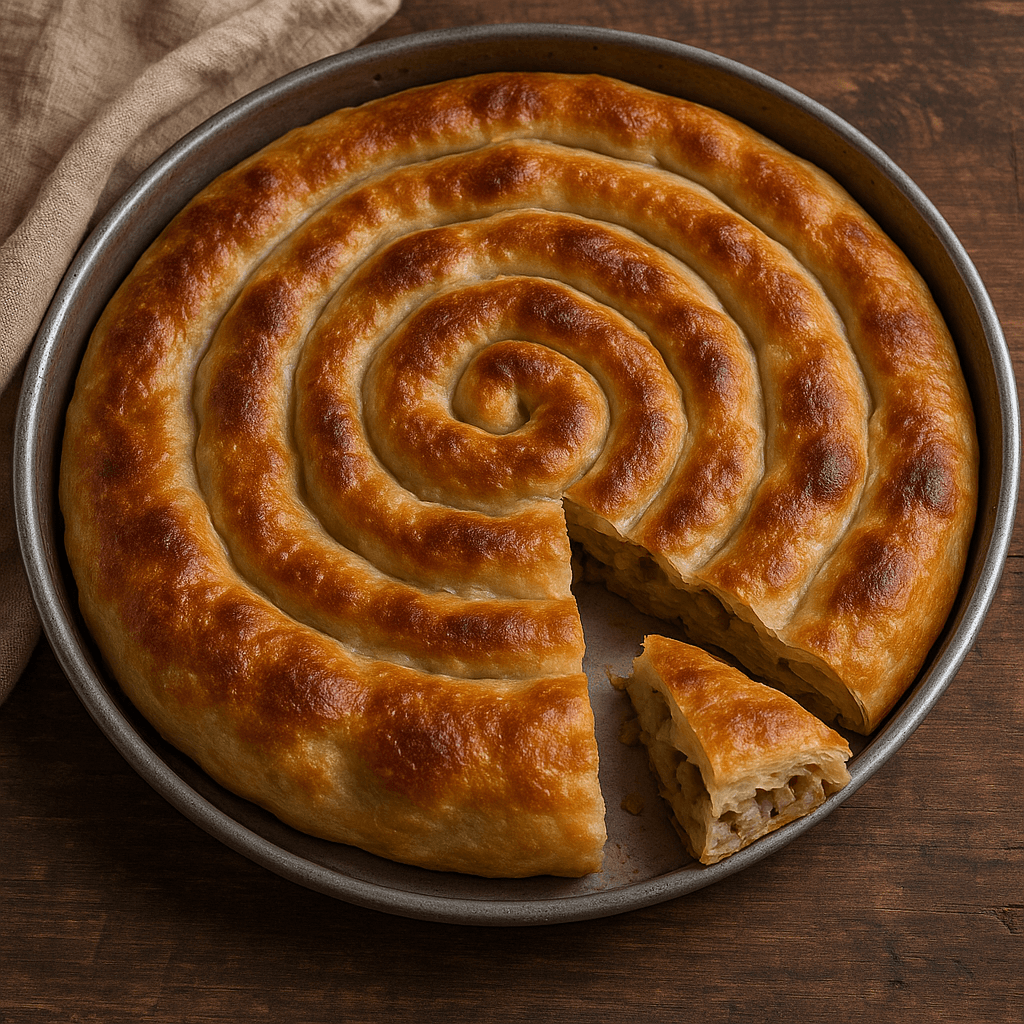
Bosnian Börek
(Generated by artificial intelligence)
Geography | Bosnia and Herzegovina | ||||||||
|---|---|---|---|---|---|---|---|---|---|
Origin | Ottoman culinary tradition | ||||||||
Type | Dough products | ||||||||
Local Names | Burek, Pita | ||||||||
Form | Kol börek, düz börek | ||||||||
Distribution | Bosnia and Herzegovina, Türkiye (particularly the Marmara region) | ||||||||
Bosnian Börek is one of the most well-known pastry varieties in Bosnian cuisine. It developed as a local interpretation of the börek tradition introduced to the region during the Ottoman period. This flavor, widespread across the Balkans, is also known in Bosnian culinary culture as “pita” or “burek”. It stands out due to the delicate rolling of the dough, balanced placement of the filling, and baking in a stone oven.

Bosnian Börek (AA)
As börek traditions spread from Ottoman cuisine into the Balkans, they acquired a unique typology in Bosnia and Herzegovina through the use of local ingredients and preparation techniques. It is estimated that Bosnian börek entered Bosnian cuisine in the mid-1400s.【1】 Through Bosnian communities that migrated to Türkiye, the dish remains alive in the culinary traditions of the Marmara Region, especially in Istanbul, and is commonly served on special occasions.【2】
The dough for Bosnian börek is made from flour, water, salt, and sometimes liquid oil. After kneading, the dough is rested and then divided into small balls. Each ball is rolled out with a rolling pin or by hand until it becomes translucently thin. Layers of oil are brushed between the dough sheets, ensuring that during baking the layers separate and form a flaky texture.

Preparation of Bosnian Börek (AA)
The filling varies according to the intended preparation. The most common types include minced meat, potato, spinach, leek, and cheese fillings. The distribution of the filling is carefully done to ensure consistent flavor intensity in every slice. Börek is typically baked in a stone oven or in a home oven using a tray. Oil or butter brushed on top ensures even browning of both the upper and lower layers during baking.

Preparation of Bosnian Börek (AA)
Preparation methods for börek vary slightly across different cities in Bosnia and Herzegovina and among Bosnian diaspora communities. In some areas, the börek is rolled into long cylinders and baked in a coil shape, while in others, two layers of dough are laid flat on a tray with filling in between to form a flat börek.
For example, in some Bosnian settlements in western North Macedonia, dough layers are rolled thin with oil, filled, and arranged in a circular shape on a tray. These practices emerged from the fusion of Ottoman culinary techniques with local Balkan cultures.
Local names for börek also vary by region: in Bosnia and Herzegovina it is called “burek” and “pita”; in Serbia it is known as “burek”; in Montenegro as “pita”; and in Türkiye it is generally referred to as “Bosnian börek”. These differing names among Bosnian diaspora communities reflect the convergence of language and identity with culinary tradition.
Bosnian börek is a traditional dish passed down through generations in Bosnia and Herzegovina and is regarded as a symbol of familial unity and cultural identity.【3】 This culinary tradition, brought to Türkiye through migration, continues to be observed on special occasions by Bosnian communities.【4】
Preparing börek is typically a shared activity among women, with tasks such as rolling the dough, preparing the filling, and baking distributed among family members. This division of labor sustains collective effort and cultural belonging through domestic practice. In this sense, börek is both part of everyday life and a manifestation of social solidarity.
Bosnian börek holds a symbolic place in Bosnia and Herzegovina’s national cuisine. To increase its visibility, various festivals and promotional events are organized. In 2017, during an event in Bosnia and Herzegovina, the world’s largest börek was baked, drawing international attention as a cultural heritage initiative. Such events demonstrate how traditional Bosnian börek has become both an economic and promotional element within gastronomy tourism.

World’s Largest Bosnian Börek (AA)
Bosnian börek is a dish that reflects the Balkans’ layered identity through the unique preservation of Ottoman culinary techniques in Bosnian culture. Its thin dough, simple ingredients, and tradition of sharing have established it as an important element in the historical memory of Bosnian communities. Today, it continues to serve as a marker of identity, belonging, and connection to the past within migrant culinary cultures, maintaining its role as a symbol of cultural continuity.
Anadolu Ajansı. “Bosna Hersek’in Asırlık Lezzeti: Boşnak Böreği.” Accessed October 21, 2025.https://www.aa.com.tr/tr/kultur-sanat/bosna-hersekin-asirlik-lezzeti-bosnak-boregi/1027898.
Anadolu Ajansı. “Bosna Hersek’te Dünyanın En Büyük Böreğini Pişirdiler.” Accessed October 21, 2025.https://www.aa.com.tr/tr/dunya/bosna-hersekte-dunyanin-en-buyuk-boregini-pisirdiler/935656.
Ramadanoğlu, Elif, and Ecem İnce Karaçeper. “Boşnȧk Göçmenlerinin Mutfak Kültürü ve Sofra Gelenekleri: İstanbul İli, Pendik, Kartal ve Bayrampaşa İlçeleri Örneği.” *Türk Turizm Araştırmaları Dergisi* 8, no. 1 (2024): 1–23. Accessed October 21, 2025.https://tutad.org/index.php/tutad/article/view/697/666
Yıldız, Cemre Sena. "Balkan Türk Mutfağında “Ayvar”, “Pite”, “Börek” ve Makedonya Çevresindeki Durumları Üzerine." *Balkanlarda Türk Dili ve Edebiyatı Araştırmaları* 4, no. 2 (2022): 141-155. Accessed October 21, 2025.https://doi.org/10.47139/balted.1132814
[1]
Anadolu Ajansı. “Bosna Hersek’in Asırlık Lezzeti: Boşnak Böreği.” Anadolu Ajansı. Erişim Tarihi 21 Ekim 2025. https://www.aa.com.tr/tr/kultur-sanat/bosna-hersekin-asirlik-lezzeti-bosnak-boregi/1027898.
[2]
Elif Ramadanoğlu ve Ecem İnce Karaçeper “Boşnȧk Göçmenlerinin Mutfak Kültürü ve Sofra Gelenekleri: İstanbul İli, Pendik, Kartal ve Bayrampaşa İlçeleri Örneği .” Türk Turizm Araştırmaları Dergisi 8, no. 1 (2024): 19. Erişim Tarihi 21 Ekim 2025. https://tutad.org/index.php/tutad/article/view/697/666
[3]
Anadolu Ajansı. “Bosna Hersek’in Asırlık Lezzeti: Boşnak Böreği.” Anadolu Ajansı. Erişim Tarihi 21 Ekim 2025. https://www.aa.com.tr/tr/kultur-sanat/bosna-hersekin-asirlik-lezzeti-bosnak-boregi/1027898.
[4]
Ramadanoğlu ve Karaçeper “Boşnak Göçmenlerinin Mutfak Kültürü ve Sofra Gelenekleri: İstanbul İli, Pendik, Kartal ve Bayrampaşa İlçeleri Örneği.” s. 6. Erişim Tarihi 21 Ekim 2025. https://tutad.org/index.php/tutad/article/view/697/666
Bosnian Börek
(Generated by artificial intelligence)
Geography | Bosnia and Herzegovina | ||||||||
|---|---|---|---|---|---|---|---|---|---|
Origin | Ottoman culinary tradition | ||||||||
Type | Dough products | ||||||||
Local Names | Burek, Pita | ||||||||
Form | Kol börek, düz börek | ||||||||
Distribution | Bosnia and Herzegovina, Türkiye (particularly the Marmara region) | ||||||||
Origin
Dough Preparation and Baking Technique
Regional Practices and Variations
Cultural and Sociological Significance
Gastronomic Representation and Record Attempt